
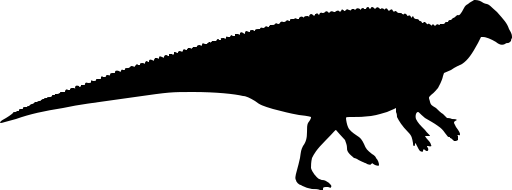

New Jersey is where American dinosaur science started. Hadrosaurus foulkii, dug from a marl pit in Haddonfield in 1858 and described by Joseph Leidy, was the first dinosaur in North America known from more than isolated teeth. Today the state has 4,622 fossil records, 106 of them dinosaurs.
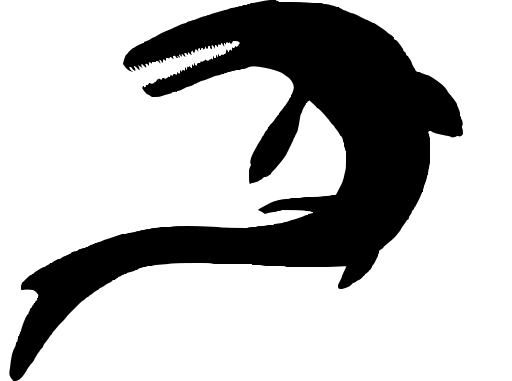
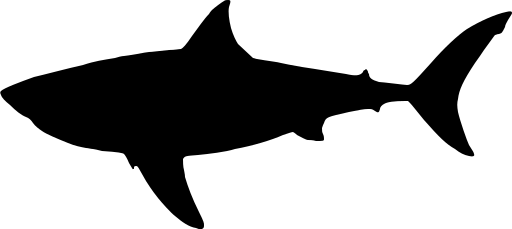
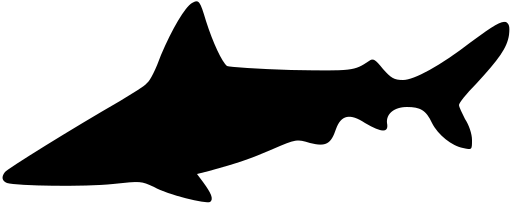
The marl is the reason. Marl, a Cretaceous greensand, was dug as fertilizer, which cut pits into old sea floor. Cretaceous fossils number 2,851 of the state's records, mostly from a shallow sea: Squalicorax with 41 records and Mosasaurus with 29.
Marl workers also found Dryptosaurus at Barnsboro in 1866. Edward Drinker Cope called it the finest discovery he had made; the database has six records. In 1868 Hadrosaurus became the first mounted dinosaur skeleton, displayed in Philadelphia. New Jersey named it state dinosaur in 1991.
Older rock holds tracks. The Triassic and Jurassic Newark Basin has 25 records of Grallator and nine of Eubrontes.
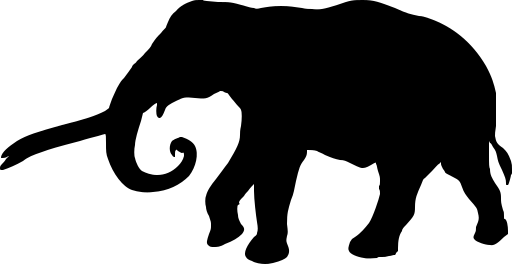
The ice age is represented by 18 records of Mammut, the mastodon.
Dinosaurs found in New Jersey
The Paleobiology Database lists 106 dinosaur finds in New Jersey. These are the best documented.
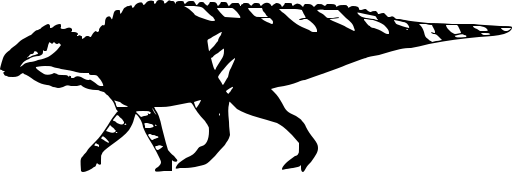
- Hadrosaurus: A duck-billed dinosaur. Its skeleton, dug up in 1858, was the first nearly complete dinosaur skeleton found. Found 4 times, from 83.6 to 66 million years ago.
- Grallator: Small three-toed footprints of a meat-eating dinosaur, common in Triassic and Jurassic rock. A track name. Found 25 times, from 237 to 193 million years ago.
- Edmontosaurus: A duck-billed dinosaur up to about 12 m long, with hundreds of small teeth packed into its cheeks for grinding plants. Found 1 time, from 83.6 to 72.2 million years ago.
- Eubrontes: Large three-toed footprints over 25 cm long, made by a big meat-eating dinosaur. Common in Early Jurassic rock. Found 9 times, from 237 to 193 million years ago.
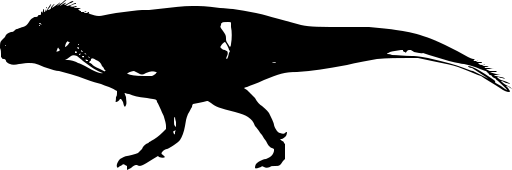
- Dryptosaurus: A Late Cretaceous tyrannosaur relative named Laelaps by Edward Cope in 1866. Othniel Marsh renamed it in 1877. Found 6 times, from 83.6 to 66 million years ago.
- Anomoepus: Footprints of a small plant-eating dinosaur that sometimes sat, leaving hand and heel marks beside its toe prints. Found 5 times, from 237 to 200 million years ago.
- Anchisauripus: Mid-sized three-toed footprints from Early Jurassic rock, bigger than Grallator and smaller than Eubrontes. Found 4 times, from 227 to 200 million years ago.
- Teihivenator: A tyrannosaur. Found 1 time, from 72.2 to 66 million years ago.
- Argoides: A footprint type named in 1845 from eastern North American rock. Known only from tracks; the maker is uncertain. Found 1 time, from 227 to 206 million years ago.
- Sauropus: A footprint name for tracks in Triassic and Jurassic rock. The animal that made them is uncertain. Found 1 time, from 227 to 206 million years ago.
- Coelurosaurichnus: A dinosaur track. Found 2 times, from 227 to 206 million years ago.
- Atreipus: A three-toed dinosaur track. Found 1 time, from 227 to 206 million years ago.
Other fossils found in New Jersey
Beyond dinosaurs, the New Jersey record includes these animals and plants.
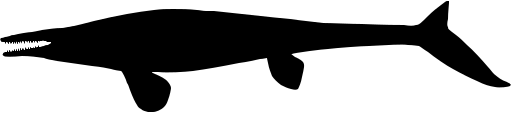
- Mosasaurus: A giant sea lizard up to about 12 m long, a relative of snakes and monitor lizards. It died out 66 million years ago. Found 29 times, from 101 to 61.7 million years ago.
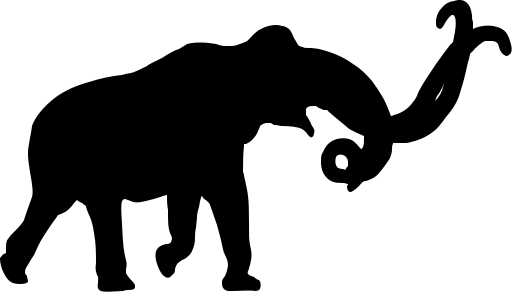
- Mammut (mastodon): A browsing Ice Age elephant relative with long, upward-curving tusks and ridged, low-crowned teeth. Not a mammoth. Found 18 times, from 2.6 to 0.01 million years ago.
- Otodus (megalodon): The largest known predatory shark, about 15 m long, with teeth up to 18 cm. It died out about 3.6 million years ago. Found 4 times, from 66 to 16 million years ago.
- Mammuthus (mammoth): An Ice Age elephant relative with long curved tusks. Woolly mammoths lived in the north, Columbian ones farther south. Found 3 times, from 2.6 to 0.01 million years ago.
- Baculites (baculite): An ammonite with a straight, rod-shaped shell instead of a coil, common in Late Cretaceous seas. Found 15 times, from 83.6 to 61.7 million years ago.
- Squalicorax (crow shark): A Late Cretaceous shark with serrated, triangular teeth. Its name means crow shark. Found 41 times, from 143 to 61.7 million years ago.
- Equus (horse): The horse genus, with zebras and donkeys. Horses evolved in North America and died out there in the Ice Age. Found 1 time, from 2.6 to 0.01 million years ago.
- Tylosaurus: A Late Cretaceous mosasaur about 12 m long, with a toothless bony tip on its snout. Found 1 time, from 72.2 to 66 million years ago.
- Bison: The bison genus. Ice Age bison were larger than today's, and Bison latifrons had horns spanning about 2 m. Found 1 time, from 2.6 to 0.01 million years ago.
- Megalonyx (Jefferson's ground sloth): A ground sloth about 3 m long. Thomas Jefferson described its claw bones in 1797 and named it for the claw. Found 1 time, from 2.6 to 0.01 million years ago.
- Placenticeras (ammonite): A flat, coiled ammonite of the Late Cretaceous. Some were more than 30 cm across. Found 12 times, from 83.6 to 66 million years ago.
- Xiphactinus: A Late Cretaceous fish up to about 5 m long. One fossil has a fish nearly 2 m long preserved in its stomach. Found 6 times, from 101 to 66 million years ago.
State symbols
- State dinosaur: Hadrosaurus (adopted 1991) Read the statute
NJSA 52:9A-5 (P.L.1991 c.161 s.2; signed June 13 1991) per NJ State Library page (fetched). njleg.gov statute page unreachable from this environment. PBDB Hadrosaurus valid. No NJ state fossil designation found.
How the land changed
Every fossil records the place it was buried in. Reading those places period by period shows how New Jersey changed.
- Triassic (252 to 201 Ma): most fossils from this time come from dry land.
- Jurassic (201 to 143 Ma): most fossils from this time come from rivers and lakes.
- Cretaceous (143 to 66 Ma): most fossils from this time come from a shallow sea.
- Paleogene (66 to 23 Ma): most fossils from this time come from a shallow sea.
- Neogene (23 to 2.6 Ma): most fossils from this time come from a coast or delta.
- Quaternary (2.6 to 0 Ma): most fossils from this time come from a shallow sea.
Oldest and youngest finds in New Jersey
The oldest find in the New Jersey record is Archaeocyathus, dated to about 516 million years ago. The youngest is Astarte, from the last 12,000 years.
Fossil finds in New Jersey by period
| Period | Million years ago | Finds | Most common group |
|---|---|---|---|
| Cambrian | 539 to 487 | 5 | Invertebrates |
| Ordovician | 487 to 443 | 1 | Invertebrates |
| Devonian | 420 to 359 | 10 | Invertebrates |
| Triassic | 252 to 201 | 145 | Reptiles, amphibians and birds |
| Jurassic | 201 to 143 | 48 | Fish and sharks |
| Cretaceous | 143 to 66 | 2,851 | Invertebrates |
| Paleogene | 66 to 23 | 594 | Invertebrates |
| Neogene | 23 to 2.6 | 540 | Invertebrates |
| Quaternary | 2.6 to 0 | 428 | Invertebrates |
Frequently asked questions
What is the state dinosaur of New Jersey?
Hadrosaurus is the official state dinosaur of New Jersey, adopted in 1991.
What dinosaurs have been found in New Jersey?
The best-documented dinosaurs in the New Jersey record are Hadrosaurus, Grallator, Edmontosaurus, Eubrontes and Dryptosaurus. The Paleobiology Database lists 106 dinosaur finds there.
How many fossils have been found in New Jersey?
The Paleobiology Database records 4,622 fossil finds in New Jersey, covering 909 kinds of animals, plants and other life.
What is the oldest fossil found in New Jersey?
The oldest find in the New Jersey record is Archaeocyathus, dated to about 516 million years ago.
How can I see fossils near me in New Jersey?
Type a town or ZIP code into the search box at the top of this page, or use your location, to see the fossils recorded within 25 to 200 km. Natural history museums and state fossil parks are the best places to see real specimens.
Keep exploring
More fossil states: California, Texas, Wyoming, Florida, Utah, New Mexico, all 50 states.
Credits and data
- Fossil finds: the Paleobiology Database, licensed CC BY 4.0. Counts are records in the database, which reflect research effort as well as geology.
- Ancient Earth maps and plate motion: PALEOMAP PaleoDEMs, Scotese and Wright (2018), CC BY 4.0, doi:10.5281/zenodo.5460860.
- Place names: US Census Gazetteer (public domain) and GeoNames, CC BY 4.0.
- Silhouettes: PhyloPic contributors (Amy Beauvois, Steven Traver, Will Toosey, Vincent BACHA, artrociraptor, U.S. National Park Service (vectorized by William Gearty), Margot Michaud, An Ignorant Atheist, David Orr, Scott Hartman).