Glass petri dishes are cleaned in four stages: decontaminate, remove the agar, wash, sterilize. Disposable plastic dishes get only the first stage and then go in the trash. The order matters. Every colony on a used plate holds millions of cells, and scrubbing that plate at a sink spreads them around the sink, so nothing gets washed until it has been decontaminated.
This guide contains Amazon affiliate links. 33Science earns a commission on qualifying purchases. See our affiliate disclosure.
Table of contents
- TLDR
- What you need
- Glass or plastic: check first
- How to clean glass petri dishes
- How to dispose of plastic petri dishes
- What does not sterilize a petri dish
- In a school or lab
- FAQ
- Sources
TLDR
- Used glass dishes: pressure cook at 15 psi for 30 to 60 minutes or soak in 10% bleach for 1 hour, scrape the solid agar into the trash, wash, rinse and dry.
- Sterilizing clean glass: wrap in foil, then bake at 320°F (160°C) for 2 hours or pressure cook at 15 psi for 15 minutes.
- Disposable plastic dishes: decontaminate, bag and throw away. Do not reuse them.
- Never pour agar down a drain, and never heat anything that contains bleach in a pressure cooker or autoclave.
What you need
Buy plain unscented household bleach at a grocery store. Avoid scented, splash-less and color-safe versions.
| Item | Used for | Buy |
|---|---|---|
| Stovetop pressure canner with a dial gauge | Decontaminating used plates and sterilizing dishes | Presto 01781 23-Quart |
| Heat-stable biohazard bags | Holding plates inside the canner | Autoclavable bags, 10 pack |
| Nitrile gloves | All handling of used plates | Nitrile gloves, 100 count |
| Splash goggles | Mixing and pouring bleach | MELASA ANSI Z87.1 goggles |
| Flexible plastic scraper | Lifting agar without scratching glass | SURDOCA scrapers, 3 pack |
| Laboratory detergent | Washing without residue (mild dish soap also works) | Alconox powder |
| Heavy-duty aluminum foil | Wrapping dishes before sterilizing | Amazon Basics heavy-duty foil |
| Oven thermometer | Confirming the true oven temperature | Taylor 3-inch thermometer |
| Borosilicate glass petri dishes | Replacing chipped dishes, or moving away from disposables | 100 mm glass dishes with lids |
Glass or plastic: check first
The material decides the method. Most clear disposable dishes are polystyrene, which softens near 212°F (100°C), well below sterilizing temperature. Check for a recycling code on the base.
| Material | How to identify it | Reusable? | Sterilize with |
|---|---|---|---|
| Borosilicate glass | Heavy, rings when tapped | Yes | Oven, pressure cooker or autoclave |
| Polystyrene | Clear, light, brittle, code 6 | No | Decontaminate and discard |
| Polypropylene | Cloudy, slightly flexible, code 5 | Yes | Pressure cooker or autoclave, never a dry oven |
How to clean glass petri dishes
Step 1: Decontaminate the used plates
Do this before opening or washing anything. Pressure cooking is the better option because the plates stay closed. Use it for any plate with fuzzy mold growth, since opening one releases spores.
Option A: pressure cooker. A pressure cooker reaches the same temperature as a lab autoclave and works the same way. Follow this sequence:
- Keep the lids on and stand the dishes level on the canner rack, base down, inside an open heat-stable bag. Glass sitting directly on the base can crack.
- Add water to the level in the manual, close the canner and vent it as directed.
- Bring it to 15 psi, which is 250°F (121°C), and hold for 30 minutes. Use 60 minutes for a full load. Above 2,000 feet, add 1 psi per 2,000 feet of elevation.
- Turn off the heat and let the pressure fall on its own. Do not lift the weight or open the vent early, because the melted agar will boil over.
- Leave the dishes level until the agar sets again.
Keep this canner for lab use. Do not cook food in it afterward.
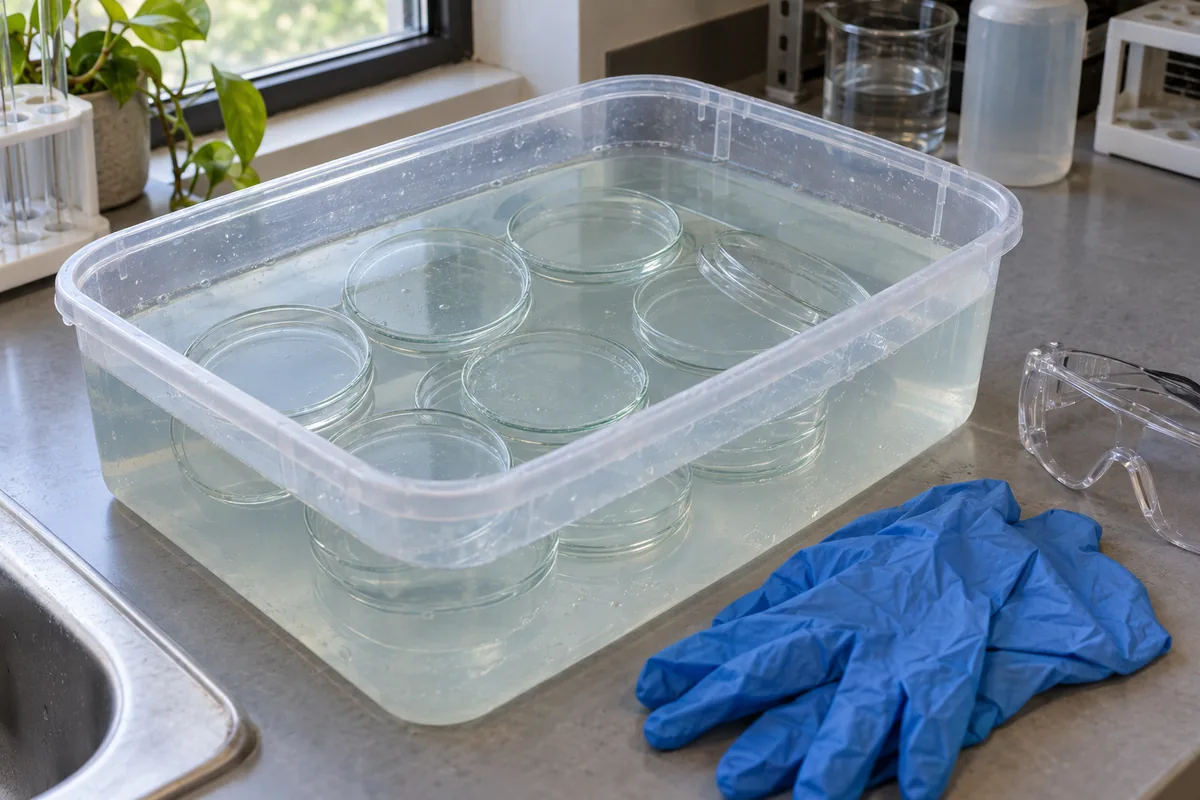
Option B: bleach. Mix 1 part household bleach with 9 parts cold water in a plastic tub, and make it fresh for each batch. Wear gloves and goggles. Open each plate low over the tub, flood the agar, then submerge the dish and lid. Soak for at least 1 hour. Pour the spent solution down the drain with plenty of running water, leaving the agar behind.
Bleach disinfects but does not sterilize. Some bacterial spores survive a soak, which is why Step 4 still applies. Never mix bleach with ammonia or acids, and never put bleached dishes in a pressure cooker or autoclave until they are fully rinsed, because heating bleach can release chlorine gas.
Step 2: Remove the agar
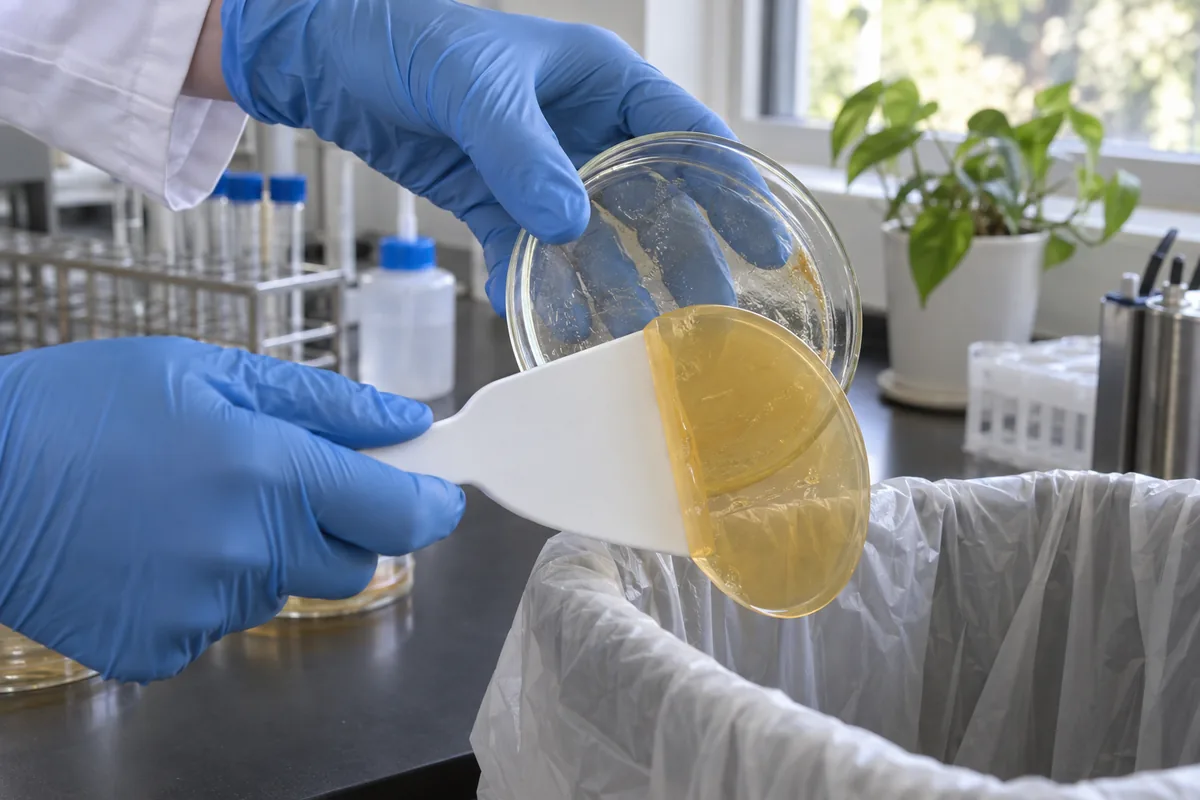
Once the agar is cool and solid, slide a plastic scraper under it and lift it out in one piece. Metal tools scratch the glass. Put the agar in a bag and tie it. Agar belongs in the trash, even when molten. In a drain it sets and blocks the pipe.
Step 3: Wash, rinse and dry
- Wash each dish and lid in warm water with lab detergent or mild dish soap and a soft sponge. Abrasive pads leave scratches that hold residue and blur microscope work.
- Rinse at least three times under tap water, then once with distilled water. Soap and bleach residue can inhibit the growth of your next culture.
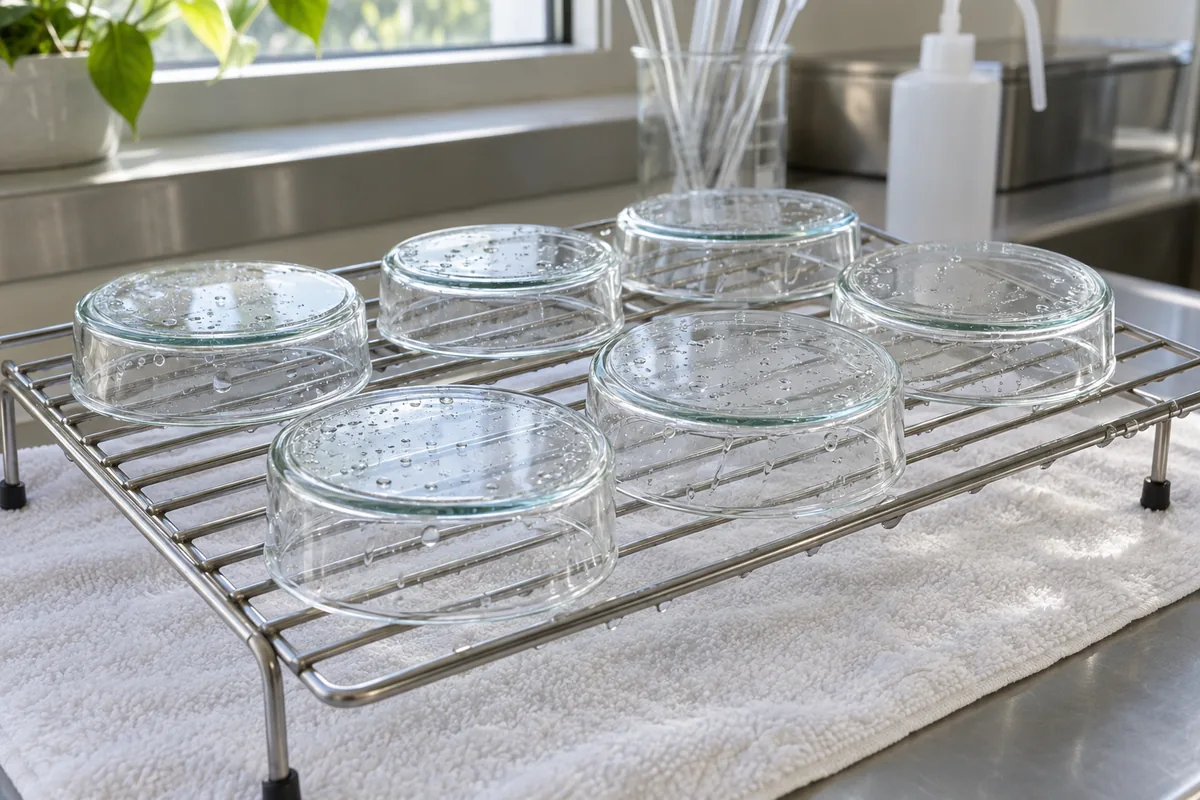
- Dry upside down on a rack.
- Hold each dish to the light. A hazy film means it needs another wash. Discard anything chipped or cracked.
Step 4: Sterilize
Washing removes residue but does not make a dish sterile. Use one of these two methods.
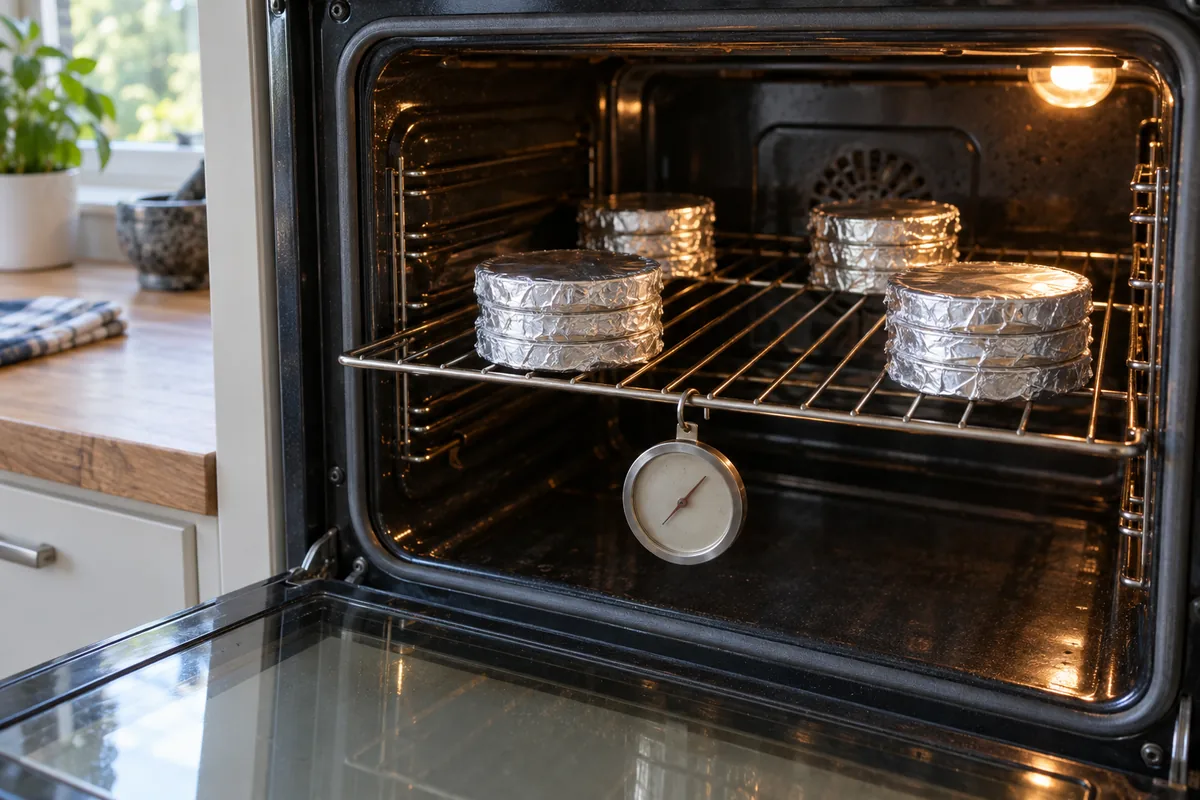
Dry oven (recommended for glass). Wrap each dish in foil, or stack several and wrap the stack. Place them in a cold oven with a thermometer on the rack and set it to 320°F (160°C). Start timing when the thermometer reads 320°F and bake for 2 hours. Turn the oven off and keep the door closed until it drops to about 160°F (70°C), since sudden cooling can crack glass.
Pressure cooker. Wrap the dishes in foil and hold at 15 psi for at least 15 minutes, with an inch or two of water in the base and the dishes on a rack. They come out damp, and moisture invites contamination, so the oven is the better choice for dishes you plan to store.
Leave the foil on until you are ready to pour plates. A wrapped dish stays sterile as long as the foil is intact and dry.
How to dispose of plastic petri dishes
Used polystyrene dishes are decontaminated and thrown away. They cannot be sterilized for reuse: heat warps them and alcohol does not kill spores.
- Put the closed dishes in a heat-stable bag inside a metal pan, because they will melt and the agar will liquefy.
- Pressure cook at 15 psi for 30 to 60 minutes, or pour in 10% bleach and soak for 1 hour.
- Let everything cool and solidify.
- Tie the bag, place it inside a second bag and put it in the household trash. Most recycling programs do not accept these plates.
What does not sterilize a petri dish
| Method | Why it falls short |
|---|---|
| Dishwasher | Washes well after decontamination, but water temperature is far below sterilizing heat |
| Boiling | 212°F (100°C) kills most living cells but leaves many bacterial spores intact |
| Rubbing alcohol | Kills many microbes on contact but not spores, and it is flammable near an oven |
| Microwave | Heats unevenly and is not a validated sterilizing method |
| UV lamp | Reaches only the exposed surface, and shadows protect anything behind them |
In a school or lab
Follow your institution’s biosafety manual, which overrides any guide. Most specify autoclave bags in a secondary tray and a cycle of at least 30 minutes at 121°C, and some require 60. Plates grown from human swabs can hold pathogenic bacteria such as Staphylococcus in large numbers, so keep them sealed until they are decontaminated. Some waste streams must go out as regulated medical waste instead of trash. See our overviews of tools used in microbiology and laboratory equipment for the rest of a basic setup.
FAQ
Bake glass dishes wrapped in foil at 320°F (160°C) for 2 hours, or hold them at 15 psi for 15 minutes in a stovetop pressure canner. Both reach sterilizing conditions. Polystyrene dishes cannot be sterilized at home.
No, not standard polystyrene dishes. They warp under heat and cannot be sterilized. Polypropylene dishes, marked with recycling code 5, can be autoclaved and reused.
Only after decontamination, and only glass or polypropylene. A dishwasher cleans the dish but does not sterilize it, so the dish still needs the oven or a pressure cooker before reuse.
No. A 10% bleach soak disinfects a dish but can leave bacterial spores alive. Follow it with rinsing, washing and heat sterilization.
Soak them for at least 1 hour in a fresh mix of 1 part bleach to 9 parts water. Agar slows the bleach down, so plates need longer than liquid cultures, which take 20 to 30 minutes.
No. Most electric multicookers peak at about 12 psi, around 244°F (118°C), which is below the 15 psi (121°C) sterilizing standard. Use a stovetop canner with a gauge.
Pressure cook them in a heat-stable bag or soak them in 10% bleach for 1 hour, let the agar solidify, then double bag them and put them in the trash. Agar never goes down the drain.
Decontaminate the dish, then soak it in warm water until the agar swells and softens. Lift it out with a plastic scraper and wash as normal.
Sources
- University of Utah, Sterilizing Solid Objects
- University of Utah, Sterilizing Liquids
- University of Utah, Sterile Technique
- Cornell EHS, Biological Waste Guide
- Stanford EHS, Biosafety Manual: Autoclaves
- Dartmouth EHS, Biohazardous Waste Disposal Guide
- University of Florida EHS, Biohazardous Waste Disposal
- Science Buddies, Agar and Its Use in Science