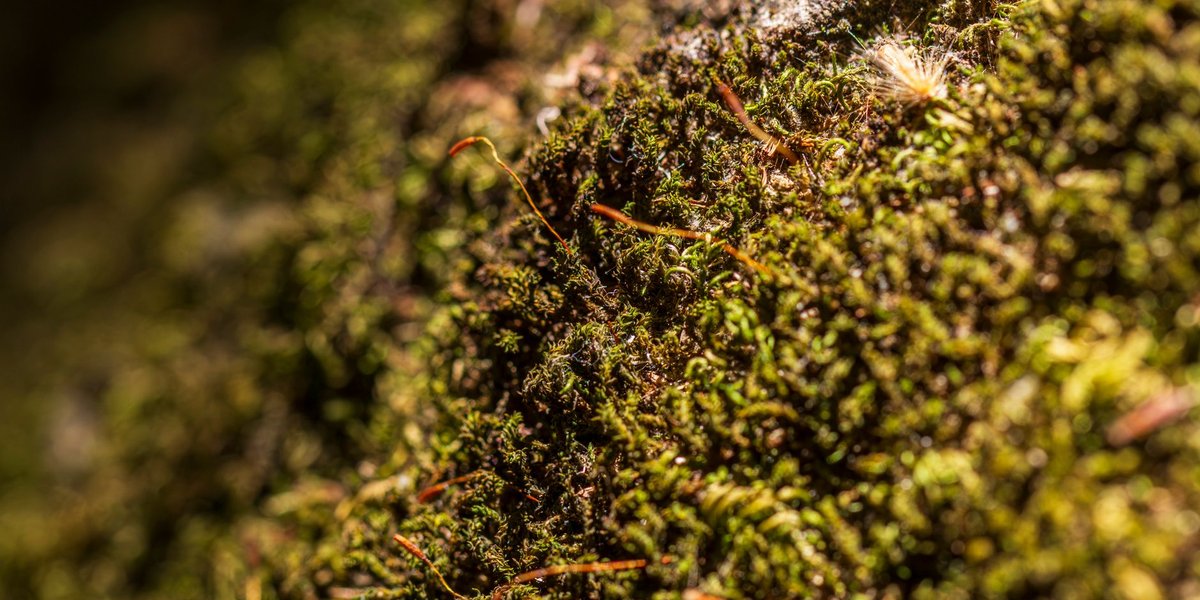
Non-vascular plants are plants without xylem and phloem, the internal plumbing that moves water and sugars around larger plants. No plumbing means no way to pump water upward, which is why these plants stay short and live close to the damp surfaces that feed them.
That single missing feature explains almost everything else about them: their size, their habitats, their odd life cycle and why you’ll find them in a sidewalk crack but never at the top of a redwood.
Table of contents
- TLDR
- What makes a plant non-vascular
- The three groups
- How they live without roots
- Alternation of generations in mosses
- Vascular vs. non-vascular plants
- Why non-vascular plants matter
- Where to find them
- FAQ
TLDR
- Non-vascular plants (bryophytes) lack xylem and phloem, true roots, true stems and true leaves.
- There are three groups: mosses (about 12,000 species), liverworts (roughly 9,000) and hornworts (about 220).
- They absorb water straight through their surfaces, so they stay mostly under 10 cm tall and grow where it’s damp.
- The green, leafy body you see is the gametophyte generation. The sporophyte is a small, dependent stalk or capsule growing out of it.
- They build peat, hold soil, colonize bare rock and store a startling amount of carbon.
What makes a plant non-vascular
Vascular plants run on two tissues. Xylem carries water up from the roots, and phloem distributes the sugars made in the leaves. Ferns, conifers and flowering plants all have both.
Non-vascular plants have neither. Water enters wherever the plant is wet, moves from cell to cell by diffusion, and stops short of anything taller than a few centimeters. Past that height, diffusion can’t deliver water to the top fast enough.
Two details trip people up:
- Some mosses have simple conducting cells. Haircap mosses (Polytrichum) have strands of water-carrying cells called hydroids. They’re a primitive version of the idea, without the lignin-reinforced walls of true xylem. That’s why a few tropical mosses, such as Dawsonia, can reach around 50 cm while most stop near 5.
- “Lower plants” is an outdated label. It suggests these plants are failed attempts at something better. They’re not. They’ve survived for hundreds of millions of years, and they’re among the closest living relatives of the first plants to colonize land.
Botanists also use the word bryophyte for these plants. Whether the three groups form a single family branch is still debated, but “non-vascular plants” works as a practical label for all of them.
The three groups
Mosses
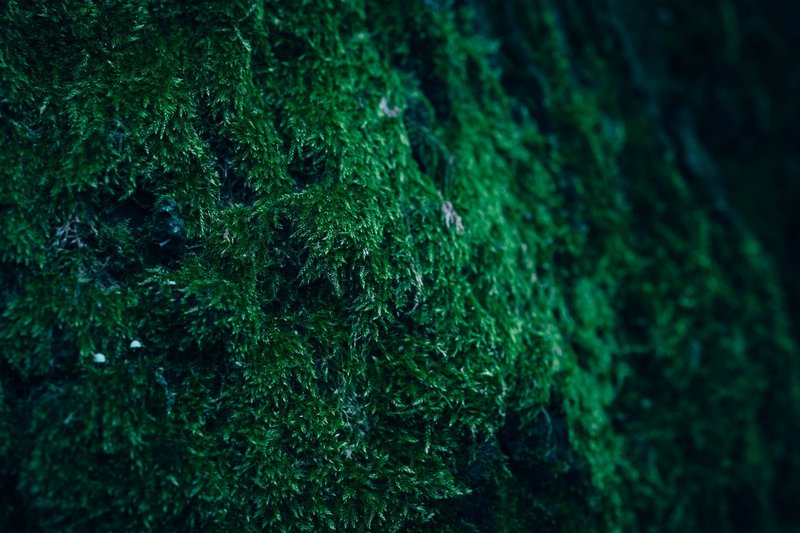
Mosses are the group you already know. There are about 12,000 species, and they form the cushions on rocks, tree trunks and shaded walls.
A moss has a stem-like axis covered in tiny, single-layer leaves called phyllids, usually just one cell thick. Look for spiral leaf arrangement and a thin wiry stalk topped with a capsule when it’s reproducing.
Three examples worth knowing:
- Sphagnum (peat moss): pale, spongy and able to hold up to about 20 times its dry weight in water. It builds peat bogs.
- Polytrichum (haircap moss): stiff, upright and star-shaped from above. One of the tallest common mosses.
- Bryum argenteum (silver moss): the silvery-green tufts packed into pavement cracks in cities.
Two things called “moss” aren’t. Reindeer moss is a lichen, and Spanish moss is a flowering plant in the pineapple family.
Liverworts
Liverworts come in two shapes. Thalloid liverworts are flat, lobed ribbons that crawl along the ground like green tongue-shaped leather. Leafy liverworts look like a flattened, scaly moss.
Marchantia polymorpha is the textbook thalloid species. It shows up in plant nursery pots and on burnt ground, and it produces tiny cups on its surface holding “gemmae,” clonal buds that splash out in rainwater and grow into new plants.
The name comes from the medieval belief that the lobed shape of some species resembled a liver, and so would treat liver disease. It didn’t. There are roughly 9,000 species.
Hornworts
Hornworts are the smallest and least known group, with about 220 species. The body is a flat, rosette-like green disc, a bit like a thalloid liverwort. The giveaway is the sporophyte: a slender green spike that sticks up like a tiny horn and splits open from the tip to release spores.
Two traits set them apart. Each cell contains a single large chloroplast instead of many small ones. And their tissues host colonies of nitrogen-fixing cyanobacteria, which gives the plant its own fertilizer supply. Hornworts were also among the first land plants to be sequenced in detail in 2020, giving botanists a new window into how early land plants evolved.
How they live without roots
Rhizoids instead of roots. Rhizoids are thin, hair-like filaments that anchor the plant to its surface. They hold the plant in place. Most of the water it uses never goes through them.
Water through the surface. Moss leaves are one cell thick and have little or no waxy cuticle. Rain, dew and fog soak straight in, and the plant dries just as fast. Many bryophytes tolerate drying out completely, then recover within minutes of getting wet. Leave a dry moss clump out in a rainstorm and it turns from brown and brittle to green and soft.
Water for reproduction. Moss sperm swim. They need a film of liquid water to travel from one plant to the egg on another. That ties the life cycle to wet conditions, even when the plant itself can survive drought.
Small size by necessity. Without xylem, height is a hard limit. This isn’t a flaw. Living low keeps the plant in the humid layer of air near the ground, where water is available.
Alternation of generations in mosses
All land plants alternate between two body forms. What’s unusual about non-vascular plants is which one is in charge. In mosses, the gametophyte (the one with a single set of chromosomes) is the dominant, visible, long-lived plant. In ferns and flowering plants it’s the other way around.
Here’s the cycle in a moss:
- The green moss plant is the gametophyte. It produces sperm and eggs on separate structures at the tips of its stems, sometimes on separate plants entirely.
- Sperm swim through a film of water to reach an egg. This only works when the moss is wet.
- The fertilized egg grows into a sporophyte. This is a stalk (the seta) with a capsule on top, and it stays attached to the parent plant, drawing water and nutrients from it.
- The capsule makes spores. When dry weather arrives, the lid pops off and the spores are released to the wind.
- A spore lands somewhere damp and grows into a thread-like green mat called a protonema, which then sprouts new moss plants. The cycle restarts.
So the “stalk with a capsule” you see on a moss isn’t a flower or a seed pod. It’s a second, dependent plant generation.
Vascular vs. non-vascular plants
| Feature | Non-vascular plants | Vascular plants |
|---|---|---|
| Xylem and phloem | None (a few mosses have simple conducting cells) | Present |
| Roots, stems, leaves | Rhizoids, stem-like axes, simple leaf-like flaps | True roots, stems and leaves |
| Typical height | Mostly under 10 cm | A few centimeters to over 100 m |
| Dominant generation | Gametophyte | Sporophyte |
| Water uptake | Directly through surface | Through roots, then up the xylem |
| Sperm needs water | Yes | Ferns: yes. Seed plants: no |
| Reproduces by | Spores | Spores (ferns) or seeds (conifers, flowering plants) |
| Habitat | Damp, shaded places; also bare rock and tundra | Nearly everywhere on land |
| Examples | Mosses, liverworts, hornworts | Ferns, pines, grasses, oak trees |
Why non-vascular plants matter
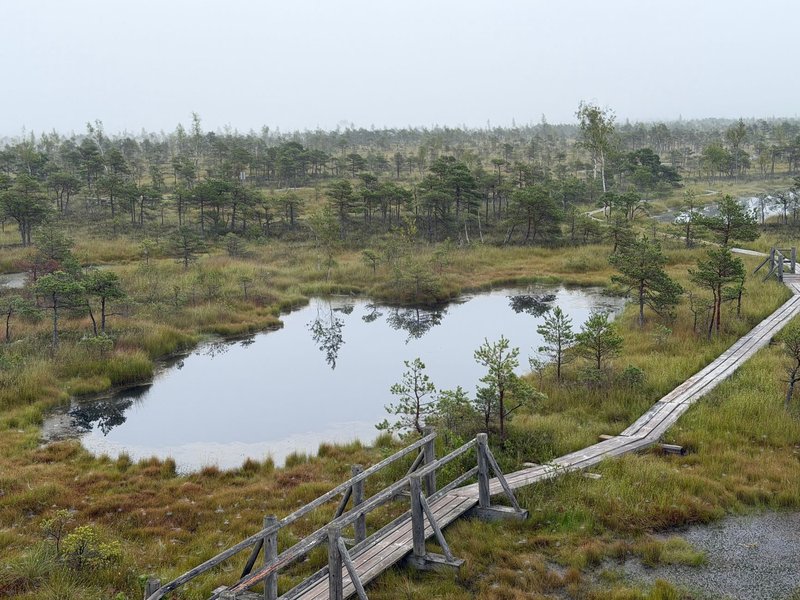
Peat and carbon. Sphagnum is the engine behind peatlands. The moss grows on top while the lower layers die and, in waterlogged, acidic, low-oxygen conditions, decay so slowly that they build up as peat. According to the UN Environment Programme, peatlands cover only about 3% of the world’s land but hold roughly twice as much carbon as all the world’s forests combined. Draining them releases that carbon as CO2. The IUCN treats peatland protection as a core climate measure for that reason.
Pioneers. Mosses and liverworts are often the first plants to colonize bare rock, lava flows and burned ground. They trap dust, hold moisture and slowly build the thin soil that larger plants need later.
Erosion control. A moss mat soaks up rainfall and slows runoff, which protects slopes and stream banks.
Nitrogen. In boreal forests, feather mosses host cyanobacteria that convert nitrogen from the air into a form other organisms can use. In cold, nutrient-poor forests, that’s a major fertilizer source.
Human uses. Dried Sphagnum is sold as peat moss for gardening and potting mixes, though digging it up is increasingly controversial because of the carbon it releases. In World War I, it was used as an absorbent wound dressing because it soaks up liquid and is mildly antiseptic. Japanese moss gardens treat moss as the entire design, not a background.
Where to find them
You don’t need a forest. Try these:
- Cracks in sidewalks and brick walls (silver moss)
- The north-facing side of tree trunks and shady roof tiles
- The base of old stone walls
- Damp soil in plant pots and greenhouse floors (look for flat, lobed liverworts)
- Streambanks and the edges of ponds
- Disturbed or recently burned ground
Hornworts are the hardest to spot. They’re small, seasonal and often found on damp soil in fields after rain, especially in autumn.
FAQ
Why don’t mosses have roots? They absorb water over their whole surface, so they don’t need roots to supply it. Rhizoids hold them in place, nothing more.
Why can’t non-vascular plants grow tall? Without xylem, water can only move by diffusion and absorption, which doesn’t work over distances longer than a few centimeters.
Is a fern a non-vascular plant? No. Ferns have xylem and phloem, true roots and true leaves, even though they reproduce with spores like mosses.
Are algae non-vascular plants? Algae aren’t land plants and aren’t part of the bryophytes. Some green algae are the ancestors of all land plants, but algae don’t have embryos or the alternation of generations that bryophytes do.
What’s the easiest way to tell the three groups apart? Look at the shape. A plant with tiny leaves on a stem is a moss. A flat ribbon or scale-covered creeper is a liverwort. A flat green rosette with a thin green spike is a hornwort.