TLDR
Silicate minerals are built from silicon-oxygen tetrahedra, and they make up roughly 90% of Earth’s crust. The 20 examples below cover the six structural groups: olivine, garnet, zircon, topaz, and kyanite (isolated tetrahedra); epidote (pairs); tourmaline and beryl (rings); augite, spodumene, and hornblende (chains); muscovite, biotite, talc, kaolinite, and serpentine (sheets); and quartz, orthoclase, plagioclase, and natrolite, a zeolite (frameworks). If you only need the big names, quartz, feldspar, mica, olivine, and garnet cover most of what you’ll see in the field.
Table of Contents
- What makes a mineral a silicate
- Quick reference: 20 silicate minerals
- Isolated tetrahedra: nesosilicates
- Paired tetrahedra: sorosilicates
- Rings: cyclosilicates
- Chains: inosilicates
- Sheets: phyllosilicates
- Frameworks: tectosilicates
- Why these minerals form together (Bowen’s reaction series)
- Silicate vs. non-silicate minerals
- Where you use silicates every day
What makes a mineral a silicate
Every silicate contains a silicon atom surrounded by four oxygen atoms, arranged as a tiny pyramid called the silica tetrahedron (SiO₄). That’s the whole definition. What separates one silicate from another is how those pyramids connect: not at all, in pairs, in rings, in chains, in sheets, or in a three-dimensional network.
Oxygen and silicon are also the two most abundant elements in the crust, at roughly 46% and 28% by weight. Put them together and you get the minerals that make up granite, basalt, sand, clay, and most of the gemstones in a jewelry store. According to the Encyclopaedia Britannica, silicates account for the large majority of the crust, and that’s why a geology course spends so much time on them.
The rule of thumb: the more oxygen atoms the tetrahedra share with each other, the more tightly linked the structure, and the harder and more chemically stable the mineral tends to be. Isolated tetrahedra share none. Frameworks share all four.
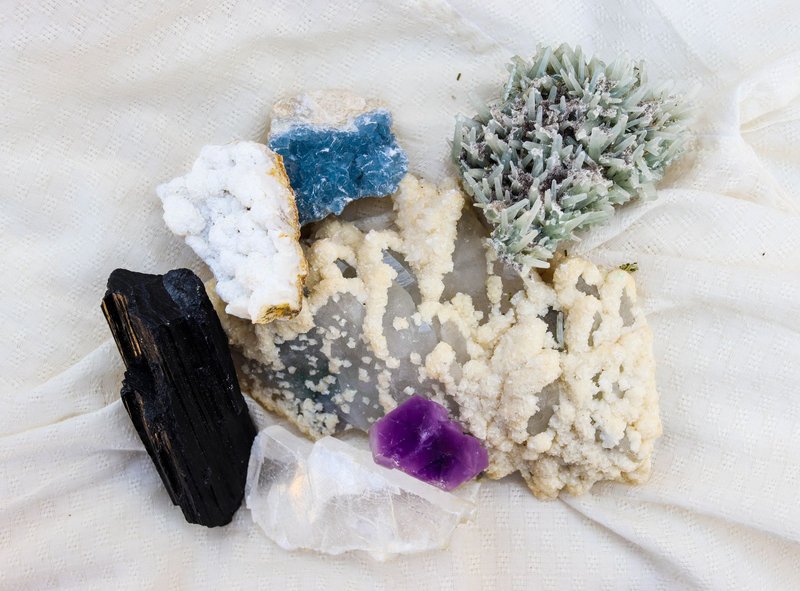
Quick reference: 20 silicate minerals
Hardness is on the Mohs scale (1 is talc, 10 is diamond). Ranges reflect natural variation, since many of these minerals are solid solutions with shifting chemistry.
| Mineral | Group | Formula | Hardness | Typical home |
|---|---|---|---|---|
| Olivine | Nesosilicate | (Mg,Fe)₂SiO₄ | 6.5-7 | Basalt, peridotite, upper mantle |
| Garnet (almandine) | Nesosilicate | Fe₃Al₂(SiO₄)₃ | 6.5-7.5 | Schist, gneiss, river sands |
| Zircon | Nesosilicate | ZrSiO₄ | 7.5 | Granite, beach sands |
| Topaz | Nesosilicate | Al₂SiO₄(F,OH)₂ | 8 | Pegmatites, rhyolite cavities |
| Kyanite | Nesosilicate | Al₂SiO₅ | 4-7 (varies by direction) | High-pressure metamorphic rock |
| Epidote | Sorosilicate | Ca₂(Al,Fe)₃(SiO₄)₃(OH) | 6-7 | Altered basalt, metamorphic rock |
| Tourmaline | Cyclosilicate | Complex boron silicate | 7-7.5 | Granite, pegmatites |
| Beryl | Cyclosilicate | Be₃Al₂Si₆O₁₈ | 7.5-8 | Pegmatites |
| Augite | Inosilicate (pyroxene) | (Ca,Na)(Mg,Fe,Al)(Si,Al)₂O₆ | 5-6 | Basalt, gabbro |
| Spodumene | Inosilicate (pyroxene) | LiAlSi₂O₆ | 6.5-7 | Lithium-rich pegmatites |
| Hornblende | Inosilicate (amphibole) | Complex Ca-Mg-Fe-Al silicate | 5-6 | Granite, diorite, amphibolite |
| Muscovite | Phyllosilicate (mica) | KAl₂(AlSi₃O₁₀)(OH)₂ | 2-2.5 | Granite, schist |
| Biotite | Phyllosilicate (mica) | K(Mg,Fe)₃(AlSi₃O₁₀)(OH)₂ | 2.5-3 | Granite, gneiss |
| Talc | Phyllosilicate | Mg₃Si₄O₁₀(OH)₂ | 1 | Soapstone, altered ultramafic rock |
| Kaolinite | Phyllosilicate (clay) | Al₂Si₂O₅(OH)₄ | 2-2.5 | Soils, weathered granite |
| Serpentine | Phyllosilicate | Mg₃Si₂O₅(OH)₄ | 2.5-5 | Altered mantle rock, ocean floor |
| Quartz | Tectosilicate | SiO₂ | 7 | Granite, sandstone, veins |
| Orthoclase (K-feldspar) | Tectosilicate | KAlSi₃O₈ | 6 | Granite, syenite |
| Plagioclase | Tectosilicate | NaAlSi₃O₈ to CaAl₂Si₂O₈ | 6-6.5 | Basalt, granite, anorthosite |
| Natrolite (a zeolite) | Tectosilicate | Na₂Al₂Si₃O₁₀·2H₂O | 5-5.5 | Gas cavities in basalt |
Isolated tetrahedra: nesosilicates
In nesosilicates, each tetrahedron stands alone. Metal ions like magnesium, iron, aluminum, and zirconium hold them together. With no silicon-oxygen chains to cleave along, these minerals tend to be dense, hard, and equidimensional. They break rather than split.
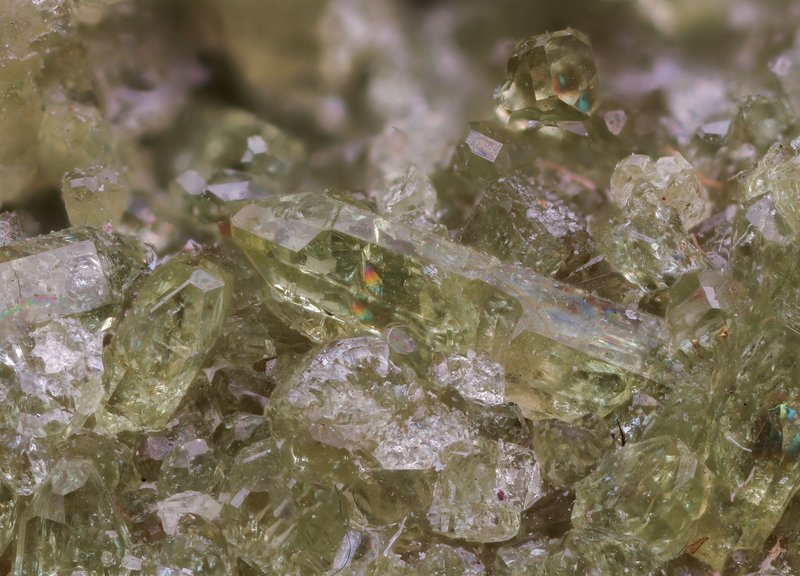
Olivine is the green mineral that makes up most of the upper mantle. It crystallizes early from basaltic magma, which is why you find it in volcanic rock from Hawaii to Iceland. The gem version, peridot, has been mined for thousands of years. Olivine weathers fast at the surface, so it rarely survives in old sedimentary rock.
Garnet is a family, not a single mineral. Almandine (iron-aluminum) is the common red-brown one, found as dark crystals in metamorphic schist and other metamorphic rocks. Because garnet grows as pressure and temperature climb, geologists use it as a thermometer for a rock’s history.
Zircon is the survivor. It’s so resistant that grains from Western Australia have been dated to about 4.4 billion years, the oldest known pieces of Earth’s crust. Tiny uranium impurities make it a natural clock.
Topaz sits at hardness 8, one step above quartz on the Mohs scale, and forms in the gas pockets of cooled rhyolite and in pegmatites. Fluorine in the formula is the giveaway that it crystallized from a fluid-rich melt.
Kyanite has a quirk that works well as an identification trick: it’s about hardness 4-5 along the length of a blade and 6.5-7 across it. Blue blades in a metamorphic rock mean the rock was buried deep.
Paired tetrahedra: sorosilicates
Sorosilicates link tetrahedra in pairs (Si₂O₇). It’s the smallest group and the one most classes rush past.
Epidote is the main example you’ll meet. Its yellow-green, pistachio color shows up in veins and coatings on altered volcanic rock and in many metamorphic rocks. If a greenish crust on a rock looks too yellow to be chlorite, think epidote.
Rings: cyclosilicates
Here the tetrahedra join into closed rings of three, four, or six. The ring leaves an open channel through the crystal, which is where odd atoms like boron and beryllium end up.
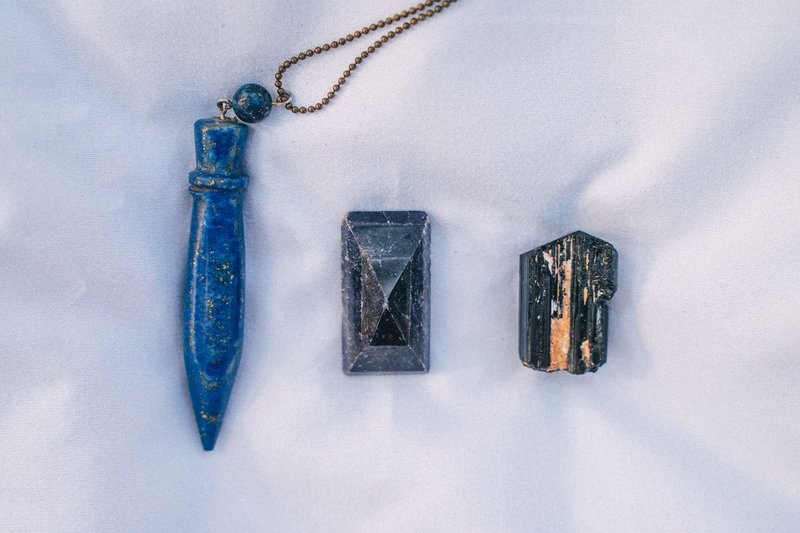
Tourmaline has a chemistry so complicated that no two textbooks print the same formula. It always contains boron, grows as elongated, striated prisms with a rounded-triangle cross-section, and comes in nearly every color. Watermelon tourmaline, pink in the core and green at the rim, is one crystal that changed color as the fluid chemistry changed.
Beryl is built from six-membered rings and shows up in two famous forms: emerald (colored by chromium or vanadium) and aquamarine (colored by iron). Plain beryl is also the main ore of beryllium, a metal used in aerospace and electronics.
Chains: inosilicates
Chain silicates come in two types. Single chains (pyroxenes) have one strand of tetrahedra. Double chains (amphiboles) have two strands joined side by side. Because the bonds along the chain are stronger than the bonds between chains, these minerals split into long fibers or blocky fragments along set angles. That’s cleavage, and it’s the best field clue for telling pyroxene from amphibole: pyroxene cleaves at about 90 degrees, amphibole at about 56 and 124.
Augite is the common pyroxene, a dark green-black mineral in basalt and gabbro, which is the rock of the ocean floor.
Spodumene is a pyroxene too, but a lithium-bearing one. Large crystals from pegmatites in places like North Carolina and Western Australia are a major source of lithium for batteries. The U.S. Geological Survey tracks the global supply.
Hornblende is the typical amphibole: dark, elongated, glassy, and flecked through granite and diorite. The black “pepper” in salt-and-pepper granite is often hornblende or biotite.
Sheets: phyllosilicates
Phyllosilicates link tetrahedra into flat sheets, and the sheets stack like pages, held together by weak bonds. That structure explains almost everything about them: they’re soft, flaky, and split along one perfect plane.
Muscovite is the clear to silvery mica that peels into thin, flexible, see-through sheets. Before glass was cheap, large sheets were used for windows and for lamp and stove panes. Today it goes into cosmetics, paint, and electrical insulation.
Biotite is the dark, brown-to-black cousin, rich in iron and magnesium. It’s the telltale flaky glitter in granite and gneiss.
Talc is the softest mineral on the Mohs scale, at 1. You can scratch it with a fingernail. Soapstone, a rock made mostly of talc, has been carved into sinks and countertops for centuries, and it’s the base for baby powder.
Kaolinite is the clay of porcelain and paper coating. It forms when feldspar in granite weathers in warm, wet climates. The name comes from Gaoling, a hill in China where it was mined for porcelain.
Serpentine forms when seawater reacts with mantle rock at the ocean floor, and the rock turns mottled green and slick, like a snakeskin. It also comes in a fibrous form, chrysotile, which is the most common type of asbestos.
Frameworks: tectosilicates
In tectosilicates, every oxygen is shared between two tetrahedra, so the whole crystal is one continuous network. Pure silica (SiO₂) is the simplest version. Swap some silicon for aluminum and you need extra potassium, sodium, or calcium to balance the charge. That’s where feldspars come in.
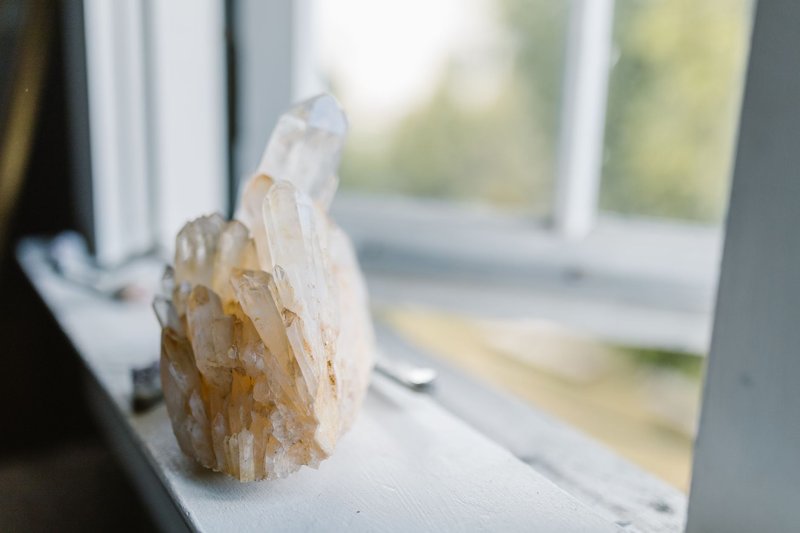
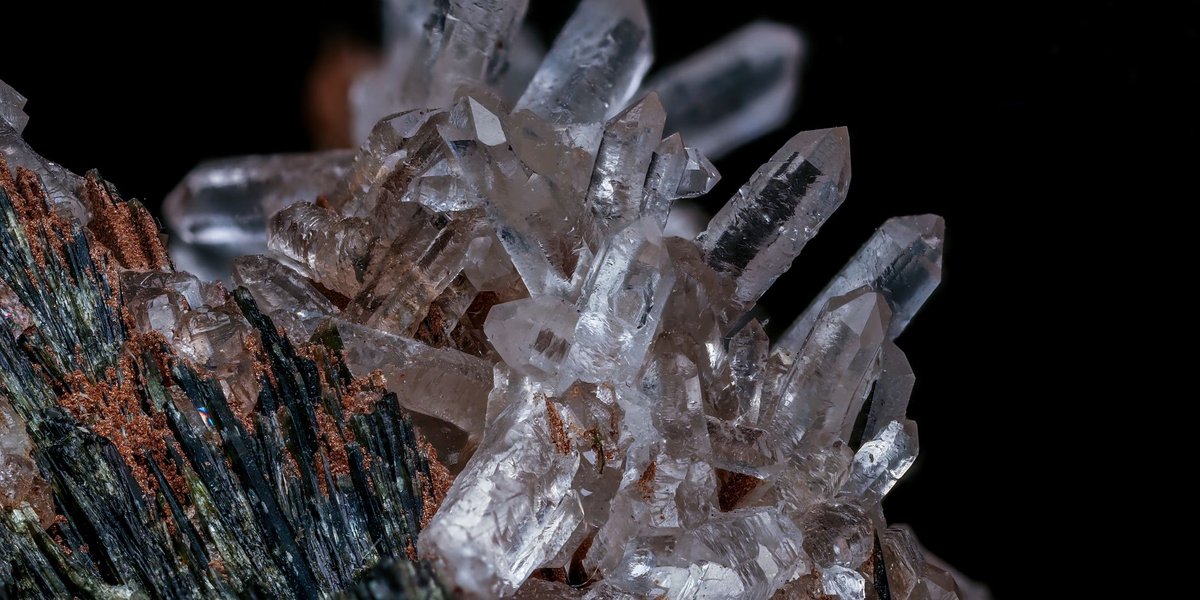
Quartz is the most familiar framework silicate and the second most abundant mineral in the crust. Hardness 7, no cleavage, glassy, and resistant to weathering, which is why beaches and deserts are mostly quartz sand. Amethyst, citrine, and rose quartz are the same mineral with different trace impurities. Industrial uses are covered in the USGS silica overview.
Orthoclase is potassium feldspar, the pink to salmon crystals in many granites. Feldspars as a group are the most abundant mineral family in the crust, and potassium feldspar has two cleavage planes at roughly 90 degrees, which is where the name (Greek for “straight fracture”) comes from.
Plagioclase is not a single mineral but a continuous series from sodium-rich albite to calcium-rich anorthite. It’s white to gray, with fine parallel stripes (twinning lines) visible on cleavage faces under a hand lens. Those stripes are the quickest way to tell plagioclase from orthoclase.
Natrolite stands in here for the zeolites, framework silicates riddled with open channels that hold water and let it back out. Delicate white needles lining gas bubbles in basalt are classic natrolite. Synthetic zeolites are used in water softeners and as molecular sieves.
Why these minerals form together (Bowen’s reaction series)
If you look at the rock samples above, some pairs always show up together and some never do. You’ll find olivine with calcium-rich plagioclase, but never with quartz. That’s Bowen’s reaction series, and it explains the pattern.
As magma cools, minerals crystallize in a set order. Two tracks run in parallel.
- Discontinuous track: olivine, then pyroxene, then amphibole, then biotite. Each one reacts with the leftover melt to become the next.
- Continuous track: plagioclase starts calcium-rich and gradually becomes sodium-rich as the melt cools.
Both converge at the cool end: potassium feldspar, muscovite, and finally quartz, the last mineral to crystallize.
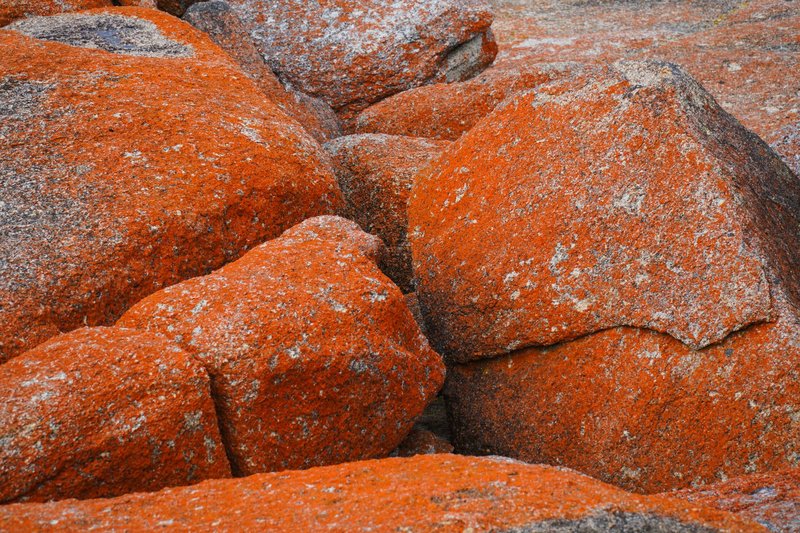
Olivine and quartz react with each other at high temperature, so they can’t coexist in equilibrium. That’s why basalt, which cools from a hot, silica-poor melt, carries olivine, and granite, which forms from a cooler, silica-rich melt, carries quartz. The series also tracks stability at the surface: the minerals that crystallize first, like olivine, weather fastest, while quartz lasts the longest.
Silicate vs. non-silicate minerals
Not every mineral has a silicon-oxygen tetrahedron. The simple test is the anion: what’s the negatively charged group in the formula?
| Class | Anion | Examples |
|---|---|---|
| Silicates | SiO₄⁴⁻ | Quartz, mica, olivine |
| Carbonates | CO₃²⁻ | Calcite, dolomite |
| Oxides | O²⁻ | Hematite, magnetite |
| Sulfides | S²⁻ | Pyrite, galena |
| Sulfates | SO₄²⁻ | Gypsum, barite |
| Halides | Cl⁻, F⁻ | Halite, fluorite |
| Native elements | None | Gold, copper, diamond |
Two cases cause confusion. Quartz is SiO₂ and has no metal, but it still counts as a silicate because it’s built from silica tetrahedra. And diamond and graphite are both pure carbon: neither is a silicate, despite diamond being a gem alongside beryl and topaz.
Where you use silicates every day
Silicate minerals are the raw material of most of the built world.
- Glass is melted quartz sand, usually with soda and lime added.
- Ceramics and porcelain start with kaolinite and feldspar, which acts as a flux to lower the firing temperature.
- Cement and concrete contain calcium silicates, which harden when mixed with water.
- Gemstones such as emerald, aquamarine, garnet, topaz, tourmaline, and peridot are all silicates.
- Batteries rely on spodumene as a lithium source.
- Cosmetics, paper, and paint use talc, mica, and kaolinite as fillers and pigments.
Next time you’re picking up a rock, try the clues in order: hardness, cleavage, color, and what else it’s sitting next to. Hard and glassy with no cleavage is quartz. Pink with two flat faces is feldspar. Flaky and peeling is mica. Green and sandy in dark volcanic rock is olivine. That gets you through most of the silicates you’ll ever find in the wild.