Titration sounds like one technique. It’s actually a family of them, and picking the wrong one gets you a number that looks precise but is wrong.
At its core, titration is a controlled reaction: you add a solution of known concentration (the titrant) to a sample of unknown concentration (the analyte) until the reaction is complete. That point — the equivalence point — tells you exactly how much of the analyte was there. The part every textbook glosses over is that “complete” looks different depending on the chemistry involved, and detecting it requires a different tool for each type. A color change works for some. Others need an electrode. A few need a photometer because your eye can’t see the endpoint at all.
Here’s every titration type chemists actually use, what each one measures, and how to tell them apart.
Table of Contents
- Acid-Base Titration
- Redox Titration
- Complexometric Titration
- Precipitation Titration
- Non-Aqueous Titration
- Photometric Titration
- Conductometric and Amperometric Titration
- Karl Fischer Titration
- Titration Methods Compared
- How to Choose the Right Titration Method
- FAQ
Acid-Base Titration
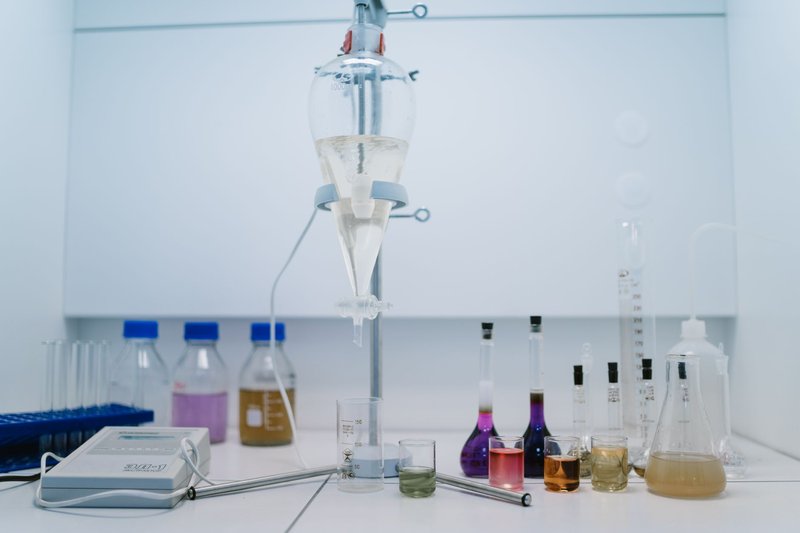
This is the one everyone learns first, and for good reason — it’s the workhorse of the group. An acid of known concentration neutralizes a base (or vice versa)—fundamentals of acid-base reactions—and the endpoint is signaled by a pH-sensitive indicator or a pH meter.
Phenolphthalein turning from clear to pink is the classic image, but it’s not the only indicator in rotation. Methyl orange, bromothymol blue, and phenol red each shift color across a different pH range, so the choice depends on whether you’re titrating a strong acid against a weak base or something in between — a weak-weak pairing often skips indicators entirely in favor of a pH meter, because the color change near the equivalence point is too gradual to trust by eye.
Real-world use: wineries measure total acidity in must and finished wine this way, food labs check vinegar and citrus juice concentration, and soil scientists use it to determine lime requirements for agricultural fields.
Redox Titration
Here the reaction transfers electrons instead of protons. One reagent gets oxidized, the other gets reduced, and the titrant is usually a strong oxidizing or reducing agent — potassium permanganate, potassium dichromate, or iodine solutions show up constantly in this category.
Permanganate titrations have a built-in convenience: the reagent is such a deep purple that it acts as its own indicator. The solution stays colorless as the permanganate gets consumed, then the faintest persistent pink signals you’ve overshot into excess titrant. No extra indicator required.
Real-world use: iodometric titration measures vitamin C content in fruit juice and supplements, and dichromate titration is a standard method for determining iron content in ore samples and chemical oxygen demand in wastewater testing.
Complexometric Titration
This type measures metal ions by forming a stable complex between the metal and a chelating agent — almost always EDTA (ethylenediaminetetraacetic acid), which wraps around a metal ion and locks it up in a 1:1 ratio regardless of the metal’s charge.
The indicator here is a metal-ion-sensitive dye, most commonly Eriochrome Black T, which is wine-red when bound to free metal ions and turns blue once EDTA has captured them all. That color flip at the endpoint is sharp enough to read by eye in most cases.
Real-world use: water hardness testing runs on complexometric titration, measuring the combined calcium and magnesium content that determines whether water is “hard” or “soft.” It’s also standard for quantifying calcium in dairy products and trace metals in pharmaceutical formulations.
Precipitation Titration
The titrant reacts with the analyte to form an insoluble precipitate, and the endpoint is the point where precipitate formation stops (or a secondary reaction kicks in to signal completion). Silver nitrate is the dominant titrant here, reacting with halide ions to form silver halide precipitates.
Two named methods handle the endpoint differently. The Mohr method uses potassium chromate as an indicator — once all the chloride has precipitated as white silver chloride, excess silver ion reacts with the chromate to form a brick-red silver chromate precipitate. The Volhard method works in reverse, back-titrating excess silver with thiocyanate and using iron(III) as an indicator that turns blood-red at the endpoint.
Real-world use: chloride content testing in drinking water, seawater, and processed foods (salt content in cured meats and snack products) relies on precipitation titration, and it’s also used to check silver content in photographic waste.
Non-Aqueous Titration
Water isn’t always the right solvent. Many organic acids and bases — particularly weak ones, and especially basic drug compounds like alkaloids — are either insoluble in water or too weak to give a sharp endpoint in it. Non-aqueous titration swaps water for solvents like glacial acetic acid, methanol, or acetonitrile, which can sharpen the acid-base behavior of compounds that behave poorly in water.
Perchloric acid dissolved in glacial acetic acid is a standard titrant for basic nitrogen-containing compounds, a combination that shows up constantly in pharmaceutical assays.
Real-world use: pharmacopeial testing of alkaloid-based drugs (codeine, quinine, and related compounds) depends on non-aqueous titration because these bases are too weak to titrate reliably in water.
Photometric Titration
Instead of a visual indicator, this method tracks the reaction with a photometer that measures light absorbance as titrant is added. The endpoint shows up as a sudden change in slope on an absorbance-versus-volume plot rather than a color flip you catch by eye.
That instrumental detection matters most when a sample is already colored, cloudy, or fluorescent enough to hide a conventional indicator’s color change — situations where a chemist’s eye would simply miss the transition, or misjudge it.
Real-world use: photometric titration is common in automated industrial quality control, where colored or turbid samples (certain dyes, petroleum products, and pigmented pharmaceutical intermediates) rule out indicator-based methods.
Conductometric and Amperometric Titration
Both of these detect the endpoint electrically rather than visually—forms of electrochemical analysis—which makes them useful exactly where color-based methods fail. Conductometric titration tracks the electrical conductivity of the solution as ions are consumed and produced — conductivity rises, falls, or changes slope at the equivalence point, plotted as a graph rather than read as a single color shift. Amperometric titration instead measures current at an electrode held at a fixed potential, watching for the point where current stops changing predictably.
Both handle dilute, colored, or turbid samples that would defeat an indicator, and neither requires the operator to judge a subjective color change.
Real-world use: amperometric titration is the standard method for measuring residual chlorine in treated drinking water and swimming pools, a role where accuracy at low concentration matters more than convenience.
Karl Fischer Titration
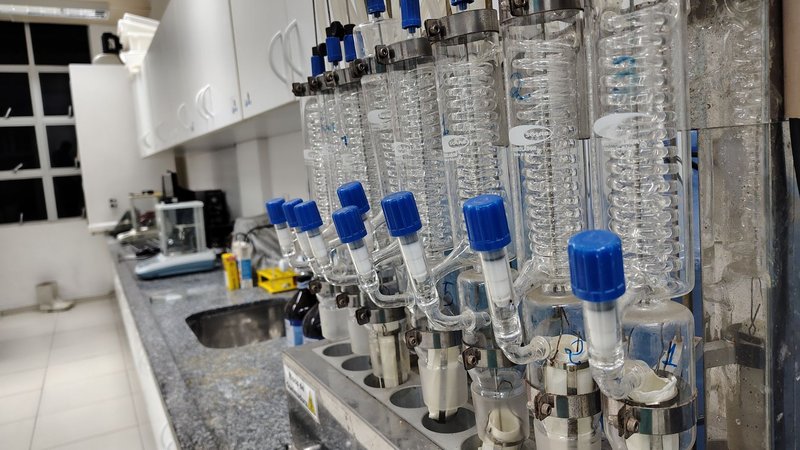
This one measures something different from every other type on this list: not an acid, base, metal, or halide, but water content itself — trace moisture inside a substance that isn’t supposed to have any. The titrant, Karl Fischer reagent, is a mix of iodine, sulfur dioxide, and a base (originally pyridine, now more often imidazole) dissolved in an alcohol solvent. It reacts stoichiometrically with any water present, and the endpoint is detected electrometrically rather than by color.
There are two operating modes. Volumetric Karl Fischer suits samples with higher moisture content, while coulometric Karl Fischer generates the iodine electrochemically in situ and handles trace-level moisture down to parts per million.
Real-world use: pharmaceutical manufacturers run Karl Fischer titration on nearly every batch of powder, tablet, and raw material because excess moisture accelerates drug degradation. Food processors use it to check moisture in honey, oils, and dried products, and petrochemical labs use it to test water contamination in fuel and lubricants.
Titration Methods Compared
| Type | Titrant | Endpoint Detection | Typical Use Case |
|---|---|---|---|
| Acid-Base | Strong/weak acid or base | Color indicator or pH meter | Wine acidity, soil pH, food QC |
| Redox | KMnO4, K2Cr2O7, iodine | Self-indicating color or starch indicator | Vitamin C content, iron in ore |
| Complexometric | EDTA | Metal-ion indicator (e.g., Eriochrome Black T) | Water hardness, calcium in dairy |
| Precipitation | Silver nitrate | Chromate or thiocyanate indicator | Chloride in water, salt in food |
| Non-Aqueous | Perchloric acid in acetic acid | Potentiometric or indicator | Alkaloid drug assays |
| Photometric | Varies by reaction | Absorbance change | Colored/turbid industrial samples |
| Conductometric/Amperometric | Varies by reaction | Conductivity or current change | Chlorine residual in water |
| Karl Fischer | Iodine/SO2 reagent | Electrometric (volumetric or coulometric) | Moisture in pharma, food, fuel |
How to Choose the Right Titration Method
Start with what you’re actually measuring. An acid or base concentration points you to acid-base titration. A metal ion points to complexometric. A halide points to precipitation. Trace water content — regardless of what else is in the sample — points to Karl Fischer, full stop; no other method on this list measures moisture directly.
Next, check the sample matrix. A clear, colorless aqueous solution plays nicely with visual indicators. A colored, cloudy, or fluorescent sample doesn’t — that’s your cue to move to photometric, conductometric, or amperometric detection instead of fighting a color change you can’t reliably see.
Then check solubility. If the analyte doesn’t dissolve well in water, or its acid-base behavior is too weak to titrate cleanly there, non-aqueous titration with an organic solvent usually solves it. This comes up constantly in pharmaceutical labs working with organic bases.
Finally, weigh precision requirements against practicality. Manual titration with a burette and visual indicator is fine for teaching labs and routine QC. Regulated industries — pharmaceuticals, food safety, environmental testing under EPA drinking water standards — typically use automated titrators with potentiometric or amperometric endpoint detection, because they remove the subjectivity of judging a color change and produce results that hold up to audit.
FAQ
What is the most common type of titration? Acid-base titration. It’s the first one taught in chemistry courses, and it remains the most widely used in routine settings — food and beverage QC, environmental water testing, and educational labs — because the chemistry is straightforward and the endpoint is easy to see.
How do I choose a titration method? Identify what you’re measuring first (acid/base concentration, metal ion, halide, oxidizer/reducer, or water content), then check whether the sample’s color or turbidity will interfere with a visual indicator. If it will, move to an instrumental endpoint method like potentiometric, photometric, or amperometric detection. If the analyte doesn’t dissolve or react cleanly in water, switch to a non-aqueous solvent system.
The Bigger Picture
Eight methods, one underlying idea: add a known quantity of something until a reaction finishes, and use that quantity to back-calculate an unknown. The differences that matter are the reaction chemistry and how you catch the exact moment it’s done. Get either one wrong for your sample — using a visual indicator on a murky solution, or trying to titrate a weak organic base in water — and the number you get back will look convincing and still be wrong. Match the method to the analyte and the matrix, and titration remains one of the most reliable quantitative tools in analytical chemistry, a status it’s held since well before instrumental methods existed, as documented in IUPAC’s analytical chemistry nomenclature.