Italy is a resource-poor country that produces some of the most valuable raw material on Earth. Both things are true. The peninsula sits on almost no oil, imports roughly three-quarters of the energy it burns, and yet it carves the white marble that built the Pantheon and pumps superheated steam out of Tuscan ground to make electricity. The story of Italy’s natural resources is mostly a story of geography doing strange, specific things in a small space.
Here’s the catch most reference articles miss: where a resource sits in Italy tells you almost everything about it. Gas is a northern and southern story. Marble is a Tuscan story. Wine and grain are a Po Valley and hill-country story. So this guide is organized the way the country actually works, by resource type, with the regions called out for each one.
Table of Contents
- Quick Answer
- Mineral Resources
- Energy Resources
- Agricultural Resources
- Forests and Timber
- Water Resources
- Fishing
- Resources by Region: A Quick Map
- Conservation and Sustainability
- Frequently Asked Questions
Quick Answer
Italy’s main natural resources are marble and dimension stone (Carrara, Tuscany), natural gas (Po Valley and Basilicata), geothermal energy (Larderello, Tuscany), agricultural land producing wine, olive oil, durum wheat, and cheese, plus forests, fresh water, and Mediterranean fisheries. The country has limited fossil fuels and almost no metal ores worth mining at scale, which is why it ranks among the most energy-import-dependent nations in the European Union. Its real mineral wealth is industrial: stone, feldspar, pumice, and clays rather than gold or iron.
Mineral Resources
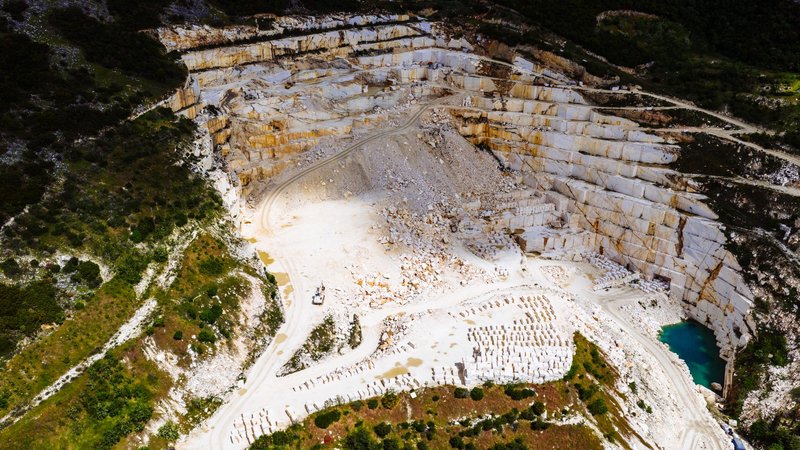
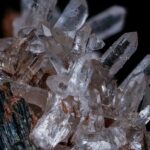
Italy’s mineral story starts and largely ends with stone. The Apuan Alps above Carrara, in northern Tuscany, hold the most famous marble deposit on the planet. This is the white stone Michelangelo hauled out for the David, and the quarries are still working hard. Estimates for annual output vary by what you count, but the Carrara basin moves on the order of one million tonnes of raw marble blocks each year, with total material extracted (blocks plus rubble and carbonate for industry) running several times higher. The mountains look snow-capped from a distance. That’s not snow. It’s exposed marble.
Beyond Carrara, Italy is a serious producer of industrial minerals rather than metals. Sardinia and the volcanic islands supply feldspar, used in ceramics and glass, where Italy is one of the world’s top producers. The Aeolian island of Lipari yields pumice and obsidian. Tuscany and Sicily historically gave up mercury (the Monte Amiata mines) and sulfur, though most metal mining wound down decades ago as cheaper foreign ore took over. Zinc and lead came out of Sardinia for over a century before the last big mines closed.
The honest summary: Italy doesn’t dig up much in the way of iron, copper, or precious metals. What it has is rock with a name buyers pay a premium for, and a deep bench of clays, marl, and aggregate that feed its cement, tile, and ceramics industries.
Energy Resources
This is where Italy’s geography turns generous in one direction and stingy in another.
Natural gas is the country’s one meaningful fossil fuel. The big basins are the Po Valley in the north and the southern region of Basilicata, with offshore fields in the Adriatic. Basilicata’s onshore fields alone account for roughly a third of national gas output, and the Val d’Agri there is the largest onshore oil and gas field in continental Western Europe. The trouble is scale. Italian gas production hit a record low of around 2.8 billion cubic meters in 2024, a fraction of what the country consumes. Proven reserves sit near 42 billion standard cubic meters, concentrated mostly onshore. It’s real, but it’s not enough.
Geothermal energy is the genuinely distinctive one. At Larderello, in the hills south of Pisa, Italy built the world’s first geothermal power plant in 1904, generating commercial electricity from 1913. The Larderello complex today runs dozens of plants with a combined capacity around 800 megawatts, part of an Italian geothermal fleet of roughly 900+ megawatts. The ground there leaks steam hot enough to spin turbines because the region sits over a shallow magma intrusion. Geothermal is one of the many renewable energy sources Italy leans on, and it’s a category few countries on Earth can tap this way. Italy did it first and still does it well.
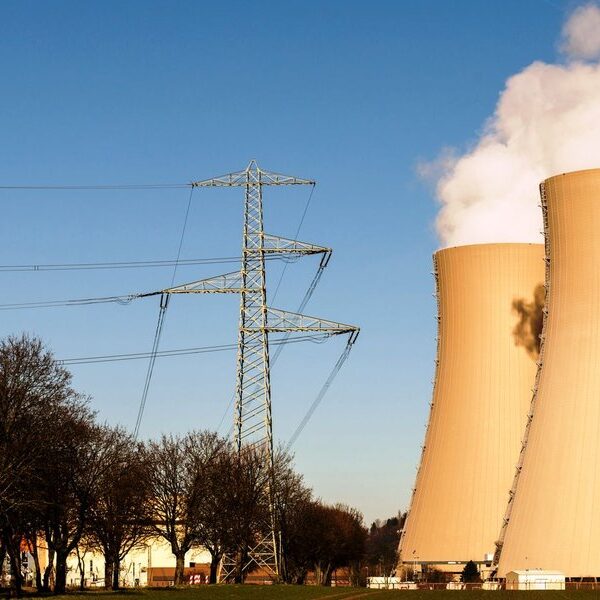
The rest of the energy mix leans on imports and renewables. Hydroelectric power from Alpine reservoirs has been a backbone since the early 1900s, and solar capacity has climbed fast across the sunny south. In 2024 Italy crossed a milestone, generating more electricity from clean sources than from fossil fuels for the first time. Even so, the country imports the most electricity of any nation in Europe and buys most of its gas abroad, with Algeria now the top supplier. Italy is a net energy importer, full stop, and that fact shapes its politics and its push toward renewables.
Agricultural Resources
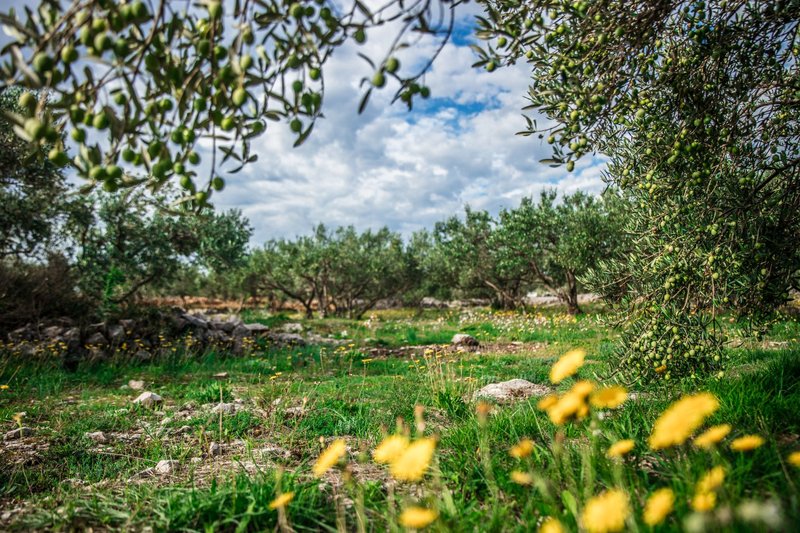
Italy’s most productive natural resource might just be its dirt. The country’s varied terrain, from the flat alluvial Po Valley to terraced hillsides, supports an agricultural output that’s the envy of much of the world.
The Po Valley is the agricultural engine. This is the broad northern plain drained by the Po River, and it grows the bulk of Italy’s wheat, maize, rice (Italy is the largest rice producer in Europe), soybeans, and the fodder that feeds the dairy herds behind Parmigiano-Reggiano and Grana Padano. The valley’s flatness and reliable water make it the one place in Italy you can farm at industrial scale.
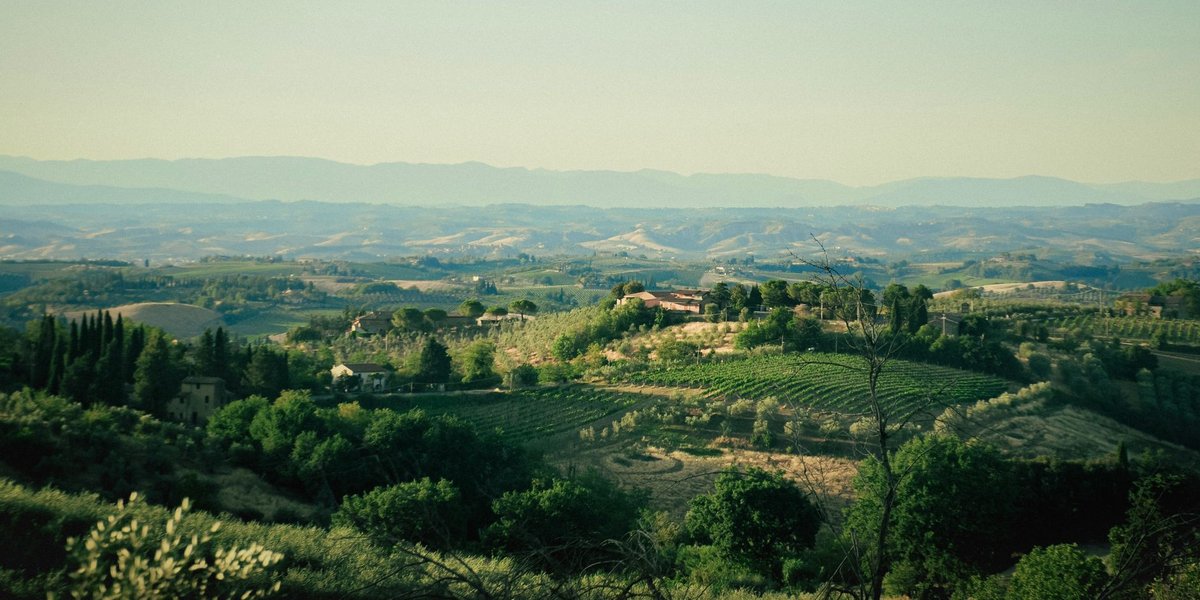
Then there’s the stuff Italy is famous for. Wine grapes grow nearly everywhere, from Piedmont’s Nebbiolo to Sicily’s Nero d’Avola, making Italy regularly the world’s largest or second-largest wine producer by volume. Olive groves blanket the south, Puglia, Calabria, Sicily, and Tuscany, putting Italy among the top olive oil producers globally. Add citrus from Sicily and Calabria, tomatoes from Campania, hazelnuts from Piedmont, and durum wheat for pasta, and you have a food economy built directly on soil and climate.
Forests and Timber
Forests cover something close to a third of Italy’s land area, and the share has actually grown over the last century as marginal farmland in the mountains was abandoned and trees moved back in. The composition shifts with altitude: oak, chestnut, and beech in the hills and lower mountains, then conifers, spruce, larch, and fir, in the Alps and Apennines, both of them fold mountains thrown up by colliding tectonic plates.
Italy isn’t a timber heavyweight the way Scandinavia or Canada is, and it imports a lot of wood for its furniture industry. But the forests matter for chestnuts (a traditional food and flour source), cork from the oaks of Sardinia, truffles in the wooded hills of Piedmont and Umbria, and the simple work of holding steep slopes together against erosion. The forest’s biggest value here is ecological, not industrial.
Water Resources
For a Mediterranean country, Italy is comparatively well-watered, at least in the north. The Alps feed major rivers, the Po, Adige, Ticino, and dozens of glacier- and lake-fed tributaries, and the big northern lakes (Garda, Maggiore, Como) store enormous volumes of fresh water. That water drives hydroelectric plants, irrigates the Po Valley, and supplies cities.
The south is a different climate entirely. Sicily, Puglia, and much of the Mezzogiorno run dry and increasingly face summer water stress, a gap that’s widened with hotter, drier years. So Italy’s water wealth is lopsided: abundant where the mountains are, scarce where the sun is hardest. Managing that north-south imbalance is one of the country’s quieter long-term challenges.
Fishing
Italy has thousands of kilometers of coastline along the Mediterranean and Adriatic, and fishing has fed coastal communities for as long as there have been coastal communities. The Adriatic and the waters around Sicily are the most productive grounds, landing anchovies, sardines, hake, mackerel, swordfish, and the bluefin tuna that’s both a delicacy and a conservation flashpoint.
The catch is that the Mediterranean is heavily overfished, and Italian landings have declined for decades under pressure from too many boats chasing too few fish. Aquaculture, especially mussels, sea bass, and sea bream, now fills much of the gap. Fishing remains a real resource, but it’s one Italy increasingly has to ration rather than expand.
Resources by Region: A Quick Map
If you want the whole picture at a glance, here’s where the major resources concentrate:
| Region | Primary Natural Resources |
|---|---|
| Tuscany | Carrara marble, geothermal energy (Larderello), wine, olive oil |
| Po Valley (Lombardy, Emilia-Romagna, Veneto, Piedmont) | Natural gas, grain, rice, dairy, fresh water, hydro |
| Basilicata | Natural gas and oil (Val d’Agri) |
| Sardinia | Zinc/lead (historic), feldspar, cork, granite |
| Sicily | Sulfur (historic), citrus, wine, fishing, solar |
| Puglia & Calabria | Olive oil, wheat, vegetables, fishing |
| Alps (Trentino, Aosta Valley, Lombardy) | Hydroelectric power, timber, fresh water |
| Aeolian Islands (Lipari) | Pumice, obsidian |
This is the table the encyclopedic write-ups tend to skip, and it’s the one that actually explains the country. Resources in Italy aren’t spread evenly. They’re clustered, and the clusters track the geology.
Conservation and Sustainability
Italy’s resource future is mostly about doing more with less. The country has no large untapped fossil reserves to fall back on, which is precisely why it leans hard into geothermal, solar, and hydro, and why crossing the renewables-over-fossils threshold in 2024 mattered so much. Heavy energy import dependence is a strategic vulnerability, and the cleanest fix is to grow domestic renewable generation rather than chase the small gas reserves left in the ground.
The marble industry faces its own reckoning. Quarrying in the Apuan Alps generates enormous waste and reshapes protected mountains, and a large share of extracted carbonate now goes to industrial powder rather than sculpture-grade blocks, a point environmental groups raise often. Water scarcity in the south, overfishing in the Mediterranean, and soil pressure on prized farmland all point the same direction: Italy’s resources are finite, famous, and increasingly managed for the long haul rather than mined for the quarter.
Frequently Asked Questions
What are the main natural resources of Italy? Marble and dimension stone, natural gas, geothermal energy, agricultural land (wine, olive oil, wheat, rice, dairy), forests, fresh water, and Mediterranean fisheries. Italy is short on oil, coal, and metal ores.
Where are natural resources located in Italy? They cluster by geology: marble and geothermal power in Tuscany, natural gas in the Po Valley and Basilicata, hydro and timber in the Alps, agriculture across the Po Valley and southern hills, and fishing along the Adriatic and Sicilian coasts.
Why does Italy import so much energy? Italy has very limited domestic oil and gas and no significant coal. Its own gas production keeps falling, so it buys roughly three-quarters of its energy abroad, making it Europe’s largest net electricity importer and a major gas importer, mainly from Algeria.
Is Carrara marble still mined today? Yes. The quarries above Carrara in Tuscany are very active, moving on the order of a million tonnes of raw blocks a year, plus far more carbonate destined for industrial use.
Does Italy produce its own electricity from renewables? Increasingly, yes. In 2024 Italy generated more electricity from clean sources, hydro, solar, geothermal, and wind, than from fossil fuels for the first time, though it still imports large volumes of power and gas.
Italy’s natural resources don’t add up to self-sufficiency, and they never have. What they add up to is a handful of things the country does better than almost anyone, marble, geothermal, wine, olive oil, set against a permanent need to buy energy from its neighbors. Read the map and the contradiction makes sense: small country, varied ground, a few world-class deposits, and a long bet on the sun, the rivers, and the heat under Tuscany to cover the rest.