The fast answer most people want: aluminium, lithium, magnesium, sodium, tungsten, platinum, titanium, oxygen gas, gadolinium, and a pile of transition-metal ions like Fe³⁺, Cr³⁺, and Mn²⁺ are all paramagnetic. They get weakly pulled toward a magnetic field — not yanked like iron, just nudged.
The reason every one of them makes the list comes down to a single feature: unpaired electrons. That’s the whole game. If an atom or ion has at least one electron without a partner, those tiny electron magnets line up with an applied field and the material drifts toward it. No unpaired electrons, no paramagnetism.
Below is the example-dense version of this topic. Each material gets its unpaired-electron count and where you’d actually run into it, followed by the comparison table, Curie’s Law, and a step-by-step method for working out whether any substance is paramagnetic.
Table of Contents
- What makes a material paramagnetic
- Paramagnetic metals (the elements)
- Paramagnetic gases
- Paramagnetic ions and compounds
- Paramagnetic vs diamagnetic vs ferromagnetic
- Curie’s Law: why temperature matters
- How to tell if a material is paramagnetic
- FAQ
What makes a material paramagnetic
Every electron behaves like a microscopic bar magnet because of two motions: its spin and its orbit around the nucleus. When electrons pair up in an orbital, they sit with opposite spins and their magnetic moments cancel. Neat and quiet.
Paramagnetism shows up when that cancellation doesn’t finish. Leave one or more electrons unpaired and you’ve got leftover magnetic moments with nothing to cancel them. Switch on an external field and those moments rotate to align with it, so the material is drawn in — weakly, because thermal jostling keeps knocking the alignment out of order.
Kill the field and the effect vanishes. Paramagnetic materials don’t stay magnetized; they have no memory of the field once it’s gone. That’s the clean line between them and the ferromagnets like iron that hold onto magnetization. The strength of the pull is measured by magnetic susceptibility, which for paramagnets is a small positive number — typically somewhere around 10⁻³ to 10⁻⁵.
Paramagnetic metals (the elements)
The elemental paramagnets are the easiest examples to picture because most of them are sitting in your kitchen, garage, or phone.
- Aluminium (Al) — One unpaired electron in its 3p orbital. Your soda can, foil, and bike frame are all weakly paramagnetic, which is why a strong magnet doesn’t stick to aluminium but does interact with it in moving-magnet experiments.
- Lithium (Li) — One unpaired electron in 2s. The same element powering the battery in your laptop and phone is paramagnetic in its metallic form.
- Sodium (Na) — One unpaired 3s electron. The alkali metals are a reliable source of single-unpaired-electron paramagnets.
- Magnesium (Mg) — Weakly paramagnetic as a bulk metal, used in lightweight alloys for everything from laptop shells to aircraft parts.
- Titanium (Ti) — Two unpaired 3d electrons. Strong, light, and the reason titanium shows up in jet engines and medical implants.
- Tungsten (W) — Unpaired d-electrons, plus the highest melting point of any metal, which is why it lived inside incandescent bulb filaments for a century.
- Platinum (Pt) — Paramagnetic with unpaired d-electrons. The catalytic converter under your car relies on it.
Note one subtlety: in metals, paramagnetism gets a contribution from the free conduction electrons too (Pauli paramagnetism), not only from isolated atomic moments. The bottom line for an exam answer stays the same — these metals are weakly attracted to a magnetic field.
Paramagnetic gases
The headline example here is the one that surprises people.
- Oxygen (O₂) — Yes, the air you’re breathing is paramagnetic. Each O₂ molecule carries two unpaired electrons, a result that simple Lewis structures get wrong and that molecular orbital theory predicts correctly. You can prove it: liquid oxygen poured between the poles of a strong magnet visibly sticks and bridges the gap. This is one of the cleanest demonstrations of paramagnetism in any chemistry lab.
Nitrogen, by contrast, has all its electrons paired, so it’s diamagnetic — a useful side-by-side that exam questions love to exploit.
Paramagnetic ions and compounds
Transition-metal ions are the richest source of paramagnetic examples because their partially filled d-orbitals almost guarantee unpaired electrons.
- Iron(III), Fe³⁺ — Five unpaired 3d electrons, the maximum for a single d-subshell. It’s why many iron salts and rust-related compounds respond to magnetic fields.
- Manganese(II), Mn²⁺ — Also five unpaired electrons (3d⁵), making it strongly paramagnetic among the ions.
- Chromium(III), Cr³⁺ — Three unpaired 3d electrons. Shows up in pigments and as the active center in some catalysts.
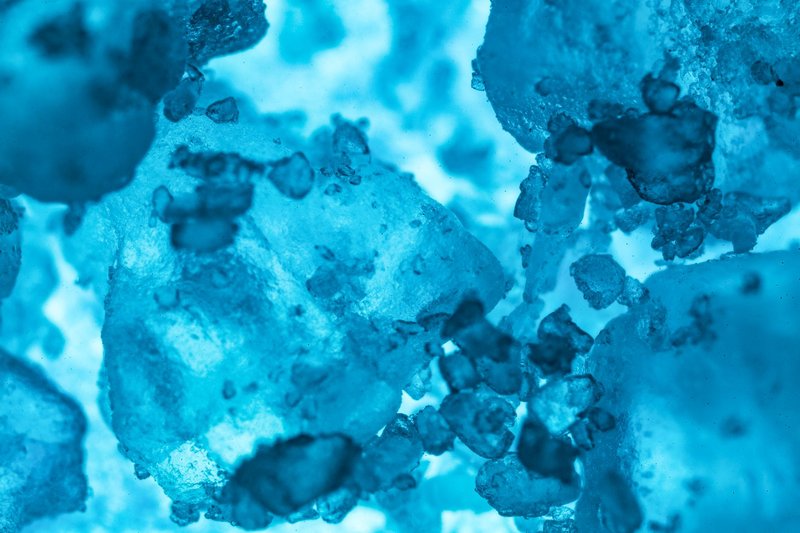
- Copper(II) in copper sulfate (CuSO₄) — One unpaired electron (3d⁹). Blue copper sulfate crystals are a classic classroom paramagnet; the anhydrous and hydrated forms behave the same way magnetically.
- Gadolinium (Gd / Gd³⁺) — The heavyweight, with seven unpaired 4f electrons. This is why gadolinium is the workhorse of MRI contrast agents: its enormous magnetic moment changes how nearby water protons relax, sharpening the image. That same responsiveness drives a whole range of practical uses beyond medical imaging, from high-strength magnets and alloys to phosphors. Gadolinium is so responsive it’s nearly ferromagnetic near room temperature.
The pattern is worth memorizing for tests: more unpaired electrons means a larger magnetic moment and stronger paramagnetism. Fe³⁺ and Mn²⁺ (five each) beat Cu²⁺ (one), and Gd³⁺ (seven) beats them all.
Paramagnetic vs diamagnetic vs ferromagnetic
This is the comparison the whole topic hinges on. The three categories differ by what their electrons are doing and how they respond to a field.
| Property | Diamagnetic | Paramagnetic | Ferromagnetic |
|---|---|---|---|
| Unpaired electrons | None | At least one | Many, aligned in domains |
| Response to a magnet | Weakly repelled | Weakly attracted | Strongly attracted |
| Magnetic susceptibility | Small, negative | Small, positive | Large, positive |
| Keeps magnetization? | No | No | Yes |
| Effect of heating | Roughly unchanged | Weakens (Curie’s Law) | Lost above Curie temperature |
| Examples | Copper, water, nitrogen, bismuth | Aluminium, oxygen, Fe³⁺, gadolinium | Iron, cobalt, nickel |
The headline distinctions: diamagnetic materials are repelled (every material has a diamagnetic component, but it only wins when there are no unpaired electrons). Paramagnetic materials are weakly attracted and forget the field instantly. Ferromagnetic materials are strongly attracted and remember — that’s what a permanent magnet is.
One material can even cross categories. Gadolinium is paramagnetic above about 19°C and ferromagnetic below it, which makes it a favorite teaching example for the Curie temperature.
Curie’s Law: why temperature matters
Paramagnetism fights a constant battle with heat. The applied field tries to line the electron moments up; thermal energy keeps randomizing them. Cool the material down and alignment wins more often, so the attraction gets stronger.
Pierre Curie put numbers on this. Curie’s Law states that the magnetic susceptibility of a paramagnetic material is inversely proportional to its absolute temperature:
χ = C / T
where χ is the magnetic susceptibility, T is the temperature in kelvin, and C is the Curie constant, specific to each material. Double the absolute temperature and you roughly halve the paramagnetic response. This is the opposite of ferromagnets, which lose their magnetization entirely once heated past their Curie point.
How to tell if a material is paramagnetic
Here’s the step-by-step method, the part most reference pages skip. You can determine paramagnetism on paper before ever touching a magnet.
Step 1 — Write the electron configuration. For an atom, fill orbitals in order (1s, 2s, 2p, 3s, 3p, 4s, 3d…). For an ion, write the neutral atom first, then remove electrons. Important catch: transition metals lose their outer s electrons before their d electrons. Iron is [Ar]3d⁶4s², so Fe³⁺ is [Ar]3d⁵ — not [Ar]3d³4s².
Step 2 — Draw the orbital diagram. Put electrons into the orbital boxes using Hund’s rule: every orbital in a subshell gets one electron before any gets a second, and those singles all share the same spin direction.
Step 3 — Count the unpaired electrons. Look for any box holding a single arrow.
Step 4 — Decide.
- One or more unpaired electrons → paramagnetic.
- All electrons paired → diamagnetic.
Quick worked examples:
- Sodium atom: 1s²2s²2p⁶3s¹. That lone 3s electron is unpaired → paramagnetic.
- Fe³⁺: [Ar]3d⁵. Five d-orbitals, one electron each by Hund’s rule, all unpaired → strongly paramagnetic.
- Zn²⁺: [Ar]3d¹⁰. Every d-orbital full and paired → diamagnetic.
- O₂ molecule: molecular orbital filling leaves two unpaired electrons in the π* antibonding orbitals → paramagnetic. (This one needs MO theory, not just atomic configurations.)
For molecules and complexes, atomic configurations alone won’t always give the right answer — you need molecular orbital theory (as with O₂) or crystal field theory (for coordination complexes, where strong-field ligands can pair electrons up and quietly turn a would-be paramagnet diamagnetic). For the standard atom-and-ion questions on most exams, the four steps above are all you need.
FAQ
Is oxygen paramagnetic? Yes. Molecular oxygen (O₂) has two unpaired electrons in its antibonding molecular orbitals, so it’s paramagnetic. Liquid oxygen will physically cling to a strong magnet, which is the standard demonstration.
Is aluminium paramagnetic or diamagnetic? Paramagnetic. Aluminium has one unpaired 3p electron, giving it a small positive susceptibility. It’s weakly attracted to magnetic fields, though far too weakly to feel with a fridge magnet.
Is water paramagnetic? No, water is diamagnetic. All the electrons in an H₂O molecule are paired, so water is actually weakly repelled by a magnetic field.
Which has the strongest paramagnetism on this list? Gadolinium, thanks to its seven unpaired 4f electrons — the largest unpaired-electron count among common examples. That’s exactly why it’s used in MRI contrast agents.
Why is iron metal ferromagnetic but Fe³⁺ only paramagnetic? Isolated Fe³⁺ ions have unpaired electrons but no coordinated alignment between neighbors, so they’re paramagnetic. In solid iron metal, the atomic moments lock into aligned domains, which is what produces the much stronger, memory-keeping ferromagnetism.
Do paramagnetic materials stay magnetized? No. The alignment only exists while an external field is applied. Remove the field and thermal motion randomizes the electron moments immediately, so there’s no residual magnetism.