Most explanations of plant roots stop after two words: taproot and fibrous. That covers the carrot in your garden and the grass in your lawn, and then the page ends. But a banyan tree drops woody roots from its branches, a mangrove pushes roots up out of the mud to breathe, and a corn plant braces itself with roots that shoot out above the soil line. Those don’t fit the two-box model, and they’re some of the most interesting roots a plant grows.
So this is the full picture: the two main root systems, the specialized roots that bend the rules, a comparison table you can scan in ten seconds, and a quick tour of what a root actually looks like up close.
Table of Contents
- The Two Main Root Systems
- Taproot System
- Fibrous Root System
- Comparison Table: All Root Types at a Glance
- Modified and Specialized Roots
- Root Anatomy: What a Root Is Made Of
- Frequently Asked Questions
The Two Main Root Systems
Almost every plant you’ll meet builds one of two basic root systems, and the split tracks a much older one in the plant family tree.
Dicots — the broad-leaved plants, the group that includes beans, oaks, roses, and carrots — start life with a single embryonic root called the radicle, and that radicle grows straight down into the dominant root of the plant. That’s a taproot system.
Monocots — grasses, corn, lilies, palms, anything with parallel-veined leaves — let the original radicle die off early. In its place, a cluster of roughly equal-sized roots sprouts from the base of the stem. That’s a fibrous system.
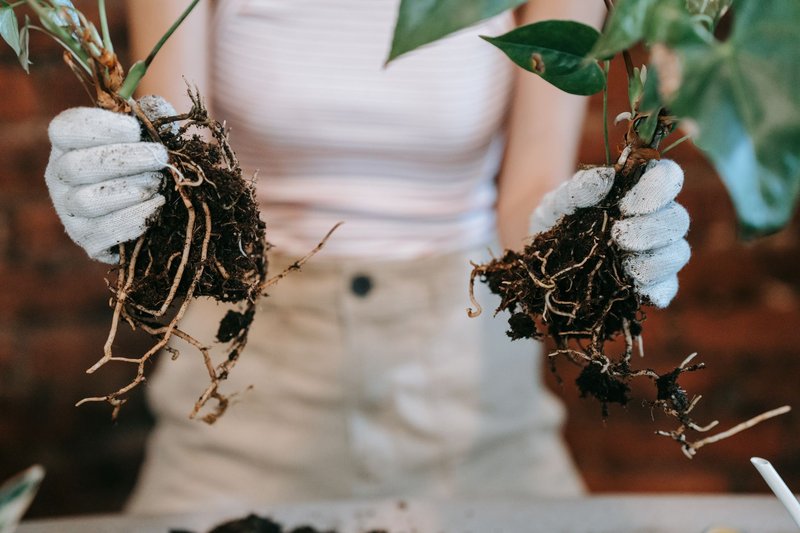
The difference isn’t cosmetic. A taproot anchors deep and reaches water that shallow-rooted plants can’t, which is why a dandelion survives a drought that browns out the grass around it. A fibrous system spreads wide and shallow, gripping a large volume of topsoil — which is exactly why grasses are planted to hold slopes and stop erosion. Same job, two strategies.
Taproot System
A taproot is one thick, central root that grows vertically downward, with thinner lateral roots branching off it like the limbs of an upside-down tree. The main root is clearly the boss; everything else is secondary.
The carrot is the textbook example, and for good reason — the orange part you eat is the taproot, swollen with stored sugars. Beets, radishes, turnips, and parsnips are the same idea: a taproot doing double duty as a pantry. Trees like oaks and pines also begin with taproots, though the system gets more complicated as the tree matures.
What taproots are good at:
- Deep anchorage. A mature oak’s taproot and supporting roots can hold the tree against serious wind loads.
- Reaching deep water. Mesquite roots have been documented extending tens of meters down to tap groundwater, letting the plant survive in desert conditions.
- Storage. Biennial plants like carrots store energy in the taproot during year one and spend it on flowering in year two.
The trade-off: taproots are slow to establish and don’t like being transplanted. Snap the main root and you’ve often crippled the plant.
Fibrous Root System
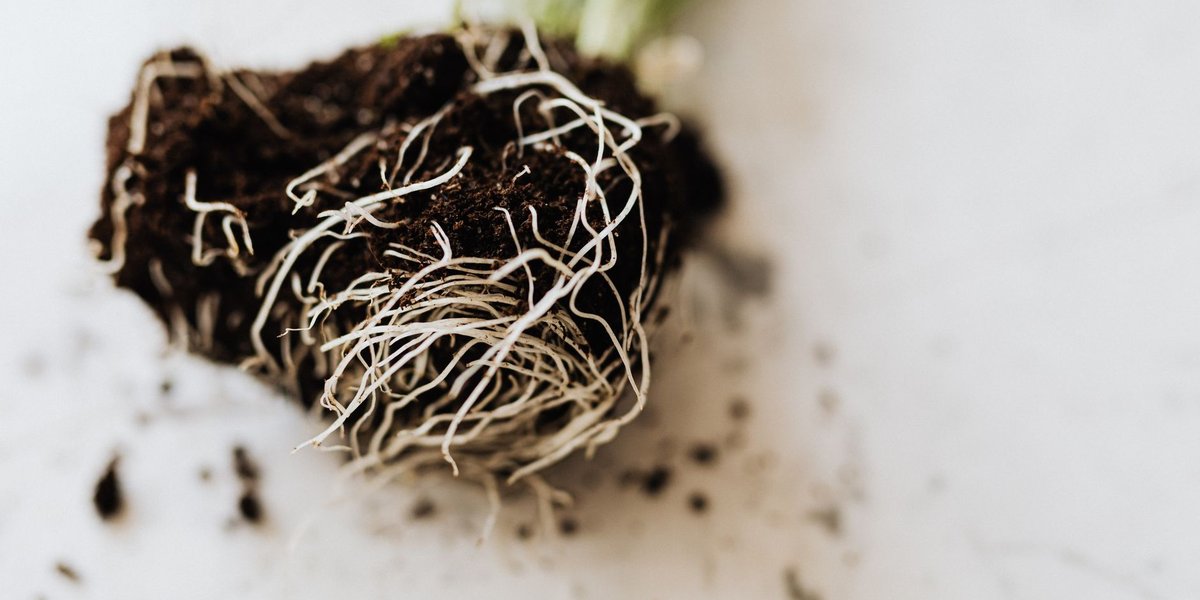
A fibrous system has no single dominant root. Instead, dozens or hundreds of similarly sized roots fan out from the stem base, branching repeatedly into a dense, fuzzy mat that usually stays in the top several inches of soil.
Grasses are the poster child. Pull up a clump of lawn and you’ll see the tangle — a mass so dense it physically binds the soil together. Wheat, rice, corn, and onions all run fibrous systems, as do most ferns and other non-flowering plants that anchor themselves in shallow, moist ground.
The strengths flip the taproot’s weaknesses:
- Erosion control. That dense surface mat is why grass is the default for stabilizing riverbanks, dunes, and roadside slopes. According to the USDA Natural Resources Conservation Service, grass cover is one of the most cost-effective tools for reducing soil loss on farmland.
- Fast water uptake. Shallow, spread-out roots catch light rain before it drains past, which suits plants in regions with frequent small rains.
- Easy transplanting. No single root to damage means seedlings move with less shock.
The catch: fibrous roots can’t reach deep water, so these plants suffer first in a long drought.
Comparison Table: All Root Types at a Glance
| Root Type | Description | Example Plant | Main Function |
|---|---|---|---|
| Taproot | Single thick central root growing straight down | Carrot, oak | Deep anchorage, reaching deep water, storage |
| Fibrous | Many equal-sized roots in a shallow mat | Grass, wheat, corn | Soil binding, fast water uptake |
| Adventitious | Roots from non-root tissue (stems, leaves) | Ivy, sweet potato | Extra support, vegetative propagation |
| Aerial | Roots that grow above ground in the air | Orchid, money plant | Absorb moisture and gases from air |
| Prop / Stilt | Roots from lower stem arching into soil | Maize (corn), banyan | Extra mechanical support |
| Buttress | Wide flared roots flaring at the trunk base | Kapok, rainforest figs | Stability for tall shallow-rooted trees |
| Climbing | Adventitious roots that grip surfaces | English ivy, betel | Anchoring the plant to a support |
| Storage / Tuberous | Swollen roots packed with food | Sweet potato, cassava | Storing starch and water |
| Pneumatophores | Roots growing upward out of waterlogged mud | Mangrove | Taking in oxygen in flooded soil |
| Floating | Spongy, air-filled roots | Water hyacinth | Buoyancy to keep the plant afloat |
Modified and Specialized Roots
This is where roots get strange, and where most articles quit. A modified root is a normal root (or sometimes a stem-derived root) reshaped by evolution to do a non-standard job. Here are the main ones, each with a plant you can actually picture.
Adventitious roots grow from somewhere they’re not “supposed” to — a stem, a node, even a leaf. Snip a section of ivy or a sweet potato vine, stick it in water, and the roots that emerge are adventitious. This trait is the entire basis of taking plant cuttings, and it’s why gardeners can clone a plant without seeds.
Aerial roots hang in open air instead of burrowing into soil. Epiphytic orchids living on tree branches grow them to grab moisture and nutrients straight from the humid air; the common money plant (Epipremnum) does the same. The roots are often coated in a spongy tissue called velamen that soaks up water on contact.
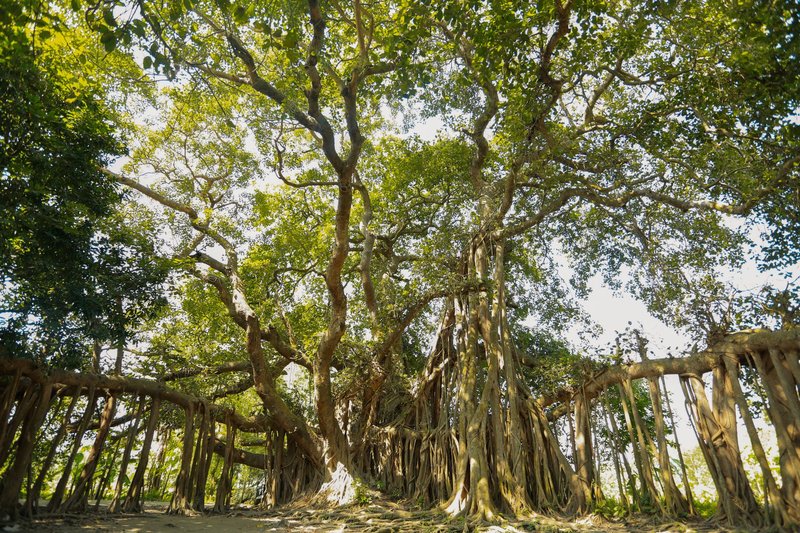
Prop and stilt roots are adventitious roots that arch out from the lower stem and plunge back into the ground, propping the plant up like guy-wires on a tent pole. A corn plant grows a visible whorl of them at its base. The banyan tree takes this to an extreme — its aerial roots descend from horizontal branches, thicken into woody pillars, and over decades a single tree can look like a small forest. The Great Banyan in Kolkata covers more than three acres on the strength of these prop roots.
Buttress roots flare out in tall, thin, plank-like ridges where the trunk meets the ground. They’re common in shallow tropical rainforest soils where a tall tree can’t anchor deep, so it braces wide instead. Kapok trees and many strangler figs show textbook buttresses.
Climbing roots are short adventitious roots that emerge along a stem and cling to walls, bark, or trellises. English ivy climbs this way — those little hold-fasts gripping a brick wall are roots, not tendrils.
Storage (tuberous) roots swell with stored starch and water. The sweet potato is the famous one; cassava and dahlia tubers work the same way. Unlike a potato (which is a modified stem), these are genuinely roots that fattened up into a food bank.
Pneumatophores are the breathing roots of mangroves and a few other swamp plants. Waterlogged mud holds almost no oxygen, so the plant sends pencil-like roots upward, poking above the waterline. Tiny pores on these roots let the submerged root system breathe — a neat fix for living with your feet permanently underwater.
Floating roots are spongy and air-filled, helping aquatic plants like the water hyacinth stay buoyant and upright on the surface of a pond.
Root Anatomy: What a Root Is Made Of
Zoom in on any single root and you’ll find the same layout from tip to base — a tidy assembly line for digging and drinking. Each zone is built from specialized cells, the same kinds of plant tissues — meristematic, vascular, ground, and dermal — that organize the rest of the plant.
- Root cap. A thimble of tough cells covering the very tip. It’s the helmet: it secretes a slick lubricant and sacrifices its outer cells as the root grinds forward through abrasive soil. Cells get scraped off the front and replaced from behind, constantly.
- Zone of cell division (meristem). Just behind the cap, this is the engine room where new cells are manufactured by rapid division. All downstream growth starts here.
- Zone of elongation. A little further back, the freshly made cells stretch lengthwise, and that stretching is what physically pushes the root tip deeper into the ground.
- Zone of maturation (root hairs). Here the cells specialize and the root grows its root hairs — single-cell extensions that explode the root’s surface area. They’re the part that does most of the actual water and mineral absorption, which is why disturbing them during transplanting sets a plant back so badly. According to Britannica, root hairs are short-lived and continually replaced as the root extends into fresh soil.
Understanding this is the practical payoff of the whole topic: when you transplant a seedling and it wilts, you damaged the root hairs near the tip, and the plant is temporarily struggling to drink until it grows new ones.
Frequently Asked Questions
What are the two main types of plant roots? The taproot system (one thick central root with smaller branches, like a carrot) and the fibrous root system (many equal-sized roots in a shallow mat, like grass). Dicots typically grow taproots; monocots typically grow fibrous systems.
What is the difference between a taproot and a fibrous root? A taproot has one dominant root growing deep, giving strong anchorage and access to deep water. A fibrous system has no main root — instead many similar roots spread wide and shallow, gripping topsoil and absorbing water quickly. Carrots and oaks use taproots; grasses, wheat, and corn use fibrous roots.
What are modified roots, with examples? Modified roots are reshaped to do special jobs: adventitious roots (ivy cuttings), aerial roots (orchids), prop/stilt roots (corn, banyan), buttress roots (kapok), climbing roots (English ivy), storage roots (sweet potato), pneumatophores or breathing roots (mangrove), and floating roots (water hyacinth).
Is a potato a root? No. A potato is a modified stem called a tuber, identifiable by its “eyes,” which are buds. A sweet potato, by contrast, is a true storage root. They look similar but come from different plant parts.
What is the main function of roots? Four core jobs: anchoring the plant in place, absorbing water and dissolved minerals, storing food, and conducting those resources up to the stem. Modified roots add extra duties like extra support, climbing, or breathing in oxygen-poor soil.
Which roots absorb the most water? Root hairs do most of the absorbing — tiny single-cell extensions in the zone of maturation just behind the root tip. They massively increase surface area, and they’re the part most easily damaged during transplanting.