
Nigeria gets talked about for a lot of things. Its endemic wildlife rarely makes the list. That’s a problem, because the country sits at the intersection of two of Africa’s major biomes — the Guinea-Congo rainforest to the south and the Sudan-Guinea savanna to the north — and that overlap has produced species you won’t find anywhere else on the planet.
The current count runs to roughly 8 endemic mammals, 4–5 endemic birds, around 5 endemic reptiles, 19–24 endemic freshwater fish, and upward of 91 endemic plant species. That’s a conservative tally. Taxonomic revisions keep nudging it higher.
Most lists stop at naming those species. This one doesn’t. Below is a breakdown of what makes each group distinctive, where the hotspots are, and what’s actually threatening these organisms — because most of them are in serious trouble.
Table of Contents
- Why Nigeria Has Endemics at All
- Endemic Mammals
- Endemic Birds
- Endemic Reptiles
- Endemic Freshwater Fish
- Endemic Plants
- Species Count Summary
- Where the Biodiversity Concentrates
- Conservation Status
Why Nigeria Has Endemics at All {#why-nigeria-has-endemics}
Endemism doesn’t happen randomly. It requires geographic or ecological isolation long enough for populations to diverge into distinct species. Nigeria has several mechanisms that drove this.
The Jos Plateau rises to over 1,700 meters in north-central Nigeria, creating a highland “island” surrounded by lowland savanna. Species that colonized the plateau got cut off from their lowland relatives. Over millennia, they became something new — the Jos Plateau Indigobird being the textbook case.
The Niger Delta is the opposite situation: a vast, low-lying maze of river channels, mangroves, and seasonally flooded forest. The hydrological complexity isolates fish populations in ways that a simple riverbank can’t. That’s why the freshwater fish endemism count is so high relative to other groups.
Cross River State in the southeast holds the largest remaining block of lowland rainforest in Nigeria. It’s geographically continuous with Cameroon’s forests, but historical climate fluctuations created refugia — pockets where forest-dependent species survived dry periods and diverged from populations elsewhere. Several of Nigeria’s endemic primates and plants are concentrated there.
Endemic Mammals {#endemic-mammals}
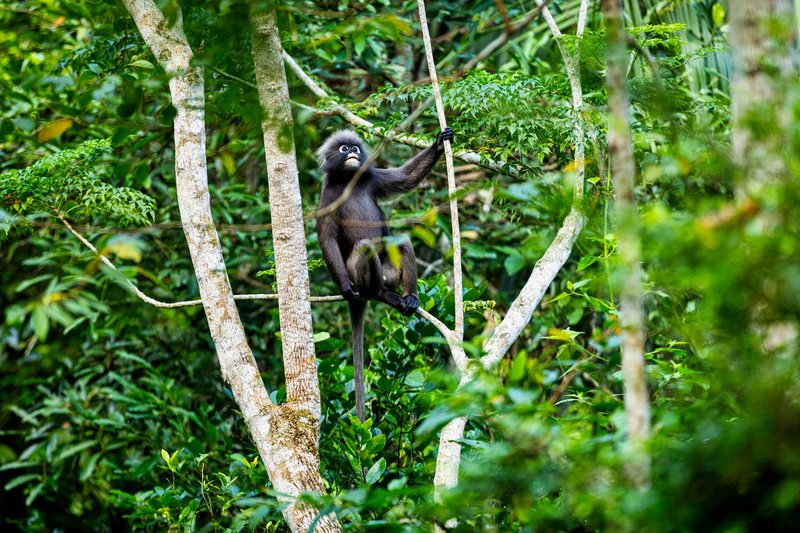
Nigeria has approximately 8 mammal species considered endemic or near-endemic, most of them primates.
Sclater’s Guenon (Cercopithecus sclateri) is one of the more striking examples. This small monkey was formally described in 1904 but wasn’t rediscovered alive in the wild until 1988. It’s restricted to forest fragments south of the Niger River in southeastern Nigeria — a range measured in hundreds of square kilometers, not thousands. It’s listed as Vulnerable on the IUCN Red List, with habitat loss from logging and subsistence farming as the main pressures.
The Niger Delta red colobus (Piliocolobus epieni) has a worse situation. Once considered a subspecies, it’s now classified as a full species endemic to the Niger Delta’s freshwater swamp forests. Hunting pressure and the near-total destruction of its swamp forest habitat have pushed it to Critically Endangered. Some surveys have found it in only a handful of locations.
Preuss’s Red Colobus (Piliocolobus preussi) straddles the Nigeria-Cameroon border, with the Nigerian population concentrated in Cross River National Park. The IUCN classifies it as Critically Endangered, citing fewer than 5,000 individuals remaining.
Other endemic or near-endemic mammals include the Russet-eared Guenon and several small rodent species in the montane zones of the Jos Plateau and Obudu Plateau.
Endemic Birds {#endemic-birds}
Nigeria’s endemic bird list is short — four to five species depending on how you count near-endemics — but each one is distinctly tied to a specific Nigerian landscape.
The Ibadan Malimbe (Malimbus ibadanensis) is confined to a small patch of forest near Ibadan in southwestern Nigeria, one of the most fragmented and degraded forest zones in the country. It’s Endangered. Its entire global range fits inside a few scattered forest remnants in and around a city of several million people. The species was first described in 1951, and ornithologists continue to debate whether any truly intact habitat remains for it.
The Jos Plateau Indigobird (Vidua maryae) is the highland isolation example in bird form. Indigobirds are brood parasites — they lay their eggs in the nests of specific finch hosts — and each indigobird species typically specializes on a single host. The Jos Plateau population became isolated from lowland relatives, evolved to parasitize a different local finch host, and became a separate species. Its range is the Jos Plateau. Nowhere else.
Anambra Waxbill (Estrilda poliopareia) is restricted to the lower Niger floodplain. It’s Near Threatened, with numbers declining as seasonal floodplain vegetation gets converted to agriculture.
Endemic Reptiles {#endemic-reptiles}
Nigeria’s reptile endemics are less studied than its mammals and birds, but the five or so recognized endemic species cluster in recognizable patterns: forest reptiles in Cross River and the southeast, and montane species on the plateau systems.
Perret’s Toad-headed Agama (Agama pater) is one of the better-documented endemic lizards, found in the rocky outcrops of central Nigeria. Rock-dwelling lizards make good candidates for endemism — they can’t cross unsuitable terrain between rocky patches, and Nigeria’s central plateau outcrops are geologically isolated from similar habitats elsewhere.
Several skink and chameleon species have restricted ranges centered on Cross River State, though taxonomic work is still ongoing for some lineages. The lack of herpetological surveys in many parts of Nigeria means the true reptile endemism count is probably an underestimate.
Endemic Freshwater Fish {#endemic-freshwater-fish}
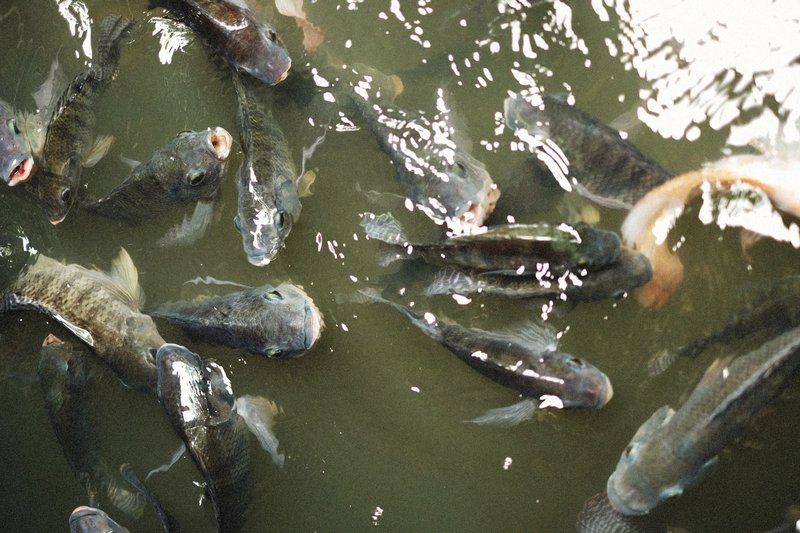
The freshwater fish list is where Nigeria’s endemism count gets genuinely striking: 19–24 recognized endemic species, with researchers regularly adding more as molecular tools reveal what morphology alone missed.
The Niger and Cross River systems dominate the distribution. The Cross River has an unusually high proportion of endemic cichlids and mormyrids — the electric fish family, whose weak electric organ discharges are species-specific enough to act almost like fingerprints.
Tilapia cameronensis (now reclassified within Coptodon) and several other cichlid species occupy specific rapids and pools within the Cross River catchment. Rapids-dwelling fish are classic endemics: the fast water isolates populations above and below each cascade, and differentiation follows.
Mormyrids in the Niger Delta face a different threat. Artisanal fishing pressure in the Delta is intense, and several species have extremely limited distributions — a single river segment, sometimes less. They’re poorly monitored because freshwater fish survey work in Nigeria is chronically underfunded.
Endemic Plants {#endemic-plants}
The plant endemism count — roughly 91 species — dwarfs all the animal groups combined. That’s not unusual globally; plants tend to show higher rates of endemism because their dispersal mechanisms are often more limited than those of mobile animals.
Most of Nigeria’s endemic plants are in two zones: the Cross River rainforest block and the montane zones of the southeastern highlands (Obudu, Mambilla, Oban). These are the same refugia that sheltered forest species during Pleistocene dry periods.
Cross River National Park protects the single largest concentration. The park holds several endemic tree species in families like Leguminosae and Rubiaceae, along with endemic orchids and ferns. Some of these haven’t been collected since their original description in the early 20th century — which either means they’re extremely rare or that botanists simply haven’t gotten back to those forest patches.
The Jos Plateau adds a separate cluster of endemic montane plants — grasses, composites, and herbaceous species adapted to the plateau’s cooler, wetter microclimate. These are isolated from similar montane vegetation elsewhere in West Africa by hundreds of kilometers of lowland terrain.
Species Count Summary {#species-count-summary}
| Group | Approx. Endemic Species | Key Hotspot |
|---|---|---|
| Mammals | ~8 | Cross River, Niger Delta |
| Birds | 4–5 | Jos Plateau, Ibadan forest, Niger floodplain |
| Reptiles | ~5 | Cross River, central plateau outcrops |
| Freshwater fish | 19–24 | Cross River, Niger Delta |
| Plants | ~91 | Cross River NP, Obudu Plateau, Jos Plateau |
| Total | ~130–140+ |
Where the Biodiversity Concentrates {#where-the-biodiversity-concentrates}
Three geographic zones account for the bulk of Nigeria’s endemic species.
Cross River National Park is the most biodiverse area in Nigeria by almost any measure. It protects roughly 4,000 km² of lowland and montane rainforest along the Cameroon border. In addition to its endemic plants and primates, it’s one of the last Nigerian refuges for gorillas and chimpanzees. The park is split into two sectors — Oban and Okwangwo — with a degraded corridor between them that conservationists have been trying to restore for decades.
The Jos Plateau functions as a biological island in the center of the country. Its 1,200–1,700 m elevation creates a temperature and precipitation regime unlike the surrounding savannas, and that distinctiveness has filtered in species from both northern and southern lineages while producing its own endemics.
The Niger Delta is a case study in how high biodiversity and high human pressure can occupy the same space. The Delta’s endemic fish and the Critically Endangered Niger Delta red colobus coexist with oil infrastructure, intensive fishing, and agricultural encroachment. Delta forest cover has declined sharply since the mid-20th century.
Conservation Status {#conservation-status}
The picture across all groups is not good. Most of Nigeria’s endemic species are listed as Vulnerable, Endangered, or Critically Endangered by the IUCN. The main threats are consistent: deforestation for agriculture and timber, bushmeat hunting, freshwater pollution and overfishing, and the fragmentation of remaining habitat into patches too small to sustain viable populations.
Nigeria lost an estimated 35–40% of its forest cover between 1990 and 2015. The country now has one of the highest deforestation rates in Africa by absolute area. That trajectory directly compresses the ranges of species that already had nowhere else to go.
Protected areas exist — Cross River National Park, Gashaka-Gumti National Park, Okomu National Park — but enforcement is resource-constrained, and many critical habitat patches fall outside park boundaries entirely.
The freshwater endemics are the least protected of any group. Nigeria has no freshwater-specific protected areas, and endemic fish species outside the Cross River catchment have essentially no formal protection at all.
What Nigeria has going for it is scientific attention. Taxonomic work on its primates, birds, and fish has accelerated in the past two decades, and international conservation organizations have maintained a presence in Cross River State. That’s not nothing. Named species with known ranges can at least be argued for at the policy level. Unnamed ones can’t.