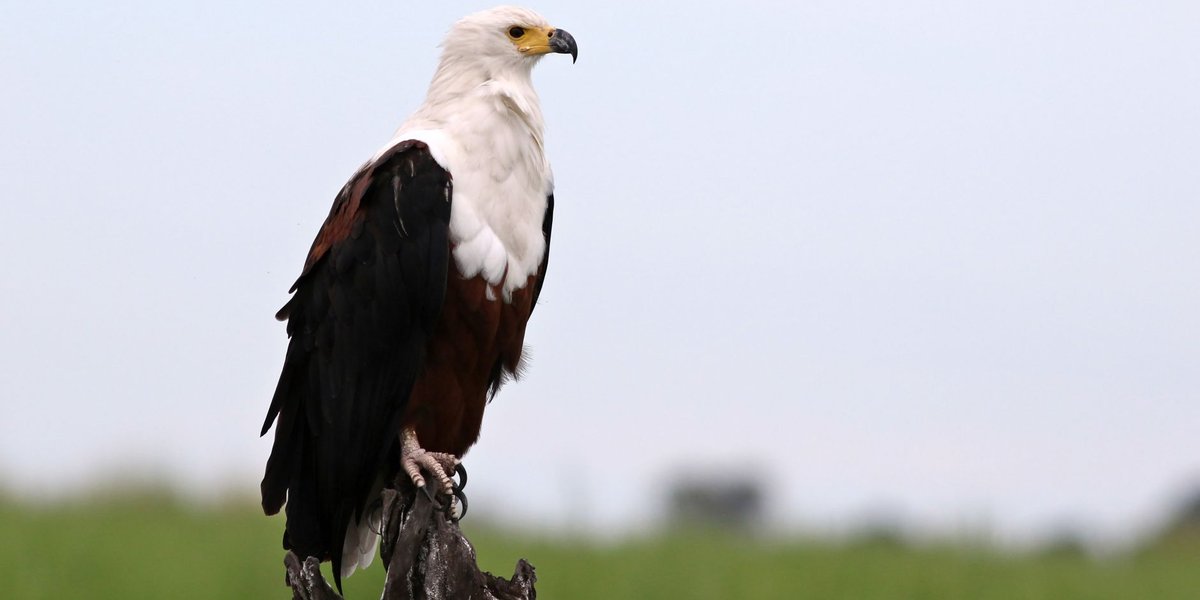
Nigeria has somewhere around 940 to 975 bird species depending on whose checklist you trust, and exactly one of them lives nowhere else on Earth. That’s the headline most lists bury under a wall of scientific names. The birds of Nigeria span everything from the Black Crowned Crane standing in the Sahel to fish eagles screaming over the Niger Delta, and a single drab weaver outside Ibadan that ornithologists spent decades worrying had gone extinct.
This is the part of the country’s wildlife story that rarely gets told well. The encyclopedic lists give you taxonomy and not much else. What you actually want to know is which birds matter, what makes them special, and where and when you can stand in a field and see one. So that’s how this is organized.
Table of Contents
- The quick numbers
- Nigeria’s national bird
- Six birds worth knowing
- Where to go birding in Nigeria
- Best time to visit
- Beginner identification tips
- The takeaway
The quick numbers
A few facts to anchor everything else:
- ~940–975 species recorded in the country, the spread depending on how a given authority handles vagrants and unconfirmed sightings.
- One true endemic: the Ibadan Malimbe, found in a narrow band of southwestern forest and nowhere else.
- National bird: the Black Crowned Crane, not the eagle people assume from the coat of arms.
- Roughly 20+ globally threatened species, including the Critically Endangered hooded vulture, whose population has collapsed across West Africa.
Nigeria’s range count is high for a reason. The country stacks four major habitat zones from south to north — coastal mangrove and rainforest, the Guinea savanna belt, the drier Sudan savanna, and the Sahel scrub bleeding toward the Sahara. Each zone has its own bird community, and the migratory species passing through in winter pad the list further.
Nigeria’s national bird
People guess the eagle. The bird on the national coat of arms is an eagle, and the football team is the Super Eagles, so the confusion is fair. But the official national bird of Nigeria is the Black Crowned Crane (Balearica pavonina).
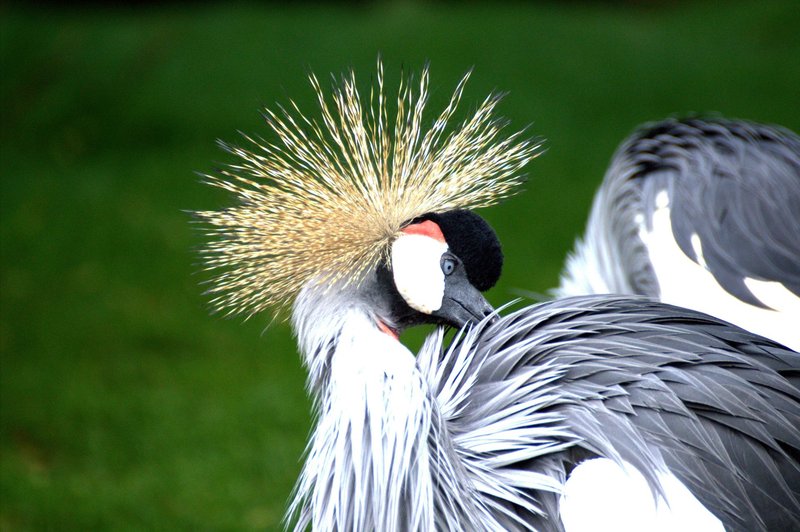
It’s a stunner — slate-grey body, white wing panels, a red throat wattle, and a spray of stiff golden feathers fanning off the back of its head like a crown. It feeds in wetlands and wet grasslands across the north, often in pairs or small flocks, stamping the ground to flush insects. The cruel irony is that the national bird is in trouble. Habitat drainage and capture for the pet trade have pushed it onto the threatened list, and you’re far more likely to see one in the northern wetlands than anywhere near a city.
Six birds worth knowing
You can’t profile 940 species, and you wouldn’t want to read it. These six tell you most of what makes Nigerian birdlife distinctive — the endemic, the near-endemics, and the icons.
1. Ibadan Malimbe
The only bird found in Nigeria and nowhere else. The Ibadan Malimbe (Malimbus ibadanensis) is a black weaver with a blood-red head and chest, restricted to a small patch of forest and farmland around Ibadan and Ife in the southwest. It was described in 1958, then went largely unseen for years as its forest got cleared, and it’s now classified as Endangered. Estimates put the population in the low thousands at most. If you see one, you’re looking at a bird with a global range smaller than some city parks — and one of a surprisingly short list of species found only in Nigeria, which spans more than just birds.
2. Rock Firefinch
A near-endemic that’s effectively a Nigerian specialty. The Rock Firefinch (Lagonosticta sanguinodorsalis) wasn’t even described until 1998, found on the rocky outcrops of the Jos Plateau. The male is a soft pink-red with a grey crown and fine white spotting on the flanks. It has a strange life history: it’s the primary host for the Jos Plateau Indigobird, a brood parasite that lays its eggs in the firefinch’s nest and mimics its song. Birders come to Jos specifically for this pair.
3. Anambra Waxbill
Another near-endemic, scarce and localized. The Anambra Waxbill (Estrilda poliopareia) lives in tall grass and reedbeds along the lower Niger and in the Niger Delta. It’s a quiet, buff-and-grey finch with a reddish rump, and it’s one of the harder targets on a Nigerian list precisely because its wet-grassland habitat is being squeezed. It’s listed as Vulnerable.
4. African Fish Eagle
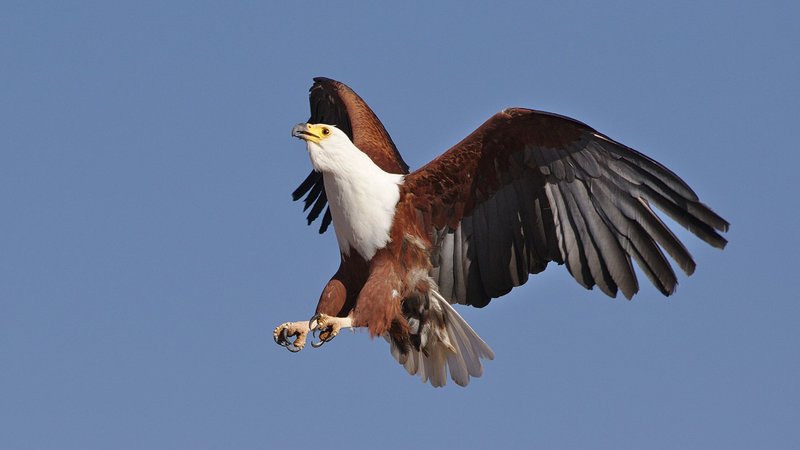
The sound of African waterways. The African Fish Eagle (Haliaeetus vocifer) has a white head and chest, chestnut body, and a yelping call that carries for miles across a lagoon. In Nigeria you’ll find it over the Niger Delta, large rivers, and reservoirs, where it snatches fish off the surface or pirates catches from other birds. It’s the species most people picture when they imagine an African eagle, and it’s common enough that a Delta boat trip almost guarantees one.
5. Black Crowned Crane
Covered above as the national bird, but it earns a place on any “must-see” list on its own merits. The northern wetlands — Hadejia-Nguru in particular — are your best bet.
6. Hooded Vulture
The cautionary tale. The Hooded Vulture (Necrosyrtes monachus) was once the ubiquitous urban scavenger across West African towns, picking through markets and abattoirs. It’s now Critically Endangered, hammered by poisoning and the trade in body parts. Seeing a healthy group is no longer guaranteed, which is exactly why it belongs on the list — it’s a snapshot of a population in freefall, and a reason birders should support local conservation work.
Where to go birding in Nigeria
Nigeria isn’t a polished safari destination, and that’s part of the appeal — the sites are wild and the lists are long. Four regions do most of the heavy lifting.
Gashaka-Gumti National Park (Taraba/Adamawa) is the country’s largest national park and its best forest-and-montane birding, climbing from lowland forest to highland grassland. It holds species you won’t get elsewhere in Nigeria and remains gloriously under-visited.
Cross River National Park (Cross River State) protects some of West Africa’s last intact rainforest, dense with forest specialists — hornbills, greenbuls, and the kind of canopy birds that take patience to spot.
Hadejia-Nguru Wetlands (Yobe/Jigawa) is the northern jewel: a Ramsar-listed wetland that floods seasonally and pulls in thousands of waterbirds and Palearctic migrants, cranes and waders among them.
Jos Plateau (Plateau State) is the cool, rocky highland that delivers the Rock Firefinch, the Jos Plateau Indigobird, and other plateau specialties in a compact, accessible area.
The Amurum Forest Reserve near Jos, run as a research and conservation site, is the most birder-friendly base of the lot if you want guides and infrastructure.
Best time to visit
The window that matters is November through February — the dry season, and the heart of the Palearctic winter when European and Asian migrants flood in. The Hadejia-Nguru wetlands peak for waterbirds in this stretch, roads in the north and east are passable, and the vegetation has thinned enough to actually see what’s calling.
Avoid the wet season (roughly June to September) for serious birding. Tracks turn to mud, especially around Gashaka-Gumti and the Delta, and forest visibility drops. The trade-off is that the wet months are when breeding plumage and song peak, so resident-bird specialists sometimes go anyway and accept the logistics.
Beginner identification tips
You don’t need to memorize 940 species to start. A few shortcuts get you a long way:
- Use habitat as your first filter. A finch in northern reedbeds, a hornbill in southern rainforest, a crane in a flooded wetland — where you are narrows the candidates faster than any field mark.
- Learn the families, not every species. Weavers, sunbirds, hornbills, bee-eaters, and firefinches cover a huge share of what you’ll see. Nail the family and the field guide does the rest.
- Watch the rump and the head. On the small finches and weavers — malimbes, waxbills, firefinches — red on the head or rump is often the diagnostic clue.
- Carry one good regional guide. Birds of Western Africa (Borrow & Demey) is the standard reference and covers Nigeria thoroughly.
- Hire a local guide for the specialties. The Rock Firefinch or Ibadan Malimbe is far easier to find with someone who knows the exact field than with a map and hope.
The takeaway
The birds of Nigeria reward effort more than almost any list of numbers can convey. You get one bird on Earth found nowhere else — the Ibadan Malimbe — a near-mythical firefinch on the Jos rocks, a national crane that needs help, and four habitat zones stacked into one country. Come in the dry season, pick a region rather than trying to see everything, and let the habitat tell you what you’re looking at. The encyclopedic checklists will still be there when you get home to tick off what you found.