Halide minerals are the ones that form when a halogen — fluorine, chlorine, bromine, or iodine — bonds with a metal to make a simple salt. That’s the whole class in one sentence. Table salt (halite) is the poster child, but the group runs from the salt on your fries to the mineral that made aluminum smelting possible.
They tend to be soft, they often taste salty (geologists do lick rocks), and many of them dissolve in water, which is why you find them in dried-up lakes and evaporite basins rather than washed out to sea. A handful form in stranger places: volcanic vents, silver deposits weathering in the desert, hydrothermal veins.
Here are twelve worth knowing, grouped by how they’re built and where they come from. Each entry has the formula, the physical traits you’d use to spot one, and what it’s actually good for.
Table of Contents
- Quick reference table
- The common anhydrous halides
- 1. Halite (NaCl)
- 2. Sylvite (KCl)
- 3. Fluorite (CaF₂)
- 4. Chlorargyrite (AgCl)
- 5. Sal ammoniac (NH₄Cl)
- The double salts
- 6. Cryolite (Na₃AlF₆)
- 7. Carnallite (KMgCl₃·6H₂O)
- The hydrous and hydroxyl-halides
- 8. Atacamite (Cu₂Cl(OH)₃)
- 9. Boleite (a lead-copper-silver chloride)
- The rarer collector species
- 10. Villiaumite (NaF)
- 11. Bischofite (MgCl₂·6H₂O)
- 12. Fluorapophyllite… no — matlockite (PbFCl)
- How halide minerals form
- Halides vs. the minerals people confuse them with
Quick reference table
| Mineral | Formula | Crystal system | Hardness | Main use |
|---|---|---|---|---|
| Halite | NaCl | Isometric (cubic) | 2–2.5 | Table/road salt, chemical feedstock |
| Sylvite | KCl | Isometric | 2 | Potash fertilizer |
| Fluorite | CaF₂ | Isometric | 4 | Hydrofluoric acid, steel flux, optics |
| Chlorargyrite | AgCl | Isometric | 1.5–2.5 | Silver ore |
| Sal ammoniac | NH₄Cl | Isometric | 1–2 | Historical flux, batteries |
| Cryolite | Na₃AlF₆ | Monoclinic | 2.5–3 | Aluminum smelting flux |
| Carnallite | KMgCl₃·6H₂O | Orthorhombic | 2.5 | Potassium & magnesium source |
| Atacamite | Cu₂Cl(OH)₃ | Orthorhombic | 3–3.5 | Copper ore, pigment |
| Boleite | Pb₂₆Ag₉Cu₂₄Cl₆₂(OH)₄₈ | Isometric | 3–3.5 | Collector specimen |
| Villiaumite | NaF | Isometric | 2–2.5 | Collector / research |
| Bischofite | MgCl₂·6H₂O | Monoclinic | 1–2 | Magnesium, de-icing, bath salts |
| Matlockite | PbFCl | Tetragonal | 2.5–3 | Collector specimen |
The common anhydrous halides
These are the “no water in the crystal structure” halides — a metal locked directly to a halogen. They’re the ones any broad survey of mineralogy covers first because they’re abundant, economically huge, and easy to identify.
1. Halite (NaCl)
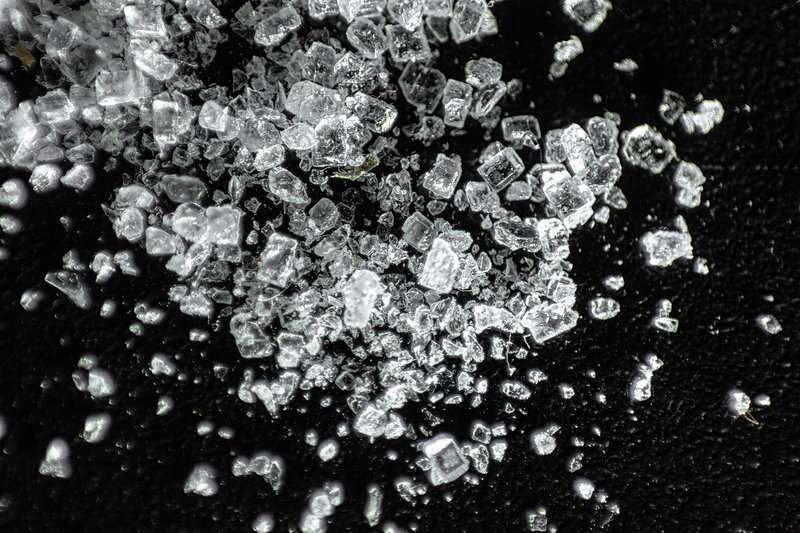
Rock salt. The most familiar mineral on this list and the reason the whole class exists in the public imagination. Halite crystallizes in perfect cubes — the cleavage is so clean it breaks into little cubic fragments when you tap it — and it’s built from sodium and chloride ions alternating in a tidy lattice. That cubic habit is your fastest field ID.
It’s soft (2–2.5 on the Mohs scale), usually colorless or white, sometimes tinted blue, purple, or pink by structural defects and trace impurities. It tastes salty because it is salt. Massive halite beds form when ancient seas evaporate, and some are staggering: the Khewra mine in Pakistan and the salt domes under Louisiana and Texas are the same mineral you shake onto fries. Beyond seasoning, halite is the feedstock for chlorine, sodium hydroxide, and soda ash — a big slice of industrial chemistry starts here.
2. Sylvite (KCl)
Sylvite is halite’s potassium twin, and the two look almost identical — both cubic, both soft, both salty. The tell is the taste: sylvite is sharply, bitterly salty in a way that makes you flinch, versus halite’s clean saltiness. (Again, geologists lick rocks. It’s a real diagnostic.)
It’s the world’s primary source of potash fertilizer, which is why Saskatchewan and the Ural Mountains mine it by the megaton. Sylvite forms in the same evaporite sequences as halite but crystallizes later, since potassium chloride stays dissolved longer than sodium chloride. It’s often the last salt to drop out of a drying brine, so you find it capping halite beds.
3. Fluorite (CaF₂)
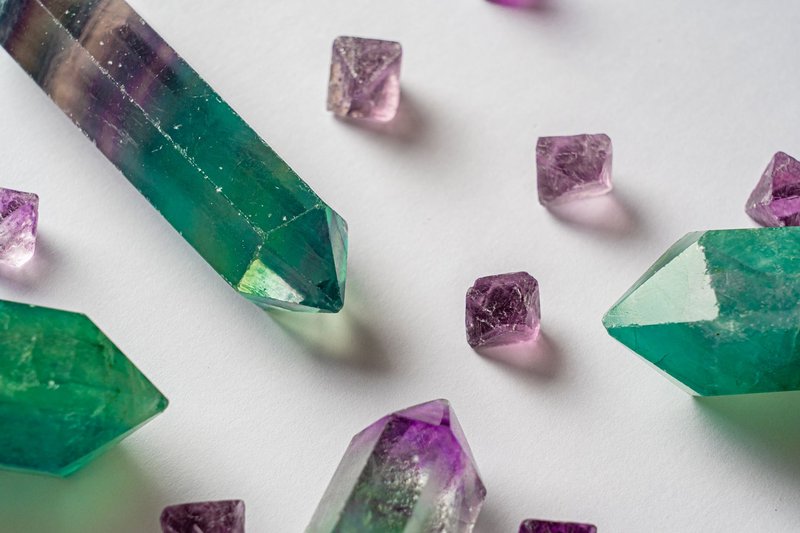
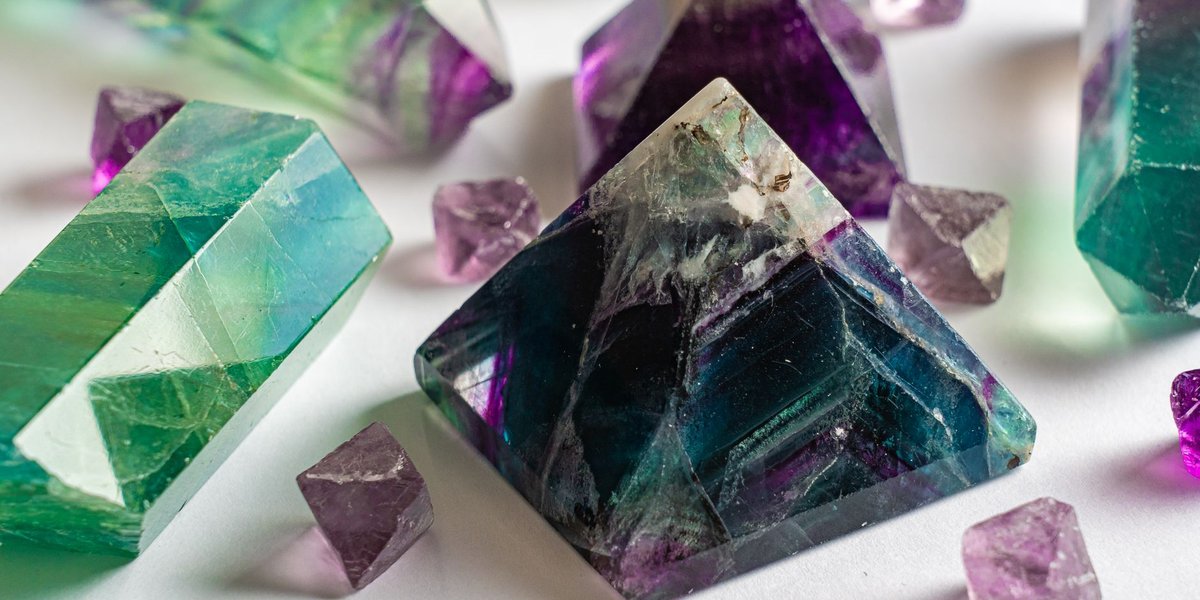
If halite is the useful halide, fluorite is the beautiful one. Calcium fluoride grows in glassy cubes and octahedra in every color a mineral can manage — purple, green, blue, yellow, colorless, sometimes zoned in bands within a single crystal. The Blue John variety from Derbyshire, England, is banded purple and yellow and has been carved into ornaments for centuries.
Fluorite gave us the word “fluorescence” — many specimens glow under UV light, and the phenomenon was first described from this mineral. At hardness 4 it’s the reference point for that number on the Mohs scale. Industrially it’s the raw material for hydrofluoric acid, a flux in steelmaking (the name comes from Latin fluere, “to flow,” because it lowers the melting point of slag), and high-purity crystals go into camera and microscope lenses that fight chromatic aberration.
4. Chlorargyrite (AgCl)
Also called cerargyrite or horn silver, chlorargyrite is silver chloride, and it behaves like nothing else on this list. Fresh specimens are colorless to pale gray, but expose them to light and they darken to violet-brown — the same light sensitivity that made silver halides the foundation of photographic film. It’s soft and sectile, meaning you can carve it with a knife like wax, which is where “horn silver” comes from: it has the translucent, horn-like feel of, well, horn.
It forms in the oxidized upper zones of silver deposits, especially in arid regions like Chile, Mexico, and the American Southwest, where it was a valuable silver ore in the bonanza mining days. Miners would find it as waxy gray crusts and coatings on richer sulfide ores below.
5. Sal ammoniac (NH₄Cl)
Ammonium chloride is the oddball — its “metal” is actually the ammonium ion, a cluster of nitrogen and hydrogen acting like a metal. It’s one of the few halides that forms around volcanic fumaroles and burning coal seams, condensing directly from hot gases as white to yellowish crusts and delicate feathery crystals. Vesuvius and Mount Etna both produce it.
Historically it was a big deal: alchemists prized it, medieval metalworkers used it as a soldering flux (it cleans oxide off metal surfaces so solder bonds), and it later went into dry-cell batteries as the electrolyte. It’s water-soluble and mildly astringent, and it sublimes readily, which is why natural specimens are fragile and don’t last long in humid air.
The double salts
Some halides pack two different metals into one structure, or bind a halogen alongside water molecules. These “double salts” are where the class gets chemically interesting — and where two of the most economically important halides live.
6. Cryolite (Na₃AlF₆)
Cryolite is sodium aluminum fluoride, and it more or less built the modern world by making aluminum cheap. Aluminum oxide melts at over 2,000°C, which is absurdly expensive to reach — but dissolve it in molten cryolite and the melting point drops to around 1,000°C, making electrolytic smelting practical. The Hall-Héroult process that runs every aluminum smelter on earth depends on it.
The name means “ice stone” because its refractive index is so close to water that crushed cryolite nearly vanishes when dropped in a glass. The only significant natural deposit ever mined was at Ivittuut in Greenland, and it was worked so hard that it’s essentially exhausted — industrial cryolite today is synthetic. Natural specimens are colorless to white, greasy-looking, and prized by collectors precisely because the source is gone.
7. Carnallite (KMgCl₃·6H₂O)
Carnallite is a hydrated potassium magnesium chloride, and it’s greedy for water — leave a specimen in open air and it deliquesces, pulling moisture from the atmosphere until it slumps into a puddle. Collectors keep it in sealed containers. It’s typically milky white to reddish (from iron oxide inclusions), with a bitter taste and a greasy feel.
It forms at the very end of marine evaporite sequences, after halite and sylvite have already crystallized out — carnallite drops only when the brine is nearly gone. That makes it both a potassium ore and one of the few natural sources of magnesium chloride. The big deposits are in Germany’s Zechstein basin and the Russian Urals.
The hydrous and hydroxyl-halides
These minerals bind a halogen together with hydroxyl (OH) groups, and they’re mostly weathering products — the colorful crusts that form when metal deposits sit in the open air and slowly react.
8. Atacamite (Cu₂Cl(OH)₃)
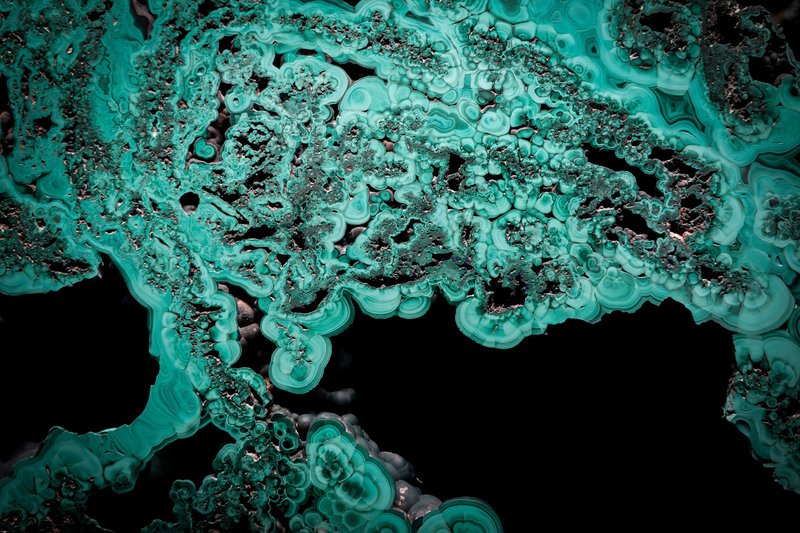
Atacamite is a copper chloride hydroxide, and it’s a deep, vivid green — the same green as weathered copper roofs, because it’s chemically related to what forms on them. It’s named for the Atacama Desert in Chile, where the extreme aridity lets copper deposits weather into chloride minerals instead of the carbonates (malachite, azurite) you’d get in a wetter climate. Which compound wins comes down to what’s around for the copper to react with — chloride here, carbonate in wetter ground, sulfide deeper down.
That’s the interesting part: atacamite is a signature of dry-climate copper weathering. It forms as emerald to blackish-green crystals and crusts on oxidizing copper ores, and it’s been used both as a minor copper ore and as a green pigment. It also turns up in some marine environments and even in the teeth of certain marine worms, which mineralize it for hardness.
9. Boleite (a lead-copper-silver chloride)
Boleite is one of the strangest-looking minerals you’ll ever see: deep indigo-blue cubes with a metallic-adjacent luster, from a complex lead-copper-silver chloride hydroxide. The formula is a monster (Pb₂₆Ag₉Cu₂₄Cl₆₂(OH)₄₈), and it forms where lead-copper deposits react with saline groundwater or seawater, again in arid settings — the type locality is Boleo, near Santa Rosalía in Baja California, Mexico.
Nobody mines boleite for anything. It exists on this list because it’s a textbook example of how exotic a halide can get when you stack three metals and a halogen together, and because those blue cubes are showpieces in any serious mineral collection.
The rarer collector species
The last three won’t show up in most intro courses, but they round out the picture — each shows a different way halides can form.
10. Villiaumite (NaF)
Villiaumite is sodium fluoride, halite’s fluorine cousin, and it’s a startling carmine-red to orange when fresh. It’s rare because it forms only in specific alkaline igneous rocks — nepheline syenites and related bodies in places like the Kola Peninsula of Russia, Mont Saint-Hilaire in Quebec, and Greenland’s Ilímaussaq complex. It’s soluble and slightly toxic (sodium fluoride is the same compound in some water-fluoridation and pesticide contexts), so specimens are kept dry and handled carefully.
11. Bischofite (MgCl₂·6H₂O)
Bischofite is hydrated magnesium chloride, and like carnallite it’s a deliquescent evaporite mineral that won’t survive open air. It’s colorless to white, very soft, and bitter. It forms in the final drops of drying brines and in salt-lake sediments, and it’s harvested as a source of magnesium, a de-icing agent, and — marketed under its mineral name — as a mineral bath salt in Eastern Europe.
12. Matlockite (PbFCl)
Matlockite is lead fluoride chloride, notable for being one of the reference minerals for the whole family of layered “halide” structures that share its pattern. It’s named for Matlock in Derbyshire, England, forms yellowish to greenish tabular crystals with an adamantine (diamond-like) luster from the lead content, and shows up as a weathering product of lead deposits. It’s purely a collector’s mineral, but its crystal structure is important enough that a whole group of minerals is named after it.
How halide minerals form
Three environments produce nearly all the halides above, and knowing which is which is half of identifying an unknown specimen.
Evaporites. When a body of salt water dries up — an inland sea, a closed lake, a lagoon cut off from the ocean — the dissolved salts crystallize in a predictable order as the water shrinks. Least soluble first: gypsum, then halite, then sylvite, then carnallite and bischofite last. This sequence is why potash and rock salt sit in stacked layers, and it’s beautifully documented in classic marine evaporite deposits like the German Zechstein basin. If your halide came from flat, layered beds, it’s an evaporite.
Fumaroles and volcanic vents. Sal ammoniac and some other halides condense straight out of hot volcanic gases, forming crusts around vents on active volcanoes. These are fragile, often fibrous or feathery, and short-lived.
Weathering and hydrothermal alteration. Atacamite, boleite, chlorargyrite, and matlockite form when existing metal deposits (copper, silver, lead) sit in arid climates and react slowly with chloride-rich groundwater. Fluorite is the exception here — it mostly crystallizes from hot hydrothermal veins, growing alongside minerals like quartz, calcite, and galena.
Halides vs. the minerals people confuse them with
Two mix-ups are worth clearing up.
First, “halide minerals” is not the same as “halides” in chemistry class. A chemistry halide is any compound with a halogen (methyl chloride, for instance). A halide mineral is specifically a naturally occurring, crystalline halogen-metal salt. Some study sites blur this line, but for geology purposes only the minerals count.
Second, halides get confused with sulfates because both appear in evaporite deposits. The difference is in the anion: halides are built on a bare halogen ion (Cl⁻, F⁻), while sulfates are built on the SO₄²⁻ group. Gypsum and anhydrite are sulfates that crystallize in the same drying-lake sequence as halite, so they’re neighbors in the rock record, but they’re a different mineral class entirely. A quick check: most common halides are noticeably soft (hardness 2–4) and many are water-soluble, while sulfates like barite are denser and don’t dissolve on your tongue.