Morocco sits on top of roughly 70% of the world’s known phosphate rock, which makes it the single most important country on Earth for the mineral that feeds modern agriculture. That’s the headline economists care about. But pull a tray out at any rock show in Tucson or Munich and you’ll find a different Morocco entirely: blood-red vanadinite crystals stacked like tiny barrels, electric-blue azurite, pink cobaltoan calcite that looks fake until you learn it isn’t.
The minerals in Morocco span both stories, and most articles pick one and ignore the other. The economic pieces never tell you which mine your specimen came from. The collector blogs rarely explain why the geology produced something that gorgeous in the first place. This guide does both, and it ends with the part nobody wants to write: how to not get ripped off when a guy in a Marrakech souk swears the malachite in his hand came out of the ground that way.
Table of Contents
- Why Morocco Produces So Many Minerals
- The Four Mineral Regions
- The Minerals Collectors Actually Chase
- Minerals by Region: Quick Reference
- Buying Moroccan Minerals Without Getting Burned
- The Big Picture
Why Morocco Produces So Many Minerals
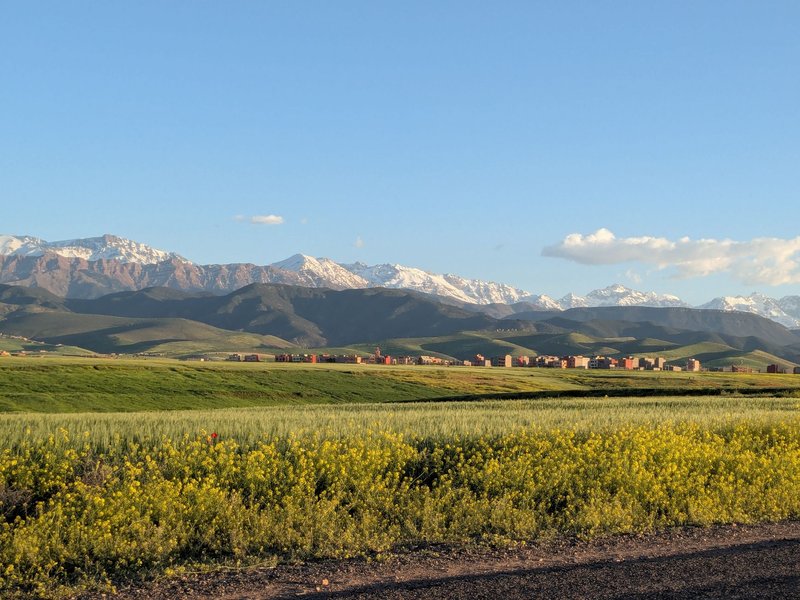
Geology in Morocco is unusually generous, and it comes down to a collision and an ocean that no longer exists.
The Anti-Atlas mountains expose some of the oldest rock in Africa — Precambrian basement more than 2 billion years old — that got shoved up and stripped bare. When ancient rock that old sits near the surface and then gets cooked by later volcanic activity and groundwater, you get hydrothermal veins: cracks where hot, mineral-rich fluids cooled and crystallized into the cobalt, silver, and copper ores Morocco is known for. Many of these are sulfide minerals, the metal-bearing compounds that dominate the country’s hard-rock metal deposits. That’s the engine behind Bou Azzer, one of the only places in the world that mines cobalt as the primary target rather than a nickel by-product.
The phosphate is a separate story altogether. Around 80 million years ago, much of Morocco sat under a shallow sea teeming with life. As marine organisms died and settled, phosphorus accumulated in the sediment over millions of years. Those beds — the Khouribga and Gantour basins — are why Morocco’s state phosphate company, OCP, supplies a huge share of the phosphate rock the USGS tracks globally. Like the metals it mines, phosphate is one of the world’s non-renewable resources — finite reserves laid down over geological time that won’t be replenished on any human scale. One process built the flashy crystals collectors want. The other built the reserves that quietly underpin global fertilizer.
Morocco also leads Africa in silver production and is a major regional source of lead and zinc. The country isn’t a one-trick deposit. It’s several distinct geological systems stacked into one map.
The Four Mineral Regions
If you remember nothing else, remember that Moroccan minerals are regional. A vanadinite and an azurite don’t come from the same place, and a dealer who can’t tell you the locality is either guessing or hiding something.
The Anti-Atlas (south). The mineral heartland. This is Bou Azzer country — cobalt, nickel, arsenic, and the secondary minerals that form when those ores weather: erythrite (cobalt bloom, a vivid magenta), azurite, and malachite. The old rock and hydrothermal veins here are why the south produces the most collectible material.
The High Atlas and Mibladen district (central/east). The lead-zinc belt. Mibladen and the nearby Aouli mines near Midelt are the source of the world’s best vanadinite — the orange-red hexagonal crystals that put Morocco on collectors’ maps. These are old lead-mining areas where vanadinite formed in the oxidized upper zones of the ore. Together, the south and the lead-zinc belt cover most of the metallic ores Morocco is known for, from cobalt and copper to lead and zinc.
The eastern region. Heavy on lead, zinc, and barite, with significant industrial mining around Touissit. Less famous for showpiece crystals, more important for tonnage.
The Rif (north). The least mineralized of the four for collectors, but geologically active and a source of some lead and zinc. It’s the region most shaped by the Africa-Europe plate boundary rather than the ancient basement to the south.
The Minerals Collectors Actually Chase
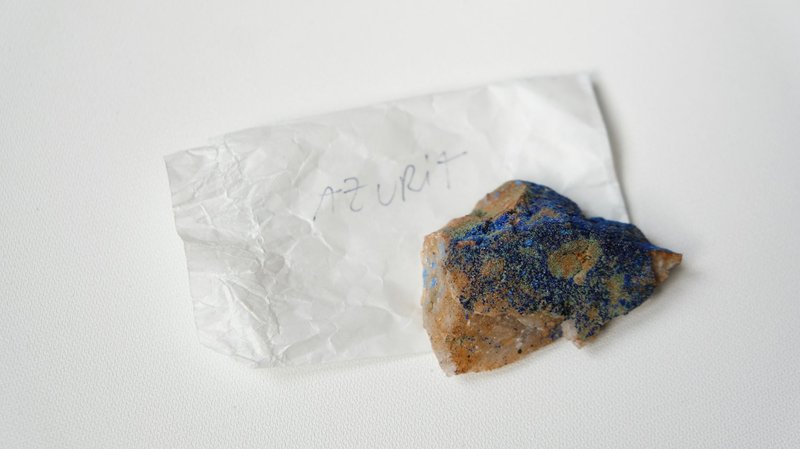
These are the six that show up most in galleries, named with the localities that matter.
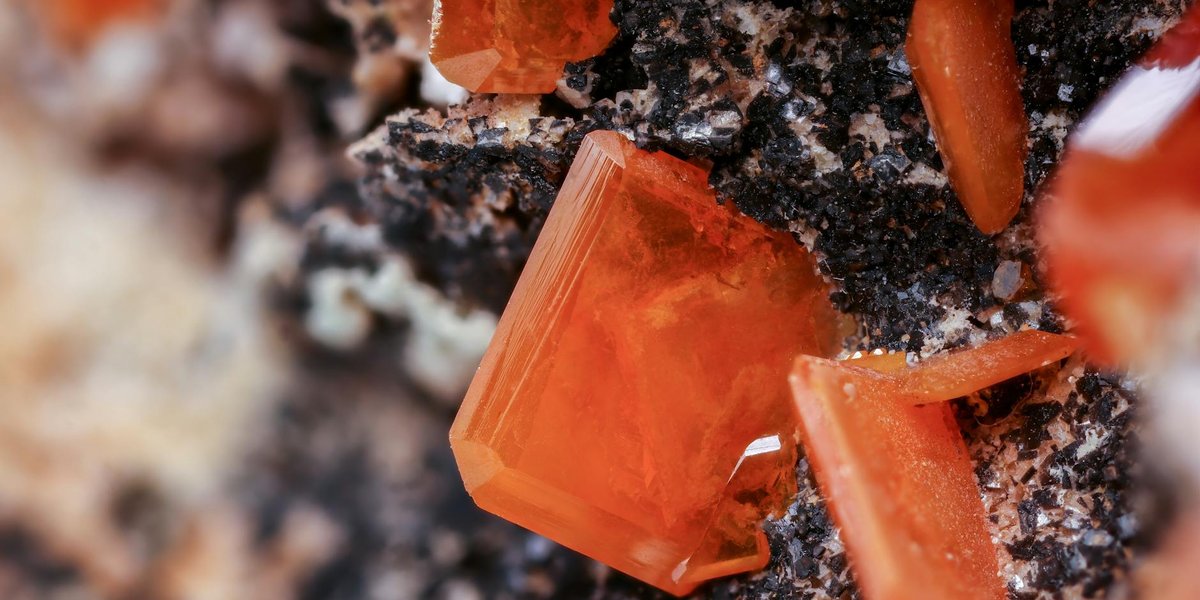
Vanadinite — Mibladen and Aouli. The one Morocco is genuinely famous for among mineralogists. Bright orange-red to brownish-red hexagonal prisms, often perched on a tan matrix, sometimes barrel-shaped with hollow ends. The Mibladen material from the mid-20th century set the global standard, and good plates still command serious money. If someone offers you a “rare Moroccan vanadinite” with no locality, be skeptical — the real ones are almost always tied to Mibladen or Aouli.
Azurite — Bou Azzer and Kerrouchen. Deep, saturated blue, sometimes in sharp crystals, sometimes as crusts that grade into green malachite. Azurite is unstable over geological time and slowly alters to malachite, which is exactly why specimens showing both colors together exist.
Malachite — Anti-Atlas copper zones. The green partner to azurite, banded and botryoidal in its massive form. Moroccan malachite is real, but malachite is also one of the most faked minerals in the souks (more on that below).
Erythrite — Bou Azzer. Cobalt’s calling card. A startling crimson-to-magenta that forms when cobalt arsenide ores weather. Fine erythrite from Bou Azzer is some of the best on the planet, and the bladed sprays of crystals are unmistakable once you’ve seen them.
Cobaltoan calcite — Bou Azzer. Calcite that’s picked up cobalt and turned a soft, candy pink. It looks artificially dyed and isn’t. The Moroccan material is a benchmark for the species, rivaled mostly by deposits in the Democratic Republic of Congo.
Selenite and other gypsum. Clear-to-amber gypsum crystals turn up across several sedimentary areas. Common compared to the showpieces above, which is why selenite is cheap and abundant in tourist markets — and why it’s a useful sanity check on pricing.
Minerals by Region: Quick Reference
| Mineral | Key Locality | Region | Look For | Rarity |
|---|---|---|---|---|
| Vanadinite | Mibladen, Aouli | High Atlas / east | Orange-red hexagonal prisms | High for fine plates |
| Erythrite | Bou Azzer | Anti-Atlas | Magenta bladed sprays | High |
| Cobaltoan calcite | Bou Azzer | Anti-Atlas | Candy-pink calcite | Moderate–high |
| Azurite | Bou Azzer, Kerrouchen | Anti-Atlas | Deep blue, often with green | Moderate |
| Malachite | Copper zones | Anti-Atlas | Banded green, botryoidal | Common (often faked) |
| Selenite / gypsum | Multiple basins | Various | Clear-amber crystals | Common |
Buying Moroccan Minerals Without Getting Burned
This is the part the tourism blogs skip. Morocco has a thriving mineral trade, and a healthy chunk of it is honest. The rest involves “enhancements” that range from harmless to outright fraud. A few hard rules:
Malachite is the most faked mineral in the country. Much of the cheap “malachite” sold in souks is reconstituted powder mixed with resin, pressed into shapes, or dyed glass. Real botryoidal malachite has visible banding when you look at a cut surface, feels cool and heavy, and won’t smell of plastic if you (carefully) touch a hot pin to an inconspicuous spot. Suspiciously uniform green eggs and perfect spheres are a red flag.
Watch for glued and assembled specimens. Loose vanadinite or quartz crystals get glued onto matrix to make a more impressive “natural” cluster. Check the contact points under magnification — natural growth looks integrated; glue leaves a gap, a different luster, or stray crystals at impossible angles.
Dyed quartz and “smoky” geodes. Bright, candy-colored quartz “points” are almost always dyed or coated. Natural amethyst and citrine exist, but the neon stuff doesn’t grow that way.
Ask for the locality and watch the answer. A real dealer will say “Mibladen” or “Bou Azzer” without hesitation. Vagueness is information.
Negotiate, but anchor on reality. Bargaining is expected, and starting offers in tourist areas are routinely inflated several times over. Common selenite and quartz should be cheap. If a “rare” specimen is being pushed hard at a tourist price, the rarity is usually the fiction.
Know the export rules before you buy big. Morocco regulates the export of significant mineral and fossil specimens, and large or museum-grade pieces can require documentation. For anything substantial, buy from established dealers who can handle paperwork rather than a roadside stall, and check current guidance from your destination’s customs authority — the U.S. Fish & Wildlife and CBP import rules are a reasonable starting point for what gets scrutinized at the border.
The Big Picture
Morocco earns its reputation twice over. On the industrial side, its phosphate reserves are a genuine strategic resource the rest of the world depends on for food production. On the collector side, the ancient rock of the Anti-Atlas and the lead veins of Mibladen produced some of the finest vanadinite, erythrite, and cobaltoan calcite anywhere — minerals so saturated in color they look retouched.
The thread connecting both stories is locality. The geology that makes a specimen worth owning is the same geology that lets an honest dealer tell you exactly where it came from. Learn the regions, learn the six minerals worth knowing, and treat any “rare Moroccan find” with no provenance as a souvenir rather than a specimen. Buy on facts, and Morocco’s minerals are one of the best deals in the hobby. Buy on vibes, and you’ll come home with a resin egg.