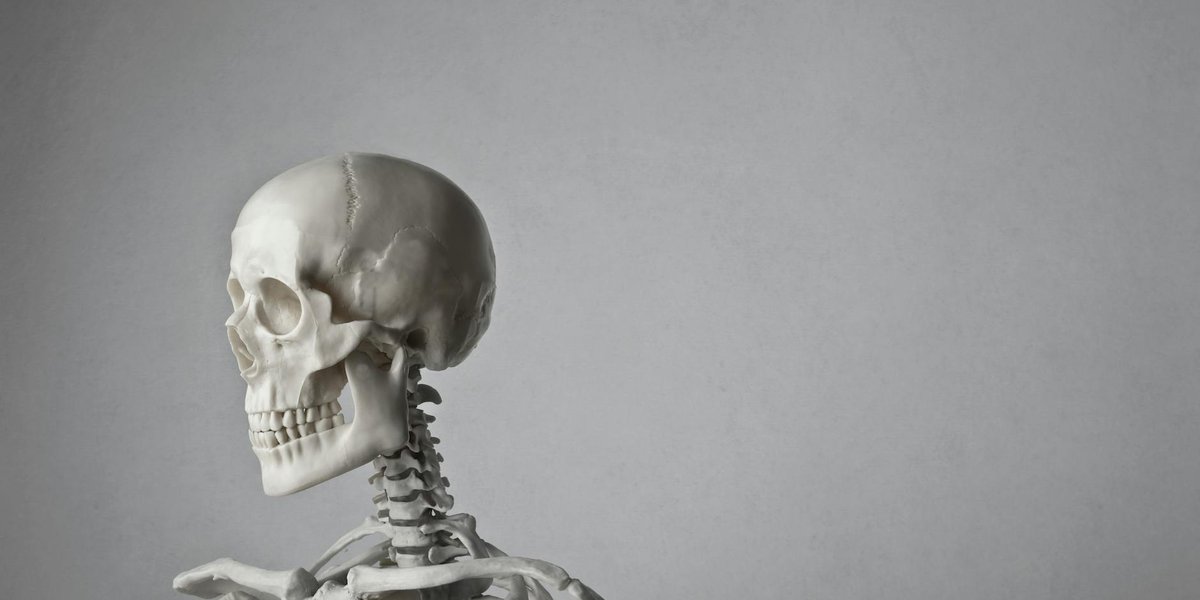
If you came here for the list, here it is: the pubic symphysis, the discs between your vertebrae, the joint where the first rib meets the sternum, the growth plates in a child’s long bones, and the seam at the base of the skull. Those are the cartilaginous joints anatomy courses actually ask you to name.
The trouble with most references is that they bury these examples three paragraphs deep, sandwiched between definitions of “amphiarthrosis” and a wall of text about cartilage histology. You shouldn’t have to mine for a list. So below is the list, sorted by subtype, with a table you can screenshot before an exam.
Table of Contents
- The quick answer
- Synchondroses (hyaline cartilage joints)
- Symphyses (fibrocartilage joints)
- Comparison table
- A mnemonic that sticks
- “Is X a cartilaginous joint?”
- Cartilaginous vs. fibrous vs. synovial
- FAQ
The quick answer {#the-quick-answer}
A cartilaginous joint is one where two bones are united by cartilage — no joint cavity, limited or no movement. There are exactly two structural subtypes, and every example you need belongs to one of them:
Synchondroses — bones joined by hyaline cartilage:
- Epiphyseal (growth) plates in growing long bones
- The first sternocostal joint (rib 1 to the sternum)
- The costochondral joints (each rib to its costal cartilage)
- The spheno-occipital synchondrosis (base of the skull)
Symphyses — bones joined by fibrocartilage:
- The pubic symphysis
- The intervertebral discs (between vertebral bodies)
- The manubriosternal joint (manubrium to body of the sternum)
That’s the whole roster. Everything else below is detail, context, and the reasoning that keeps you from mixing them up.
Synchondroses: the hyaline cartilage joints {#synchondroses}
A synchondrosis uses hyaline cartilage — the same glassy, low-friction cartilage that caps the ends of bones in your knees and shoulders. The key thing exam writers test: many synchondroses are temporary. They exist to allow growth, then ossify and vanish.
Epiphyseal growth plates are the textbook example, and they’re the reason “temporary” matters. While a child’s femur is lengthening, a plate of hyaline cartilage sits between the shaft and the bony end. New cartilage forms on one side and converts to bone on the other, pushing the ends apart. Once growth finishes — usually by the late teens — the plate ossifies completely into an epiphyseal line. The joint is gone. Radiologists use the state of these plates to estimate skeletal age, which is exactly why an open growth plate on an X-ray tells you you’re looking at someone who isn’t done growing.
The first sternocostal joint is the classic permanent synchondrosis. The cartilage of the first rib fuses directly to the manubrium and never ossifies into a movable joint — it stays put for life. Worth memorizing as the contrast case, because the other sternocostal joints (ribs 2 through 7) are actually synovial, not cartilaginous. Anatomy questions love that trap.
Costochondral joints are where each rib’s bony end meets its own bar of costal cartilage. No movement, no cavity, just hyaline cartilage gluing bone to cartilage. There are no muscles or ligaments here — the union is the cartilage.
The spheno-occipital synchondrosis sits at the base of the skull, joining the sphenoid and occipital bones. Like the growth plates, it’s temporary: it contributes to skull-base lengthening through childhood and typically fuses in the late teens to early twenties.
Symphyses: the fibrocartilage joints {#symphyses}
A symphysis swaps hyaline for fibrocartilage — tougher, denser, built to absorb compression and shear. Symphyses are permanent, they sit on the body’s midline, and they allow a small amount of movement. That category of slight mobility has a name worth knowing: amphiarthrosis.
The pubic symphysis joins the two pubic bones at the front of the pelvis with a pad of fibrocartilage. Normally it barely moves. During pregnancy, the hormone relaxin loosens it so the pelvis can widen for birth — a rare case where a joint’s “limited movement” becomes the entire point. Research on pelvic-girdle changes in pregnancy traces a lot of late-term pelvic pain to exactly this loosening.
The intervertebral discs are the example students underrate. Each disc binds one vertebral body to the next, and individually each joint moves very little. Stack 23 of them down the spine, though, and those tiny movements sum into the bend and twist of your whole back. The disc’s outer ring (the anulus fibrosus) is fibrocartilage; the gel center (nucleus pulposus) is what herniates when a disc “slips.”
The manubriosternal joint connects the manubrium to the body of the sternum — the slight ridge you can feel a few centimeters below the notch at the top of your breastbone. It’s a symphysis in most adults, though it can ossify later in life, which is the kind of edge case that shows up in a “best answer” multiple-choice question.
Comparison table {#comparison-table}
| Joint | Subtype | Cartilage type | Movement | Permanent? |
|---|---|---|---|---|
| Epiphyseal growth plate | Synchondrosis | Hyaline | None (synarthrosis) | Temporary |
| First sternocostal joint | Synchondrosis | Hyaline | None (synarthrosis) | Permanent |
| Costochondral joint | Synchondrosis | Hyaline | None (synarthrosis) | Permanent |
| Spheno-occipital | Synchondrosis | Hyaline | None (synarthrosis) | Temporary |
| Pubic symphysis | Symphysis | Fibrocartilage | Slight (amphiarthrosis) | Permanent |
| Intervertebral disc | Symphysis | Fibrocartilage | Slight (amphiarthrosis) | Permanent |
| Manubriosternal joint | Symphysis | Fibrocartilage | Slight (amphiarthrosis) | Permanent |
The two columns that earn you marks: cartilage type (hyaline = synchondrosis, fibrocartilage = symphysis) and location (symphyses live on the midline). Get those two reflexes down and you can place any new example without memorizing it.
A mnemonic that sticks {#mnemonic}
The thing people mix up is which subtype gets which cartilage. Try this:
“S for Symphysis, S for Spine — and the spine takes the strong fibrocartilage.”
The two most-tested symphyses — the spine (intervertebral discs) and the symphysis pubis — both start with S and both use fibrocartilage. Everything left over (ribs, growth plates, skull base) is a synchondrosis with plain hyaline cartilage.
A second anchor: symphyses are midline. Pubic symphysis (dead center of the pelvis), intervertebral discs (down the middle of your back), manubriosternal joint (center of the chest). If the joint is on the body’s centerline, bet on symphysis.
“Is X a cartilaginous joint?” {#is-x-a-cartilaginous-joint}
The most common mistakes, settled:
- The knee? No — synovial. It has a joint cavity, synovial fluid, and a wide range of motion. The cartilage in the knee doesn’t make the joint cartilaginous.
- The skull sutures? No — fibrous (specifically, sutures). Bones joined by dense connective tissue, not cartilage.
- The sacroiliac joint? It’s a hybrid, but classified as synovial — not a symphysis, despite sitting near the midline.
- Ribs 2–7 to the sternum? Synovial. Only the first sternocostal joint is cartilaginous.
- The mandible (jaw)? No — synovial, and one of the more mobile joints in the body.
- The intervertebral discs? Yes — the canonical symphysis. (The vertebrae also meet at small synovial facet joints, but the disc itself is cartilaginous.)
Cartilaginous vs. fibrous vs. synovial {#vs-fibrous-vs-synovial}
Most references explain cartilaginous joints in isolation, which is why students still freeze when a question lists all three side by side. Here’s the contrast that actually resolves it:
| Held together by | Joint cavity? | Movement | Example | |
|---|---|---|---|---|
| Fibrous | Dense connective tissue | No | Little to none | Skull sutures, the tibiofibular ligament joint |
| Cartilaginous | Cartilage (hyaline or fibro) | No | None to slight | Pubic symphysis, growth plates |
| Synovial | A fluid-filled capsule | Yes | Free | Knee, shoulder, hip, jaw |
The single fastest discriminator is the joint cavity. If there’s a fluid-filled space, it’s synovial — full stop. No cavity means it’s either fibrous or cartilaginous, and then you just ask what’s filling the gap: tough connective tissue (fibrous) or cartilage (cartilaginous). The standard joint classifications in open anatomy and physiology coursework all hang on this one structural question.
FAQ {#faq}
What are the two types of cartilaginous joints? Synchondroses (bones joined by hyaline cartilage) and symphyses (bones joined by fibrocartilage).
What is the most common example of a cartilaginous joint? The pubic symphysis and the intervertebral discs are the two most frequently cited. For synchondroses, the epiphyseal growth plate is the standard example.
Where are cartilaginous joints found in the body? Along the spine (intervertebral discs), in the pelvis (pubic symphysis), in the chest (costochondral, first sternocostal, and manubriosternal joints), in growing long bones (growth plates), and at the base of the skull (spheno-occipital synchondrosis).
Is the pubic symphysis a synchondrosis or a symphysis? A symphysis. It uses fibrocartilage and sits on the midline — both signatures of the symphysis subtype.
Do cartilaginous joints move? Barely. Synchondroses are effectively immovable (synarthroses). Symphyses allow slight movement (amphiarthroses) — small at any single joint, but additive across structures like the spine.
Are growth plates permanent? No. Epiphyseal plates are temporary synchondroses that ossify into epiphyseal lines once skeletal growth finishes, usually by the late teens.