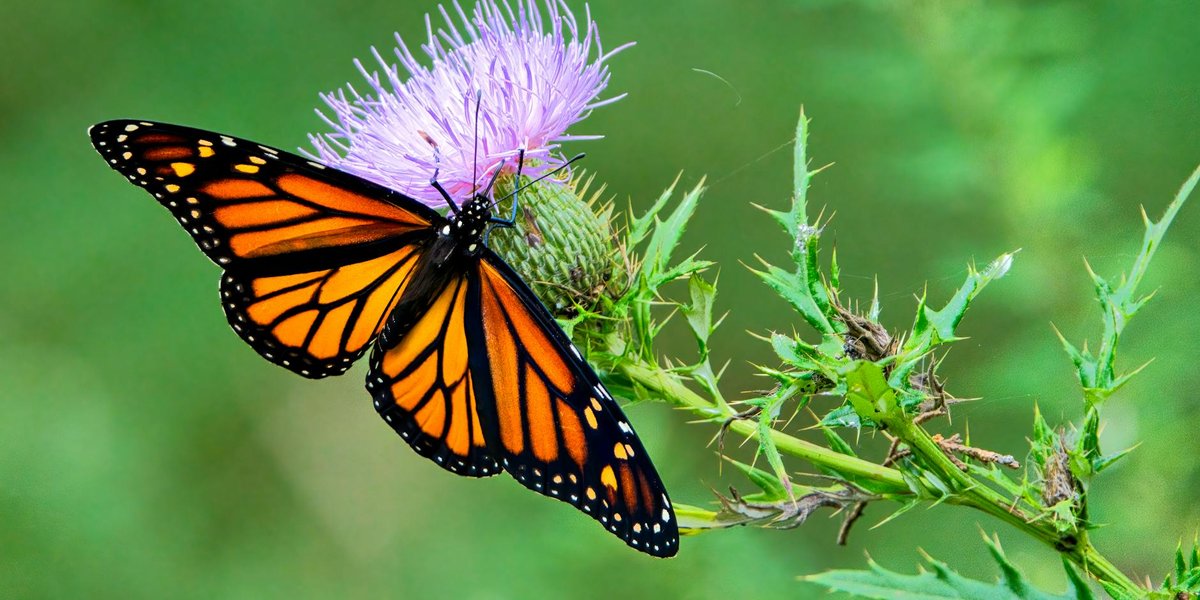
A butterfly weighs about as much as two rose petals, navigates by polarized sunlight, and tastes the world through its feet. Roughly 18,500 species flutter across every continent except Antarctica, and yet most people can confidently name maybe three of them. This guide fixes that.
Butterflies are flying insects in the order Lepidoptera, the same group that includes moths. What sets the group apart is the four-stage transformation every individual goes through and the microscopic scales that tile their wings like roof shingles. Below you’ll find how that transformation works, how to tell a butterfly from a moth in two seconds, how to identify the common ones in your backyard, and how to get more of them to show up.
Table of Contents
- What Exactly Is a Butterfly?
- The Butterfly Life Cycle: Four Stages of Metamorphosis
- Butterfly Anatomy and Those Famous Wing Scales
- Butterfly vs. Moth: How to Tell Them Apart
- How Many Butterflies Are There? Diversity and Habitat
- The Monarch Migration
- What Do Butterflies Eat?
- Common Butterflies: A Quick ID Reference
- How to Attract Butterflies to Your Garden
- Why Butterflies Matter
- Butterfly FAQ
What Exactly Is a Butterfly? {#what-is-a-butterfly}
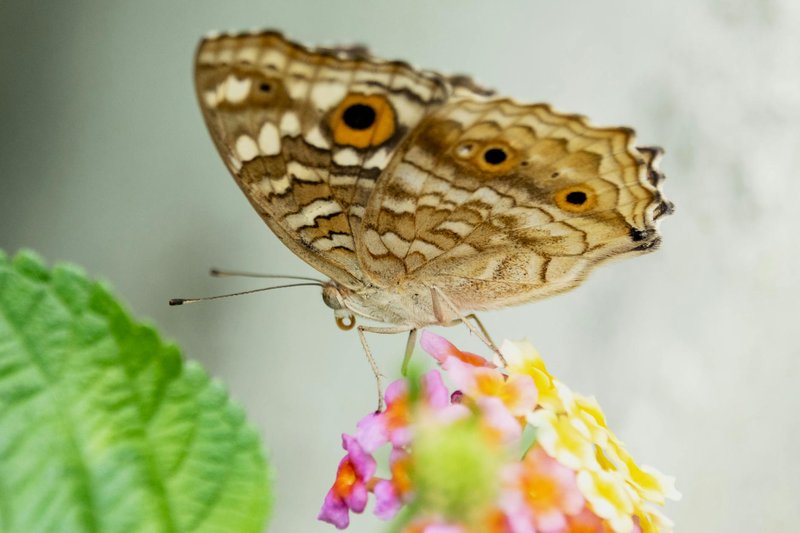
Butterflies belong to the insect order Lepidoptera, a word that translates literally to “scale wing.” They’re characterized by clubbed antennae, three pairs of legs, a body split into head, thorax, and abdomen, and two pairs of scale-covered wings. They feed primarily on nectar through a coiled, straw-like mouthpart called a proboscis, which unrolls when it’s time to drink and curls back up like a party blower when it’s not.
The thing that makes butterflies genuinely strange among animals is that they live two completely different lives. The first is as a caterpillar, an eating machine built to consume leaves. The second is as a winged adult built to fly, find a mate, and lay eggs. The bridge between those two lives is metamorphosis, and it’s far weirder than the classroom version suggests.
The Butterfly Life Cycle: Four Stages of Metamorphosis {#life-cycle}
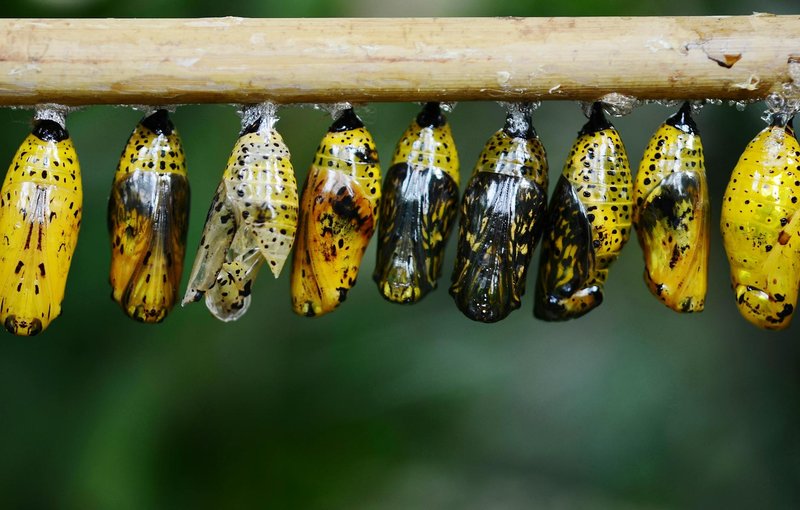
The butterfly life cycle runs through four distinct stages: egg, larva (caterpillar), pupa (chrysalis), and adult. This is called complete metamorphosis, and the four stages look so different from one another that early naturalists sometimes catalogued the caterpillar and the adult as separate species.
Egg. A female lays eggs directly on a host plant the caterpillar can eat. Eggs are tiny, often ribbed or sculpted, and species-specific in shape. Depending on temperature, they hatch in anywhere from a few days to a couple of weeks.
Larva (caterpillar). This is the eating stage, full stop. A caterpillar’s job is to grow, and grow fast. It molts its skin several times as it outgrows it, passing through stages called instars. A monarch caterpillar can multiply its mass roughly 2,000-fold before it’s done.
Pupa (chrysalis). The caterpillar attaches itself to a surface, sheds its skin one last time, and hardens into a chrysalis. Inside, something close to demolition happens. Much of the caterpillar’s body breaks down into a cellular soup, and clusters of cells called imaginal discs rebuild it into wings, legs, eyes, and antennae. The insect that emerges is not a modified caterpillar. It’s been reassembled almost from scratch.
Adult. The butterfly emerges, pumps fluid into its crumpled wings to expand them, waits for them to dry, and flies off. Most adult butterflies live only a few weeks. Their entire mission is reproduction, and many barely eat beyond the nectar that fuels flight.
What survives the rebuild is more interesting than the rebuild itself. Experiments have shown that moths can retain memories formed as caterpillars, which means some neural wiring persists even as the body is taken apart and reassembled.
Butterfly Anatomy and Those Famous Wing Scales {#anatomy}
A butterfly’s body follows the standard insect three-part plan. The head carries the eyes, antennae, and proboscis. The thorax anchors the legs and wings. The abdomen holds the digestive and reproductive organs.
The wings are the headline act. Up close, they’re covered in thousands of overlapping scales, each one a flattened, modified hair. Some scales contain pigment. Others produce color through structure alone — microscopic ridges that scatter light and create the metallic blues and iridescent flashes you see on a morpho or a swallowtail. That’s why a blue butterfly looks blue from one angle and dull from another. The color isn’t a dye; it’s an optical trick, the same physics that makes a soap bubble shimmer.
Those scales rub off easily, which is why a butterfly you’ve handled too much leaves powder on your fingers. The scales also help with temperature regulation, camouflage, and waterproofing. Butterflies are cold-blooded, so you’ll often see them basking with wings spread flat, using them as solar panels to warm flight muscles before takeoff.
The antennae do double duty as smell organs and balance sensors, and the feet carry taste receptors. A female “tastes” a leaf by standing on it to confirm it’s the right host plant before laying eggs.
Butterfly vs. Moth: How to Tell Them Apart {#butterfly-vs-moth}
Butterflies and moths are close cousins, and the line between them is fuzzier than most people think — there are far more moth species than butterfly species, and a few moths break every rule below. Still, these four checks will sort the vast majority correctly.
| Feature | Butterfly | Moth |
|---|---|---|
| Antennae | Thin with a club or knob at the tip | Feathery or thread-like, no club |
| Active when | Daytime | Mostly night |
| Resting wings | Usually held upright over the back | Usually held flat or tented over the body |
| Body | Slim, smooth | Stout, fuzzy |
| Pupa | Bare chrysalis | Often spins a silk cocoon |
The antenna test is the most reliable. If it ends in a little knob, it’s a butterfly. If it looks feathery or like a fine thread, it’s a moth. The fuzzy-body-versus-slim-body check is the fastest from a distance.
How Many Butterflies Are There? Diversity and Habitat {#diversity}
There are roughly 18,500 butterfly species worldwide, and they live nearly everywhere — rainforests, deserts, mountain slopes above the tree line, even the Arctic tundra. The only continent without native butterflies is Antarctica.
Diversity is wildly uneven. The tropics, especially the Amazon basin and Southeast Asia, hold the lion’s share. A single rainforest reserve in Peru can host more butterfly species than all of Europe combined. Temperate regions have fewer species but often larger, more visible populations of each.
Butterflies are grouped into several families. The big ones to know: swallowtails (Papilionidae), the large, often tailed species; whites and sulphurs (Pieridae), the small white and yellow ones drifting over fields; brush-footed butterflies (Nymphalidae), the largest family, including monarchs, fritillaries, and admirals; gossamer-winged butterflies (Lycaenidae), the tiny blues and coppers; and skippers (Hesperiidae), small, fast, moth-like fliers that bridge the gap between the two groups.
The Monarch Migration {#migration}
The monarch is the one butterfly almost everyone recognizes, and its migration is one of the strangest feats in the animal kingdom. Monarchs east of the Rocky Mountains fly up to 3,000 miles each fall, from southern Canada and the northern United States down to a handful of mountain forests in central Mexico, where they cluster on oyamel fir trees by the millions.
Here’s the part that breaks your brain. No single butterfly makes the round trip. The monarchs that fly south in autumn are several generations removed from the ones that flew north the previous spring. The insect navigating to a specific Mexican forest it has never seen is the great-great-grandchild of the last butterfly that was there. They do it using a time-compensated sun compass and a backup magnetic sense, with the navigational instructions written entirely into instinct.
Monarch numbers have dropped sharply in recent decades, driven largely by the loss of milkweed — the only plant their caterpillars can eat. The eastern population is tracked through annual surveys of the Mexican overwintering colonies, and recent winters have ranked among the lowest on record. The IUCN classifies the migratory monarch as a subspecies of conservation concern.
What Do Butterflies Eat? {#diet}
Adult butterflies and their caterpillars eat completely different things, which is the whole point of metamorphosis — the two life stages don’t compete for food.
Caterpillars eat leaves, and they’re picky. Many species can only digest one plant or one small group of plants, called the host plant. Monarchs eat milkweed and nothing else. Black swallowtail caterpillars eat plants in the carrot family, including dill and parsley straight out of your herb garden. This specialization is why planting the right host plant matters so much if you want butterflies to breed, not just visit.
Adults drink nectar through the proboscis, and most aren’t fussy about which flowers they feed from. But nectar isn’t the whole diet. Many butterflies engage in “puddling” — gathering on damp soil, mud, or even animal dung to sip dissolved minerals, especially sodium, that nectar doesn’t provide. Some tropical species feed on rotting fruit or tree sap. The males of many species need those puddle minerals to produce viable sperm, which is why a mud puddle full of butterflies is usually a stag party.
Common Butterflies: A Quick ID Reference {#identification}
If you want to name the butterflies in your yard, start with these widespread, easy-to-spot species. The descriptions below cover North American and broadly familiar butterflies.
- Monarch — Orange with thick black veins and a black, white-spotted border. Wingspan around 4 inches. The reference orange-and-black butterfly.
- Painted Lady — Orange-brown with black and white tips, mottled underside. One of the most widespread butterflies on Earth, found on every continent except Antarctica and Australia.
- Eastern Tiger Swallowtail — Large and yellow with bold black tiger stripes and tail-like extensions on the hindwings. Hard to miss.
- Cabbage White — Small, plain white with one or two black dots per wing. The butterfly you see fluttering over vegetable gardens and the bane of broccoli growers.
- Red Admiral — Dark wings crossed by a bright orange-red band, with white spots near the tips. Bold and often willing to land on people.
- Mourning Cloak — Deep maroon-brown wings edged with a pale cream border and a row of blue spots. One of the few that overwinters as an adult and flies in early spring.
- Common Buckeye — Tan-brown with striking eyespots ringed in orange. The eyespots startle predators.
The fastest way to confirm an ID in the field is the underside of the wings, which is often more distinctive than the top and is what you see when a butterfly rests with wings folded.
How to Attract Butterflies to Your Garden {#attract}
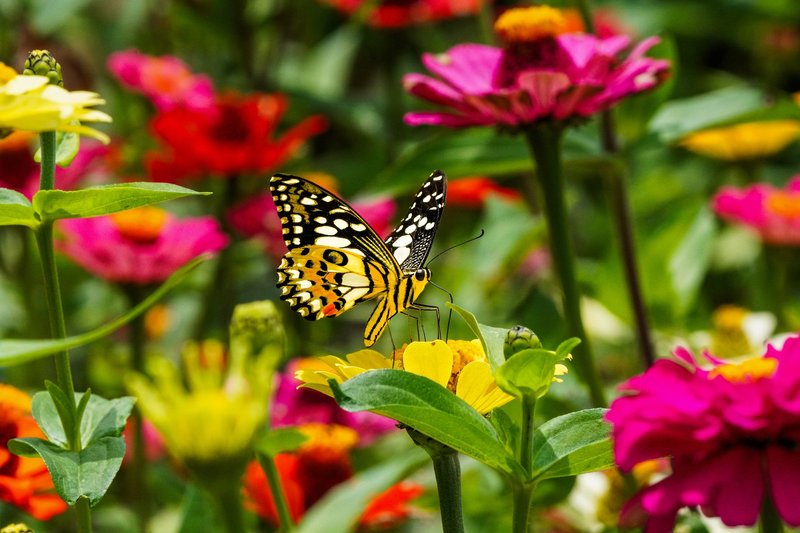
Getting butterflies to visit is easy. Getting them to stay and breed takes a little planning. The trick is to provide for both life stages — nectar for the adults and host plants for the caterpillars.
Plant nectar flowers in clusters. Butterflies find food by sight and color. Big drifts of one plant read better than scattered singles. Reliable nectar producers include coneflower, zinnia, lantana, milkweed, and butterfly bush. Aim for blooms across the whole season, not just midsummer. Butterflies are far from the only visitors these flowers will draw, so it helps to know the full cast of garden pollinators and the plants they favor when you’re planning what to put in the ground.
Add host plants, and accept the chewing. This is the step most people skip. If you want monarchs to lay eggs, you need milkweed. Black swallowtails need dill, fennel, or parsley. Yes, the caterpillars will eat the leaves — that’s the deal, and it’s the entire point.
Skip the pesticides. Broad-spectrum insecticides kill caterpillars as efficiently as they kill pests. A butterfly garden and a spray schedule can’t coexist.
Give them sun and shelter. Butterflies bask to warm up, so place plantings in full sun. A few flat stones for basking and a shallow dish of wet sand or mud for puddling go a long way. The USDA’s pollinator guidance covers habitat planning in more depth.
Let part of the yard go wild. A neat lawn is a desert to a butterfly. A patch of unmowed native plants in a corner does more than any single flower.
Why Butterflies Matter {#why-they-matter}
Butterflies pollinate. They’re not as efficient as bees — they don’t have the dense body hair that hauls pollen in bulk — but they travel farther between plants, which spreads genes across wider distances and helps maintain genetic diversity in wild plant populations.
They’re also one of the best early-warning systems we have for ecosystem health. Butterflies respond fast to changes in temperature, habitat, and chemical use, which makes them sensitive indicators — they sit alongside frogs, lichens, and other classic indicator species that scientists watch to gauge the condition of an ecosystem. When butterfly counts crash in a region, it’s often the first measurable sign that something broader is going wrong. Long-running citizen-science counts have documented steep declines across North America and Europe, tracking closely with habitat loss and pesticide use.
And they sit in the middle of the food web — caterpillars feed birds, especially during nesting season when a single clutch of chicks can eat thousands of them. Lose the caterpillars and you lose songbirds shortly after.
Butterfly FAQ {#faq}
How long do butterflies live? Most adult butterflies live two to four weeks. The exceptions are striking: migratory monarchs and species that overwinter as adults, like the mourning cloak, can live several months to nearly a year.
Can butterflies see color? Yes, and better than humans in some ways. They see ultraviolet light, which means many flowers and even other butterflies display patterns invisible to us. Those UV markings often guide them to nectar and help them recognize mates.
Do butterflies sleep? Not in the way mammals do, but they enter a resting state called quiescence, usually at night or in cool weather. They tuck under leaves or perch on stems, stay still, and wait for warmth before flying again.
Why do butterflies land on people? Usually for salt. Human sweat contains sodium and other minerals butterflies seek out, the same reason they gather at mud puddles. It’s not affection — you’re a salt lick.
What’s the difference between a chrysalis and a cocoon? A chrysalis is the hardened pupal case of a butterfly, formed from the insect’s own body when it sheds its final caterpillar skin. A cocoon is a silk casing that many moth caterpillars spin around themselves before pupating inside. Butterflies make chrysalises; most moths make cocoons.
Are butterflies and moths actually different animals? They’re both in the order Lepidoptera, so they’re close relatives rather than separate categories. Butterflies are essentially a few specialized branches of the larger moth family tree that became day-active and lost the fuzzy, drab look. The clearest tell remains the antennae: clubbed for butterflies, feathery or thread-like for moths.
Butterflies reward attention. Once you can name the orange-and-black one and tell a swallowtail from a sulphur, your backyard stops being scenery and starts being a place where four-stage metamorphosis, polarized-light navigation, and structural color are all happening in plain sight — usually before lunch.