Spain punches absurdly above its weight for endemics. Roughly a third of Europe’s endemic species live here, and the country holds more than 1,400 endemic vascular plants alone — many growing in a single ravine on a single island. The reasons are geographic luck: the Iberian Peninsula is a near-island walled off by the Pyrenees, and the Canary Islands are oceanic volcanoes that never touched a continent, so life that arrived there evolved in isolation. The Canaries alone host over 17,000 wild species, and nearly one in three exists nowhere else.
Below are 15 of them — the ones worth knowing, organized by where they live. Each entry gives you the habitat, the conservation status, and where you’d actually have a shot at seeing it.
Table of Contents
- Quick conservation reference
- Mainland Spain
- The mountains: Pyrenees, Cantabria, Sierra Nevada
- The Balearic Islands
- The Canary Islands
Quick conservation reference
A skimmable view of all 15. Statuses follow the IUCN Red List where assessed; subspecies and a few regional listings are noted as such.
| Species | Group | Region | Status |
|---|---|---|---|
| Iberian lynx | Mammal | Mainland south | Vulnerable |
| Spanish imperial eagle | Bird | Central/south Iberia | Vulnerable |
| Pyrenean desman | Mammal | Pyrenees, NW Iberia | Endangered |
| Cantabrian capercaillie | Bird | Cantabrian Mts. | Endangered (subspecies) |
| Spanish toothcarp | Fish | E Mediterranean coast | Endangered |
| Sierra Nevada violet | Plant | Sierra Nevada | Restricted endemic |
| Lilford’s wall lizard | Reptile | Balearic islets | Endangered |
| Majorcan midwife toad | Amphibian | Mallorca | Vulnerable |
| Tenerife blue chaffinch | Bird | Tenerife | Near Threatened |
| Gran Canaria blue chaffinch | Bird | Gran Canaria | Endangered |
| El Hierro giant lizard | Reptile | El Hierro | Critically Endangered |
| Canary Islands dragon tree | Plant | Canaries | Vulnerable |
| Teide violet | Plant | Tenerife (Mt. Teide) | High-altitude endemic |
| Laurel pigeon | Bird | W Canaries | Least Concern |
| Canary Islands chiffchaff | Bird | Canaries | Least Concern |
Mainland Spain
1. Iberian lynx (Lynx pardinus)
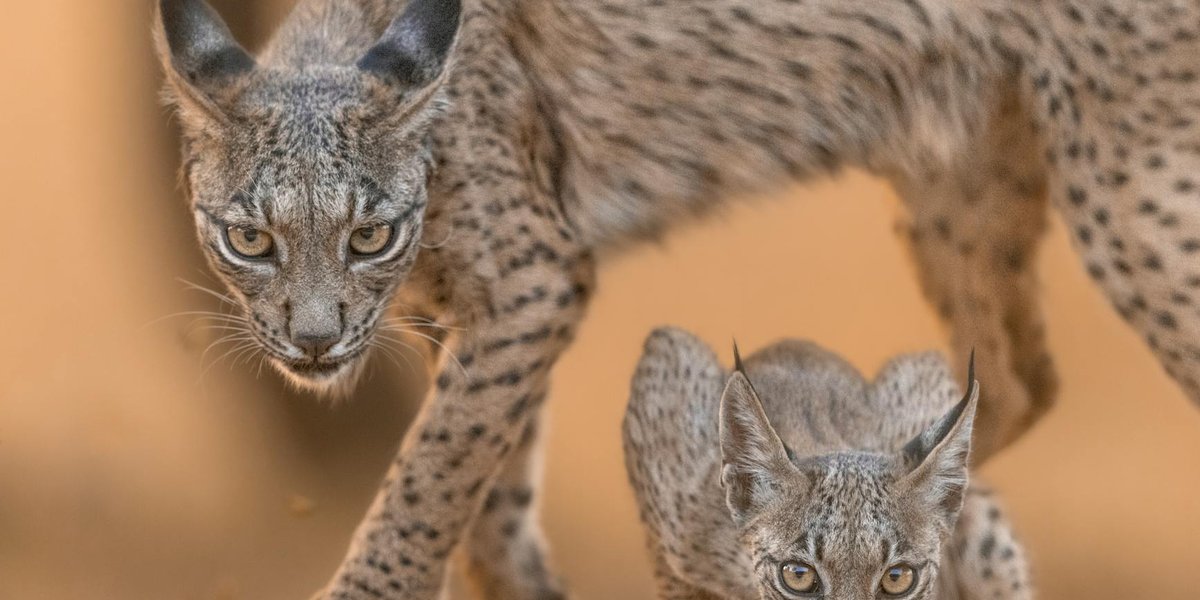
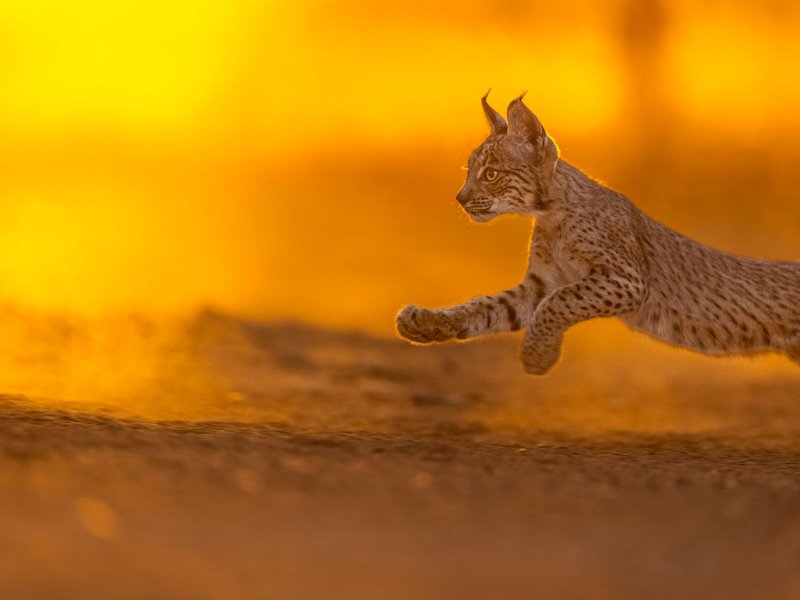
The one everybody comes for. The Iberian lynx is the most threatened cat on the planet’s recent memory and the icon of Spanish conservation — a spotted, bob-tailed cat with absurd tufted ears and a ruff of cheek whiskers, built almost entirely around hunting one prey: the European rabbit. When rabbit populations crashed, so did the lynx.
The recovery is the headline. In 2001 there were just 62 mature individuals left. By 2022 that number hit 648, with the total population (cubs included) now estimated above 2,000. In 2024 the IUCN moved the species from Endangered to Vulnerable, the result of reintroductions, roadkill mitigation, and genetic management. It’s still nowhere near fully recovered, but it’s no longer staring at extinction.
Where to see it: Sierra de Andújar Natural Park in Jaén, Andalusia, is the reliable spot — winter mornings, scanning the scrubby hillsides from a roadside, often with a local guide who knows the territories.
2. Spanish imperial eagle (Aquila adalberti)
For decades this was lumped in with the eastern imperial eagle; it’s now its own species, found only in Iberia. It’s a big, dark raptor — wingspan up to 210 cm — with a pale golden crown and unmistakable white shoulder patches that flash when it’s perched. It shares the lynx’s problem of being tied to rabbits, and it shares the lynx’s comeback story.
In the 1970s the population bottomed out at around 38 breeding pairs. Targeted work on powerline electrocution and poisoning has pushed it past 600 occupied territories, with most pairs in central and southern Spain and a small Portuguese population spilling over the border.
Where to see it: Doñana National Park and the dehesa woodlands of Extremadura, particularly Monfragüe National Park, where birders glass the cliffs along the Tagus.
The mountains: Pyrenees, Cantabria, Sierra Nevada
3. Pyrenean desman (Galemys pyrenaicus)
This is the strange one. The Pyrenean desman — also called the Iberian desman, or “trumpet rat” by people who’ve actually seen its snout — is a semi-aquatic mole relative the size of a small rat, with a long flexible trunk-like nose, webbed hind feet, and a paddle of a tail. It hunts insect larvae in cold, fast, clean mountain streams, which makes it a living water-quality gauge: where the desman survives, the river is genuinely pristine.
That’s also why it’s in trouble. The IUCN reclassified it from Vulnerable to Endangered in 2021, after surveys found an average 68% decline across its range. It lives in the Pyrenees, the Cantabrian Mountains, and the Sistema Central. The same high Pyrenean watershed straddles the border with Andorra, whose alpine refuges shelter their own roster of endemic species adapted to that mountain isolation.
Where to see it: Realistically, you won’t — it’s nocturnal, aquatic, and shy. Your best odds are the clear headwater streams of the Pyrenees and Picos de Europa, at dusk, with patience and luck.
4. Cantabrian capercaillie (Tetrao urogallus cantabricus)
A subspecies of the western capercaillie isolated in northwest Spain, the Cantabrian capercaillie is a turkey-sized grouse whose males perform a famous spring lek — fanned tail, throaty clicking-and-popping song, the works. It once ranged the whole Cantabrian range from Galicia to Cantabria. It has since contracted hard, and it’s now critically reduced, surviving in fragmented old-growth and beech forest with a captive-breeding program trying to hold the line.
Where to see it: The mountains of Asturias and León. Lekking sites are protected and access is deliberately restricted — disturbance at the lek is part of why the bird is declining, so this is one to admire from a distance, if at all.
5. Spanish toothcarp (Aphanius iberus)
Proof that endemics aren’t all charismatic megafauna. The Spanish toothcarp is a tiny killifish, a couple of centimeters long, living in the brackish salt marshes and coastal lagoons of Spain’s eastern Mediterranean shore. It tolerates wild swings in salinity and temperature that would kill most fish — and it’s still losing, squeezed out by habitat loss and by the introduced mosquitofish that outcompetes it. Its extinction risk is among the highest of any Iberian vertebrate, and the IUCN lists it as Endangered.
Where to see it: Protected coastal wetlands like the Albufera de Valencia and the lagoons of the Murcia–Alicante coast, where recovery projects maintain populations.
6. Sierra Nevada violet (Viola crassiuscula)
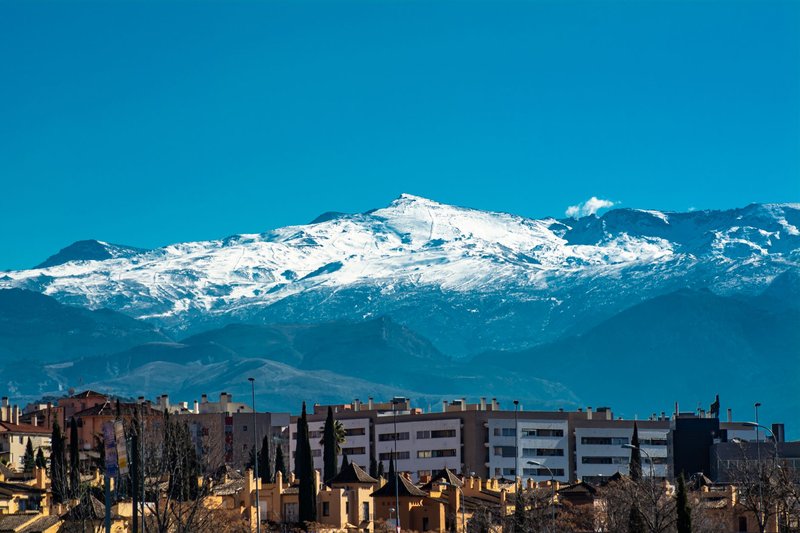
The Sierra Nevada has the highest count of endemic plants in Europe — around 2,100 vascular plant species, roughly 70 of which grow nowhere else. The Sierra Nevada violet is the poster child: a cushion-forming alpine violet, pale lilac, that blooms above 2,500 meters in loose, frost-shattered scree, sometimes flowering right at the edge of melting snow. It survives where almost nothing else bothers to, and it ranks among the most extreme of the continent’s endemic plants of Europe that cling to a single mountain range.
Where to see it: The high zones of Sierra Nevada National Park near Granada, on summer treks toward the Mulhacén and Veleta summits. It’s small — you have to look down, not up.
The Balearic Islands
7. Lilford’s wall lizard (Podarcis lilfordi)
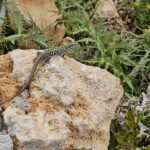
When humans (and the rats, cats, and snakes that come with them) arrived in the Balearics, this lizard vanished from the two main islands of Mallorca and Menorca. It now survives only on the surrounding islets — and on each one it evolved its own look, which is why there are 27 recognized subspecies, some jet-black, some greenish, varying island to island. Total occupied area is under 500 km², and the IUCN lists it as Endangered.
Where to see it: Boat trips to islets like Cabrera (a national park) and the rocky stack of Es Colomer off Mallorca, where the lizards are bold enough to investigate your shoes.
8. Majorcan midwife toad (Alytes muletensis)
The “ferreret” — the name comes from its call, which sounds like a tiny hammer tapping metal (“little metal worker” in Balearic Catalan). Here’s the twist: it was first described in 1977 from fossils and assumed long extinct. Then in 1979, living froglets turned up in Mallorca’s limestone canyons, hiding in deep, cool gorge pools where introduced predators couldn’t follow. As the name suggests, the male carries the eggs wrapped around his hind legs until they hatch. A reintroduction program has pulled it back to Vulnerable from the brink.
Where to see it: The Serra de Tramuntana mountains of northern Mallorca, in shaded torrent pools — a UNESCO World Heritage landscape worth the hike on its own.
The Canary Islands
Spain’s endemism engine. Volcanic, never connected to Africa, and stacked into climate zones from coastal desert to high-altitude pine and laurel forest — the archipelago turns isolation into new species the way few places on Earth do.
9. Tenerife blue chaffinch (Fringilla teydea)
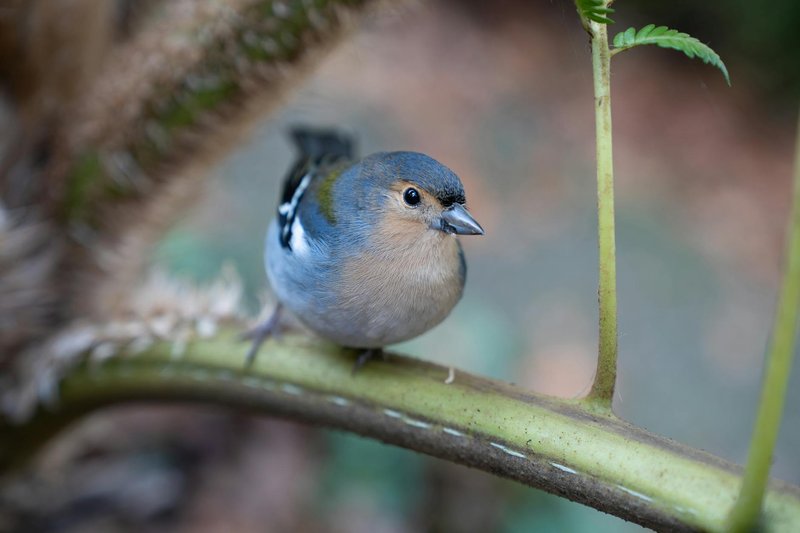
Steel-blue and unmistakable, the Tenerife blue chaffinch lives only in the high pine forests of Tenerife, where it cracks pine seeds the way a lesser finch couldn’t. It’s the natural symbol of the island, paired in that honor with the dragon tree.
Where to see it: The Las Lajas recreation area in the Corona Forestal, in the pine belt below Mt. Teide. The birds come down to the picnic-ground water troughs and are surprisingly approachable.
10. Gran Canaria blue chaffinch (Fringilla polatzeki)
Long considered the same bird as its Tenerife cousin, the Gran Canaria blue chaffinch is now its own species — and one of the most endangered birds on the planet, down to a tiny population after wildfires gutted its pine-forest home. Captive breeding and a second introduced population are the safety net.
Where to see it: The Inagua pine forest reserve on Gran Canaria, access restricted to protect the birds, and the supplementary site at La Cumbre.
11. El Hierro giant lizard (Gallotia simonyi)
The Canaries once had genuinely giant lizards — over half a meter long. Most are extinct, but the El Hierro giant lizard hangs on, a stocky, broad-headed reptile that was believed extinct until its rediscovery in 1974 on a single cliff face. It’s the official symbol of El Hierro and is Critically Endangered, with a recovery center breeding animals for release.
Where to see it: The Lagartario (Giant Lizard Recovery Center) at Guinea on El Hierro, where you can see the animals up close and learn the rediscovery story.
12. Canary Islands dragon tree (Dracaena draco)
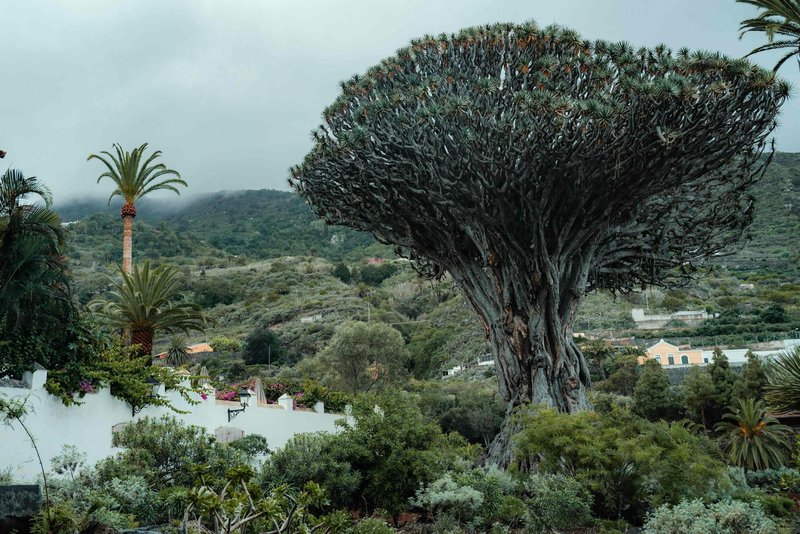
Not a tree in the ordinary sense — a giant monocot with an umbrella of stiff blue-green sword leaves and bark that bleeds a deep red resin called “dragon’s blood.” The famous specimen at Icod de los Vinos on Tenerife is reckoned to be many centuries old and is one of the island’s most photographed living things. Wild populations are sparse, and the IUCN lists it as Vulnerable.
Where to see it: The Drago Milenario at Icod de los Vinos, Tenerife, plus wild stands clinging to cliffs across the western islands.
13. Teide violet (Viola cheiranthifolia)
The highest-altitude flowering plant in Spain. The Teide violet grows only on the slopes of Mt. Teide, Spain’s tallest peak, pushing up through volcanic pumice well above 3,000 meters — higher than almost anything else dares. Mt. Teide National Park’s flora includes 168 plant species, 58 of them Canarian endemics, and this violet is the standout survivor of that thin, cold, sun-blasted zone.
Where to see it: The upper trails of Teide National Park, near the summit cable-car station, flowering in late spring and early summer.
14. Laurel pigeon (Columba junoniae)
A large, dark, rufous-tailed pigeon tied to the laurisilva — the misty laurel cloud forest that’s a living relic of the subtropical woodland that once covered the Mediterranean millions of years ago. This is one of the rarest of the world’s forest biomes, and the laurel pigeon disperses the seeds of those laurel trees, so bird and forest depend on each other. It’s currently Least Concern, a quieter conservation story than most on this list.
Where to see it: The laurel forests of La Gomera (Garajonay National Park) and the northern slopes of La Palma and Tenerife, best spotted at dawn flying between ridges.
15. Canary Islands chiffchaff (Phylloscopus canariensis)
A small, restless, olive-brown warbler that split off from its mainland relatives long enough ago to become its own species, with a distinctive song. Unlike the pine- and laurel-forest specialists above, it’s a generalist — you’ll find it in gardens, scrub, and woodland edges across the islands, which is exactly why it’s thriving and listed as Least Concern.
Where to see it: Almost anywhere with vegetation on the central and western islands. It’s often the first endemic a visiting birder ticks off, usually before leaving the hotel garden.