Cycloalkanes are hydrocarbons whose carbon atoms form a closed ring, joined only by single bonds. Their general formula is CnH2n, two hydrogens fewer than the matching open-chain alkane (CnH2n+2), because closing the ring costs one hydrogen from each end of the chain.
That one missing pair of hydrogens explains most of what makes these molecules interesting. Rings can’t always sit at the bond angles carbon prefers, so some of them are tense, reactive and unstable, while one of them (cyclohexane) is practically stress-free.
Contents
- What is a cycloalkane?
- Cycloalkanes vs open-chain alkanes
- Ring strain: why size matters
- Small rings: cyclopropane and cyclobutane
- Common rings: cyclopentane, cyclohexane, cycloheptane
- Cyclohexane chair and boat conformations
- Medium and large rings
- How to name cycloalkanes
- Reactions of cycloalkanes
- Where cycloalkanes show up in the real world
- Identifying cycloalkanes with spectroscopy
- Quick-reference table
- FAQ
What is a cycloalkane?
A cycloalkane is a saturated hydrocarbon with at least one ring of carbon atoms. “Saturated” means every carbon holds as many hydrogens as it can, so there are no double or triple bonds. Each ring carbon makes four single bonds: two to neighboring ring carbons and two to hydrogens (or to substituents, if the ring carries any).
The simplest case is cyclopropane, C3H6: three carbons in a triangle. Add one CH2 group at a time and you get cyclobutane (C4H8), cyclopentane (C5H10), cyclohexane (C6H12), and so on. Every member fits CnH2n, with n of at least 3. A two-carbon ring can’t exist.
The formula also tells you something useful about unsaturation. An alkene with one double bond has the same CnH2n formula as a cycloalkane. A ring counts as one “degree of unsaturation,” just like a double bond, which is why you can’t tell a cycloalkane from an alkene using the molecular formula alone.
Cycloalkanes vs open-chain alkanes
Same atoms, different shape, different behavior. The ring locks the carbons in place, which changes boiling points, reactivity and geometry.
| Property | Open-chain alkanes | Cycloalkanes |
|---|---|---|
| General formula | CnH2n+2 | CnH2n |
| Bond rotation | Free rotation around every C-C bond | Restricted by the ring |
| Boiling point (6 carbons) | Hexane: 69 °C | Cyclohexane: 81 °C |
| Shape | Flexible, zigzag chains | Rings, often puckered |
| Strain | Essentially none | Zero to very high, depending on ring size |
| Typical reactivity | Combustion, radical halogenation | Same, plus ring-opening for small rings |
Cycloalkanes boil higher than their straight-chain twins. A ring is more rigid and packs more tightly, so molecules touch over a larger surface and the London dispersion forces between them add up. Compare hexane (69 °C) with cyclohexane (about 81 °C). Cyclopropane, by contrast, boils at around -33 °C and is a gas at room temperature, cyclobutane boils near 12 °C, and cyclopentane at about 49 °C.
Ring strain: why size matters
A carbon atom with four single bonds is happiest when those bonds point to the corners of a tetrahedron, with angles of 109.5°. Put that carbon in a ring and the ring geometry can pull the angles away from that ideal. The extra energy is called ring strain, and it comes from three sources:
- Angle strain: bond angles forced away from 109.5°.
- Torsional strain: neighboring C-H bonds lined up on top of each other (eclipsed) instead of staggered.
- Steric strain: atoms or groups jammed too close together across the ring.
In 1885, the German chemist Adolf von Baeyer proposed that rings are strained in proportion to how far their angles deviate from tetrahedral. He treated rings as flat polygons, and that’s where the idea breaks down, but it explained the instability of the small ones well enough that Baeyer was awarded the 1905 Nobel Prize in Chemistry for his broader organic work.
You can measure strain from the heat of combustion. Burn one mole of a cycloalkane, divide by the number of CH2 groups, and compare with a strain-free reference. Any excess is stored strain energy.
Typical values for total ring strain:
| Ring | Strain energy (approx.) |
|---|---|
| Cyclopropane | 115 kJ/mol |
| Cyclobutane | 110 kJ/mol |
| Cyclopentane | 26 kJ/mol |
| Cyclohexane | about 0 kJ/mol |
| Cycloheptane | 26 kJ/mol |
| Cyclooctane | 40 kJ/mol |
The pattern is not what Baeyer’s flat-ring model predicted. Strain doesn’t keep climbing with ring size. It drops to nothing at six carbons because rings that big aren’t flat. They pucker into three-dimensional shapes that restore near-perfect tetrahedral angles.
Small rings: cyclopropane and cyclobutane
Cyclopropane is the most strained ring you’ll meet in a first-year course. Three carbons must form an equilateral triangle, so the C-C-C angle is 60°, nearly 50° short of the tetrahedral ideal. The carbon-carbon bonds can’t overlap head-on the way normal sigma bonds do. Instead, the orbitals overlap off-axis and form bent bonds, sometimes called “banana bonds,” which are weaker than ordinary C-C bonds. On top of the angle strain, all three CH2 groups are eclipsed, which adds torsional strain.
The result is a molecule that behaves a little like an alkene. It reacts with hydrogen over a nickel catalyst to open the ring and give propane, something larger rings won’t do under the same conditions.
Cyclobutane has a similar total strain (about 110 kJ/mol) but spreads it differently. A flat square would have 90° angles and four eclipsed pairs of CH2 groups. To relieve some of the eclipsing, the ring folds into a slightly puckered shape, with angles near 88°. That reduces torsional strain a little while angle strain gets slightly worse. Cyclobutane is less reactive than cyclopropane, but it will still open under forcing conditions.
Here’s the practical answer to the common question of cyclopropane vs cyclobutane stability: they’re about equally strained in total, but cyclopropane’s strain is concentrated in fewer bonds, so it’s the more reactive of the two.
Common rings: cyclopentane, cyclohexane, cycloheptane
Cyclopentane would have angles of 108° if it were flat, almost perfect. The issue is torsion: a flat pentagon eclipses every C-H bond. So the ring bends into an “envelope” shape, with four carbons roughly in a plane and one flapped up like the lid of an envelope. The flap moves around the ring constantly. Net strain is small, about 26 kJ/mol, nearly all of it torsional.
Cyclohexane is the star. Flat, it would need 120° angles, which is too wide. But it doesn’t stay flat. In its chair form every bond angle is about 111°, every C-H bond on adjacent carbons is staggered, and strain is effectively zero. That’s why six-membered rings are everywhere in nature: sugars, steroids, terpenes and many drugs are built on them.
Cycloheptane is more flexible than cyclohexane and not as comfortable. It exists as a family of twisted shapes that interconvert quickly, with about 26 kJ/mol of strain from transannular crowding (hydrogens pointing across the ring at each other) plus some torsion.
Cyclohexane chair and boat conformations
If you only learn one 3D structure in organic chemistry, make it the cyclohexane chair.
In the chair, the six carbons zigzag up and down alternately. Each carbon carries two hydrogens, and they point in two different directions:
- Axial hydrogens point straight up or straight down, parallel to the ring’s central axis. There are six, alternating up and down around the ring.
- Equatorial hydrogens point outward, roughly along the ring’s “equator,” and slightly up or down. There are also six.
To draw a chair, sketch two parallel lines offset from one another, then connect the ends to make the footrest and the headrest. Axial bonds are vertical lines. Equatorial bonds are drawn parallel to the ring bonds once removed.
Ring flip
A chair isn’t fixed. At room temperature, cyclohexane flips between two chair forms millions of times a second, and the energy barrier is only about 45 kJ/mol. During a ring flip, every axial position becomes equatorial and every equatorial becomes axial.
For plain cyclohexane the two chairs are identical, so the flip changes nothing you could observe. Add a substituent and it matters a lot.
Why substituents prefer the equatorial position
Put a methyl group on the ring. In the axial position, it sits on the same side as two other axial hydrogens, three carbons away. The clash is called 1,3-diaxial interaction, and it’s steric strain. In the equatorial position the methyl points outward, away from everything.
For methylcyclohexane the equatorial chair is more stable by about 7 kJ/mol, so roughly 95% of molecules sit in that form at room temperature. Bigger groups push the balance further. A tert-butyl group is so large that it effectively locks the ring into the chair with the group in the equatorial position.
Boat and twist-boat
Cyclohexane can adopt other shapes. In the boat, two carbons at opposite ends point up like the bow and stern of a rowing boat. Their hydrogens bump into each other (the “flagpole” interaction) and several bonds are eclipsed. The boat sits roughly 30 kJ/mol above the chair, and it’s an energy peak between more stable forms rather than a stable shape itself. A slight twist relieves some of the strain, giving the twist-boat at about 23 kJ/mol above the chair. Only a tiny fraction of molecules are anything other than a chair at any moment.
Medium and large rings
Rings of 8 to 11 carbons are the awkward middle. They can pucker, but the hydrogens inside the ring crowd one another, and strain stays between about 40 and 50 kJ/mol for the worst ones. Cyclooctane through cycloundecane are the least comfortable of the common-ish rings.
From 12 carbons up, the ring is big enough to fold into shapes with little or no strain, and the strain goes back down toward the level of a straight-chain alkane. Large rings exist in nature, notably the musk compounds (muscone is a 15-carbon ring ketone) and macrolide antibiotics, though those are more complicated than simple cycloalkanes.
How to name cycloalkanes
The IUPAC rules are short.
- Count the ring carbons and add the prefix “cyclo” to the alkane name. Six carbons: cyclohexane. Eight: cyclooctane.
- Name substituents as prefixes, in alphabetical order, and number them with locants.
- Number the ring so the substituents get the lowest possible numbers. With one substituent, no number is needed: methylcyclohexane, not 1-methylcyclohexane.
- If there’s a tie, give the lower number to the substituent that comes first alphabetically.
- Ring or chain as the parent? The one with more carbons is the parent. A cyclopropane with a six-carbon chain attached is named as a hexane with a cyclopropyl substituent. When both have equal carbons, the ring takes priority.
- For rings with two substituents on different sides, add cis (same side) or trans (opposite sides) to specify geometry.
Worked examples
Example 1: A cyclohexane ring with a methyl group on carbon 1 and an ethyl group on carbon 2.
Number from either end of the ring so the lowest locants go to the two groups. They get 1 and 2 either way. Now alphabetical order breaks the tie: ethyl comes before methyl, so ethyl gets 1. The name is 1-ethyl-2-methylcyclohexane.
Example 2: A cyclopentane ring with three methyl groups.
Try numbering so the locants are as low as possible: 1,2,4 beats 1,3,4. If the methyls sit on carbons that allow 1,2,4, the name is 1,2,4-trimethylcyclopentane.
Example 3: A five-carbon ring attached to a chain of three carbons.
The ring has more carbons than the chain, so the ring is the parent: propylcyclopentane.
Example 4: A cyclobutane ring on a seven-carbon chain.
The chain wins. It’s cyclobutylheptane, with a locant on the heptane to show where the ring attaches (for instance, 3-cyclobutylheptane).
Try one on your own: draw cyclohexane with an isopropyl group at carbon 1 and a chlorine at carbon 3. The answer is 1-chloro-3-isopropylcyclohexane, since “chloro” comes before “isopropyl” alphabetically.
Reactions of cycloalkanes
Cycloalkanes are not very reactive. The C-C and C-H bonds are strong and nonpolar, so most reagents ignore them. Three reaction types cover nearly everything you’ll see in a course.
Combustion. All cycloalkanes burn in oxygen to give carbon dioxide and water. For cyclohexane:
C6H12 + 9 O2 → 6 CO2 + 6 H2O
Heats of combustion per CH2 group are the standard way to measure ring strain, as described above.
Free-radical halogenation. Under UV light or heat, chlorine or bromine replaces a hydrogen on the ring. Cyclohexane plus Cl2 gives chlorocyclohexane and HCl. The mechanism is a radical chain reaction, and it gives mixtures when the ring has more than one kind of hydrogen. Bromine is far more selective than chlorine.
Ring-opening of small rings. Only cyclopropane and, with more difficulty, cyclobutane do this. Cyclopropane reacts with hydrogen over a nickel catalyst to give propane, and with bromine to give 1,3-dibromopropane. Cyclopentane and cyclohexane resist these conditions, because there’s no strain to release.
Where cycloalkanes show up in the real world
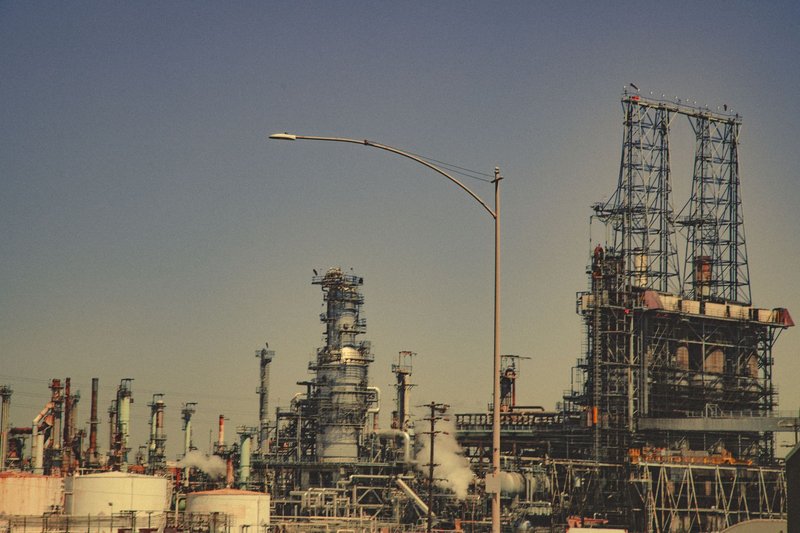
Crude oil. Cycloalkanes, which the petroleum industry calls naphthenes, make up a substantial share of crude oil. Cyclopentane and cyclohexane rings with alkyl side chains are common, and the proportion varies widely by oil field. Refiners convert naphthenes into aromatic compounds in catalytic reforming to raise gasoline’s octane rating.
Nylon. Most industrial cyclohexane is oxidized to a mixture of cyclohexanol and cyclohexanone, known as KA oil. From there it goes to adipic acid (for nylon-6,6) and caprolactam (for nylon-6). So the ring in your cyclohexane chair diagram ends up in clothing, carpets and car parts.
Solvents. Cyclohexane is a nonpolar solvent used in laboratories and in manufacturing. It’s flammable, and the CDC’s NIOSH pocket guide for cyclohexane lists an exposure limit of 300 ppm over an 8-hour workday. High concentrations of vapor can irritate the eyes and respiratory tract and cause drowsiness.
Insulation. Cyclopentane is used as a blowing agent in rigid polyurethane foam, such as the insulation inside refrigerators. It replaced ozone-depleting chlorofluorocarbons and many hydrofluorocarbons.
Medicine. Cyclopropane was used as a general anesthetic from the 1930s until the 1980s. It worked well and acted quickly, but it’s explosive when mixed with oxygen, and it was dropped in favor of safer agents. Many modern drugs, though, carry a cyclopropane ring on purpose, because it holds a molecule in a rigid shape.
Natural products. Six-membered rings underpin menthol, steroids such as cholesterol, and the glucose ring. Five-membered rings appear in prostaglandins. Small rings are rarer in nature, but cyclopropane units appear in some pyrethrins, the insecticidal compounds from chrysanthemum flowers.
Environment and safety. Cycloalkanes are volatile organic compounds, so they contribute to ground-level ozone when released in large amounts. Cyclohexane is also toxic to aquatic life. Proper storage and ventilation matter, and you can find its full property and hazard data in PubChem’s cyclohexane entry.
Identifying cycloalkanes with spectroscopy
You won’t always get the structure handed to you. Here’s how the standard techniques help.
- Mass spectrometry: Cycloalkanes have a molecular ion peak at CnH2n, which is 2 mass units lower than the matching alkane. Cyclohexane shows its parent peak at m/z 84.
- Infrared: Cycloalkanes show C-H stretches just below 3000 cm⁻¹, like alkanes. Cyclopropane is the exception, with C-H stretches slightly above 3000 cm⁻¹, because its bent bonds give the C-H bonds more s-character.
- 1H NMR: Ordinary cycloalkane hydrogens appear at about 1.2 to 1.5 ppm. Cyclohexane gives a single sharp peak near 1.4 ppm at room temperature, because the ring flip is so fast that axial and equatorial hydrogens average out. Cool it to about -90 °C and the flip slows enough that the peak splits in two. Cyclopropane protons are unusually shielded and show up near 0.2 ppm, far upfield of every other alkane.
- 13C NMR: Symmetric rings show one signal for all carbons. Cyclohexane gives a single peak near 27 ppm.
Quick-reference table
| Cycloalkane | Formula | Ring angle (planar) | Strain (kJ/mol) | Boiling point | Shape |
|---|---|---|---|---|---|
| Cyclopropane | C3H6 | 60° | about 115 | -33 °C | Planar triangle |
| Cyclobutane | C4H8 | 90° | about 110 | 12 °C | Puckered |
| Cyclopentane | C5H10 | 108° | about 26 | 49 °C | Envelope |
| Cyclohexane | C6H12 | 120° | about 0 | 81 °C | Chair |
| Cycloheptane | C7H14 | 128.6° | about 26 | 119 °C | Twist-chair |
| Cyclooctane | C8H16 | 135° | about 40 | 151 °C | Boat-chair |
FAQ
What is the general formula for cycloalkanes?
CnH2n, where n is at least 3. It has two fewer hydrogens than the open-chain alkane formula CnH2n+2.
Why is cyclohexane more stable than cyclopropane?
Cyclohexane folds into a chair shape with bond angles near 111° and all C-H bonds staggered, so it has almost no angle or torsional strain. Cyclopropane is locked into a triangle with 60° angles and eclipsed hydrogens, giving it about 115 kJ/mol of strain.
Are cycloalkanes saturated or unsaturated?
Saturated. They contain only single bonds. They share the CnH2n formula with alkenes, but an alkene has a C=C double bond and a cycloalkane has a ring.
What is the difference between axial and equatorial positions?
Axial bonds point straight up or down, parallel to the ring’s axis. Equatorial bonds point outward around the ring’s edge. Bulky groups prefer equatorial positions to avoid 1,3-diaxial crowding.
Is cyclohexane flat?
No. The flat form would force 120° angles and strain the ring. Cyclohexane puckers into a chair, boat or twist-boat shape, and the chair is by far the most stable.
Are cycloalkanes dangerous?
The small ones are the most reactive, and several are flammable, volatile liquids or gases. Cyclohexane vapor can irritate the eyes and airways and cause dizziness at high concentrations. Ordinary lab handling with ventilation and no ignition sources is enough for most work.
What is a naphthene?
It’s the petroleum industry’s name for cycloalkanes found in crude oil, mostly cyclopentane and cyclohexane derivatives.