
Charts and posters
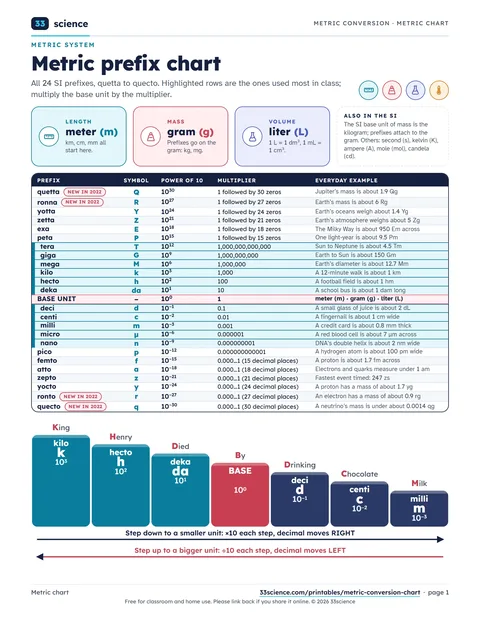
Metric Prefix and Conversion Chart
2 pages · US Letter · PDF
All 24 SI prefixes with the staircase on page 1, conversion tables on page 2.
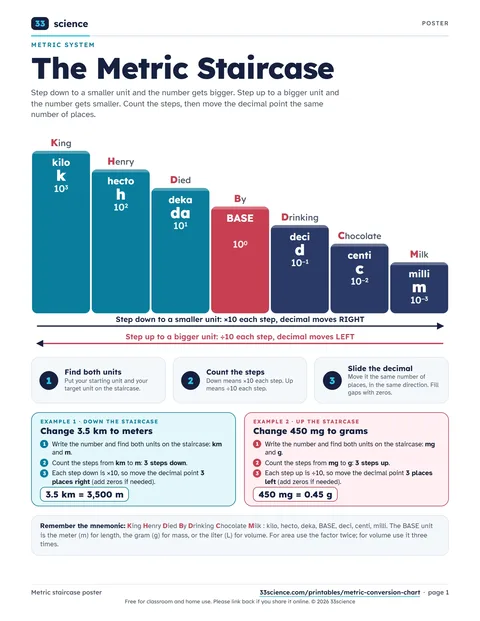
Metric Staircase Poster
1 page · US Letter · PDF
One-page King Henry staircase for the classroom wall, with worked steps.
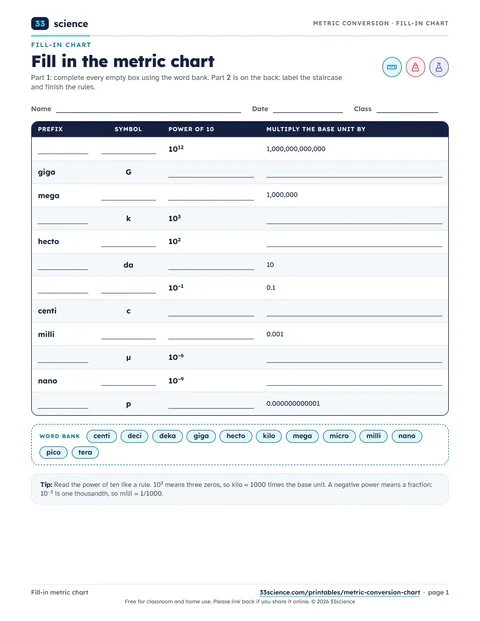
Fill-in Metric Chart
2 pages · US Letter · PDF
The chart with blanks to fill in from memory. The answer key shows every blank.
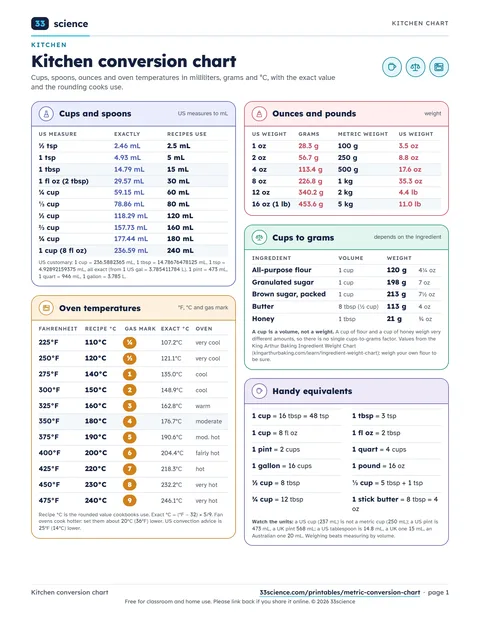
Kitchen Conversion Chart
1 page · US Letter · PDF
Cups, spoons, ounces, grams and oven temperatures for converting recipes.
Grades 4-5 (ages 9 to 11)
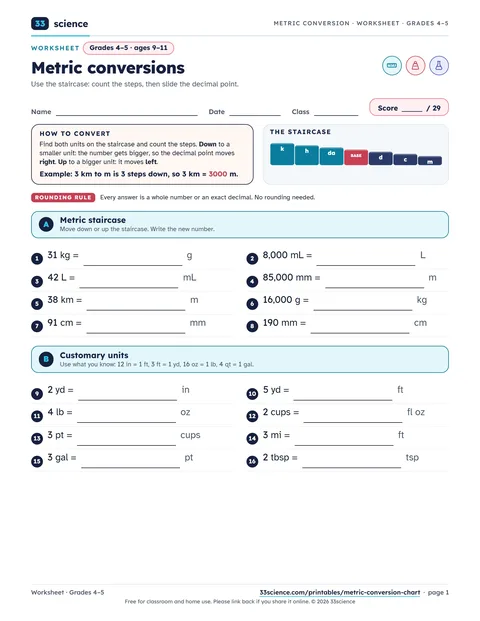
Metric Conversion Worksheet, Grades 4–5
2 pages · US Letter · PDF
Staircase moves with whole numbers, comparing units, word problems.
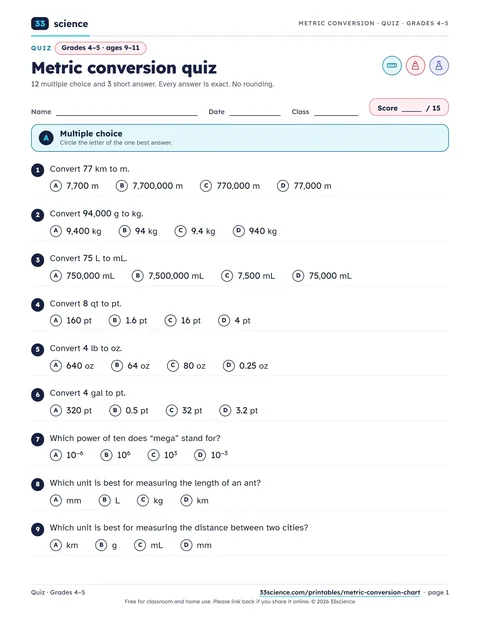
Metric Conversion Quiz, Grades 4–5
2 pages · US Letter · PDF
12 multiple choice and 3 short answer questions on the staircase.
Grades 6-8 (ages 11 to 14)
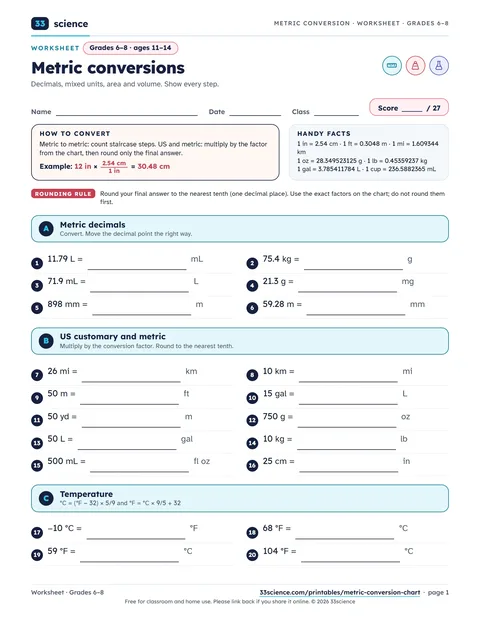
Metric Conversion Worksheet, Grades 6–8
2 pages · US Letter · PDF
Decimals, area and volume, temperature and two-step problems.
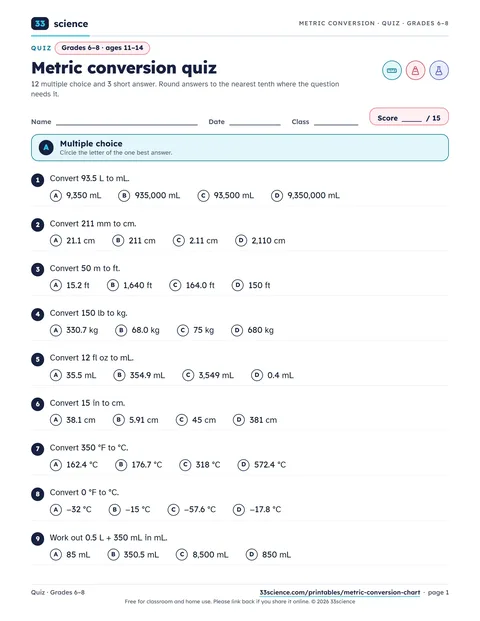
Metric Conversion Quiz, Grades 6–8
2 pages · US Letter · PDF
12 multiple choice and 3 short answer questions with decimals and units.
High school (ages 14 to 18)
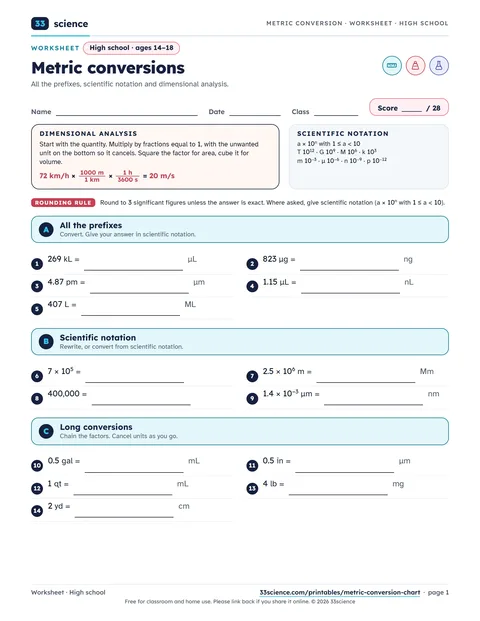
Metric Conversion Worksheet, High school
2 pages · US Letter · PDF
All prefixes, scientific notation, rates and dimensional analysis.
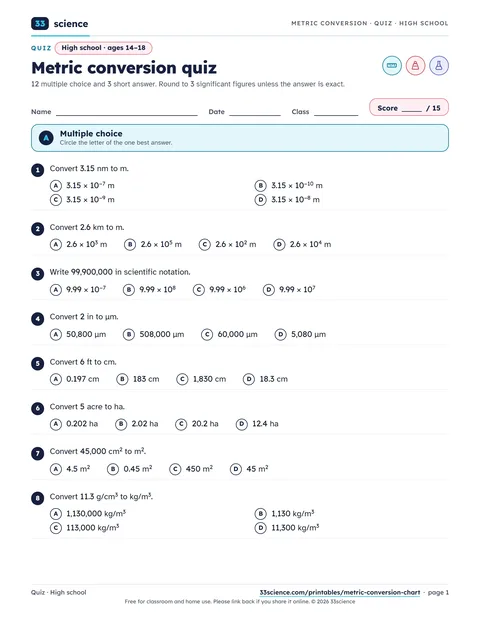
Metric Conversion Quiz, High school
2 pages · US Letter · PDF
12 multiple choice and 3 short answer questions on prefixes and rates.
Free for classroom and home use. Please link back if you share it.
Print the chart, the staircase poster, and a worksheet and quiz for each grade band, or work through the converter and practice quiz further down this page. Every printable comes in US Letter and A4, and every worksheet and quiz has an answer key that shows the working.
Printable metric conversion worksheets and quizzes with answer keys
Each metric unit conversion worksheet is paired with a quiz at the same level. Use the switches at the top of the page to change the paper size, show the answer key links, or print the chart in ink-saver black and white.
- Grades 4-5 (ages 9 to 11): moving the decimal point on the staircase with whole numbers, comparing units and simple word problems. The US Letter set adds feet, yards, ounces and quarts.
- Grades 6-8 (ages 11 to 14): decimals, mixed units, area and volume, temperature, and US-to-metric conversion on the Letter set.
- High school (ages 14 to 18): all 24 prefixes, scientific notation, rates and density, and multi-step dimensional analysis.
The fill-in chart works as a quick check before a unit test: students rebuild the prefix table from memory and mark it against the key.
Metric conversion chart: all 24 SI prefixes
The metric system is built on powers of ten. A prefix names the power and attaches to a base unit: the meter for length, the gram for mass, the liter for volume. Kilo means 1,000, so a kilometer is 1,000 meters. Milli means one thousandth, so a milliliter is 0.001 liter. The chart below is a metric system chart you can print or read on screen.
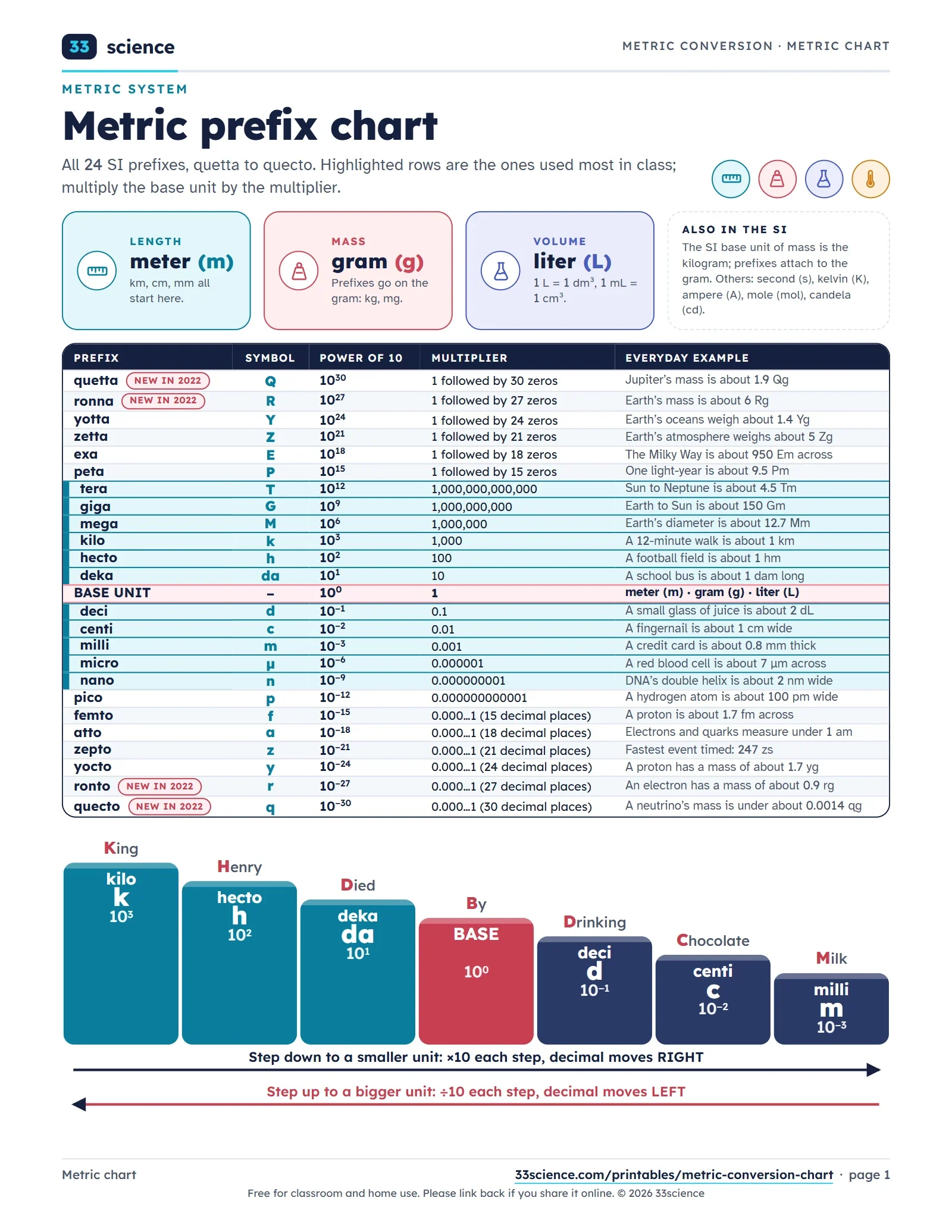
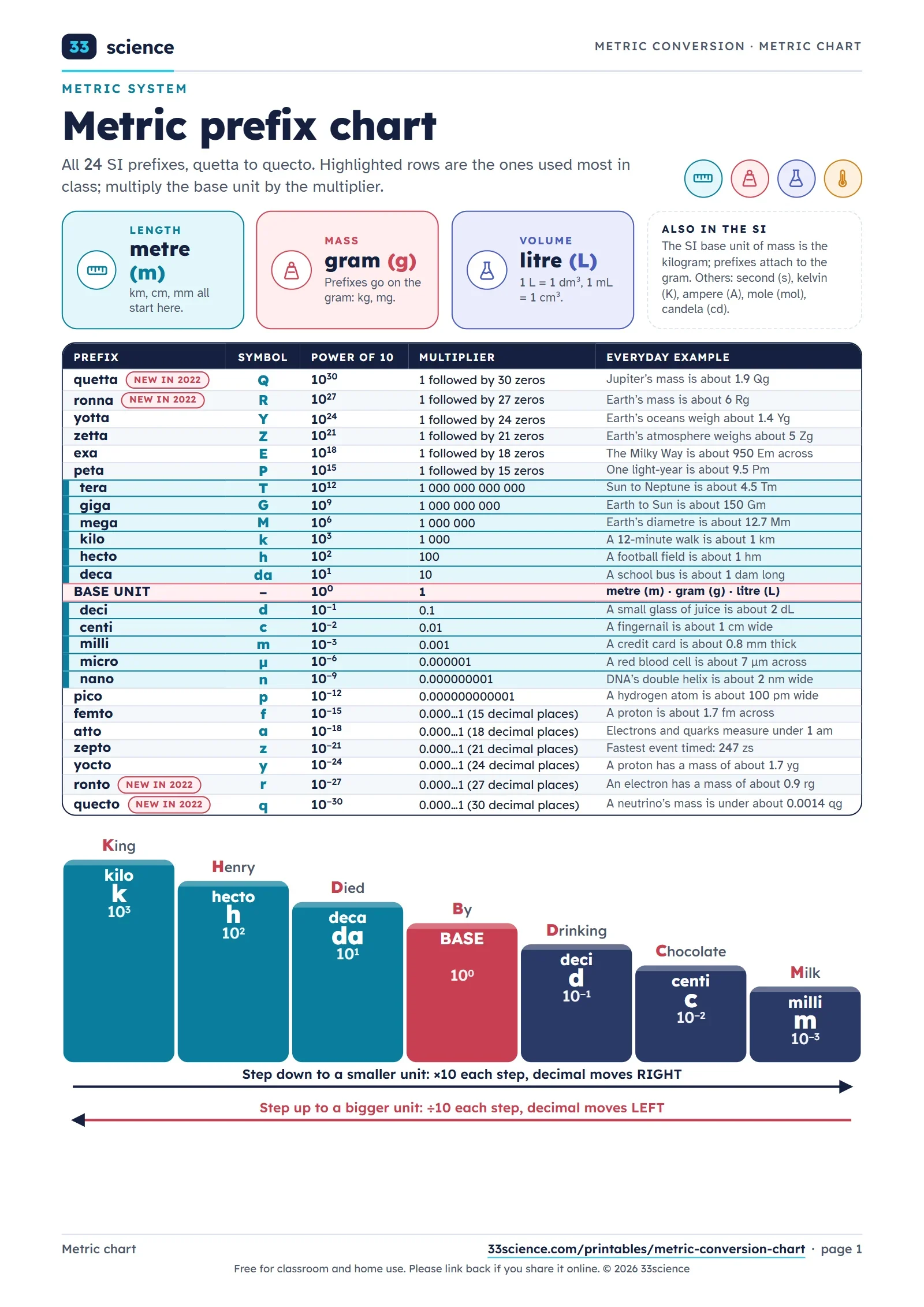
This metric prefixes chart shades the six prefixes taught in most classrooms (kilo, hecto, deka, deci, centi and milli) and the five that matter next in science: tera, giga, mega, micro and nano.
| Prefix | Symbol | Power of 10 | Multiplier | Everyday example |
|---|---|---|---|---|
| quetta new in 2022 | Q | 1030 | 1 followed by 30 zeros | Jupiter's mass is about 1.9 Qg |
| ronna new in 2022 | R | 1027 | 1 followed by 27 zeros | Earth's mass is about 6 Rg |
| yotta | Y | 1024 | 1 followed by 24 zeros | Earth's oceans weigh about 1.4 Yg |
| zetta | Z | 1021 | 1 followed by 21 zeros | Earth's atmosphere weighs about 5 Zg |
| exa | E | 1018 | 1 followed by 18 zeros | The Milky Way is about 950 Em across |
| peta | P | 1015 | 1 followed by 15 zeros | One light-year is about 9.5 Pm |
| tera | T | 1012 | 1 000 000 000 000 | Sun to Neptune is about 4.5 Tm |
| giga | G | 109 | 1 000 000 000 | Earth to Sun is about 150 Gm |
| mega | M | 106 | 1 000 000 | Earth's diameter is about 12.7 Mm |
| kilo | k | 103 | 1 000 | A 12-minute walk is about 1 km |
| hecto | h | 102 | 100 | A football field is about 1 hm |
| deka | da | 101 | 10 | A school bus is about 1 dam long |
| Base unit | – | 100 | 1 | meter (m), gram (g), liter (L) |
| deci | d | 10−1 | 0.1 | A small glass of juice is about 2 dL |
| centi | c | 10−2 | 0.01 | A fingernail is about 1 cm wide |
| milli | m | 10−3 | 0.001 | A credit card is about 0.8 mm thick |
| micro | µ | 10−6 | 0.000 001 | A red blood cell is about 7 µm across |
| nano | n | 10−9 | 0.000 000 001 | DNA's double helix is about 2 nm wide |
| pico | p | 10−12 | 0.000 000 000 001 | A hydrogen atom is about 100 pm wide |
| femto | f | 10−15 | 0.000...1 (15 decimal places) | A proton is about 1.7 fm across |
| atto | a | 10−18 | 0.000...1 (18 decimal places) | Electrons and quarks measure under 1 am |
| zepto | z | 10−21 | 0.000...1 (21 decimal places) | Fastest event timed: 247 zs |
| yocto | y | 10−24 | 0.000...1 (24 decimal places) | A proton has a mass of about 1.7 yg |
| ronto new in 2022 | r | 10−27 | 0.000...1 (27 decimal places) | An electron has a mass of about 0.9 rg |
| quecto new in 2022 | q | 10−30 | 0.000...1 (30 decimal places) | A neutrino's mass is under about 0.0014 qg |
Four of the prefixes are new. In November 2022 the General Conference on Weights and Measures added quetta (1030), ronna (1027), ronto (10−27) and quecto (10−30) because data science was outgrowing yotta. A chart that stops at yotta and yocto is missing them.
The metric staircase: King Henry Died By Drinking Chocolate Milk
The staircase, also called the metric ladder, lists the seven units used most often in order of size. The sentence gives the order: King Henry Died By Drinking Chocolate Milk stands for kilo, hecto, deka, base unit, deci, centi, milli.
- Kingkilok103
- Henryhectoh102
- Dieddekada101
- Bybase unit100
- Drinkingdecid10−1
- Chocolatecentic10−2
- Milkmillim10−3
Down a step: ×10, decimal moves right. Bigger number, smaller unit.
Up a step: ÷10, decimal moves left. Smaller number, bigger unit.
How to use the staircase
- Write the number and find both units on the staircase.
- Count the steps from the starting unit to the unit you want.
- Moving down toward milli multiplies by 10 for each step, so move the decimal point right. Moving up toward kilo divides by 10 for each step, so move it left.
Most metric conversions are nothing more than this decimal move. Add zeros when the number runs out of digits.
Worked examples
3.5 km to meters: kilo to the base unit is 3 steps down, so the decimal point moves 3 places right. 3.5 km = 3,500 m. 450 mg to grams: milli to the base unit is 3 steps up, so the decimal point moves 3 places left. 450 mg = 0.45 g.
Metric conversion table: US customary to metric
Every US customary unit is defined in metric terms, so each factor in this unit conversion chart is exact. Multiply to go from US to metric and divide to come back. The metric-only tab is a metric system conversion chart for conversions inside the system, such as kilometers to meters or liters to milliliters.
Lengthinternational foot
| US unit | Equals (exact) | Metric to US |
|---|---|---|
| 1 in | 2.54 cm | × 0.393701 |
| 1 ft | 0.3048 m | × 3.28084 |
| 1 yd | 0.9144 m | × 1.09361 |
| 1 mi | 1.609344 km | × 0.621371 |
Massavoirdupois
| US unit | Equals (exact) | Metric to US |
|---|---|---|
| 1 oz | 28.349523125 g | × 0.0352740 |
| 1 lb | 0.45359237 kg | × 2.20462 |
| 1 short ton | 907.18474 kg | × 0.00110231 |
VolumeUS liquid measure
| US unit | Equals (exact) | Metric to US |
|---|---|---|
| 1 fl oz | 29.5735295625 mL | × 0.0338140 |
| 1 cup | 236.5882365 mL | × 0.00422675 |
| 1 pt | 0.473176473 L | × 2.11338 |
| 1 qt | 0.946352946 L | × 1.05669 |
| 1 gal | 3.785411784 L | × 0.264172 |
Areasquare the linear factor
| US unit | Equals (exact) | Metric to US |
|---|---|---|
| 1 in2 | 6.4516 cm2 | × 0.155000 |
| 1 ft2 | 0.09290304 m2 | × 10.7639 |
| 1 yd2 | 0.83612736 m2 | × 1.19599 |
| 1 acre | 0.40468564224 ha | × 2.47105 |
| 1 mi2 | 2.589988110336 km2 | × 0.386102 |
Temperatureformulas and landmarks
°C = (°F − 32) × 5/9
°F = °C × 9/5 + 32
K = °C + 273.15
| °C | °F | Kelvin | Landmark |
|---|---|---|---|
| −273.15°C | −459.67°F | 0 K | absolute zero |
| −40°C | −40°F | 233.15 K | same on both scales |
| 0°C | 32°F | 273.15 K | water freezes |
| 20°C | 68°F | 293.15 K | room temperature |
| 37°C | 98.6°F | 310.15 K | body temperature |
| 100°C | 212°F | 373.15 K | water boils |
Lengthbase unit: meter
| Start | Equals | How to remember |
|---|---|---|
| 1 km | 1000 m | ×1000 |
| 1 m | 100 cm | ×100 (centi = hundredth) |
| 1 cm | 10 mm | ×10 |
| 1 m | 1000 mm | ×1000 |
| 1 mm | 1000 µm | ×1000 |
Massbase unit: gram
| Start | Equals | How to remember |
|---|---|---|
| 1 t | 1000 kg | a tonne is a metric ton |
| 1 kg | 1000 g | ×1000 |
| 1 g | 1000 mg | ×1000 |
| 1 mg | 1000 µg | ×1000 |
Volume1 L = 1 dm3
| Start | Equals | How to remember |
|---|---|---|
| 1 L | 1000 mL | ×1000 |
| 1 mL | 1 cm3 | the same amount |
| 1 L | 1 dm3 | the same amount |
| 1 m3 | 1000 L | 10 × 10 × 10 dm |
| 1 kL | 1 m3 | the same amount |
Areasquare the factor
| Start | Equals | How to remember |
|---|---|---|
| 1 m2 | 10000 cm2 | 100 × 100 |
| 1 cm2 | 100 mm2 | 10 × 10 |
| 1 ha | 10000 m2 | a 100 m square |
| 1 km2 | 100 ha | 10 × 10 hundred-meter squares |
| 1 km2 | 1000000 m2 | 1000 × 1000 |
Temperatureformulas and landmarks
K = °C + 273.15
°C = K − 273.15
| °C | Kelvin | Landmark |
|---|---|---|
| −273.15°C | 0 K | absolute zero |
| −40°C | 233.15 K | same on both scales |
| 0°C | 273.15 K | water freezes |
| 20°C | 293.15 K | room temperature |
| 37°C | 310.15 K | body temperature |
| 100°C | 373.15 K | water boils |
Check the size of your answer before you trust it: inches become more centimeters (about 2.5 times as many) and pounds become fewer kilograms (about 0.45 times as many).
Kitchen, liquid, weight and temperature conversions
Recipes mix systems more than any other place. The kitchen conversion chart in the download section covers the common cases. These are the numbers to remember.
- Liquid: 1 cup = 236.6 mL (recipes round to 240 mL), 1 tablespoon = 14.8 mL (15 mL), 1 teaspoon = 4.9 mL (5 mL), 1 liter = 1.057 quarts.
- Weight: 1 ounce = 28.35 g and 1 pound = 453.6 g.
- Cups to grams: there is no single factor because a cup measures volume. A cup of all-purpose flour is about 120 g and a cup of granulated sugar is about 198 g.
- Temperature: 350 °F = 177 °C, which recipes round to 180 °C.
Metric unit converter
Choose a quantity, type a value and read the result with the steps. Conversions inside the metric system show the staircase and the decimal move. Conversions between systems show the fractions that cancel the units.
10 ft = 3.048 m
10 ft × 0.3048 m1 ft = 3.048 m
Metric conversion practice
The practice quiz makes a new problem each time from the same sets as the worksheets, so the rounding rule matches the printed sheets. Equivalent answers count: 3,500 and 3500 are the same, and so are 3.2e5 and 3.2 × 10^5.
Loading a problem…
Type a number. Commas, spaces and 3.2e5 or 3.2 × 10^5 all work.
How teachers can use the set
- Teach: hang the staircase poster and walk through the worked examples on the board.
- Practice: assign the worksheet for the grade band. The answer key gives each answer with one line of working, so students can check themselves.
- Check: give the matching quiz, which has 12 multiple choice and 3 short answer questions, or use the fill-in chart as an exit ticket.
- Differentiate: hand fast finishers the next band up. The layout is the same on Letter and A4.
- Save ink: switch the chart to its black and white version.
For the systems behind these units, read units of measurement and examples of SI units. In chemistry the same conversions run through the molar mass calculator, which turns grams into moles. More free sheets are in the printables hub.
Frequently asked questions
How do you convert units in the metric system?
Count the steps between the two units on the metric staircase, then move the decimal point that many places. Each step down to a smaller unit multiplies by 10, so the decimal moves right. Each step up to a bigger unit divides by 10, so it moves left. Example: 3.5 km to m is 3 steps down, so 3.5 becomes 3,500 m.
What is the easiest way to remember the metric prefixes?
Use "King Henry Died By Drinking Chocolate Milk". The first letters give kilo, hecto, deka, base unit, deci, centi and milli, from the largest unit to the smallest. Each step to the right is a factor of 10.
How many SI prefixes are there?
There are 24, from quetta (1030) to quecto (10-30). Four of them are new: quetta (Q), ronna (R), ronto (r) and quecto (q) were adopted in November 2022, the first additions since 1991. Most classrooms only use kilo, hecto, deka, deci, centi and milli, plus mega, giga, micro and nano in science.
How do I convert US customary units to metric?
Multiply by the exact factor: 1 in = 2.54 cm, 1 ft = 0.3048 m, 1 mi = 1.609344 km, 1 lb = 0.45359237 kg, 1 gal = 3.785411784 L. To go back, divide by the same factor. Keep the full factor during the work and round only the final answer.
How do I convert Celsius to Fahrenheit?
Multiply the Celsius value by 9/5 and add 32: °F = °C × 9/5 + 32. To go the other way, subtract 32 and multiply by 5/9. Kelvin is °C + 273.15. For a quick estimate, double the Celsius value and add 30: 20 °C is about 70 °F (exactly 68).
How many milliliters are in a liter?
There are 1,000 mL in 1 L. A milliliter is also exactly 1 cm³, and a liter is exactly 1 dm³ (a cube 10 cm on each side), which is why 1 L = 1,000 cm³.
Are the printable metric conversion worksheets free?
Yes. Print them for classroom or home use. If you share them online, link to this page instead of re-hosting the PDFs.
What is the difference between the US Letter and A4 versions?
The layout is the same and the paper size differs. The US Letter set (8.5 × 11 in) covers US customary and metric units. The A4 set (210 × 297 mm) is metric only, so its worksheets stay inside the metric system, including area, volume and kelvin. The A4 kitchen chart is the exception: it converts American recipes.
Do the worksheets and quizzes have answer keys?
Yes. Each worksheet, quiz and the fill-in chart has a separate answer key PDF. Every answer comes with a one-line working. Switch on "Include answer keys" in the download section to show the key links.
Is the converter exact?
Yes. It uses exact fractions, not floating-point numbers, and every factor is a definition (for example 1 in = 2.54 cm exactly). A result is rounded only for display, and a rounded result is marked with the approximately-equal sign.