Here’s the short version most pages bury three paragraphs deep: Slovenia has produced exactly one Nobel laureate born on its soil. One. His name was Friderik Pregl, he won the Chemistry prize in 1923, and he did it by figuring out how to weigh almost nothing.
That number trips people up. A country of two million that punches above its weight in skiing, chess, and a recent NBA Most Valuable Player only has a single Nobel medal to its name? It feels like there should be more. There isn’t — at least not in the way most people mean it. But the full answer is more interesting than the headline, because the question “who counts as Slovenian?” gets genuinely tangled once you involve a collapsed empire, a wandering physicist, and the difference between where you’re born and which passport you happen to hold.
Table of Contents
- The quick answer
- Who was Friderik Pregl?
- What he actually won for
- The Duncan Haldane wrinkle
- Born Slovenian vs. of Slovenian descent
- Why so few? The Austria-Hungary problem
- Slovenia vs. its neighbors
- Pregl’s living legacy
- The bottom line, restated
The quick answer
If you came here to settle a trivia argument, here it is:
The only Nobel laureate born in present-day Slovenia is Friderik (Fritz) Pregl, who won the 1923 Nobel Prize in Chemistry. He was born in Ljubljana in 1869, did his prize-winning work in Graz, Austria, and that’s the whole list of Slovenian-born winners.
You’ll see other names floated — Duncan Haldane (2016 Physics) sometimes gets attached to Slovenia because of a citizenship technicality, and a handful of laureates have distant Slovenian roots. None of them were born in Slovenia. We’ll get to why those edge cases exist, because they’re the reason this question is messier than a one-line answer suggests.
Who was Friderik Pregl?
Pregl was born on September 3, 1869, in Ljubljana, back when the city was called Laibach and sat inside the Austro-Hungarian Empire. His background was the kind of mixed Slovene-German heritage that was completely normal in the Habsburg lands and completely confusing to anyone trying to assign him a single nationality afterward. His father, a bank treasurer, was Slovene; the family spoke German at home. When his father died young, Pregl’s mother moved the household to Graz.
That move mattered. Pregl studied medicine at the University of Graz, qualified as a physician in 1894, and then did something that reroutes a lot of scientific careers: he got bored with the patients and fascinated by the lab. He drifted toward physiology and chemistry, spent time studying in Germany under heavyweights like the organic chemist Emil Fischer, and came back to Graz to build the thing that would eventually win him a medal in Stockholm.
He never married, never had a flashy public life, and by most accounts was a meticulous, slightly obsessive experimentalist — the kind of person who would happily spend two years redesigning a balance because the existing one wasn’t accurate enough. Which, as it turns out, is exactly what he did.
What he actually won for
The official citation reads “for his invention of the method of micro-analysis of organic substances.” That phrasing makes it sound dustier than it is. Here’s the plain version.
If you want to know what an unknown organic compound is made of, you burn a sample and measure the products — how much carbon, hydrogen, nitrogen, and so on. The problem in the early 1900s was that the standard method needed a relatively large sample, often hundreds of milligrams. For a chemist working with a rare natural product — say, a tiny amount of a compound painstakingly extracted from animal tissue — that was a dealbreaker. You’d use up your entire supply just identifying it.
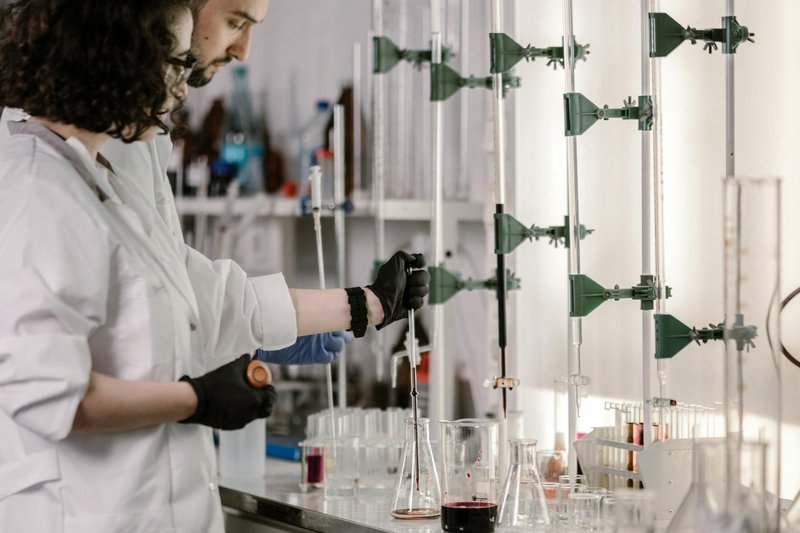
Pregl’s breakthrough was shrinking the whole operation. He developed techniques and apparatus that let chemists run the same analysis on samples roughly fifty times smaller — milligrams instead of hundreds of milligrams. To pull that off, he needed to weigh quantities down to a few millionths of a gram, so he worked with the instrument-maker community to develop a microbalance sensitive enough to detect changes that earlier balances simply couldn’t register.
The payoff was enormous and quiet. Quantitative organic microanalysis became a standard workhorse of chemistry and biochemistry for decades. Anyone isolating vitamins, hormones, or natural compounds in small quantities — which was a huge slice of twentieth-century biochemistry — relied on the basic approach Pregl systematized. The Nobel Prize organization’s own account credits the method with making it possible to analyze substances that were previously too scarce to study at all. He won a prize not for a single dramatic discovery but for handing every other chemist a sharper tool.
The Duncan Haldane wrinkle
This is where the trivia gets slippery, and where most of the thin pages that rank for this topic just stop.
F. Duncan M. Haldane shared the 2016 Nobel Prize in Physics for theoretical work on topological phases of matter. Haldane is British-born, educated at Cambridge, and spent most of his career in the United States, where he’s a professor at Princeton. So why does his name keep surfacing in searches about Slovenia?
Because at the time of his award, Haldane held Slovenian citizenship in addition to his British and American ones. He’d obtained it — reportedly through marriage and a connection to the country — and so, technically, in 2016 a Slovenian citizen was named a Nobel laureate in Physics. Slovenian media noted it; national-pride math being what it is, the connection stuck around in lists and search results.
But hold the celebration. Haldane wasn’t born in Slovenia, wasn’t raised there, didn’t study there, and did none of his prize-winning physics there. Counting him as “Slovenia’s second Nobel laureate” stretches the word until it snaps. If a passport alone qualified someone, the geography of Nobel history would look very different. He’s a citizen who won a Nobel — not a Slovenian product of Slovenian science. The honest framing: an asterisk, not an entry.
Born Slovenian vs. of Slovenian descent
The Haldane case points at the broader confusion, which is that “Slovenian Nobel laureate” can mean at least three different things, and people slide between them without noticing:
- Born in present-day Slovenia. This is the strictest, cleanest definition. Exactly one person qualifies: Friderik Pregl.
- Holding Slovenian citizenship. This pulls in the Haldane edge case, where the link is legal rather than biographical.
- Of Slovenian ancestry or descent. This is the loosest bucket, and it’s where the count gets fuzzy and arguable.
That third category is the one that tempts people into inflating Slovenia’s tally. Over the decades, various laureates with partial Slovenian roots — a grandparent here, an emigrant ancestor there — have been claimed by enthusiastic genealogists. Some of those links are real, some are tenuous, and almost none of them produced a laureate who’d have called themselves Slovenian or who worked within Slovenian science. Descent is a thread, not a flag.
The useful rule of thumb: if you mean “scientists Slovenia produced,” the answer is Pregl, full stop. If you mean “anyone, anywhere, with a drop of Slovenian blood or a Slovenian document,” you can pad the list, but you’re no longer answering the question most people are actually asking.
Why so few? The Austria-Hungary problem
A reasonable follow-up: how does a nation with a serious intellectual tradition end up with a single homegrown laureate?
Part of it is simple math — Slovenia is small, and Nobel counts scale roughly with population and research funding. But the deeper reason is historical, and it’s the same reason Pregl himself is hard to pin down. For most of the period when modern science was professionalizing and Nobels started being handed out, there was no independent Slovenia. The territory was a set of provinces inside Austria-Hungary, and ambitious Slovene scientists went where the universities, labs, and money were: Vienna, Graz, Prague. Their achievements got logged under the empire, then under Austria, then under Yugoslavia.
Pregl is the perfect illustration. He was born in Ljubljana but built his career and did his Nobel work in Graz. Austria has, understandably, also claimed him — he appears on lists of Austrian laureates too, since he was an Austrian citizen who worked at an Austrian university. He’s a shared figure, which is what happens to talent that crosses borders that themselves keep moving.
Slovenia only became an independent state in 1991, after breaking from Yugoslavia. A country that’s existed for a few decades, with a research budget sized to two million people, was never going to rack up a long Nobel ledger. One laureate from the soil, with a complicated dual claim, is roughly what the history predicts. The University of Ljubljana and Slovenian research institutes are productive, but Nobel-scale recognition is a lagging, lopsided indicator that favors big, old, well-funded systems.
Slovenia vs. its neighbors
To put the single medal in context, here’s how Slovenia stacks up against the countries it borders or shares history with. The numbers below count laureates by the country most commonly associated with them, which — as the Pregl case shows — is itself a slightly fuzzy exercise.
| Country | Approx. Nobel laureates | Population (millions) | Notes |
|---|---|---|---|
| Slovenia | 1 (Pregl, by birth) | ~2.1 | Plus the Haldane citizenship asterisk |
| Austria | ~20+ | ~9 | Often also claims Pregl |
| Croatia | ~2–3 | ~3.9 | Includes claims via descent/birth, similarly contested |
| Italy | ~20 | ~59 | Bordering Slovenia to the west |
| Hungary | ~13+ | ~9.6 | Many laureates emigrated before winning |
The pattern is the same one you see everywhere on the Nobel map: the older, larger states with deep university systems dominate, and the smaller successor states of Austria-Hungary carry thin counts with overlapping, disputed claims. Croatia’s situation rhymes with Slovenia’s — a short list, an argument about who really “belongs” to them, and a much longer one if you count descent.
Pregl’s living legacy
Pregl died in Graz in 1922 — and here’s a detail that surprises people — he learned he’d won the 1923 prize, but the award was actually conferred in his lifetime in late 1923 after a year’s deferral, and he donated a portion of his prize money to support young researchers. (Sources differ slightly on the timeline of his final years; what’s consistent is that he funneled his winnings back into science rather than keeping it.)
His name still circulates in chemistry circles. The Austrian Society for Analytical Chemistry awards the Fritz Pregl Medal, and his microanalytical methods were taught as foundational technique well into the era when instrumental analysis began replacing manual combustion methods. In Slovenia, he’s a point of national pride precisely because the list is so short — when you’ve got one laureate, you make him count. You’ll find his face on commemorative materials and his name attached to chemistry honors and lecture halls.
The throughline from Pregl to modern Slovenian science is real but modest: a tradition of strong analytical chemistry and a research culture that, given its size, produces good work that rarely makes Stockholm’s shortlist. That’s not a failure. It’s the ordinary fate of small nations in a prize system built around scale.
The bottom line, restated
So, Slovenia’s Nobel Prize winners, counted honestly:
- One laureate born in Slovenia: Friderik Pregl, Chemistry 1923, for inventing organic microanalysis — the art of weighing almost nothing accurately enough to identify it.
- One citizenship asterisk: Duncan Haldane, Physics 2016, a Slovenian citizen at the time of his award but British-born and a lifelong outsider to Slovenian science.
- A scattering of descent claims that depend entirely on how generously you define “Slovenian.”
The reason the count is low isn’t that Slovenia lacks brains. It’s that for almost the entire Nobel era, Slovene scientists worked under other flags, in other cities, logged in other countries’ ledgers — and the independent nation is younger than a lot of the people reading this. Pregl shrank the sample size needed to identify a compound. Slovenia, fittingly, offers a small but unambiguous sample of Nobel greatness: just enough to be sure of what it is.