Ask most people whether Ukraine has volcanoes and you’ll get a confused look. The country’s better known for wheat fields and the Carpathians than for anything that erupts. But the answer is yes — with one big asterisk. Ukraine’s volcanoes are almost all mud volcanoes, plus a chain of long-dead magmatic peaks that stopped erupting millions of years ago. No glowing lava, no Pompeii. What you get instead is bubbling clay, hissing gas, and mountains that were once volcanic but have since cooled into forested ridges.
That distinction — mud versus magma — is the whole story here, and it’s the part nearly every search result gets muddled. Let’s sort it out.
Table of Contents
- Mud volcanoes vs. real volcanoes
- Starunia: Ukraine’s only active volcano
- The Crimean mud fields (Kerch & Bulganak)
- The Volcanic Carpathians: extinct giants
- Quick comparison
- How to visit Starunia
Mud volcanoes vs. real volcanoes
A magmatic volcano — the kind you picture — is fed by molten rock rising from deep in the Earth. Hawaii, Vesuvius, Iceland. Heat is the engine.
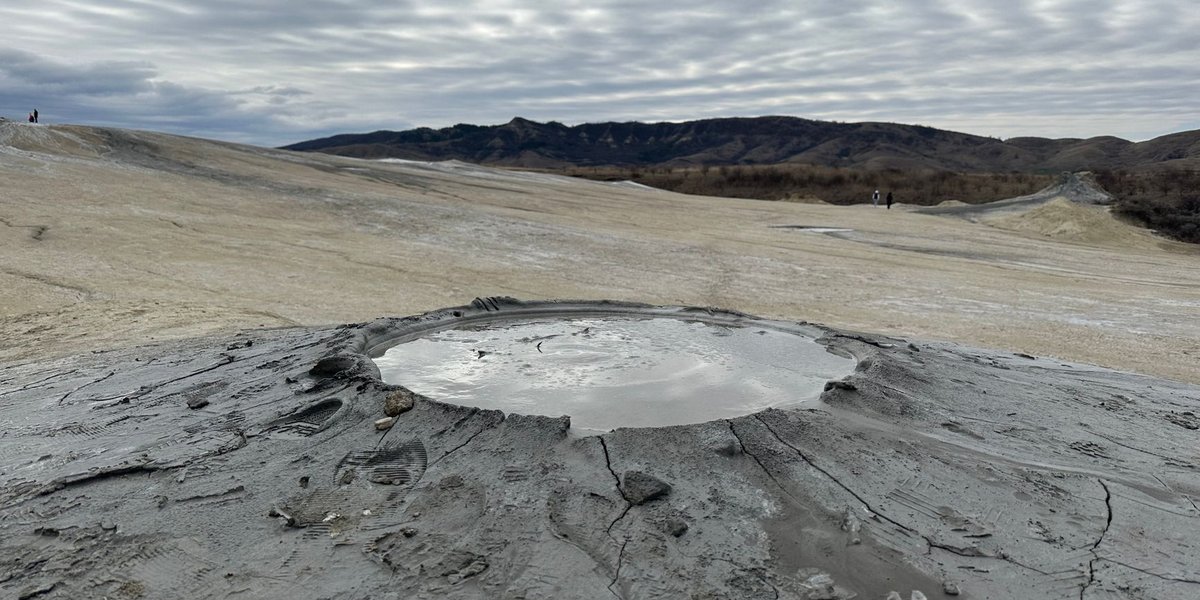
A mud volcano runs on something completely different: pressurized gas (mostly methane) and groundwater pushing semi-liquid clay up through a fault. The mud comes out cold. You can usually stand right next to the vent. The “eruption” is a slow gurgle, occasionally a meter-high burp of grey slurry, not a fountain of fire. They form where deep gas deposits sit under sedimentary rock — which is exactly the geology of western Ukraine’s old oil belt and the Kerch Peninsula.
So when a headline calls Starunia “Ukraine’s active volcano,” it’s technically true and slightly misleading at the same time. It’s active. It’s a volcano of the mud variety. Nobody’s evacuating villages over it.
Starunia: Ukraine’s only active volcano
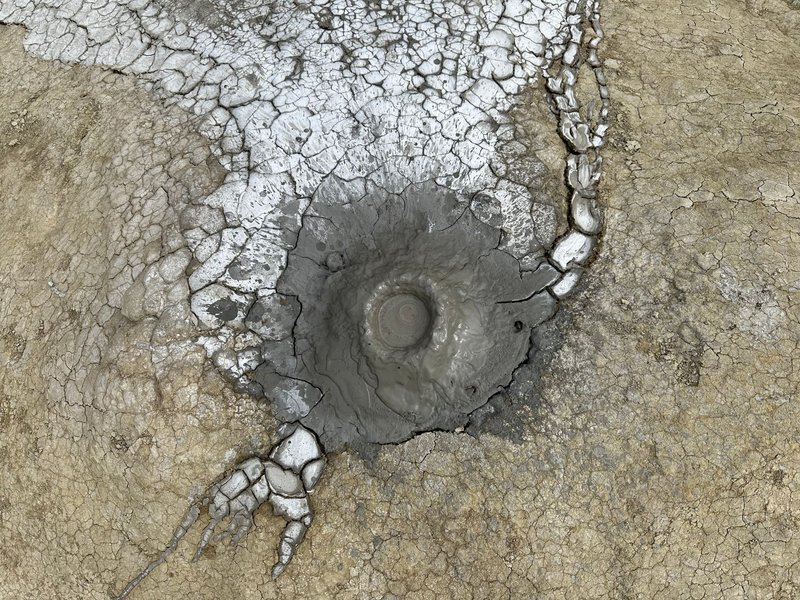
Tucked near the village of Starunia in the Ivano-Frankivsk region, this is the headliner — the one source after source labels “the only active volcano in Ukraine.” It earned that title in a strange way.
Starunia sits on top of an old ozokerite (mineral wax) and oil mining site that had been worked for decades. Then, in 1977, a powerful earthquake in Romania’s Vrancea Mountains rattled the region, and the abandoned workings answered back. Gas, clay, and oil began erupting from the ground. The result was a cluster of eight permanent craters plus several temporary ones that come and go.
The numbers are humble. The largest vent is about 30 centimeters across. During active spells the mud can shoot up two to three meters, but most of the time the craters just “breathe” — bubbling, hissing, oozing grey-blue clay that smells faintly of petroleum. It’s often called the smallest mud volcano in Europe, which is the opposite of the marketing you’d expect from a “volcano.”
What makes Starunia genuinely interesting isn’t size. It’s sensitivity. The vents react to earthquakes hundreds, even thousands of kilometers away — a distant tremor in the Mediterranean can set the craters bubbling harder days later. That’s why geologists treat it as a kind of natural seismograph, and why there’s an ongoing push to fold it into a UNESCO geopark. The same site, decades earlier, also gave up perfectly preserved Ice Age woolly rhinoceros and mammoth remains, pickled in the oil-soaked clay.
The Crimean mud fields (Kerch & Bulganak)
Ukraine’s largest concentration of mud volcanoes isn’t in the Carpathians at all — it’s on the Kerch Peninsula in Crimea, at the eastern tip near the Sea of Azov. The peninsula is one of the more geologically distinctive landforms in the region; if you like this sort of jutting, sea-flanked geography, it’s worth seeing how it stacks up against other notable peninsulas around the world.
The star here is the Bulganak field, roughly six kilometers from the city of Kerch, often nicknamed the “Moon Valley” for its cracked, otherworldly crust. It’s the biggest cluster of active mud volcanoes on the peninsula — a flat basin dotted with seven or so vents, the largest known as Andrusov Hill (Andrusova Sopka), alongside the Pavlov, Vernadsky, and Tishchenko hills. These aren’t shallow puddles: the mud they push up originates from six to nine kilometers down, carrying minerals and gas from deep sedimentary layers.
The Bulganak vents have been documented as continuously active since geologists first surveyed the peninsula in the nineteenth century. Visitors come for the surreal landscape and for the mud itself, which is widely claimed to have skin and joint benefits — the usual mud-spa pitch you should take with appropriate skepticism.
One important note: Crimea has been under Russian occupation since 2014. Internationally, the peninsula remains part of Ukraine, but it’s not somewhere you can casually plan a geology trip right now. Include these fields in the count, but treat the “how to visit” advice for Bulganak as suspended.
The Volcanic Carpathians: extinct giants
Now the magmatic volcanoes — the real-fire kind. Ukraine had them, but you’d have needed a time machine to see one erupt.
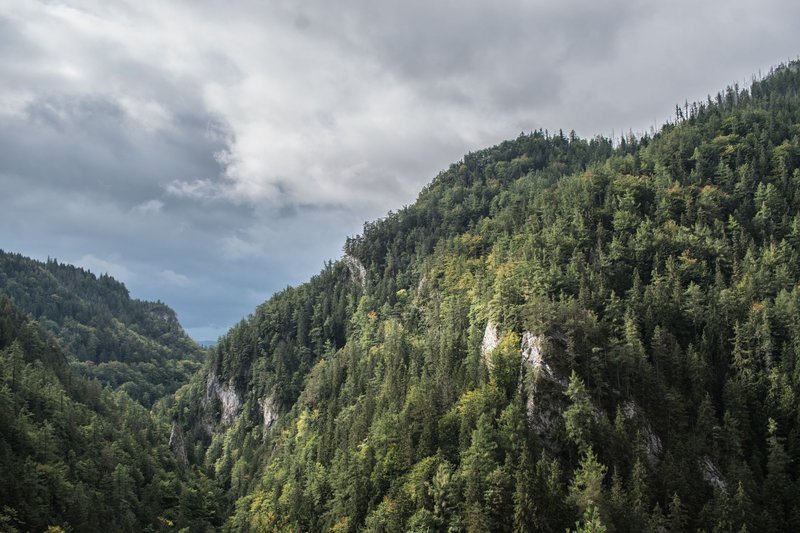
Running along the southwestern edge of the Ukrainian Carpathians is the Vyhorlat-Hutyn range, a belt of ancient volcanic mountains that’s part of the larger East Carpathian volcanic arc. These formed during the Miocene epoch, with eruptions spanning roughly 17 to 9 million years ago, as the inner Carpathian block subsided and magma forced its way up.
The range is a roll-call of forested summits that were once eruption centers: the Vyhorlat Mountains (1,074 m), the Syniak (1,014 m), Velykyi Dil (1,086 m), and the Hutyn massif (1,093 m). The rock tells the volcanic story plainly — andesites, trachytes, rhyolites, and tuffs, the signatures of both explosive blasts and slow lava flows. Today they’re covered in beech forest and dotted with crater lakes; the most famous, Lake Synevyr, sits in this volcanic country, though it was actually formed by a landslide rather than a crater.
The key point: these are extinct. Stone cold, no activity, no risk. They’re volcanoes the way a fossil is an animal — the shape is there, the life is long gone.
Quick comparison
| Volcano / region | Type | Status | Can you visit? |
|---|---|---|---|
| Starunia (Ivano-Frankivsk) | Mud | Active since 1977 | Yes — accessible, free |
| Bulganak field (Kerch, Crimea) | Mud | Active | Not currently — occupied territory |
| Vyhorlat-Hutyn range (Carpathians) | Magmatic | Extinct (~9 mya) | Yes — hiking, forests, lakes |
How to visit Starunia
Starunia is the one Ukraine volcano you can realistically go see, and it’s free.
Where it is: the village of Starunia, Bohorodchany district, Ivano-Frankivsk region, in western Ukraine. The nearest hub is the city of Ivano-Frankivsk, about an hour’s drive southwest. From there you head toward Bohorodchany and on to Starunia; the craters sit in a field a short walk from the village.
Getting there: there’s no train to the volcano itself. A car or a hired transfer from Ivano-Frankivsk is the practical option, and the final stretch can be a rough dirt track — wet weather turns it to mud, fittingly. Some Carpathian tour operators bundle it with nearby Bukovel trips.
When to go: late spring through early autumn. The site is muddy by nature and miserable in winter or after heavy rain, when the access road floods.
What to expect: a quiet field, not a tourist attraction. Look for the small craters bubbling and hissing at ground level. The activity ebbs and flows, so you might catch vigorous burping or just a lazy gurgle. Wear boots you don’t mind ruining, watch your footing near the vents, and don’t expect signage, fences, or a gift shop. That’s part of the appeal.
So — does Ukraine have volcanoes? It does. Just not the kind that make the news for the right reasons. One small, breathing mud volcano in the Carpathian foothills, a field of grey lunar mounds in occupied Crimea, and a range of extinct giants that went quiet before humans existed. No lava, plenty of geology.