TLDR
- Haiti has no active volcanoes. It has a few extinct volcanic features, and none has erupted in recorded history.
- The two best-documented sites are Morne la Vigie, a scoria cone near Saut-d’Eau, and the Thomazeau cinder cones, dated to about 1.5 million years ago.
- Haiti’s hazard is earthquakes, not eruptions. It sits on a strike-slip plate boundary, not a subduction zone.
Table of Contents
- Does Haiti have active volcanoes?
- Morne la Vigie
- The Thomazeau cinder cones
- Haiti’s volcanoes at a glance
- Why Haiti has earthquakes instead of eruptions
- The 2010 “volcano” rumor
- Can you visit them?
- FAQ
Does Haiti have active volcanoes?
No. The volcanoes in Haiti are all extinct, and the Smithsonian’s Global Volcanism Program, the standard catalog of Holocene eruptions, lists no active Haitian volcano. What the country has is a handful of old volcanic landforms: cones built from ash, cinders and basalt that stopped erupting long before anyone was around to record it.
That surprises people, because Haiti shares a sea with some of the most dangerous volcanoes in the Western Hemisphere. Martinique’s Mount Pelée killed roughly 30,000 people in 1902. Montserrat’s Soufrière Hills has been erupting on and off since 1995. Both belong to the Lesser Antilles arc, hundreds of kilometers southeast. Haiti isn’t part of that chain, and the geology explains why.
Morne la Vigie
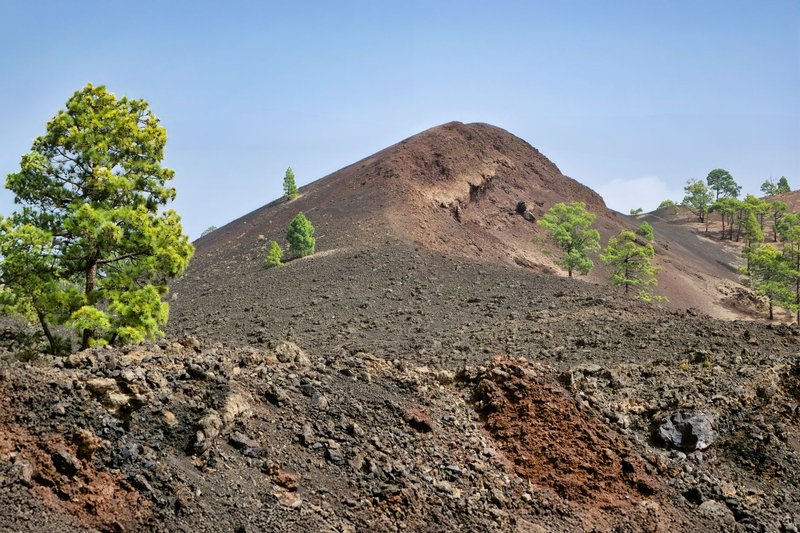
Morne la Vigie is an extinct scoria cone near Saut-d’Eau, about 21 km from Port-au-Prince. Its summit sits around 694 m (2,276 ft).
A scoria cone is the simplest kind of volcano: a short burst of gas-rich lava throws out blobs of rock that cool in the air, fall back as porous cinders, and pile up around the vent. It’s the shape you’d draw if someone asked for “a volcano” in thirty seconds. They tend to erupt once, over weeks or months, and never again. That’s why a cone like this goes extinct rather than going dormant.
The name is French for “lookout hill,” and from the top that’s what it is.
The Thomazeau cinder cones
The Thomazeau cones are a group of small volcanic cones on the plain northeast of Port-au-Prince. The Haitian Bureau of Mines and Energy identified them in 1982, and they’re dated to about 1.5 million years ago. The deposits are basalt and pyroclastic material, meaning fragments blown out during eruption.
For scale: 1.5 million years ago, early Homo erectus populations were spreading across Africa and Eurasia, and the Caribbean islands were still without humans for another million-plus years. Nothing about these cones suggests recent activity, and nothing suggests they’re connected to a magma system that’s still alive.
Haiti’s volcanoes at a glance
| Site | Type | Status | Details |
|---|---|---|---|
| Morne la Vigie | Scoria cone | Extinct | Near Saut-d’Eau, about 21 km from Port-au-Prince; summit around 694 m (2,276 ft) |
| Thomazeau cinder cones | Cinder cones | Extinct | Identified in 1982; about 1.5 million years old; basalt and pyroclastic deposits |
Why Haiti has earthquakes instead of eruptions
Most of the world’s dangerous volcanoes sit where one plate dives under another. The sinking slab releases water into the hot mantle above it, the rock melts, and magma rises. That’s the Lesser Antilles: the North American plate slides beneath the Caribbean plate, and a curved chain of volcanoes forms on top.
Haiti sits on a different part of the boundary. Along Hispaniola, the island Haiti shares with the Dominican Republic, the Caribbean and North American plates move past each other sideways, at a few centimeters a year. Geologists call this a strike-slip boundary. Plates grinding sideways don’t push rock down into the mantle, so there’s no steady supply of melt. What builds up instead is stress along faults.
Two of those faults matter most. The Septentrional fault runs along the north of the island, and the Enriquillo-Plantain Garden fault runs through the south. The second one is the fault line behind the magnitude 7.0 earthquake that struck near Port-au-Prince on January 12, 2010, as documented in the USGS event record. So the answer to “is Haiti at risk of an eruption?” is no. The answer to “is Haiti at risk of a major earthquake?” is yes, and that’s where the planning needs to go.
The cones at Morne la Vigie and Thomazeau are leftovers from a more local kind of volcanism, where magma found a way up through cracks in the crust, not an arc of volcanoes feeding on a subducting slab.
The 2010 “volcano” rumor
After the 2010 earthquake, reports circulated that the ground was burning near Port-au-Prince and that a volcano might be waking up. It made for an alarming headline.
The explanation was less dramatic. The reported burning ground was attributed to methane, a flammable gas that can seep up through fractured ground and ignite. No lava, no ash and no volcanic seismic signal came with it. An earthquake can shake gas loose and break the ground open, but that isn’t a volcanic eruption.
If you’ve seen the rumor and wondered whether Haiti has a hidden volcano, that’s the whole story.
Can you visit them?
Morne la Vigie is the more approachable of the two. It’s a hill near Saut-d’Eau, a town better known for its waterfalls and an annual pilgrimage, so most visitors there are not going for the geology. Don’t expect a crater trail, signage or a visitor center.
The Thomazeau cones are low and spread across farmland, and they’re easy to drive past without noticing. If you want to see them, a local guide or a geologist who knows the area will save you a lot of wandering. Check current travel advisories before planning any trip in Haiti, since conditions on the ground change quickly.
FAQ
Are there any active volcanoes in Haiti? No. All the known volcanic features are extinct.
What are the volcanoes in Haiti called? The two documented sites are Morne la Vigie and the Thomazeau cinder cones.
Is Haiti at risk of a volcanic eruption? No. Haiti isn’t on a subduction zone, so the supply of magma that feeds active volcanoes is missing. Earthquakes are the real hazard.
Does the Dominican Republic have active volcanoes? No. Hispaniola as a whole has none. The nearest active volcanoes are in the Lesser Antilles.
What caused the 2010 earthquake? Movement on the Enriquillo-Plantain Garden fault, part of the strike-slip boundary between the Caribbean and North American plates.