TLDR
- Ytterbium has seven stable isotopes: 168Yb, 170Yb, 171Yb, 172Yb, 173Yb, 174Yb and 176Yb.
- 174Yb is the most abundant, at about 32% of natural ytterbium.
- The radioisotopes worth knowing are 169Yb (about 32 days), 175Yb (about 4.2 days) and 166Yb (about 56.7 hours).
- 169Yb is a gamma source for radiography and has been studied for brachytherapy. 176Yb is the starting material for lutetium-177 cancer drugs. 171Yb and 173Yb sit inside some of the most precise optical lattice clocks ever built.
Table of Contents
- The seven stable ytterbium isotopes
- What “stable” means here
- The radioisotopes that matter
- Ytterbium-169: gamma rays on demand
- Ytterbium-176: the lutetium-177 factory
- Bosons, fermions, and atomic clocks
- Which isotope is which: quick reference
The seven stable ytterbium isotopes
Natural ytterbium is a mix of seven isotopes, and none of them are radioactive in any way you could measure. Element 70 has more stable isotopes than most of the periodic table, and the mix is lopsided: four isotopes (172, 173, 174 and 176) account for most of the mass, and 174Yb alone is about a third of it.
| Isotope | Natural abundance | Nuclear spin | Particle type |
|---|---|---|---|
| 168Yb | about 0.13% | 0 | Boson |
| 170Yb | about 3.0% | 0 | Boson |
| 171Yb | about 14.1% | 1/2 | Fermion |
| 172Yb | about 21.7% | 0 | Boson |
| 173Yb | about 16.1% | 5/2 | Fermion |
| 174Yb | about 32.0% | 0 | Boson |
| 176Yb | about 13.0% | 0 | Boson |
Notice the gap: there is no 175Yb in nature. It exists, but it decays in days. The abundances above are close to the values tabulated by IUPAC’s Commission on Isotopic Abundances and Atomic Weights, which also explains why ytterbium’s atomic weight (about 173.05) lands near the heavy middle of the pack.
What “stable” means here
Chemistry references often call these isotopes “observationally stable.” That phrase is honest rather than evasive. Some of them, 168Yb and 176Yb among them, are predicted by theory to decay by extremely rare double-beta-type processes, with half-lives so long that no experiment has ever caught one happening. Until someone does, they count as stable.
For anything you’d do with a sample, the distinction is irrelevant. A gram of ytterbium metal doesn’t glow, doesn’t heat itself, and doesn’t set off a Geiger counter.
The radioisotopes that matter
Ytterbium has dozens of artificial isotopes, from about 149Yb up to 189Yb, and almost all of them vanish in seconds or minutes. Three last long enough to be useful or to show up in a lab:
| Isotope | Half-life | Decay |
|---|---|---|
| 166Yb | about 56.7 hours | Electron capture |
| 169Yb | about 32 days | Electron capture |
| 175Yb | about 4.2 days | Beta minus |
Electron capture means the nucleus swallows one of its own inner electrons, turning a proton into a neutron. 169Yb becomes thulium-169 this way and releases gamma rays on the way down. 175Yb goes the other direction: a neutron turns into a proton and the atom becomes lutetium-175, which is stable. The nuclear data for all of them are collected in the National Nuclear Data Center at Brookhaven National Laboratory.
Ytterbium-169: gamma rays on demand
A 32-day half-life is a sweet spot for a gamma source. It’s long enough to ship and use for weeks, short enough that disposal isn’t a decades-long problem. 169Yb emits gamma rays in the range of roughly 60 to 200 keV, softer than the iridium-192 sources typically used in industrial radiography.
That softness is the selling point. Lower-energy gamma rays give better contrast on thin-walled pipes, welds and light metal components, and they’re easier to shield. Portable 169Yb cameras have been used for this kind of field inspection, where a bulky X-ray tube isn’t practical.
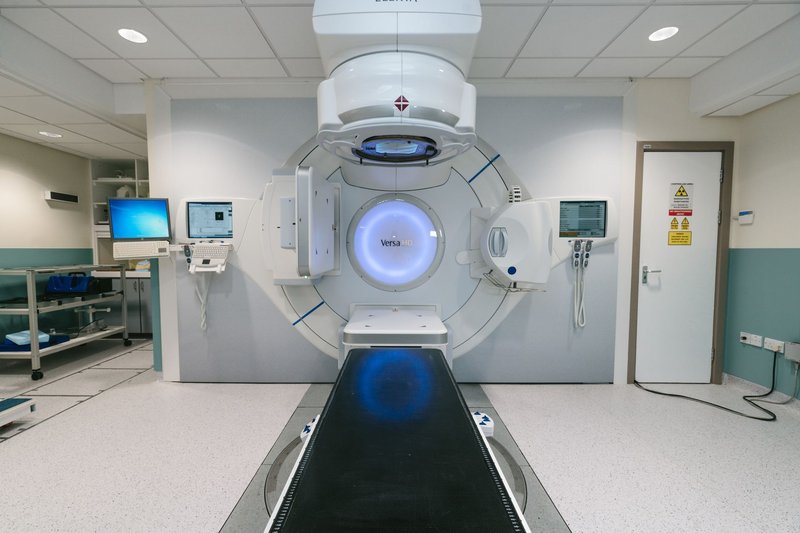
Medicine has been interested for the same reason. Researchers have examined 169Yb as a brachytherapy source, a tiny sealed radioactive seed placed next to a tumor, because its lower-energy photons deposit dose closer to the target. It remains mostly a research option rather than a routine clinical one.
Production is straightforward: irradiate enriched 168Yb with neutrons in a reactor, and some atoms capture one and become 169Yb. Enrichment matters because the 0.13% abundance of 168Yb means natural ytterbium would yield very little.
Ytterbium-176: the lutetium-177 factory
176Yb is the quiet workhorse of modern nuclear medicine. When it absorbs a neutron it becomes 177Yb, which has a half-life of only about 1.9 hours and decays by beta emission into lutetium-177.
177Lu (half-life about 6.65 days) is the radioactive payload in drugs such as Lutathera and Pluvicto, which carry it to neuroendocrine tumors and prostate cancer cells. The FDA approved Lutathera in 2018, and demand for the isotope has grown quickly since.
Why start from ytterbium instead of irradiating lutetium directly? Because the ytterbium route gives “carrier-free” 177Lu. Lutetium made from a ytterbium target is a different element from its parent, so a chemical separation can pull out nearly pure 177Lu with no stable lutetium mixed in. Stable lutetium would compete for the drug’s binding sites and weaken the dose. The cost is a hard separation: ytterbium and lutetium are neighbors on the periodic table and chemically almost identical, which makes the split a serious engineering job.
Bosons, fermions, and atomic clocks
Here’s the part the data tables skip. Every nucleus has a property called spin. Isotopes with an even number of protons and neutrons, such as 168Yb, 170Yb, 172Yb, 174Yb and 176Yb, have zero nuclear spin. Together with their electrons, these atoms behave as bosons, which are particles that can pile into the same quantum state. Isotopes with an odd neutron count, 171Yb (spin 1/2) and 173Yb (spin 5/2), behave as fermions, which refuse to share a state.
That split is useful in the lab:
- Bosons like 174Yb were among the first ytterbium atoms cooled into a Bose-Einstein condensate, in 2003. With no nuclear spin, they’re clean, simple systems for studying collisions and quantum gases.
- 171Yb has the simplest fermion structure, with a spin of 1/2 that works like a built-in qubit. That makes it a favorite for quantum simulation and quantum computing experiments.
- 171Yb and 173Yb are used in optical lattice clocks. Atoms are trapped in a lattice of laser light and probed on an ultra-narrow transition near 578 nm. Ytterbium lattice clocks at labs such as NIST have reached stability and accuracy at the level of one part in 10^18, which is roughly one second of drift over the age of the universe.
Such clocks are candidates to eventually redefine the second, and they’re sensitive enough to detect height differences of a centimeter or so through gravitational time dilation.

Which isotope is which: quick reference
| If you need… | Use |
|---|---|
| The most common isotope | 174Yb (about 32%) |
| A spin-1/2 fermion for qubits and clocks | 171Yb |
| A spin-5/2 fermion for clocks and multi-level quantum systems | 173Yb |
| A gamma source for radiography | 169Yb (about 32 days) |
| A target for carrier-free lutetium-177 | 176Yb |
| A short-lived beta emitter (decays to stable 175Lu) | 175Yb (about 4.2 days) |
| A rare isotope that needs enrichment | 168Yb (about 0.13%) |
Seven stable, one dominant, and three radioisotopes with real jobs. The ytterbium isotopes are a good case study in how a small difference in neutron count changes what an atom is good for.