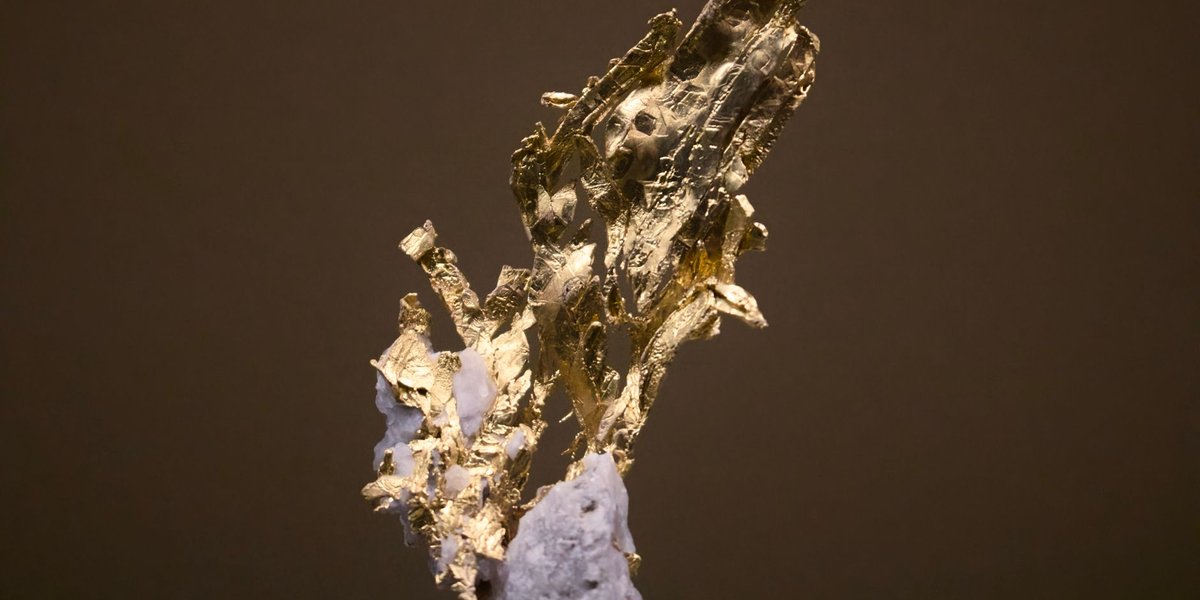
Native elements are exactly what they sound like: chemical elements that occur in nature in their pure, uncombined form. No bonding with other elements, no compound required — just the element itself, crystallized out of the earth.
It sounds simple, but it’s actually rare. Most elements are chemically reactive enough that they bond with something else almost immediately. The fact that certain elements stay pure in geological conditions tells you something specific about their chemistry — and their value to humans throughout history.
Table of Contents
- What Makes an Element “Native”?
- Native Metals
- Gold
- Silver
- Copper
- Platinum
- Native Semimetals
- Antimony
- Bismuth
- Arsenic
- Native Nonmetals
- Diamond
- Graphite
- Sulfur
- Quick Reference Table
- How to Identify Native Elements in Rocks
What Makes an Element “Native”?
An element is considered “native” when it’s found in its elemental state — meaning it isn’t chemically bonded to other elements in a mineral compound. Native gold, for example, is just gold atoms arranged in a crystal structure. It’s not gold bonded to sulfur (that would be pyrite, which isn’t gold at all, despite appearances). Pyrite belongs instead to the sulfide minerals — a large and economically important group of compounds where metals bond with sulfur.
The reason most elements don’t occur natively comes down to reactivity. Iron, for instance, bonds aggressively with oxygen under normal conditions — which is why iron ore is iron oxide, not pure iron. The native elements that do survive in pure form tend to share a few traits: low reactivity with oxygen and water, stable metallic bonding that resists chemical attack, or special geological conditions that isolate them from reactive partners.
Geologists classify native elements into three groups: metals, semimetals, and nonmetals.
Native Metals
Gold
Gold is the most famous native element — and one of the reasons humans developed metallurgy in the first place. It sits so low on the reactivity series that it essentially refuses to corrode. You can leave a gold nugget in water, acid, or air for millions of years and it comes back looking the same.
It forms in hydrothermal veins, where hot mineral-rich fluids move through rock fractures and deposit gold as they cool. The California Gold Rush of 1848 was built on placer gold — nuggets and flakes eroded from veins and deposited in riverbeds, where miners panned for them in creek sediment.
Gold crystallizes in the cubic system and, when it forms proper crystals rather than irregular masses, produces distinctive octahedral or cubic shapes. Most natural gold looks like irregular grains or branching “dendritic” masses, not the blocky ingot shape people expect.
Silver
Native silver occurs in similar environments to gold, often in hydrothermal veins and sometimes alongside native gold in a natural alloy called electrum. Unlike gold, silver does tarnish over time — it reacts slowly with sulfur compounds in the atmosphere, forming a black silver sulfide coating.
One of silver’s most distinctive natural forms is “wire silver” — long, twisted, wire-like crystals that look almost grown rather than mined. These formations occur when silver precipitates slowly from hydrothermal fluids under specific temperature and pressure conditions.
The largest silver deposits are found in Mexico, Peru, and Bolivia, which supplied much of Europe’s silver coinage during the colonial period.
Copper
Copper has a particular distinction among native metals: it was almost certainly the first metal humans used in a pure metallic form, roughly 10,000 years ago. The reason is geological accessibility — native copper deposits near the surface, in a form early humans could pick up, hammer, and shape without smelting.
The Lake Superior copper deposits in Michigan and Ontario are the world’s most significant native copper occurrence. Indigenous peoples in the region mined and traded this copper for thousands of years before European contact, producing tools and ceremonial objects across a trade network that stretched across much of North America.
Copper’s characteristic reddish-orange color makes it easy to identify. It oxidizes green (that’s the patina on old copper roofs and the Statue of Liberty), but fresh native copper in rock is unmistakably reddish. Beyond its geological interest, copper’s conductivity and ductility have made it indispensable in modern industry — from electrical wiring to plumbing, as detailed in this overview of uses of copper.
Platinum
Native platinum is rarer than gold and forms primarily in ultramafic igneous rocks — the dark, dense rocks that originate deep in the earth’s mantle. It occurs as small grains and nuggets in these rocks and in placers derived from them.
Because platinum resists corrosion even better than gold and has a much higher melting point (1,768°C versus gold’s 1,064°C), it went largely unused until the 18th century — early metallurgists couldn’t work with it easily. The largest platinum deposits are in the Bushveld Complex of South Africa, which accounts for the majority of the world’s platinum group metal production.
Native Semimetals
Semimetals (also called metalloids) have properties between metals and nonmetals. Their native forms are less economically significant than native metals but mineralogically important.
Antimony
Native antimony forms in hydrothermal veins, often alongside silver and arsenic minerals. It has a bright metallic luster and a distinctive lamellar (layered) cleavage pattern. Historically, antimony compounds were used as cosmetics in the ancient world — but the native element itself is primarily a mineralogical curiosity rather than an ore target.
Bismuth
Native bismuth is one of the more visually striking native elements. It forms hopper crystals — stepped, staircase-like crystal faces that result from faster growth at the crystal edges than at the center. In its pure elemental form, bismuth is a silvery-pink metal with a very low melting point (271°C), which makes it useful in low-temperature alloys.
Arsenic
Native arsenic forms in hydrothermal veins, often producing reniform (kidney-shaped) masses with a gray metallic surface that oxidizes rapidly. It’s unstable enough that fresh specimens have to be stored carefully to prevent surface alteration. Its primary occurrence is associated with silver and cobalt deposits.
Native Nonmetals
The native nonmetals are a small group, but two of them — diamond and graphite — are among the most studied minerals in earth science.
Diamond
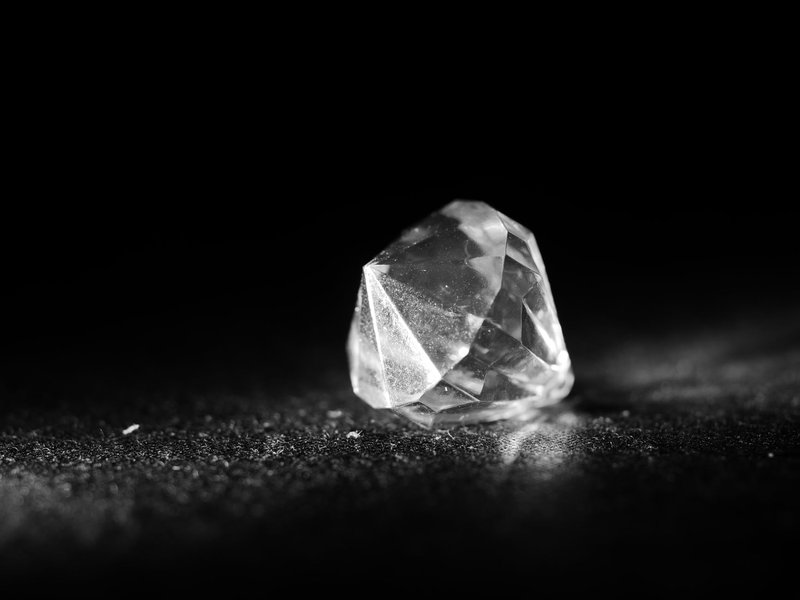
Diamond and graphite are both pure carbon. Same element, radically different structure.
Diamond forms under extreme pressure — roughly 45–60 kilobars — at depths of 150–200 kilometers in the earth’s mantle. Carbon atoms under those conditions form a rigid three-dimensional lattice where each atom bonds to four others in a tetrahedral arrangement. That structure is what makes diamond the hardest natural material on earth (10 on the Mohs scale).
Diamonds reach the surface through kimberlite pipes — narrow, carrot-shaped channels formed by deep volcanic eruptions that bring mantle material up rapidly. The speed matters: if the journey were slow, the diamond would revert to graphite as pressure decreased.
Most gem-quality diamonds are ancient. The diamond in a piece of jewelry was likely formed 1–3 billion years ago.
Graphite
Graphite is carbon atoms arranged in flat sheets, with weak van der Waals forces holding the layers together. Where diamond’s bonding runs in all three dimensions equally, graphite’s bonding runs strongly within layers and weakly between them — which is why graphite flakes apart and feels slippery. That slipperiness makes it useful as a lubricant and why pencils leave a mark (graphite layers shear off onto paper).
Graphite forms at high temperatures in metamorphic rocks — often where carbonaceous material in sedimentary rock gets cooked by heat and pressure. Major deposits are found in China, Brazil, and Mozambique.
The diamond-vs-graphite comparison is a reliable reminder that a mineral’s properties come from structure, not composition.
Sulfur
Native sulfur forms in volcanic environments, around hydrothermal vents, and near salt domes where anaerobic bacteria produce hydrogen sulfide that oxidizes into elemental sulfur. It’s bright yellow, brittle, and has a distinctive smell when heated.
Before the development of the Frasch process in the late 19th century — which extracted underground sulfur by pumping superheated water into deposits — mining native sulfur was a dangerous and labor-intensive process. Volcanic sulfur mining, done in places like the Kawah Ijen crater in Indonesia, still involves workers carrying loads of 70–90 kg of sulfur up steep crater walls by hand.
Sulfur’s primary uses are industrial: sulfuric acid production, fertilizers, and rubber vulcanization.
Quick Reference Table
| Element | Category | Key Properties | Common Use |
|---|---|---|---|
| Gold | Metal | Yellow, non-reactive, dense | Jewelry, electronics, currency |
| Silver | Metal | White, conductive, tarnishes | Jewelry, photography, electronics |
| Copper | Metal | Reddish, conductive, ductile | Wiring, plumbing, coinage |
| Platinum | Metal | Gray-white, very resistant to corrosion | Catalytic converters, jewelry |
| Antimony | Semimetal | Silver-gray, lamellar cleavage | Alloys, flame retardants |
| Bismuth | Semimetal | Silvery-pink, hopper crystals | Low-temp alloys, pharmaceuticals |
| Arsenic | Semimetal | Gray, volatile, toxic | Semiconductor dopant |
| Diamond | Nonmetal | Colorless to pale yellow, hardest mineral | Cutting tools, gemstones |
| Graphite | Nonmetal | Gray-black, slippery, conductive | Pencils, lubricants, electrodes |
| Sulfur | Nonmetal | Bright yellow, brittle, pungent | Sulfuric acid, fertilizers |
How to Identify Native Elements in Rocks
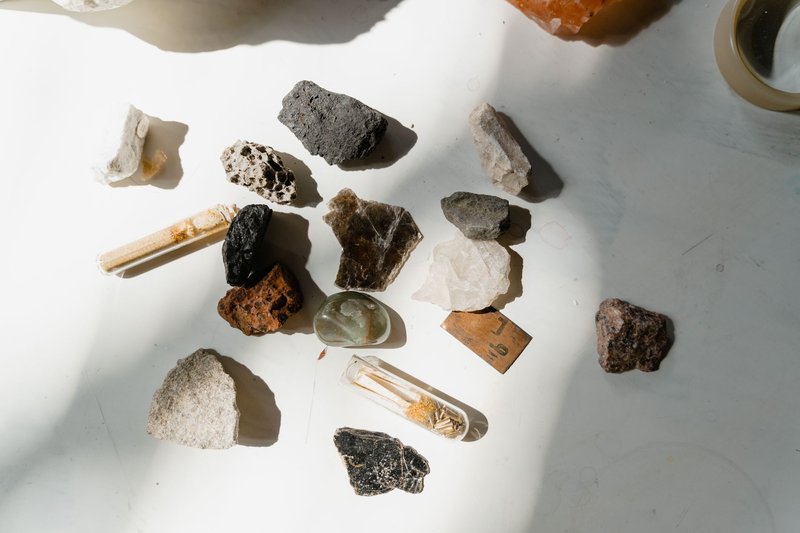
Native elements have some reliable field characteristics that set them apart from compound minerals.
Malleability is the first test for suspected native metals. Gold, silver, and copper will deform when struck — they flatten rather than shatter. This immediately distinguishes them from sulfides like pyrite, which will crumble. The old “fool’s gold” test works on exactly this principle: strike it with a knife blade, and pyrite chips while gold bends.
Color and luster narrow the field quickly. Native gold is a specific warm yellow with no silvery tint; electrum (gold-silver alloy) is paler. Native copper has the distinctive reddish-orange tone. Native sulfur’s bright yellow is essentially unmistakable in a volcanic context.
Crystal habit helps when specimens are well-formed. Native bismuth’s hopper crystals, silver’s wire forms, and arsenic’s reniform masses are each characteristic enough to be diagnostic.
For serious identification, the USGS Mineral Resources Program maintains reference databases of mineral properties that go well beyond field characteristics — including chemical analysis methods for ambiguous specimens.
The native elements occupy a small fraction of earth’s mineralogy by number of species, but a disproportionately large fraction of human economic and cultural history. Gold shaped empires. Copper enabled the first metalworking. Carbon, in two structural forms, spans the range from pencil marks to the hardest material in nature.
What makes them interesting isn’t just their purity — it’s what their existence tells you about the geological conditions that produced them.