Bahrain has no volcanoes. Not dormant ones, not ancient calderas buried under sand — none. If you’ve heard rumblings about volcanic activity in the Gulf region and started wondering whether your archipelago home is sitting on something ominous, you can set that aside.
But the why is worth understanding. It’s not just geological luck. Bahrain’s volcanic-free status is a direct consequence of where it sits on the planet’s tectonic map — and the contrast with nearby regions makes the story genuinely interesting.
Table of Contents
- Why Bahrain Has No Volcanoes
- What Is the Arabian Plate?
- The Nearest Volcanic Activity to Bahrain
- What About Earthquakes?
- FAQ
Why Bahrain Has No Volcanoes
Volcanoes form in three main tectonic settings: at diverging plate boundaries (where plates pull apart), at subducting boundaries (where one plate dives under another), and at hotspots (isolated plumes of heat rising through the mantle, like Hawaii). Bahrain doesn’t qualify for any of them.
The island nation sits squarely on the interior of the Arabian Plate — one of the more stable pieces of continental crust on Earth. It’s far from any active plate boundary, away from hotspot tracks, and geologically old enough that any ancient volcanic history has long been buried under sedimentary rock and limestone.
Bahrain’s terrain reflects this. The country is almost entirely flat, built up of layered limestone and marl. The highest point, Jabal ad Dukhan, tops out at 135 meters. This kind of low, sedimentary landscape is the physical opposite of what you’d see around a volcanic system, where you’d expect elevated terrain, igneous rock, and hydrothermal features.
What Is the Arabian Plate?
The Arabian Plate is a tectonic plate that covers the Arabian Peninsula, extending from the Red Sea in the west to the Zagros mountain belt in the northeast (where it collides with the Eurasian Plate). It’s moving slowly northward — roughly 2–3 centimeters per year — carrying Bahrain, Saudi Arabia, Yemen, and much of the Gulf with it.
The plate’s interior is geologically quiet. The action happens at its edges: the collision with Eurasia to the north creates the Zagros fold-and-thrust belt across Iran. The spreading ridge along the Red Sea in the west is pulling the Arabian Peninsula away from Africa. But both of those boundaries are hundreds of kilometers from Bahrain.
This is structurally similar to living in the middle of North America — far from the Pacific subduction zones and the Atlantic spreading ridges. The continental interior is simply not where volcanic activity happens.
The Nearest Volcanic Activity to Bahrain
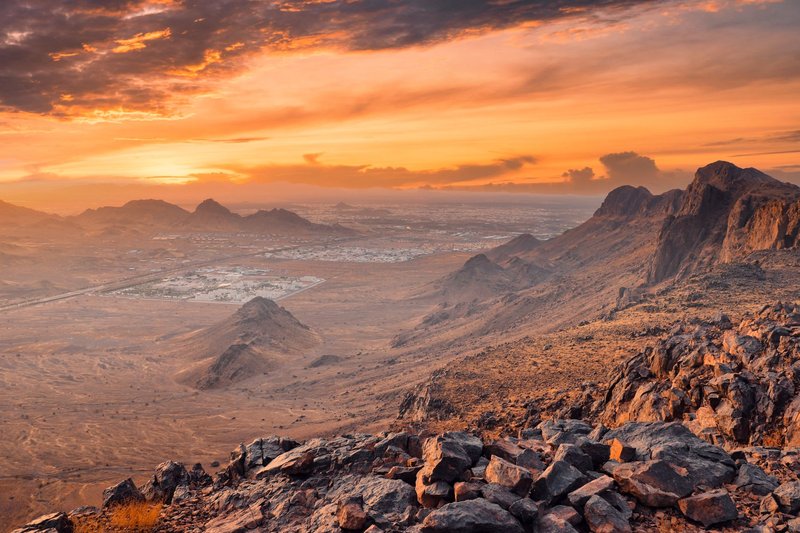
The closest volcanic terrain to Bahrain is in western Saudi Arabia, roughly 1,000 to 1,500 kilometers away — not exactly a neighborhood concern.
These are the harrat fields: vast lava plains that spread across the Hejaz and Nejd regions of the Arabian Peninsula. The Harrat Rahat field near Medina is the largest lava field on the Arabian Peninsula, covering about 20,000 square kilometers, and it had a historically documented eruption in 1256 CE. The eruption sent lava flows toward Medina, an event recorded in medieval Arabic chronicles.
These harrats formed as the Arabian Plate spread away from Africa along the Red Sea Rift, generating magma that pushed up through the crust on the western edge of the peninsula. The mechanism that produces volcanoes on Arabia’s western margin — rifting, lithospheric thinning, mantle upwelling — simply doesn’t exist under the flat, Gulf-facing eastern side where Bahrain sits.
There’s also volcanic activity to Bahrain’s south and west, in Yemen (where the Sana’a region has volcanic fields) and in the East African Rift extending through Djibouti and Ethiopia. But again, these are thousands of kilometers removed from the Gulf.
What About Earthquakes?
Bahrain is not a seismically active country by any meaningful measure, but it’s not entirely immune either.
The Arabian Plate’s collision with Eurasia along the Zagros belt generates significant earthquakes in Iran — some large enough to be felt faintly in Bahrain. In 2013, a 6.1 magnitude earthquake in southern Iran was felt across the Gulf, including in Bahrain and the UAE. The transmission of seismic waves across the relatively rigid Arabian Plate means distant events can produce mild shaking.
Bahrain itself has no significant fault systems and hasn’t recorded a damaging local earthquake in modern times. According to the United States Geological Survey, the Gulf region as a whole sits in a low-to-moderate seismic hazard zone — low by global standards, slightly elevated compared to the geologically dead continental interiors farther from plate boundaries.
So: minor felt shaking from distant Iranian earthquakes is plausible. A locally generated damaging quake is not a realistic risk based on current geological evidence.
FAQ
Does Bahrain have any volcanic rock? No. Bahrain’s exposed geology is almost entirely sedimentary — limestone, dolomite, and marl deposited in shallow marine environments over tens of millions of years. There’s no surface igneous rock.
Is Bahrain at risk from a tsunami caused by volcanic activity? Extremely unlikely. The Arabian Gulf is a shallow, semi-enclosed sea with no active submarine volcanoes nearby. Tsunamis in the Gulf are theoretically possible from seismic activity, but the geography of the Gulf significantly limits wave propagation. No credible volcanic tsunami risk exists for Bahrain.
Are there any ancient volcanoes in Bahrain’s geological history? The region that is now Bahrain was covered by shallow seas for much of its geological history, accumulating the carbonate sediments that form its current geology. There are no known ancient volcanic sequences in Bahrain’s stratigraphic record.
What is the nearest active volcano to Bahrain? The nearest historically active volcanic field is Harrat Rahat in western Saudi Arabia, roughly 1,200 km from Bahrain. Its last confirmed eruption was in 1256 CE. Active volcanoes in the East African Rift system (Ethiopia, Eritrea, Djibouti) are over 2,000 km away.
Could a volcanic eruption in Saudi Arabia affect Bahrain? A large eruption at Harrat Rahat could theoretically disperse ash across the Arabian Peninsula depending on wind direction, similar to how volcanic ash from Iceland disrupted European airspace in 2010. However, significant ground-level effects in Bahrain from such a distant eruption would be minimal at most.