
Table of Contents
- TLDR
- Why Holmium Almost Always Shows Up as +3
- Holmium Oxide (Ho₂O₃)
- Holmium Chloride (HoCl₃)
- Holmium Fluoride (HoF₃)
- Holmium Nitrate (Ho(NO₃)₃)
- Holmium Sulfate, Oxalate, Carbonate, and Hydroxide
- Holmium Acetate (Ho(CH₃COO)₃)
- The Magnetism That Makes Holmium Famous
- Ho:YAG Lasers: Holmium’s Biggest Medical Export
- Handling Holmium Compounds Safely
TLDR
Holmium forms a small, tidy family of compounds, and almost all of them share the same +3 oxidation state and a yellow-to-orange color palette. Here’s the cheat sheet:
| Compound | Formula | Color | Main Use |
|---|---|---|---|
| Holmium oxide | Ho₂O₃ | Pale yellow | Glass/ceramic coloring, optical calibration filters |
| Holmium chloride | HoCl₃ | Yellow (pink under fluorescent light) | Laser crystal doping, research reagent |
| Holmium fluoride | HoF₃ | Bright yellow | Laser crystal doping, glass manufacturing |
| Holmium nitrate | Ho(NO₃)₃·5H₂O | Yellow | Precursor for other holmium compounds |
| Holmium sulfate | Ho₂(SO₄)₃ | Orange-yellow | Research, magnetic studies |
| Holmium oxalate | Ho₂(C₂O₄)₃ | Yellow | Precipitation/purification step in refining |
| Holmium carbonate | Ho₂(CO₃)₃ | Yellow | Intermediate in oxide production |
| Holmium hydroxide | Ho(OH)₃ | Yellow | Intermediate, precipitates from basic solution |
| Holmium acetate | Ho(CH₃COO)₃ | Pale pink to yellow crystals | Research reagent, sol-gel processing |
The short version of why any of this matters: holmium’s compounds feed three real technologies — colored glass and optical filters, the strongest permanent magnet pole pieces known, and the holmium:YAG laser that urologists use to blast kidney stones. Keep reading for the specifics.
Why Holmium Almost Always Shows Up as +3
Holmium sits in the lanthanide row, and like its neighbors, it wants to lose three electrons and stop there. Once it sheds two from the 6s shell and one from 4f, what’s left is a stable, half-plus-two-electron 4f10 configuration that doesn’t want to give up any more. That’s why you won’t find a holmium(II) or holmium(IV) salt sitting on a supplier’s shelf next to the +3 compounds — the +3 state is thermodynamically the only one worth manufacturing.
That single oxidation state is also why holmium chemistry looks so repetitive at first glance. Swap the counter-ion — chloride, fluoride, nitrate, sulfate — and the metal center behaves the same way each time: hard, oxophilic, and eager to grab water molecules into its coordination sphere. Most holmium salts you can buy are hydrates for exactly this reason.
The color is the other constant. Ho³⁺’s 4f electrons produce narrow, sharp absorption bands that land in a way that reads as pale yellow to orange across nearly every compound, whether it’s dissolved in water or locked into a crystal lattice. Chemists use this so often as a reference that holmium oxide glass filters are a standard calibration tool for spectrophotometers — the absorption peaks are that reliable.
Holmium Oxide (Ho₂O₃)
Holmium oxide is the compound you’ll run into first, because it’s the one holmium metal oxidizes into on contact with air, and it’s the starting material most other holmium compounds get made from. It’s pale yellow at room temperature, shifts toward a deeper tan when heated, and doesn’t dissolve in water — you need acid to bring it into solution as a salt.
Its most recognizable job is coloring glass and cubic zirconia a yellow-to-red hue, but the more technical use is as the reference material in those holmium oxide glass filters mentioned above, used across pharmaceutical and chemical labs to verify that a spectrophotometer’s wavelength readings haven’t drifted. It’s also the compound most often cited for holmium’s magnetic behavior, since Ho₂O₃ is one of the most strongly paramagnetic substances known.
Holmium Chloride (HoCl₃)
Holmium chloride is the workhorse reagent — the compound you buy if you need holmium ions in solution for a synthesis or a doping process. It forms yellow, hygroscopic crystals that melt around 718°C, and it dissolves readily in water, which is exactly why it’s the go-to starting salt rather than the oxide.
The party trick is the lighting shift: HoCl₃ reads yellow under sunlight but shifts to a distinct pink under fluorescent light, a quirk of how its absorption bands interact with different light spectra. Industrially, it’s used to dope garnet crystals for solid-state lasers, the same family of crystal that becomes the Ho:YAG laser rod discussed further down.
Holmium Fluoride (HoF₃)
Holmium fluoride shows up wherever chloride would react badly with the process — it’s more chemically inert and far less soluble in water, which makes it useful in applications where you don’t want the holmium leaching out. It’s a bright yellow solid, and like the chloride, it’s used as a dopant in laser garnet crystals and as an additive in specialty glass and metal halide lamp manufacturing.
Because it resists moisture and most acids better than the chloride does, HoF₃ is the preferred form when holmium needs to survive high-temperature processing steps intact.
Holmium Nitrate (Ho(NO₃)₃·5H₂O)
Holmium nitrate rarely ends up as a finished product. Instead, it’s the intermediate chemists reach for when they need holmium in a form that decomposes cleanly on heating, without leaving behind a stubborn anion. Heat the pentahydrate and it breaks down toward the oxide, which makes it a convenient precursor in sol-gel synthesis and in preparing other holmium salts through metathesis reactions. It’s a yellow, water-soluble solid, and its main commercial relevance is as a raw material rather than an end-use chemical.
Holmium Sulfate, Oxalate, Carbonate, and Hydroxide
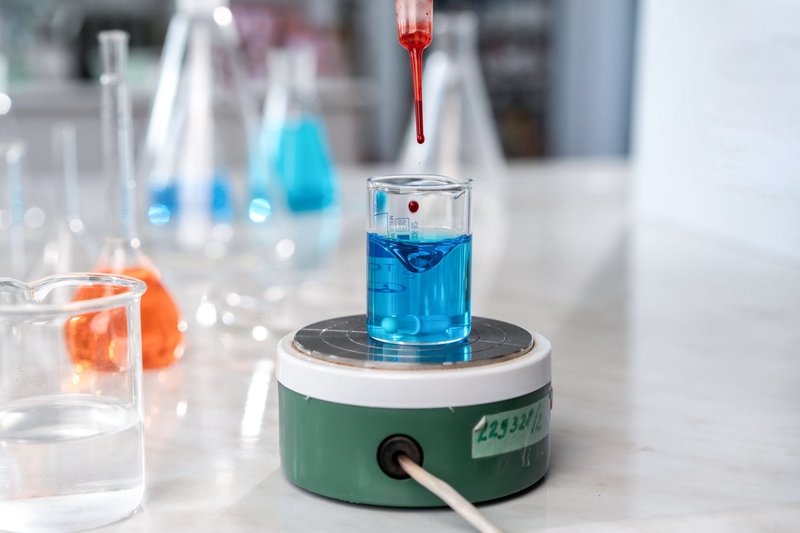
These four don’t get their own supplier catalog pages, but they matter in the middle of the process, not at the end of it. Holmium sulfate (Ho₂(SO₄)₃) is an orange-yellow solid used mostly in academic studies of magnetic and crystal behavior, since sulfate salts of the lanthanides crystallize predictably and are easy to grow into single crystals for spectroscopy.
Holmium oxalate (Ho₂(C₂O₄)₃) is the compound refiners actually rely on: rare-earth separation plants precipitate holmium out of a mixed lanthanide solution as the oxalate, because oxalates of different rare earths precipitate at slightly different conditions, letting technicians separate holmium from its neighbors on the periodic table. That oxalate is then calcined to produce the oxide.
Holmium carbonate and holmium hydroxide (Ho(OH)₃) are both yellow intermediates that show up during the same purification chain — hydroxide when holmium salts are precipitated with a base, carbonate when precipitated with a carbonate source. Neither is something you’d order unless you’re doing rare-earth process chemistry yourself.
Holmium Acetate (Ho(CH₃COO)₃)
Holmium acetate is the compound of choice when a process needs holmium ions but can’t tolerate chloride or nitrate contamination — common in sol-gel synthesis of specialty ceramics and in some research applications where a cleaner-burning organic counter-ion matters. It forms pale crystals in the yellow-to-pink range and, like the nitrate, functions mainly as a synthetic intermediate rather than a finished material.
The Magnetism That Makes Holmium Famous

Here’s the fact that gets holmium mentioned outside of chemistry circles: it has the highest magnetic moment of any naturally occurring element, at roughly 10.6 Bohr magnetons. That’s not a typo or a rounding trick — it genuinely beats iron, and it’s a property that traces directly back to holmium’s electron configuration, not its compounds. Holmium’s 4f shell holds four unpaired electrons in an arrangement that maximizes both spin and orbital angular momentum, and unlike most transition metals, the lanthanides don’t “quench” that orbital contribution the way iron-group metals do. The result is an atom with an unusually large magnetic moment, even though holmium itself isn’t ferromagnetic at room temperature.
That property gets put to work in a specific, unglamorous way: pure holmium metal (not its compounds) is used to make polepieces and flux concentrators for the strongest static magnets ever built, including the specialized magnets used in advanced MRI research and high-field laboratory magnets. Holmium oxide’s own strong paramagnetism, meanwhile, is what makes it useful as a magnetically “loud” reference material in physics research on rare-earth magnetism, as described in ongoing neutron-diffraction studies of holmium’s magnetic structure published in Scientific Reports.
Ho:YAG Lasers: Holmium’s Biggest Medical Export
If you’ve had kidney stones treated in the last two decades, there’s a decent chance holmium was involved without you ever hearing its name. The holmium:YAG laser dopes yttrium-aluminum-garnet crystal with holmium ions, producing a 2,100 nanometer beam that’s strongly absorbed by water. That matters clinically because tissue and stones are both mostly water — the laser energy gets absorbed in the top half-millimeter to millimeter of whatever it hits, so surgeons get precise cutting and stone fragmentation without a wide zone of collateral thermal damage.
Urologists use it for lithotripsy — breaking kidney and ureteral stones into fragments small enough to pass or extract, according to research published via the National Institutes of Health — as well as for cutting strictures and ablating superficial bladder tumors. The same wavelength has since found its way into orthopedic, gynecological, and dental procedures, largely because the fiber-optic delivery works well in tight endoscopic spaces.
Handling Holmium Compounds Safely
Holmium compounds aren’t in the same danger category as, say, heavy-metal salts, but they’re not inert either. Most are mild irritants to skin, eyes, and the respiratory tract in powder form, and like other rare-earth salts, chronic exposure data is thin — a reason to treat them with the same baseline caution you’d apply to any fine metal-salt powder rather than assume “rare earth” means “harmless.” Standard lab practice applies: gloves, eye protection, and handling powders under a fume hood or with local exhaust to avoid inhaling dust, particularly with the more hygroscopic salts like the chloride, which readily absorbs moisture from skin and humid air. The Royal Society of Chemistry’s element profile is a solid starting reference if you’re setting up a first-time synthesis and want the baseline physical and safety data in one place.
None of holmium’s common compounds are flammable or notably reactive with water, which puts them well down the hazard list compared to the alkali or alkaline-earth salts a chemistry student might handle in the same semester. The bigger practical risk in most labs is simply cross-contamination during rare-earth separation work, where holmium, dysprosium, and erbium salts look and behave similarly enough to mix up if containers aren’t labeled carefully.