Two organisms, both walking away better off. That’s mutualism, and once you start looking, it’s everywhere — stuck to coral reefs, buried in tree roots, riding around on the backs of zebras, and living by the trillion inside your own intestines.
Most roundups give you the same eight examples: clownfish, bees, oxpeckers, repeat. This one goes wider. Fifteen pairings, grouped by where they live, each labeled with who gets what and whether the partners need each other (obligate) or just benefit from each other when convenient (facultative). That last distinction is the thing nearly every list skips, and it’s the difference between a relationship that’s nice-to-have and one where both species die without it.
Table of Contents
- What mutualism actually is
- Mutualism vs. commensalism vs. parasitism
- Ocean examples
- Land examples
- Microscopic and inside-the-body examples
- Quick-reference table
- Obligate vs. facultative: why it matters
What mutualism actually is {#what-mutualism-actually-is}
Mutualism is a relationship between two different species where both come out ahead. Biologists sort the benefits into three buckets: a swap of resources for resources (a plant trades sugar for a fungus’s minerals), a service for a resource (a bee gets nectar, the flower gets pollinated), or a service for a service (a cleaner fish gets to eat, the client fish gets cleaned).
It’s a subset of symbiosis, which just means two species living in close contact. Symbiosis itself is neutral on who wins. Mutualism is the version where the ledger comes out positive for both.
Mutualism vs. commensalism vs. parasitism {#mutualism-vs-commensalism-vs-parasitism}
These three get mixed up constantly, and the only thing separating them is who pays and who profits.
| Relationship | Species A | Species B |
|---|---|---|
| Mutualism | Benefits | Benefits |
| Commensalism | Benefits | Unaffected |
| Parasitism | Benefits | Harmed |
A barnacle riding a whale is commensalism — the barnacle gets a free ride and a current of food, the whale neither gains nor loses much. A tapeworm in your gut is parasitism — it eats, you lose. Mutualism is the only one where both columns read “benefits.” If the line between a partnership and a hijacking still feels blurry, the differences between symbiosis and parasitism come down to who carries the cost. Keep that table in mind for every example below.
Ocean examples {#ocean-examples}
1. Clownfish and sea anemones
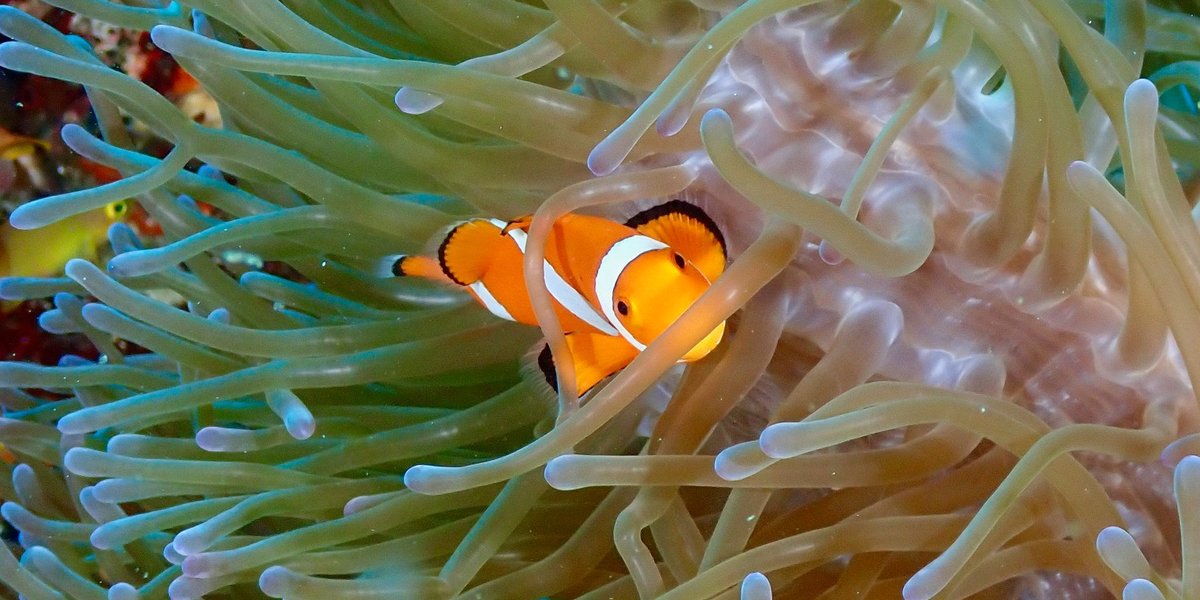
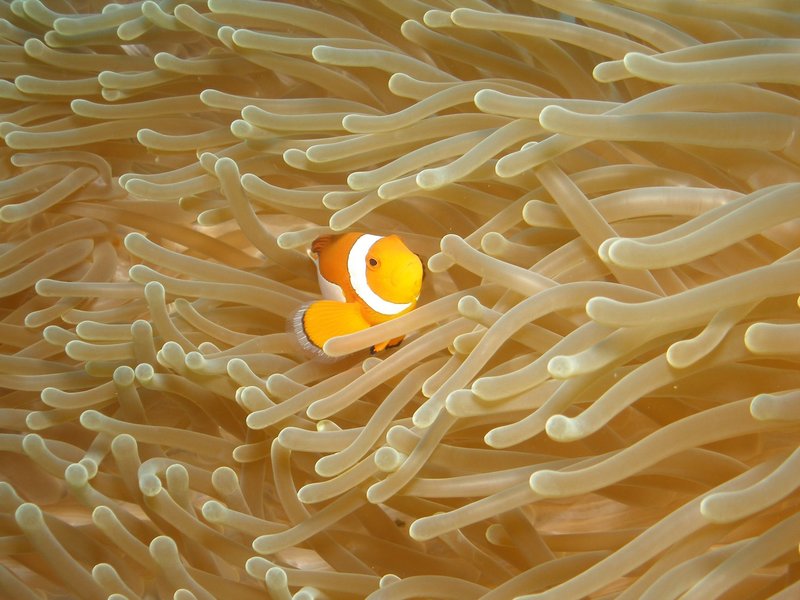
Yes, the Finding Nemo one — it earns the spot. Sea anemones are armed with stinging tentacles that paralyze most fish. Clownfish are coated in a thick mucus layer that the anemone’s nematocysts don’t fire on, so they nest inside the tentacles untouched. The clownfish gets a fortress no predator will enter. The anemone gets a tenant that drives off polyp-nibbling butterflyfish, drops scraps of food, and circulates water with its fins to keep the anemone oxygenated. Obligate for the clownfish (it can’t survive predation without the anemone), facultative for the anemone.
2. Cleaner wrasse and reef fish
Cleaner wrasse run what amount to roadside service stations on the reef. Bigger fish — groupers, parrotfish, even moray eels — line up at “cleaning stations” and hold still while the wrasse picks parasites, dead skin, and mucus off their bodies and out of their mouths and gills. The wrasse eats; the client leaves parasite-free. Reefs with cleaning stations removed show measurably higher parasite loads and lower fish diversity, which tells you how load-bearing this little fish is.
3. Goby and pistol shrimp
The pistol shrimp is nearly blind but a relentless digger; it excavates and maintains a burrow in the sand. The goby has sharp eyes but no home. So they share. The goby stands guard at the burrow entrance while the shrimp works, keeping one antenna touching the fish at all times. When the goby flicks its tail at an approaching predator, both bolt into the hole. Obligate for the shrimp, which would be a sitting duck above ground without the lookout.
4. Coral and zooxanthellae
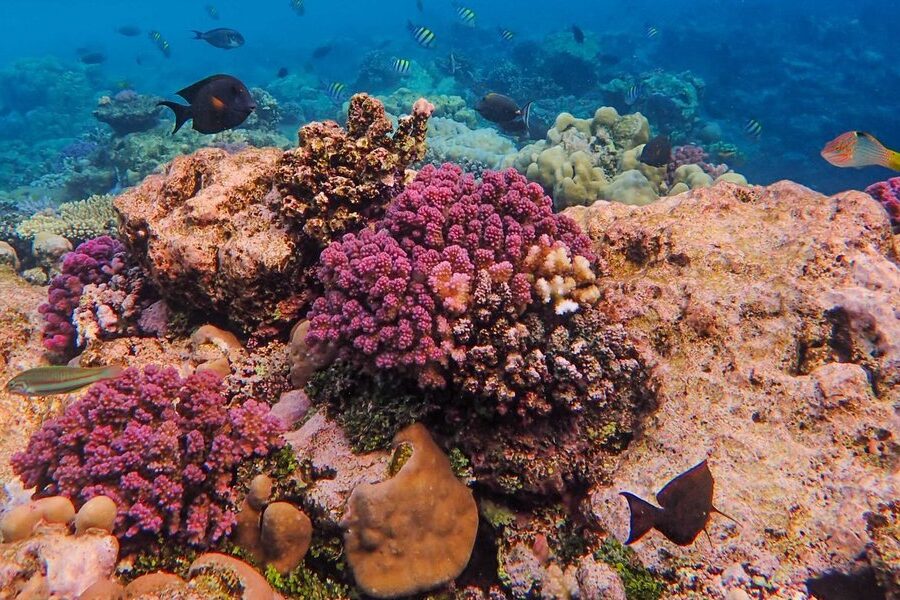
This one builds entire ecosystems. Reef-building corals host microscopic algae called zooxanthellae in their tissues. The algae photosynthesize and hand over up to 90% of the sugars they produce; the coral gives them shelter, CO₂, and nitrogen waste to feed on. It’s a vivid corrective to some of the common myths about how ecosystems work — the reef isn’t a free-for-all of competition but a partnership holding the whole structure up. It’s also the cause of coral bleaching — when water gets too warm, the coral expels the algae and loses its food supply, which is why warming oceans are an existential reef problem. The NOAA coral reef program tracks bleaching events driven by exactly this breakdown. Obligate both ways.
5. Octopus and grouper hunting teams
Coral groupers actively recruit octopuses and moray eels to hunt with them. The grouper does a headstand-shaking “follow me” signal pointing at prey hiding in a crevice, and the octopus or eel flushes it out from the inside. Whoever catches the meal keeps it, but over many hunts both eat more than they would solo. It’s one of the few documented cases of cross-species cooperative hunting, and the research on grouper signaling suggests genuine intentional communication, not accident.
Land examples {#land-examples}
6. Bees and flowering plants
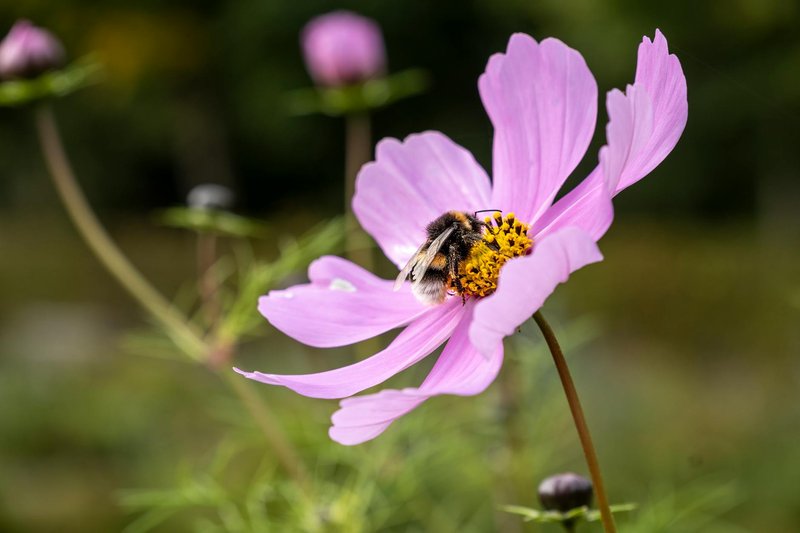
The textbook case, and it scales to a third of the human food supply. Bees visit flowers for nectar and pollen; in the process they carry pollen from bloom to bloom, fertilizing the plants. Flowers evolved colors, scents, and landing-pad shapes specifically to court them. The USDA estimates pollinators are responsible for roughly one in every three bites of food we eat. Mostly facultative — many flowers have backup pollinators — but for specialists like the squash bee, it tilts toward obligate.
7. Oxpeckers and large grazers
Oxpeckers perch on rhinos, zebras, and cattle and eat the ticks, fleas, and botfly larvae crawling on their hides. The bird gets a mobile buffet; the grazer gets pest control and, as a bonus, an early-warning system — oxpeckers hiss and flush when a predator approaches. The relationship has an asterisk: oxpeckers also peck at open wounds to drink blood, which nudges it toward parasitism in some readings. Biology is rarely tidy.
8. Acacia trees and ants
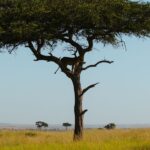
Bullhorn acacias grow hollow thorns and secrete protein-rich nectar for one purpose: to house and feed colonies of Pseudomyrmex ants. In exchange, the ants are a standing army. They swarm and bite any herbivore that touches the tree, and they prune competing vines and seedlings that sprout nearby. Strip the ants off, and the acacia gets shredded by browsers within months. Obligate both ways — these acacias can’t defend themselves, and the ants live nowhere else.
9. Yucca moths and yucca plants
A near-perfect lock-and-key partnership. The female yucca moth gathers pollen, flies to another yucca flower, and deliberately packs the pollen onto the stigma — actively pollinating it — then lays her eggs in the flower’s ovary. Her larvae eat some of the developing seeds, but never all of them. The plant gets pollinated; the moth gets a nursery. Neither species can reproduce without the other. Textbook obligate mutualism.
10. Mycorrhizal fungi and plant roots
Underground, roughly 90% of land plants are plugged into fungal networks. The fungi wrap around or penetrate root cells and extend a vast web of filaments through the soil, pulling in phosphorus, nitrogen, and water far beyond the roots’ reach. The plant pays in sugar from photosynthesis. This is the literal foundation of forests — the so-called “wood wide web” that links trees underground runs on these fungi.
11. Pitcher plants and woolly bats
In Borneo, one pitcher plant gave up on catching insects and rents out rooms instead. Hardwicke’s woolly bat roosts inside the pitcher’s slippery tube during the day. The plant’s reward: bat droppings, which supply a large share of the nitrogen the plant needs in poor soil. The pitcher even evolved a reflective structure that helps the bats’ echolocation find it. The bat gets a predator-free, parasite-free bed; the plant gets fertilizer delivered.
12. Honeyguides and humans
A wild bird that cooperates with people. In parts of Africa, greater honeyguides lead human honey-hunters to bees’ nests, chattering and flying ahead from tree to tree. The humans crack open the nest and take the honey; the bird gets the beeswax and larvae it can’t access alone. Research published in Science found the Yao people of Mozambique use a specific call that nearly triples the odds a honeyguide will guide them — a two-way conversation between species.
Microscopic and inside-the-body examples {#microscopic-examples}
The smallest mutualisms might be the most important to you personally.
13. Gut microbiota and humans
You carry trillions of bacteria in your intestines, and the relationship is a genuine trade. They break down fibers your own enzymes can’t touch, synthesize vitamins K and several B vitamins, and crowd out pathogens. You provide a warm, food-rich habitat. The NIH Human Microbiome Project cataloged just how integrated this community is — disrupt it, and digestion, immunity, and even mood take a hit. Effectively obligate for us.
14. Rhizobia bacteria and legumes
Beans, peas, clover, and other legumes grow nodules on their roots to house Rhizobium bacteria. The bacteria pull nitrogen straight out of the air and convert it into a form the plant can use — natural fertilizer manufactured on site. The plant feeds the bacteria sugars in return. This is why farmers rotate legumes into fields: the partnership enriches the soil for free, no synthetic nitrogen required.
15. Termites and gut protozoa
A termite chewing through your deck can’t actually digest wood on its own. The cellulose-breaking work is done by protozoa and bacteria living in its hindgut, which ferment the wood into nutrients the termite absorbs. The microbes get a steady feed and a stable home. Remove them — which happens naturally each time a termite molts and sheds its gut lining — and the insect starves on a full stomach until it re-acquires them. Obligate both ways.
Quick-reference table {#quick-reference-table}
| # | Partners | Who benefits how | Type |
|---|---|---|---|
| 1 | Clownfish + anemone | Shelter ↔ cleaning & defense | Obligate (fish) |
| 2 | Cleaner wrasse + reef fish | Food ↔ parasite removal | Facultative |
| 3 | Goby + pistol shrimp | Burrow ↔ lookout | Obligate (shrimp) |
| 4 | Coral + zooxanthellae | Shelter ↔ sugars | Obligate both |
| 5 | Octopus + grouper | Joint hunting payoff | Facultative |
| 6 | Bees + flowers | Nectar ↔ pollination | Mostly facultative |
| 7 | Oxpeckers + grazers | Food ↔ pest control | Facultative |
| 8 | Acacia + ants | Food & shelter ↔ defense | Obligate both |
| 9 | Yucca moth + yucca | Nursery ↔ pollination | Obligate both |
| 10 | Mycorrhizae + plants | Minerals ↔ sugars | Mostly obligate |
| 11 | Pitcher plant + bat | Roost ↔ nitrogen | Facultative |
| 12 | Honeyguide + humans | Wax & larvae ↔ nest access | Facultative |
| 13 | Gut microbiota + humans | Habitat ↔ digestion & vitamins | Obligate (us) |
| 14 | Rhizobia + legumes | Sugars ↔ nitrogen fixing | Facultative |
| 15 | Termites + gut protozoa | Habitat ↔ wood digestion | Obligate both |
Obligate vs. facultative: why it matters {#obligate-vs-facultative}
An obligate mutualism means at least one partner can’t survive or reproduce without the other — a yucca with no moth makes no seeds, a termite with no gut microbes starves. A facultative one means both partners benefit but can get by alone if they have to; a bee will happily drink from a hundred flower species, and most of those flowers have backup pollinators.
The distinction tells you how fragile a relationship is. Obligate pairings are precise, often the product of millions of years of co-evolution, and brutally vulnerable — lose one species and the other follows. That’s why coral bleaching is so alarming: it’s an obligate partnership breaking down at the scale of an entire ecosystem. Facultative ones are more flexible and more forgiving.
Next time someone tells you nature is all competition, point them at this list. The reef, the forest floor, the inside of a bee’s favorite flower, and your own gut all run on cooperation — two species that figured out they’re worth more together than apart.