From table-top cryostats to high-pressure cells in national labs, superconducting materials show up across many research settings and experimental platforms. A clear, compact list helps both newcomers and specialists spot trends and pick candidates for further study.
There are 48 Examples of Superconductors, ranging from (TMTSF)2PF6 to κ-(BEDT-TTF)2Cu(NCS)2. Each entry is presented with Class,Tc (K),Pressure (GPa) so you can compare families, critical temperatures and pressure dependence—details you’ll find below.
How should I interpret the Tc and Pressure columns when comparing materials?
Tc is listed in kelvin (K) and indicates the temperature where zero-resistance was observed under the stated conditions; Pressure is in gigapascals (GPa) and often shows whether the Tc was measured at ambient or under applied pressure. When comparing entries, match Tc values measured under similar pressures and note the Class column (e.g., cuprate, organic, iron-based) because pairing mechanisms and measurement conditions vary by family.
Are any of these superconductors practical at room temperature or ambient pressure?
No listed examples operate at room temperature; most require cryogenic cooling, and some only superconduct under significant pressure. A few high-Tc materials work at liquid-nitrogen temperatures at ambient pressure, but widespread room-temperature, ambient-pressure superconductors are not present in this list—see the Pressure (GPa) column below for which entries need compression.
Examples of Superconductors
| Name | Class | Tc (K) | Pressure (GPa) |
|---|---|---|---|
| Niobium | elemental | 9.25 | 0 |
| Lead | elemental | 7.20 | 0 |
| Mercury | elemental | 4.15 | 0 |
| Aluminum | elemental | 1.20 | 0 |
| Tin | elemental | 3.72 | 0 |
| Vanadium | elemental | 5.40 | 0 |
| Tantalum | elemental | 4.48 | 0 |
| Niobium–titanium (NbTi) | intermetallic/alloy | 9.20 | 0 |
| Niobium–tin (Nb3Sn) | intermetallic/A15 | 18.00 | 0 |
| Nb3Ge | A15 | 23.00 | 0 |
| V3Si | A15 | 17.00 | 0 |
| Magnesium diboride (MgB2) | intermetallic | 39.00 | 0 |
| Niobium nitride (NbN) | binary nitride | 16.00 | 0 |
| YBa2Cu3O7 (YBCO) | cuprate | 92.00 | 0 |
| Bi2Sr2CaCu2O8 (Bi-2212) | cuprate | 95.00 | 0 |
| Bi2Sr2Ca2Cu3O10 (Bi-2223) | cuprate | 110.00 | 0 |
| HgBa2Ca2Cu3O8+δ (Hg-1223) | cuprate | 133.00 | 0 |
| La2-xSrxCuO4 (LSCO) | cuprate | 38.00 | 0 |
| La2-xBaxCuO4 (LBCO) | cuprate | 30.00 | 0 |
| Tl2Ba2Ca2Cu3O10 (Tl-1223) | cuprate | 125.00 | 0 |
| LaFeAsO1-xFx | pnictide | 26.00 | 0 |
| Ba1-xKxFe2As2 (Ba-122) | pnictide | 38.00 | 0 |
| SmFeAsO1-xFx | pnictide | 55.00 | 0 |
| FeSe | pnictide/Fe-based | 8.00 | 0–9 |
| Monolayer FeSe on SrTiO3 | pnictide/interface | 65.00 | 0 |
| H3S (sulfur hydride) | hydride | 203.00 | 150 |
| LaH10 | hydride | 250.00 | 170 |
| YH6 | hydride | 224.00 | 150 |
| YH9 | hydride | 243.00 | 150 |
| SrTiO3 (doped) | oxide | 0.35 | 0 |
| Boron-doped diamond | doped covalent | 4.00 | 0 |
| K3C60 (alkali fulleride) | molecular | 19.30 | 0 |
| κ-(BEDT-TTF)2Cu(NCS)2 | organic | 10.40 | 0 |
| (TMTSF)2PF6 | (organic) | 1.20 | 1 |
| CeCu2Si2 | heavy-fermion | 0.70 | 0 |
| UPt3 | heavy-fermion | 0.50 | 0 |
| UBe13 | heavy-fermion | 0.90 | 0 |
| PuCoGa5 | heavy-fermion | 18.50 | 0 |
| LiTi2O4 | spinel | 13.70 | 0 |
| CaC6 | intercalated graphite | 11.50 | 0 |
| Twisted bilayer graphene (magic-angle) | van der Waals/2D | 1.70 | 0 |
| KBiO3 / Ba1-xKxBiO3 (BKBO) | bismuthate | 30.00 | 0 |
| PbMo6S8 (Chevrel phase) | chevrel | 14.00 | 0 |
| Nd0.8Sr0.2NiO2 | nickelate | 15.00 | 0 |
| Sr2RuO4 | topological/candidate | 1.50 | 0 |
| MgCNi3 | intermetallic | 8.00 | 0 |
| FeSe intercalates (e.g., KxFe2−ySe2) | pnictide/Fe-based | 45.00 | 0 |
| Sm1.85Ce0.15CuO4 (electron-doped cuprate) | cuprate | 25.00 | 0 |
Images and Descriptions
Niobium
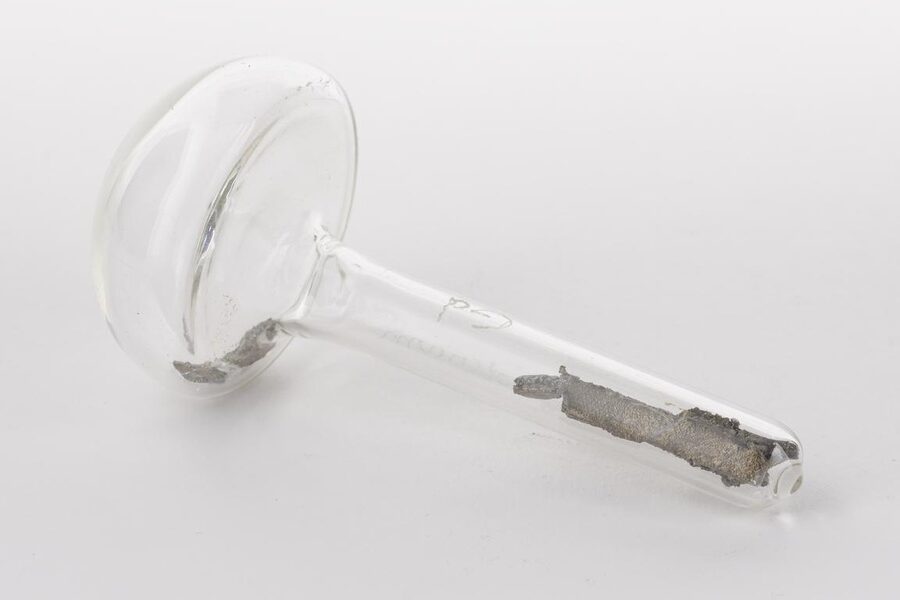
Niobium is the highest-Tc elemental superconductor (9.25 K). Widely used in superconducting radio-frequency cavities and magnets, it’s notable for strong type-II behavior and for forming technologically important alloys and compounds like NbTi and Nb3Sn.

Lead
Lead superconducts at 7.2 K and was historically important in early superconductivity studies. Easy to work with in lab settings, lead illustrates classic BCS phonon-mediated pairing but is mostly of educational and historical interest today.
Mercury
Mercury (4.15 K) was the first element in which superconductivity was discovered. It’s mainly of historical significance, demonstrating the Meissner effect early on, but is impractical for applications due to toxicity and vapor pressure.

Aluminum
Aluminum superconducts at about 1.2 K and is commonly used in low-temperature experiments and detectors. It is a conventional, well-understood BCS superconductor with ease of thin-film fabrication and useful for tunnel junctions.
Tin
Tin becomes superconducting at 3.72 K; it’s simple to make, historically important, and sometimes used in low-temperature devices. Tin demonstrates conventional electron–phonon superconductivity and serves as a reference material in labs.
Vanadium
Vanadium superconducts near 5.4 K and is notable for forming superconducting compounds and A15 phases (e.g., V3Si). It’s used in research on unconventional phases and helps illustrate alloy and compound effects on Tc.
Tantalum
Tantalum (4.48 K) is a ductile elemental superconductor used in cryogenic wiring and as a thin-film superconductor. Its robustness and corrosion resistance make it useful in some niche low-temperature applications.
Niobium–titanium (NbTi)
NbTi alloy (≈9.2 K) is the workhorse superconductor for MRI, accelerator and NMR magnets. It’s mechanically flexible, easy to fabricate into wires, and remains the dominant practical low-temperature superconducting material.
Niobium–tin (Nb3Sn)
Nb3Sn (A15) superconducts around 18 K and is used where higher fields and temperatures than NbTi are needed, such as high-field magnets. It’s brittle, requires special heat treatments, and displays strong type-II superconductivity.
Nb3Ge
Nb3Ge thin films showed record A15 Tc values (~23 K) historically. Not widely used commercially due to fabrication challenges, Nb3Ge was important in understanding high-Tc mechanisms in intermetallic A15 systems.
V3Si
V3Si (≈17 K) is another A15 compound important in early high-field superconductor research. It helped establish relationships between crystal structure and superconductivity, though brittleness limits practical wire use.
Magnesium diboride (MgB2)
MgB2 (39 K) sparked renewed interest as a relatively simple, phonon-mediated high-Tc superconductor. It’s cheap, lightweight, and used in some magnets and microwave applications where moderately high Tc helps reduce cooling costs.
Niobium nitride (NbN)
NbN (≈16 K) is a hard, thin-film superconductor used in superconducting nanowire single-photon detectors and microwave devices. It’s notable for high critical fields and rapid fabrication into thin, uniform films.
YBa2Cu3O7 (YBCO)
YBCO (≈92 K) is the most famous cuprate, superconducting above liquid-nitrogen temperature. Widely studied and used in tapes and prototype applications, it’s notable for layered copper–oxide planes and unconventional, likely non-BCS pairing.
Bi2Sr2CaCu2O8 (Bi-2212)
Bi-2212 (≈95 K) is a layered cuprate often studied for intrinsic tunneling and high-Tc physics. It’s used in research and some wire forms; complex chemistry and anisotropy are characteristic of cuprates like Bi-2212.
Bi2Sr2Ca2Cu3O10 (Bi-2223)
Bi-2223 (≈110 K) is a high-Tc cuprate used in commercial superconducting tapes. It combines relatively high Tc with workable fabrication, though grain connectivity and anisotropy complicate applications.
HgBa2Ca2Cu3O8+δ (Hg-1223)
Hg-1223 (≈133 K) holds among the highest ambient-pressure cuprate Tc values. It’s chemically sensitive and difficult to process, but highlights how layered copper-oxide structures can reach very high Tcs.
La2-xSrxCuO4 (LSCO)
LSCO (up to ≈38 K) was the first high-Tc family discovered after the initial cuprate reports. It’s a paradigmatic single-layer cuprate widely used to study doping, phase diagrams, and the pseudogap phenomenon.
La2-xBaxCuO4 (LBCO)
LBCO (≈30 K) is known for stripe order and intertwined electronic phases that compete or coexist with superconductivity. It’s a key material for studying how charge/spin ordering affects high-Tc behavior.
Tl2Ba2Ca2Cu3O10 (Tl-1223)
Tl-1223 (≈125 K) is a thallium-based cuprate with very high Tc and complex chemistry. Not practical for broad applications due to toxicity and processing issues but notable for high ambient Tc.
LaFeAsO1-xFx
LaFeAsO1-xFx (≈26 K) launched the iron-pnictide era. With layered FeAs planes and unconventional pairing, these materials show high critical fields, multiband superconductivity, and versatile chemistry for tuning Tc.
Ba1-xKxFe2As2 (Ba-122)
Ba1-xKxFe2As2 (≈38 K) is a widely studied iron-based superconductor with high critical fields and multiband behavior. It’s notable for relatively easy crystal growth and demonstrations of unconventional pairing symmetries.
SmFeAsO1-xFx
SmFeAsO1-xFx (≈55 K) is among the higher-Tc iron-pnictides at ambient pressure. It helped show that layered iron compounds can host high-temperature superconductivity distinct from cuprates and with multi-band electronic structure.
FeSe
FeSe has a modest ambient Tc (~8 K) but is remarkable for dramatic Tc increases with pressure, intercalation, or interface engineering (up to ~37 K under pressure). Simple structure makes it a platform for pairing studies.
Monolayer FeSe on SrTiO3
Single-layer FeSe on SrTiO3 exhibits greatly enhanced Tc (transport/ARPES reports ≈65 K or higher). The interface and electron–phonon coupling from the substrate appear to boost pairing, making it a key system for engineered high-Tc.
H3S (sulfur hydride)
H3S superconducts at record-high temperatures (~203 K) under very high pressures (~150 GPa). It was the first hydride to break 200 K, demonstrating hydrogen-rich materials as promising routes to high-Tc under compression.
LaH10
LaH10 exhibits superconductivity near room temperature (~250 K) but only at extreme pressures (~170 GPa). Its discovery validated high-pressure hydrides as a path toward very high Tc, albeit with impractical pressure requirements for applications.
YH6
YH6 and related yttrium hydrides show very high Tc (above 200 K) under high pressures (~100–200 GPa). These hydrogen-rich compounds highlight strong electron–phonon coupling in dense H lattices, important for high-Tc hydride research.

YH9
YH9 is another high-pressure hydride reported with Tc above 200 K at very high pressures (~150 GPa). It joins LaH10 and H3S as experimental proof that compressed hydrogen-rich materials can achieve extremely high Tcs.
SrTiO3 (doped)
Doped SrTiO3 becomes superconducting at very low temperatures (~0.3–0.4 K) and extremely low carrier densities. It’s notable for superconductivity near the insulating state and for interface-induced superconductivity in oxide heterostructures.
Boron-doped diamond
Heavily boron-doped diamond shows superconductivity around 4 K. It’s chemically robust and interesting for combining hardness and superconductivity, with potential niche uses in harsh environments and for fundamental studies.
K3C60 (alkali fulleride)
K3C60 (≈19 K) is a molecular superconductor where electron–phonon coupling and strong correlations interplay. It demonstrated superconductivity in intercalated fullerenes and inspired studies of molecular and strongly correlated superconductors.
κ-(BEDT-TTF)2Cu(NCS)2
This organic charge-transfer salt superconducts around 10.4 K and is known for strong electron correlations, low-dimensionality, and unconventional pairing. Organics are chemically tunable and illustrate superconductivity in molecular systems.
(TMTSF)2PF6
The Bechgaard salt (TMTSF)2PF6 becomes superconducting under modest pressure (~0.5–1 GPa) around 1–1.2 K. It’s a prototype quasi-one-dimensional organic superconductor with rich magnetic and superconducting phase competition.
CeCu2Si2
CeCu2Si2 (≈0.7 K) was the first heavy-fermion superconductor, illustrating superconductivity arising from strongly correlated f-electron systems. It’s central to studies of magnetically mediated pairing and quantum criticality.
UPt3
UPt3 (≈0.5 K) is a heavy-fermion superconductor notable for multiple superconducting phases and likely unconventional order parameters. It has been a benchmark system for studying complex order parameters and nodal superconductivity.
UBe13
UBe13 (≈0.9 K) is an unconventional heavy-fermion superconductor with strongly correlated 5f electrons. It shows unusual thermodynamic and transport behaviors tied to heavy quasiparticles and non-BCS pairing mechanisms.
PuCoGa5
PuCoGa5 (≈18.5 K) is a remarkable actinide superconductor with relatively high Tc for heavy-fermion systems. It combines strong correlations with high transition temperature, providing insight into f-electron-mediated pairing.
LiTi2O4
LiTi2O4 (≈13.7 K) is a superconducting spinel notable as one of the higher-Tc oxide superconductors outside the cuprate family. It’s structurally simple and useful for studying oxide superconductivity mechanisms.
CaC6
Calcium-intercalated graphite (CaC6, ≈11.5 K) is a superconducting graphite compound where intercalation electrons pair via phonons. It showed that layered graphitic systems can host relatively high-Tc superconductivity with simple chemistry.
Twisted bilayer graphene (magic-angle)
Magic-angle twisted bilayer graphene shows superconductivity near 1–2 K when two graphene sheets are twisted to a specific angle. It’s notable as a tunable, flat-band platform linking strong correlations, topology, and superconductivity.
KBiO3 / Ba1-xKxBiO3 (BKBO)
Ba1-xKxBiO3 (≈30 K) is a non-cuprate oxide superconductor with relatively high Tc and a perovskite-like structure. It highlighted that high Tc need not be unique to cuprates and inspired oxide superconductivity research.
PbMo6S8 (Chevrel phase)
PbMo6S8 (≈14 K) belongs to the Chevrel-phase family, known for high critical fields and chemistry tunability. These sulfide-based cluster compounds were important for magnet applications and fundamental studies of strong coupling.
Nd0.8Sr0.2NiO2
Doped infinite-layer nickelate thin films (≈15 K) are a recently discovered superconducting non-cuprate oxides family. Although sample- and synthesis-sensitive, they’re notable for parallels to cuprates and for probing superconductivity in nickel 3d systems.
Sr2RuO4
Sr2RuO4 (≈1.5 K) is a layered oxide with unconventional superconductivity and long-discussed possible chiral order. It remains a focal point for debates about pairing symmetry and topological superconductivity in correlated materials.
MgCNi3
MgCNi3 (≈8 K) is an intermetallic superconductor with a perovskite-derived structure and strong Ni-derived electronic states. It exemplifies how transition-metal-rich compounds can yield superconductivity with interesting electronic correlations.
FeSe intercalates (e.g., KxFe2−ySe2)
Intercalated FeSe compounds can show Tc boosted to ~40–45 K without extreme pressure, achieved by inserting ions or molecules between FeSe layers. They demonstrate chemical tuning as an alternative to pressure or interfaces.
Sm1.85Ce0.15CuO4 (electron-doped cuprate)
Electron-doped cuprates like Sm1.85Ce0.15CuO4 (≈25 K) provide a complementary route to hole-doped cuprates, useful for comparing pairing symmetries and understanding how carrier type influences high-Tc superconductivity.