Dense stellar remnants pack more mass than the Sun into a sphere the size of a city, left behind after massive stars explode. Many sit across the Milky Way and beyond as rapidly spinning pulsars, magnetars, or quietly cooling cores, and surveys collect their basic properties so you can compare them at a glance.
There are 21 Neutron Stars, ranging from 1E 1048.1-5937 to Vela Pulsar. For each entry you’ll find below Type,Distance (ly),Spin period (s),Description (30-50 words), organized so you can scan types, how far away they are, and how fast they rotate.
How were the objects on this list selected?
The list focuses on well-documented examples across classes (pulsars, magnetars, central compact objects) chosen for clear catalog names, available distance estimates, and measured spin periods; inclusion favors sources with peer-reviewed observations, though distances and classifications can be updated as new data arrive.
How can I use the spin period and distance columns?
Spin period gives a quick sense of rotation speed and, with a period derivative, can imply age or magnetic field strength; distance lets you convert observed flux into luminosity—both are starting points for comparison, but reliable age or energy estimates usually need additional measurements (period derivative, flux, spectrum).
Neutron Stars
| Name | Type | Distance (ly) | Spin period (s) | Description (30-50 words) |
|---|---|---|---|---|
| Crab Pulsar | radio pulsar | 6,500.00 ly | 0.03310 s | Young, energetic pulsar in the Crab Nebula with a 33 ms spin, born in the 1054 supernova; bright from radio to gamma rays and famous for giant pulses, strong wind, and as a laboratory for high-energy neutron-star physics. |
| Vela Pulsar | radio pulsar | 1,000.00 ly | 0.08933 s | Nearby young pulsar powering the Vela supernova remnant with an 89 ms period; frequently glitches and is bright in radio and X-rays, offering key insights into neutron-star interiors, pulsar timing, and particle winds. |
| PSR B1919+21 | radio pulsar | 2,300.00 ly | 1.33730 s | The first-discovered pulsar (1937) with a 1.337 s period; historically crucial for confirming neutron stars and initiating pulsar astronomy, used in early studies of pulsar emission and timing. |
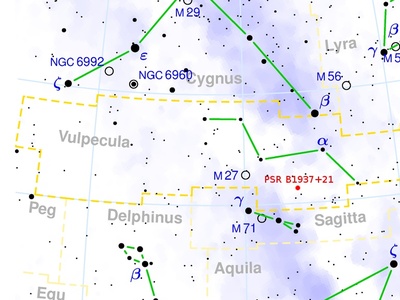
| PSR B1937+21 | millisecond pulsar | 10,000.00 ly | 0.00156 s | The first millisecond pulsar found, spinning near 1.56 ms; its extreme stability established the millisecond population, enabled precision timing experiments, and demonstrated rapidly rotating neutron-star physics. |
| PSR J0437-4715 | millisecond pulsar | 510.00 ly | 0.00576 s | A very nearby 5.76 ms millisecond pulsar in a binary; exceptionally bright and precisely timed, used for tests of stellar evolution, binary dynamics, and pulsar timing-array gravitational-wave searches. |
| PSR B1257+12 | millisecond pulsar | 2,300.00 ly | 0.00622 s | A 6.22 ms pulsar hosting the first confirmed exoplanets; notable for demonstrating planet formation or survival around neutron stars and for precise timing that revealed tiny orbital perturbations. |
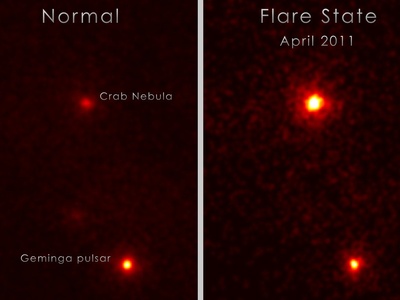
| Geminga | radio-quiet gamma pulsar | 800.00 ly | 0.23710 s | A nearby, radio-quiet gamma-ray pulsar with a 0.237 s period; bright in X-rays and gamma rays, Geminga helped reveal a population of pulsars discovered by high-energy emission rather than radio pulses. |
| SAX J1808.4-3658 | accreting millisecond X-ray pulsar | 11,400.00 ly | 0.00249 s | An accreting millisecond X-ray pulsar spinning at 2.49 ms, prototype of accretion-driven spin-up; shows outbursts, thermonuclear bursts, and links between low-mass X-ray binaries and recycled millisecond pulsars. |
| PSR J1748-2446ad | millisecond pulsar | 19,000.00 ly | 0.00140 s | The fastest known-spinning pulsar at about 1.40 ms, located in the Terzan 5 cluster; its extreme rotation places strong constraints on neutron-star structure and the equation of state of dense matter. |
| SGR 1806-20 | magnetar | 49,000.00 ly | 7.55 s | A highly magnetic neutron star (magnetar) with a 7.55 s spin, famous for its enormous 2004 giant flare; shows intense X-ray/gamma activity and extreme magnetic-field-driven physics. |
| SGR 1900+14 | magnetar | 20,000.00 ly | 5.16 s | A magnetar with a 5.16 s period that produced a major 1998 gamma-ray flare; notable for strong bursts, long-term X-ray variability, and studies of ultra-strong magnetic field effects on neutron-star crusts. |
| 1E 1048.1-5937 | magnetar | 9,000.00 ly | 6.45 s | Anomalous X-ray pulsar/magnetar spinning around 6.45 s, known for dramatic flux variability and torque changes; provides insights into magnetar outbursts, magnetospheric physics, and crustal stresses in highly magnetized neutron stars. |
| PSR J0537-6910 | young pulsar | 163,000.00 ly | 0.01612 s | A very young, energetic pulsar in the Large Magellanic Cloud with a 16.12 ms period; shows frequent large glitches and high spin-down power, illuminating young neutron-star dynamics outside the Milky Way. |
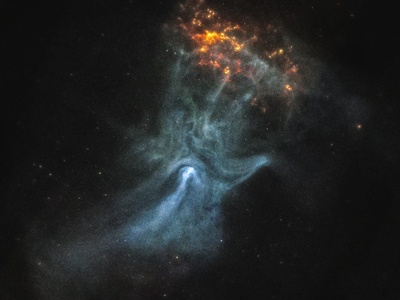
| PSR B1509-58 | radio pulsar | 17,000.00 ly | 0.15100 s | A young, energetic 151 ms pulsar driving a bright X-ray nebula; notable for its powerful wind, strong X-ray emission, and as an example of pulsar-driven supernova-remnant interaction. |
| PSR J0205+6449 | radio pulsar | 10,000.00 ly | 0.06568 s | A 65.68 ms pulsar in the 3C58 supernova remnant, young and energetic; studied for its timing, X-ray pulses, and role in understanding supernova remnants with central neutron stars. |
| Her X-1 | X-ray binary | 21,000.00 ly | 1.23776 s | A classic accreting X-ray pulsar in a high-inclination binary with a 1.238 s spin; shows X-ray pulsations, disk precession, and eclipses, serving as a cornerstone object for accretion and binary-evolution studies. |
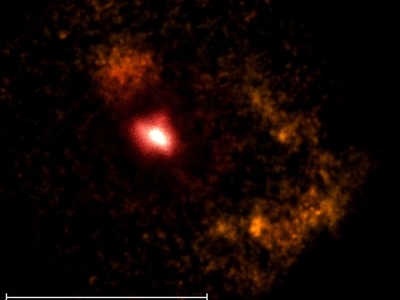
| PSR B0540-69 | young pulsar | 163,000.00 ly | 0.05050 s | A Crab-like young pulsar in the Large Magellanic Cloud with a 50.50 ms period; bright in X-rays, used to compare pulsar wind nebulae and study young neutron-star energetics beyond the Galaxy. |
| PSR J1023+0038 | transitional millisecond pulsar | 4,470.00 ly | 0.00169 s | A transitional 1.69 ms pulsar that switches between accretion-powered and rotation-powered states; key evidence for evolution from low-mass X-ray binaries to recycled millisecond pulsars and studies of pulsar magnetospheres. |
| PSR J1614-2230 | millisecond pulsar | 3,400.00 ly | 0.00315 s | A 3.15 ms millisecond pulsar noted for its precisely measured high mass (~1.97 solar masses) via binary timing; provides strong constraints on the neutron-star equation of state and dense-matter physics. |
| PSR J0348+0432 | millisecond pulsar | 2,500.00 ly | 0.03912 s | A 39.12 ms pulsar in a compact binary with a white dwarf, containing a ~2.01 solar-mass neutron star; used to test general relativity in strong fields and constrain dense-matter theories. |
| PSR J0337+1715 | millisecond pulsar | 4,200.00 ly | 0.00273 s | A 2.73 ms pulsar in a rare hierarchical triple system with two white dwarfs; provides an exceptional laboratory for precision tests of gravity, three-body dynamics, and neutron-star formation in multiple systems. |
Images and Descriptions
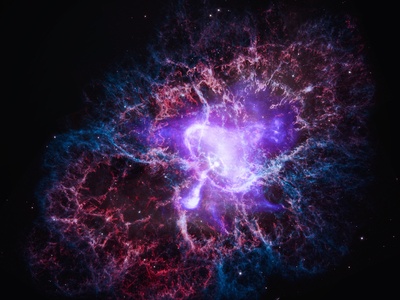
Crab Pulsar
Young, energetic pulsar in the Crab Nebula with a 33 ms spin, born in the 1054 supernova; bright from radio to gamma rays and famous for giant pulses, strong wind, and as a laboratory for high-energy neutron-star physics.

Vela Pulsar
Nearby young pulsar powering the Vela supernova remnant with an 89 ms period; frequently glitches and is bright in radio and X-rays, offering key insights into neutron-star interiors, pulsar timing, and particle winds.
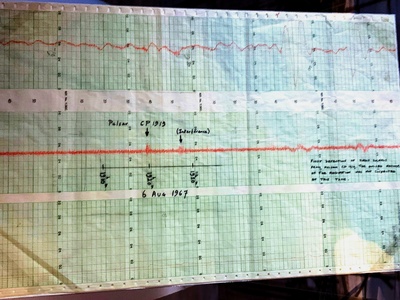
PSR B1919+21
The first-discovered pulsar (1937) with a 1.337 s period; historically crucial for confirming neutron stars and initiating pulsar astronomy, used in early studies of pulsar emission and timing.
PSR B1937+21
The first millisecond pulsar found, spinning near 1.56 ms; its extreme stability established the millisecond population, enabled precision timing experiments, and demonstrated rapidly rotating neutron-star physics.
PSR J0437-4715
A very nearby 5.76 ms millisecond pulsar in a binary; exceptionally bright and precisely timed, used for tests of stellar evolution, binary dynamics, and pulsar timing-array gravitational-wave searches.
PSR B1257+12
A 6.22 ms pulsar hosting the first confirmed exoplanets; notable for demonstrating planet formation or survival around neutron stars and for precise timing that revealed tiny orbital perturbations.
Geminga
A nearby, radio-quiet gamma-ray pulsar with a 0.237 s period; bright in X-rays and gamma rays, Geminga helped reveal a population of pulsars discovered by high-energy emission rather than radio pulses.
SAX J1808.4-3658
An accreting millisecond X-ray pulsar spinning at 2.49 ms, prototype of accretion-driven spin-up; shows outbursts, thermonuclear bursts, and links between low-mass X-ray binaries and recycled millisecond pulsars.
PSR J1748-2446ad
The fastest known-spinning pulsar at about 1.40 ms, located in the Terzan 5 cluster; its extreme rotation places strong constraints on neutron-star structure and the equation of state of dense matter.
SGR 1806-20
A highly magnetic neutron star (magnetar) with a 7.55 s spin, famous for its enormous 2004 giant flare; shows intense X-ray/gamma activity and extreme magnetic-field-driven physics.
SGR 1900+14
A magnetar with a 5.16 s period that produced a major 1998 gamma-ray flare; notable for strong bursts, long-term X-ray variability, and studies of ultra-strong magnetic field effects on neutron-star crusts.
1E 1048.1-5937
Anomalous X-ray pulsar/magnetar spinning around 6.45 s, known for dramatic flux variability and torque changes; provides insights into magnetar outbursts, magnetospheric physics, and crustal stresses in highly magnetized neutron stars.
PSR J0537-6910
A very young, energetic pulsar in the Large Magellanic Cloud with a 16.12 ms period; shows frequent large glitches and high spin-down power, illuminating young neutron-star dynamics outside the Milky Way.
PSR B1509-58
A young, energetic 151 ms pulsar driving a bright X-ray nebula; notable for its powerful wind, strong X-ray emission, and as an example of pulsar-driven supernova-remnant interaction.
PSR J0205+6449
A 65.68 ms pulsar in the 3C58 supernova remnant, young and energetic; studied for its timing, X-ray pulses, and role in understanding supernova remnants with central neutron stars.
Her X-1
A classic accreting X-ray pulsar in a high-inclination binary with a 1.238 s spin; shows X-ray pulsations, disk precession, and eclipses, serving as a cornerstone object for accretion and binary-evolution studies.
PSR B0540-69
A Crab-like young pulsar in the Large Magellanic Cloud with a 50.50 ms period; bright in X-rays, used to compare pulsar wind nebulae and study young neutron-star energetics beyond the Galaxy.
PSR J1023+0038
A transitional 1.69 ms pulsar that switches between accretion-powered and rotation-powered states; key evidence for evolution from low-mass X-ray binaries to recycled millisecond pulsars and studies of pulsar magnetospheres.
PSR J1614-2230
A 3.15 ms millisecond pulsar noted for its precisely measured high mass (~1.97 solar masses) via binary timing; provides strong constraints on the neutron-star equation of state and dense-matter physics.
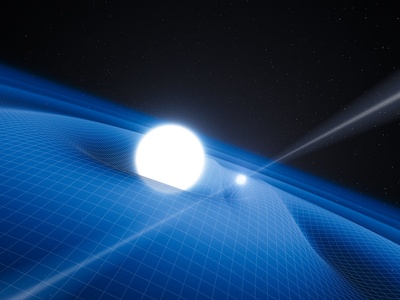
PSR J0348+0432
A 39.12 ms pulsar in a compact binary with a white dwarf, containing a ~2.01 solar-mass neutron star; used to test general relativity in strong fields and constrain dense-matter theories.
PSR J0337+1715
A 2.73 ms pulsar in a rare hierarchical triple system with two white dwarfs; provides an exceptional laboratory for precision tests of gravity, three-body dynamics, and neutron-star formation in multiple systems.