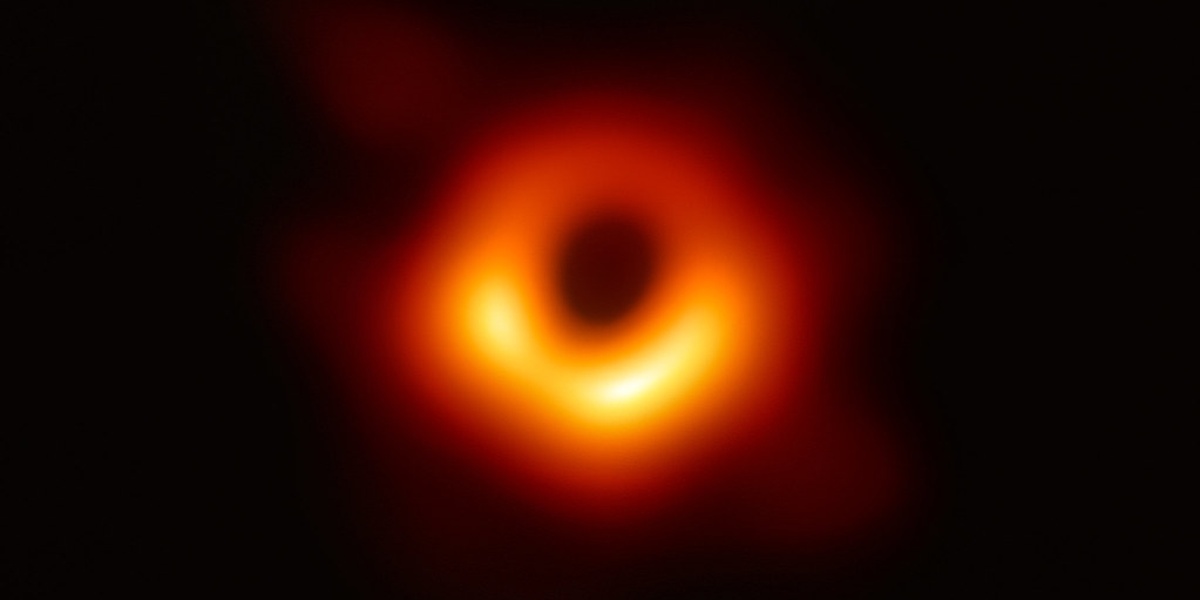
Supermassive black holes sit at the centers of most large galaxies and shape their surroundings through gravity and energetic outflows. Observing them tells us about galaxy growth, extreme physics, and how matter behaves under intense gravity.
There are 10 Examples of Supermassive Black Holes, ranging from 3C 273 to Sgr A*. For each object I list Host galaxy,Mass (10^9 Msol),Distance (Mly) so you can compare mass and proximity at a glance — you’ll find below.
How are the masses of these supermassive black holes measured?
Masses come from different methods depending on distance and available data: stellar and gas dynamics track motions near the center, water maser emission can give precise orbital speeds, and reverberation mapping uses time delays in active nuclei. Each method has uncertainties, so cross-checks improve confidence.
Why does it matter that Sgr A* and 3C 273 appear on the same list?
Listing Sgr A (our Galaxy’s central black hole) alongside bright, distant examples like 3C 273 highlights scale and observability: Sgr A is closest and easiest to resolve, while objects like 3C 273 are more massive or luminous and help study accretion at high power.
Examples of Supermassive Black Holes
| Name | Host galaxy | Mass (10^9 Msol) | Distance (Mly) |
|---|---|---|---|
| Sgr A* | Milky Way | 0.00 | 0.03 |
| M87* | Messier 87 | 6.50 | 54 |
| M31* | Andromeda (M31) | 0.14 | 2.54 |
| NGC 4258 | NGC 4258 (M106) | 0.04 | 23.5 |
| NGC 1068 | NGC 1068 (M77) | 0.02 | 47 |
| Centaurus A | NGC 5128 | 0.06 | 11 |
| NGC 1600 | NGC 1600 | 17.00 | 210 |
| NGC 4889 | NGC 4889 | 21.00 | 300 |
| NGC 3842 | NGC 3842 | 9.70 | 320 |
| 3C 273 | 3C 273 (quasar host) | 0.89 | 2,440 |
Images and Descriptions

Sgr A*
Measured from decades of infrared monitoring of S‑star orbits and radio astrometry; mass ~4.3 million solar masses. Closest SMBH to Earth, central to Milky Way studies, imaged by the EHT and used for precision tests of gravity.
M87*
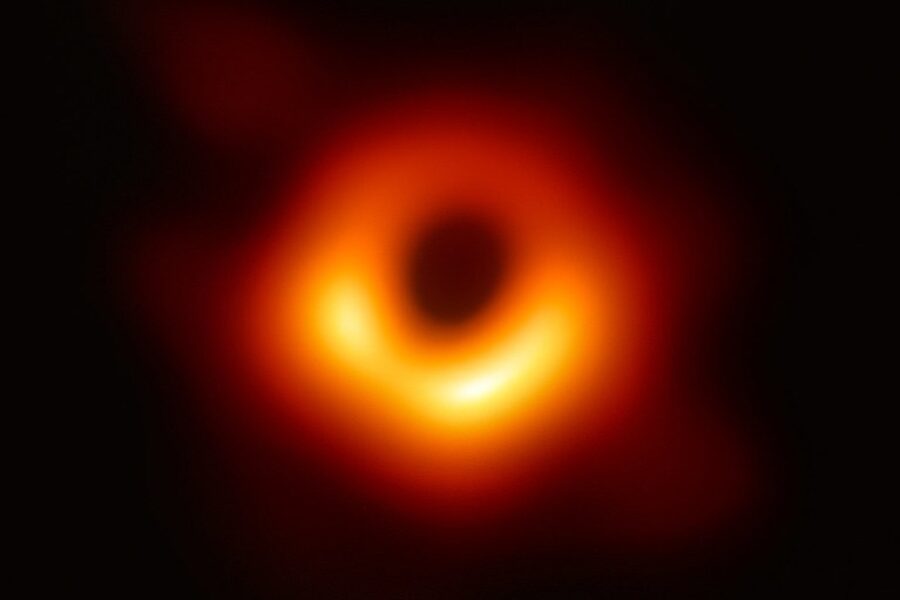
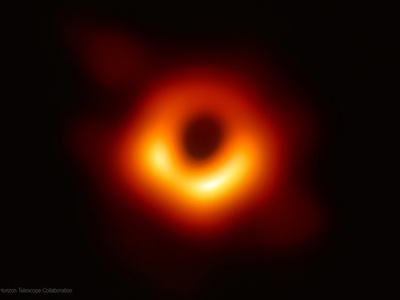
Mass ~6.5 billion solar masses measured from stellar and gas dynamics and EHT shadow modeling; first black hole imaged in 2019. Massive radio jet powers the active nucleus in Virgo A and serves as a benchmark for accretion and jet physics.
M31*
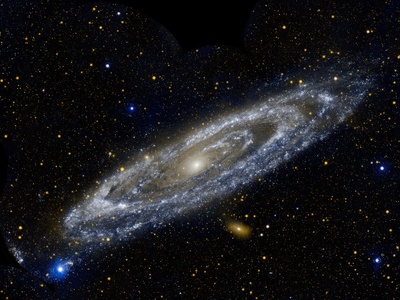
Central SMBH in Andromeda with mass ~140 million solar masses from stellar kinematics and dynamical modeling. Close neighbor to the Milky Way, used to compare galaxy nuclei and SMBH scaling relations across similar spiral galaxies.
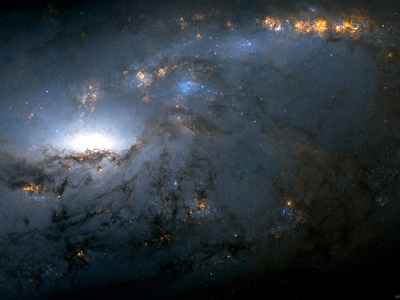
NGC 4258
Water‑maser emission traces a thin Keplerian disk yielding a very precise mass of ~39 million solar masses. Its geometry anchors extragalactic distance measurements and provides one of the most secure SMBH mass determinations.
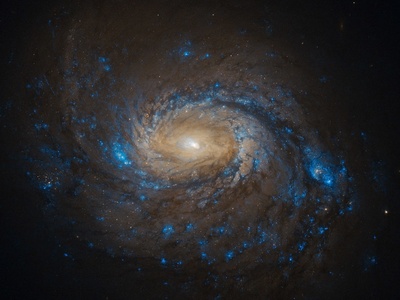
NGC 1068
Seyfert 2 nucleus with SMBH mass estimated from megamaser and reverberation mapping at roughly tens of millions of solar masses. Bright nearby type II AGN extensively studied from radio to X-rays; ALMA and maser data reveal a complex circumnuclear torus.
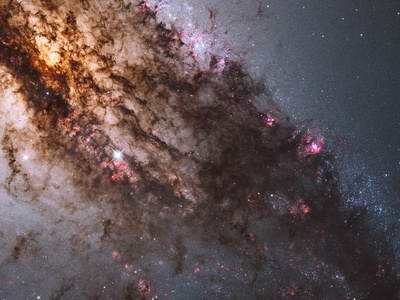
Centaurus A
Nearby radio galaxy with SMBH mass ~55 million solar masses measured from gas and stellar kinematics. Its prominent dust lane and relativistic jet make it an accessible laboratory for studying AGN feedback and jet–environment interactions.
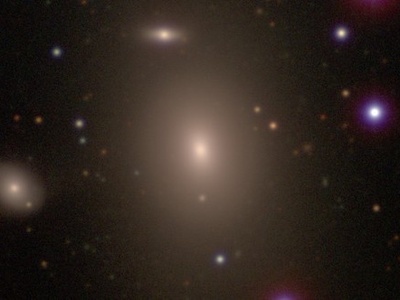
NGC 1600
Host of an ultramassive black hole measured at roughly 17 billion solar masses via stellar dynamics. Remarkable because NGC 1600 is a relatively isolated elliptical, challenging simple ideas about SMBH growth tied only to dense cluster environments.
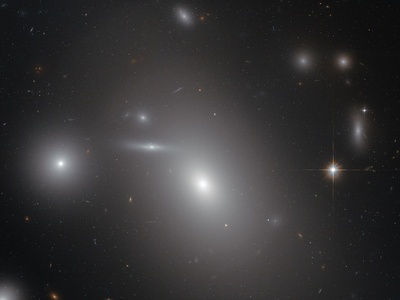
NGC 4889
Very massive SMBH in a Coma‑cluster brightest galaxy with dynamical mass estimates near ~21 billion solar masses. One of the largest directly measured black holes, important for understanding extreme SMBH growth in dense environments.
NGC 3842
Brightest cluster galaxy SMBH measured around ~9.7 billion solar masses through stellar dynamics. Part of studies that revealed a population of ultramassive black holes at the high end of the SMBH mass function.
3C 273
One of the nearest bright quasars with SMBH mass estimated from reverberation mapping and broad‑line region modeling at ~890 million solar masses. Historically the first identified quasar and an archetypal target for multiwavelength AGN and jet studies.