8 Tools Used in Astronomy
In 1609 Galileo pointed a small telescope at Jupiter and found four moons orbiting it. That single act helped move Earth out of the center of the cosmos.
Instruments shape what we can see; they determine which questions we can answer and which technologies spin off into everyday life. From lenses and photographic plates to large observatories in space, understanding instruments matters because they expand human reach and enable precise measurement.
From simple lenses and photographic plates to space telescopes and interferometers, eight essential tools have driven astronomical discovery and modern technology alike. Hubble launched in 1990 and JWST in 2021, and both show how platform and instrument choices change what we learn.
Below I group these tools into three practical categories: observational platforms, imaging and light-analysis instruments, and precision measurement and data tools. Let’s start with the platforms that collect light in the first place.
Observational Platforms: Where Astronomers Point Their Eyes
Observational platforms are the physical collectors of radiation from the sky. Location matters: the atmosphere absorbs or blurs certain wavelengths, and human-made radio noise limits sensitivity on the ground. Space-based platforms avoid atmospheric absorption and turbulence, while ground facilities often offer larger apertures and easier maintenance. Hubble (launched 1990) and JWST (launched Dec 25, 2021) illustrate the payoff of space investments, and the Very Large Array (27 dishes, operational 1980) shows the power of ground-based arrays.
1. Optical telescopes (reflectors and refractors)
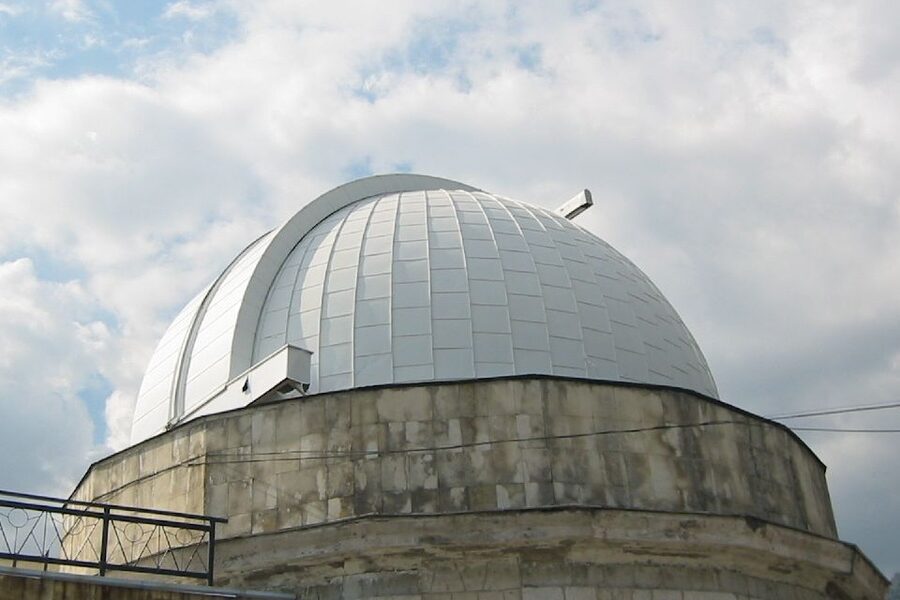
Optical telescopes collect visible light and remain central to astronomy. The light-gathering power and resolution scale with mirror diameter: Keck Observatory uses two 10-meter mirrors, ESO’s Very Large Telescope has 8.2 m units, and the historic Palomar Hale Telescope has a 200-inch (5.08 m) mirror that began operations in 1949.
Large reflectors enable faint-object imaging, deep surveys, and detailed spectroscopy. They power public outreach through planetarium feeds and amateur collaborations. Optical surveys also feed catalogs that assist navigation, calibrate climate sensors, and support spacecraft tracking.
2. Radio telescopes and arrays
Radio telescopes detect long-wavelength emission that optical instruments miss, revealing cold gas, pulsars, and the cosmic microwave background. Individual dishes like the VLA’s 27×25 m antennas collect signals, while arrays such as ALMA (66 dishes) and VLBI networks link instruments across continents—baselines for VLBI can span thousands of kilometers.
Interferometry is often used in radio work to synthesize a larger aperture and boost angular resolution. Radio discoveries—pulsars first detected in 1967 and fast radio bursts in the 2000s—have practical spin-offs in telecommunications and radar astronomy. Arecibo (305 m) was historically important for planetary radar and SETI searches.
3. Space telescopes (escaping the atmosphere)
Space telescopes avoid atmospheric absorption and turbulence, giving access to ultraviolet, X-ray, and far-infrared bands and enabling the highest-stability optical imaging. Hubble’s 2.4 m mirror (launched 1990), Chandra (X-ray, launched 1999), and JWST’s 6.5 m segmented mirror (launched Dec 25, 2021) exemplify different wavelength priorities.
Operating in space carries high costs—often hundreds of millions to several billion dollars—but the scientific return can be enormous, from precise cosmology to direct studies of star- and planet-forming regions. Space missions also improve calibration of Earth-observing instruments and drive technologies used in remote sensing and communication.
Imaging and Light-Analysis Instruments
These instruments sit at a telescope’s focal plane to record and analyze photons. They are among the tools used in astronomy that turn collected light into measurable data. Detectors and spectrographs are as crucial as the mirror for defining sensitivity and scientific reach.
4. CCDs and modern detectors (CCDs & CMOS)
Solid-state detectors like CCDs replaced photographic plates and increased efficiency dramatically. Photographic plates had quantum efficiencies near 1%, while modern CCDs routinely reach 80–90% QE. CCDs were widely adopted in astronomy in the 1980s and enabled long, high-fidelity exposures.
Large mosaic cameras make wide-field surveys possible: DECam on the Blanco 4 m telescope uses a 570-megapixel focal plane, and Pan-STARRS cameras survey the sky nightly. Detector advances moved into consumer cameras and medical imaging, and they power time-domain astronomy and amateur astrophotography.
5. Spectrographs (measuring composition and motion)
Spectrographs spread light into its component wavelengths to identify elements, temperatures, and velocities. Spectral resolution is quantified by R = λ/Δλ; high-resolution instruments like HARPS achieve R ≈ 115,000 and can measure radial velocities to the meter-per-second level.
High precision spectrographs underpin exoplanet detection through Doppler shifts and support chemical abundance studies in stars and galaxies. Multi-object spectrographs, such as those used by the Sloan Digital Sky Survey, allow millions of spectra to be collected for cosmology and galaxy evolution work.
6. Adaptive optics (AO) systems
Adaptive optics corrects atmospheric turbulence in real time to sharpen ground-based images. Systems use deformable mirrors controlled by fast electronics—correction loops often run at kilohertz rates—to approach a telescope’s diffraction limit and raise Strehl ratios dramatically.
AO has enabled ground telescopes to directly image exoplanets and resolve structures in galactic centers. Keck’s AO and instruments like VLT’s SPHERE rely on laser guide stars to bring nearly space-quality resolution to large terrestrial mirrors.
Precision Measurement, Interferometry, and Data Tools
Modern astronomy depends as much on precise measurement and software as on collection. Interferometry multiplies resolving power, and data archives and pipelines turn raw exposures into science-ready products. These systems enable follow-up for gravitational-wave events and precise spacecraft navigation.
7. Interferometers (combining signals for extreme resolution)
Interferometry links multiple telescopes to reach angular resolution equivalent to a much larger aperture. Radio VLBI baselines can span thousands of kilometers, producing microarcsecond-scale resolution for some observations; the first VLBI experiments date to the 1960s.
Interferometers made the Event Horizon Telescope image of M87* possible by synthesizing an Earth-sized aperture. Optical arrays such as CHARA and the VLTI resolve stellar surfaces and binary orbits. These techniques require precise timing (atomic clocks and GPS) and careful calibration, and they provide astrometry used in geodesy and spacecraft tracking.
8. Data archives, pipelines, and analysis software
Large surveys and observatories release catalogs and processed data that multiply scientific return. Gaia Data Release 3 contains roughly 1.8 billion sources, and the Sloan Digital Sky Survey provides millions of spectra. Pipelines standardize reduction so researchers can trust and compare results.
Open software ecosystems—Astropy for Python, CASA for radio interferometry, and HEASOFT for high-energy data—let scientists and citizen scientists analyze observations. Upcoming facilities like the Vera Rubin Observatory are expected to generate about 10 million transient alerts per night, creating rich opportunities for follow-up and machine-learning applications.
Summary
- Platforms matter: ground and space observatories define which wavelengths we can access and how sharply we can see.
- Detectors transformed astronomy: CCDs raised quantum efficiency from ≈1% to 80–90% and enabled large-format cameras like DECam (570 MP).
- Spectrographs and adaptive optics let us measure composition and motion and achieve near-diffraction-limited imaging from the ground.
- Interferometry and open data ecosystems (Gaia DR3 ≈1.8 billion sources, SDSS catalogs) extend resolution and democratize discovery through archives and shared software such as Astropy and CASA.
- Explore further: browse NASA’s image galleries, visit the ESA website, or query public catalogs like Gaia and SDSS to see these tools at work.