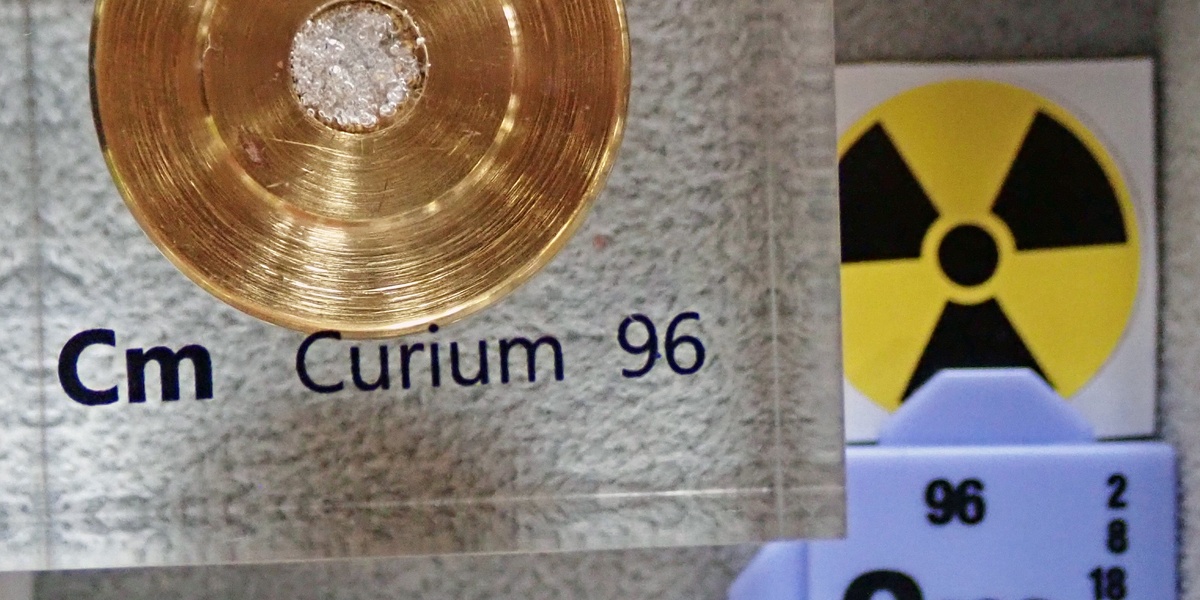
Curium was first synthesized in 1944 by Glenn T. Seaborg and his team, a landmark atomic-age discovery named for Marie and Pierre Curie that pushed the periodic table into the transuranics. The element has atomic number 96, a dominant +3 oxidation state (with +4 appearing in a few oxides), and a commonly used isotope, Cm‑244, has a half‑life of about 18.1 years. Curium metal melts around 1,340 °C and its radioactivity and chemistry drive strict handling and storage rules used by labs such as Los Alamos and Lawrence Berkeley. Outside specialist facilities these details matter because curium’s reactions determine corrosion, separations behavior, nuclear‑material targets, and the design of radiological sources. Below I walk through eight elements curium reacts with, what those reactions produce, and why they matter for storage, research, and safety.
Reactions with Nonmetals and Chalcogens
Curium reacts readily with nonmetals like oxygen, nitrogen, and sulfur to form stable, often ceramic compounds. These oxides, nitrides, and sulfides typically reflect the +3 state but can show +4 under oxidizing conditions, and they control corrosion, waste‑form chemistry, and solid‑state studies of 5f electrons.
1. Oxygen — Oxides (CmO2, Cm2O3)
Curium combines with oxygen to give documented oxides such as curium dioxide (CmO2) and the sesquioxide (Cm2O3), with curium most often in +3 but oxidized to +4 in CmO2. Oxidation to CmO2 can occur on heating curium‑bearing materials in air, and researchers have characterized both phases by X‑ray methods at national labs.
Oxides are refractory and ceramic‑like: they play a central role in storage and immobilization strategies and are common targets in solid‑state actinide research. In practice, oxide formation alters surface chemistry and containment—thin oxide layers can change corrosion rates and complicate chemical separations.
Laboratory preparation often involves controlled oxidation of curium salts or metal at elevated temperatures; because Cm shows +3 most strongly, Cm2O3 is frequently observed unless strong oxidants or higher temperatures stabilize the dioxide.
2. Nitrogen — Nitrides (CmN)
Curium forms nitrides such as CmN under high‑temperature conditions; actinide nitrides are well known for high melting points and refractory behavior. CmN is typically prepared by heating curium metal or oxide with nitrogen or by ammonolysis routes at several hundred up to >1,000 °C.
Nitrides give a different bonding environment from oxides, with stronger metal–nitrogen interactions and higher lattice energies. That makes them interesting for inert matrix fuel concepts and for probing 5f electron behavior in condensed phases.
Because nitrides are chemically robust and high‑melting, they serve in fundamental studies rather than routine processing, and comparison with uranium or plutonium nitrides helps place curium’s behavior in context.
3. Sulfur — Sulfides and Chalcogenides (CmS)
Curium reacts with sulfur to yield sulfides such as CmS and related chalcogenides under controlled, often reducing, conditions. Actinide sulfides are known to have high lattice energies and typically low aqueous solubility relative to many salts.
Sulfides provide a probe of bonding and electronic structure: changing the chalcogen shifts covalency and band structure in measurable ways. In disposal scenarios, sulfide formation can influence environmental mobility, though oxides and hydroxides are generally more relevant in oxidizing repositories.
In the lab, researchers convert curium salts to sulfides deliberately to study spectroscopic features or to prepare materials for physical measurements; handling follows strict radiological protocols because sulfide preparations can be fine powders.
Reactions with the Halogens
Halogens form stable curium salts across fluorine, chlorine, bromine, and iodine; fluorides and chlorides are best characterized. Halide chemistry matters for separations, spectroscopy, and preparing curium in soluble or crystalline forms for study—elements curium reacts with in this group often yield useful analytical standards.
4. Fluorine — Fluorides (CmF3, higher fluorides)
Curium reacts with fluorine to give stable fluorides, most commonly the trivalent fluoride CmF3, though evidence of tetravalent behavior appears under strongly oxidizing fluoride chemistries. CmF3 is a well‑characterized solid used in crystallography and spectroscopy.
Fluoride salts tend to have very high lattice energies and are often insoluble; that insolubility is useful when isolating curium as a defined solid phase for X‑ray or spectroscopic work. Preparation typically involves precipitation from solution using fluoride sources or direct fluorination of hydrates in controlled environments.
Curium fluorides have helped researchers identify electronic transitions and local symmetry in the 5f shell, and they are routine references in research‑scale separations chemistry at national laboratories.
5. Chlorine — Chlorides (CmCl3 and other halide salts)
Curium forms chlorides such as CmCl3, which are more soluble than many fluorides and commonly used in radiochemistry. Solid‑state structures often show coordination numbers of about 8–9 for trivalent curium in chloride lattices, and hydrates are readily encountered.
CmCl3 hydrates serve as convenient precursors for ligand exchange and the synthesis of organometallic curium complexes. Because chlorides are soluble under appropriate conditions, they are frequently intermediates during separations and when transferring curium between chemical media.
In practice, chemists convert CmCl3 to other salts or complexes by metathesis and ligand substitution, using the chloride form as a handle for broader curium chemistry.
Reactions with Hydrogen, Carbon, Silicon and Metals
Curium reacts with small elements like hydrogen and carbon to form hydrides and carbides, and it can alloy with transition metals to form intermetallic phases. These chemistries influence mechanical properties, source design, and advanced materials research in radiochemistry and metallurgy.
6. Hydrogen — Hydrides (CmH2 and related)
Under hydrogen atmospheres at elevated temperature, curium can form hydrides such as stoichiometric dihydrides (illustrative formula CmH2) or nonstoichiometric hydride phases, mirroring behavior seen across the actinides. Hydride formation typically requires temperatures of several hundred degrees Celsius in a controlled gas flow.
Hydrides can embrittle metal, altering ductility and complicating machining. For curium metal, that embrittlement is a practical concern during metallurgical processing or when preparing targets for irradiation, so chemists avoid hydrogen exposure or monitor hydride growth carefully.
Laboratory preparation is done under tightly controlled atmospheres at specialist facilities, with hydride phases serving occasionally as intermediates in materials studies rather than common storage forms.
7. Carbon — Carbides and Organometallic Complexes
Curium interacts with carbon both as refractory carbides and as ligand‑bound organometallic complexes. Carbide formation typically demands high temperatures often above 1,000 °C, similar to UC or PuC syntheses, producing very hard, high‑melting materials.
Organometallic chemists have also synthesized curium complexes with carbon‑based ligands—cyclopentadienyls and related species—to probe 5f–ligand bonding and electronic structure. Those studies reveal subtle covalency and help place curium among the actinides in bonding maps.
Because both carbides and organometallics require specialized, glovebox‑level work at national labs, they are primarily tools for fundamental research rather than routine processing, but they offer direct insight into curium’s chemistry.
8. Metals — Intermetallics and Alloys (e.g., iron, nickel)
Curium can form alloys and intermetallic phases with transition metals such as nickel or iron when processed under metallurgical conditions, often at temperatures from >500 °C up to >1,000 °C depending on the system. Researchers make small‑scale alloys to study mechanical and electronic effects of 5f incorporation.
Alloying changes hardness, corrosion resistance, and thermal behavior; it also influences how curium behaves in target fabrication for isotope production and how it partitions during high‑temperature metallurgy. Intermetallic phases are therefore considered when designing waste forms and experimental targets.
Such alloy work is confined to specialized facilities that control contamination and radiological risk, and the data from those studies guide both practical handling and theoretical models of actinide metallurgy.
Summary
- Curium (atomic number 96, first made in 1944) predominately shows +3 chemistry but can adopt +4 in oxides; its common isotope Cm‑244 has an 18.1‑year half‑life.
- Oxides (CmO2, Cm2O3), nitrides (CmN), and halides (CmF3, CmCl3) are the most commonly encountered products and matter for storage, separations, and spectroscopy.
- Hydrides, sulfides, carbides, organometallics, and intermetallic alloys reveal different bonding regimes and affect mechanical, thermal, and environmental behavior.
- Work with curium requires specialized labs (for example, Los Alamos or Lawrence Berkeley), strict controls, and careful material‑design choices—consult primary lab literature before attempting experiments.