In 1962, Rachel Carson’s Silent Spring exposed how widespread pesticide use threatened bird populations and human health, sparking a national outcry and policy shifts. That moment marked a shift: ongoing environmental crises demand rigorous science paired with public engagement to push policy and practice forward. This roundup profiles ten famous environmental scientists whose research and advocacy fundamentally changed how society understands and protects the natural world. The list spans conservation pioneers, climate researchers, ecologists, and oceanographers, and each entry highlights a defining discovery or contribution, the supporting dates or figures, and clear outcomes such as laws, long-running datasets, and conservation programs. Read on for concrete examples—from a book that helped prompt a national pesticide ban to a continuous CO2 record that underpins modern climate policy—and note how individual scientists translated data and storytelling into lasting institutions and action.
Pioneers of Conservation and Public Awareness
These figures shaped public attitudes, policy, and institutions for nature protection through books, campaigns, and organization-building. Their discoveries and voices moved laws, created parks, and inspired grassroots movements.
1. Rachel Carson — Silent Spring and the Modern Environmental Movement
Rachel Carson’s key contribution was Silent Spring, published in 1962, which connected pesticide use—especially DDT—to ecological and human health harms and galvanized public concern. Scientific framing and vivid examples in the book helped change how the public and policymakers viewed chemical risks.
Within a decade of Silent Spring the United States moved toward stronger environmental oversight: the U.S. Environmental Protection Agency was created in 1970 and the U.S. banned DDT in 1972. Those policy outcomes were not solely Carson’s doing, but her book provided the evidence and urgency that helped tip public opinion and regulatory action.
Today Carson’s legacy shows up in pesticide review processes, environmental impact assessments, and a thriving citizen-science culture that monitors wildlife and pollutants—proof that careful communication of science can produce measurable policy shifts.
2. John Muir — National Parks and the Conservation Ethos
John Muir helped shape public advocacy for wild places, arguing that certain landscapes deserved permanent protection for their intrinsic and recreational value. His writing and lobbying were pivotal to Yosemite’s protection and the broader national parks movement.
Muir was born in 1838 and his campaigns contributed to Yosemite National Park’s establishment in 1890. He also helped found the Sierra Club in 1892, an organization that continues to influence park policy and wilderness preservation more than a century later.
Through essays, friendships with leaders like President Theodore Roosevelt, and organizational work, Muir helped create the institutional tools—parks, clubs, and public support—that protect millions of acres today.
3. Aldo Leopold — The “Land Ethic” and Modern Ecology
Aldo Leopold introduced the idea of a “land ethic” that framed humans as responsible members of ecological communities. His essays, collected posthumously in A Sand County Almanac (1949), shifted conservation from single-species management to ecosystem thinking.
Leopold’s career in wildlife management and forestry (notably in Wisconsin) informed practical approaches to restoration ecology and sustainable land use. His writing influenced generations of conservation curricula and remains widely cited in environmental studies.
Many restoration projects and ecosystem-based management programs today trace conceptual roots to Leopold’s insistence that ethical responsibility extends to soils, waters, plants, and animals—not just resource extraction.
4. Wangari Maathai — Trees, Women’s Empowerment, and Reforestation
Wangari Maathai founded the Green Belt Movement in 1977 to mobilize communities—especially women—to plant trees for fuel, soil conservation, and income. The movement tied ecological restoration to civic engagement and women’s leadership.
By the time Maathai received the Nobel Peace Prize in 2004, the Green Belt Movement had planted more than 51 million trees across Kenya. That scale of planting supported watershed protection, native species recovery, and community livelihoods.
Maathai’s model—community-led reforestation linked to rights and governance—helped change how reforestation projects are designed worldwide, demonstrating measurable ecological and social benefits from local stewardship.
Climate and Atmospheric Science Trailblazers
A relatively small set of researchers quantified atmospheric change and linked it to human activity. Their work produced theories, continuous measurements, and public testimony that together built modern climate science—and helped shape international policy debates. These famous environmental scientists provided the concepts and data that policy makers and institutions still rely on.
5. Svante Arrhenius — Early Greenhouse Theory (1896)
In 1896 Svante Arrhenius published calculations showing that atmospheric carbon dioxide affects global temperature. He estimated that a doubling of CO2 could raise Earth’s average temperature by several degrees—a crude number by today’s standards but a remarkably prescient idea.
Arrhenius’s work established a quantitative link between greenhouse gases and climate, giving later researchers a theoretical basis for measuring radiative forcing—the way additional CO2 traps more heat in the atmosphere.
That foundational theory is still used in climate models today, even though modern methods give more precise estimates of sensitivity and feedbacks than Arrhenius could in 1896.
6. Charles David Keeling — The Keeling Curve and CO2 Monitoring (1958–)
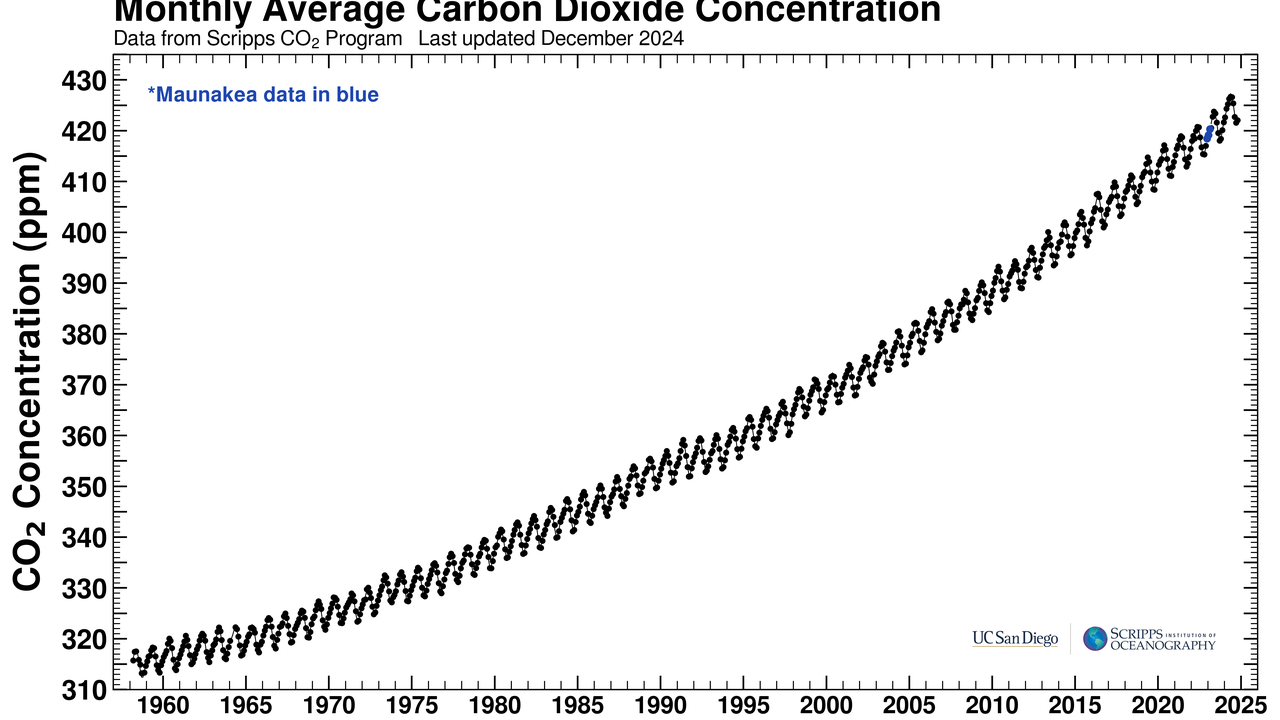
Starting precise CO2 measurements at Mauna Loa Observatory in 1958, Charles David Keeling created the Keeling Curve: the clearest empirical record of rising atmospheric CO2. His first recorded value was about 315 parts per million (ppm).
The continuous record shows CO2 rising steadily to exceed 410 ppm by 2019, and it remains a cornerstone dataset for climate science, informing IPCC assessments and national monitoring efforts. The Scripps Institution of Oceanography and NOAA now steward these data.
The Keeling Curve’s technical point: measuring seasonal cycles and long-term trend separately made it possible to attribute the upward trend to fossil-fuel emissions, providing concrete evidence linking human activity to atmospheric change. See the NOAA Mauna Loa record for the raw data.
7. James Hansen — Climate Modeling and Public Testimony (1988)
James Hansen used climate models at NASA’s Goddard Institute for Space Studies (GISS) to produce projections of future warming, and his 1988 testimony to the U.S. Congress brought scientific urgency to public attention. His testimony argued that warming was detectable and likely linked to greenhouse-gas emissions.
Hansen’s model-based scenarios and public role helped move climate science into policy discussions in the late 1980s. His work showcased how model projections, when clearly communicated, can influence national debates about emissions and mitigation strategies.
Beyond the 1988 hearings, Hansen’s research at GISS contributed to improved global temperature datasets and ongoing analysis used by researchers and regulators worldwide.
Ecology, Biodiversity, and Ocean Science Innovators

These scientists advanced understanding of species, ecosystems, and the oceans—and translated that knowledge into conservation strategy. Their fieldwork, theories, and expeditions directly informed reserve design, species protection, and marine conservation.
8. E.O. Wilson — Biodiversity and Island Biogeography
E.O. Wilson helped develop the science of biodiversity and, with Robert MacArthur, formalized island biogeography in The Theory of Island Biogeography (1967). That theory links habitat size and isolation to species richness and extinction risk.
Wilson popularized the term “biodiversity” and, through works like The Diversity of Life (1992), argued for prioritizing species- and habitat-rich areas in conservation planning. Island biogeography became a practical tool for designing nature reserves and networks of protected areas.
Conservation planners use these ideas to size reserves and predict species persistence, and Wilson’s advocacy helped focus international efforts on biodiversity hotspots and systematic protection strategies.
9. Jane Goodall — Primate Behavior and Conservation from the Field (1960–)
Jane Goodall began systematic field observations of chimpanzees at Gombe in 1960, documenting tool use, meat-eating, and complex social behavior that challenged prior assumptions about primates. Her careful, long-term observations changed both science and public perception.
Goodall founded the Jane Goodall Institute in 1977 to support research and community-based conservation. The Gombe Stream Research Center continues longitudinal studies that inform species protection measures and habitat management.
Her approach—linking research, education, and local engagement—has protected habitat corridors, supported anti-poaching efforts, and promoted eco-tourism strategies that benefit both people and chimpanzees.
10. Sylvia Earle — Ocean Exploration and Marine Conservation
Sylvia Earle advanced deep-sea science and public understanding of ocean health through more than 100 ocean expeditions and leadership roles, including serving as the first female chief scientist at NOAA. Her field experience helped document undersea ecosystems and their vulnerabilities.
Earle founded Mission Blue, which champions marine protected areas called “Hope Spots.” Mission Blue has helped establish and promote dozens of Hope Spots worldwide as focal points for protection and research.
Her advocacy for exploring and protecting the ocean—backed by expeditions, technology demonstrations, and public outreach—has accelerated the push for larger, better-managed marine reserves and stronger international conservation targets.
Summary
Key takeaways from these ten scientists show how single papers, long-term monitoring, and persistent fieldwork reshaped policy and practice. Below are three concise points and a practical next step you can take.
- The publication of Silent Spring helped drive concrete policy changes (EPA formation, DDT ban), demonstrating how science plus storytelling affects law.
- Long-term datasets like the Keeling Curve (1958 onward) provide indisputable evidence of atmospheric change and remain central to climate assessments.
- Community-driven initiatives—exemplified by the Green Belt Movement’s 51 million trees—show that local action scales to measurable environmental outcomes.
- Support local conservation groups, follow monitoring networks such as NOAA or Scripps for data, or advocate for protected areas to help turn scientific evidence into action.