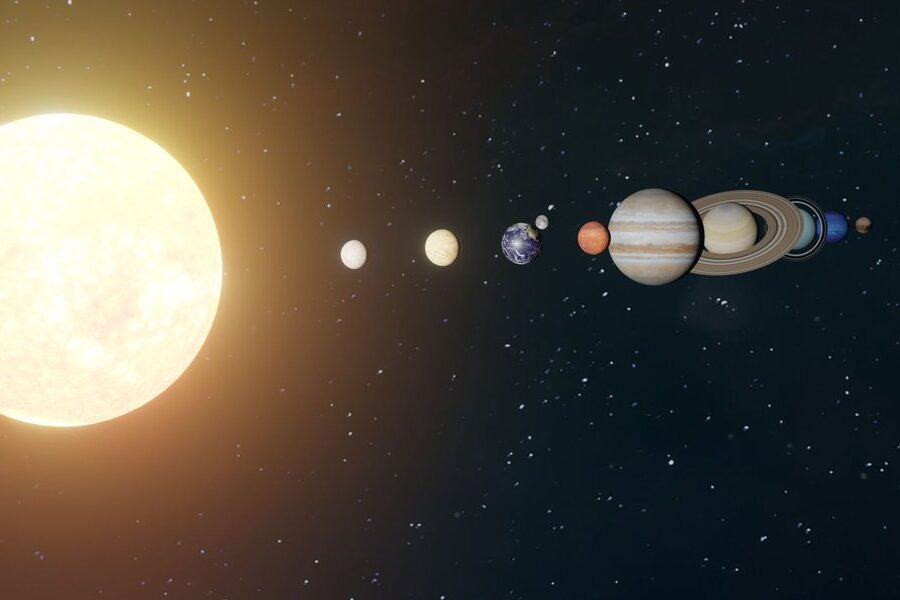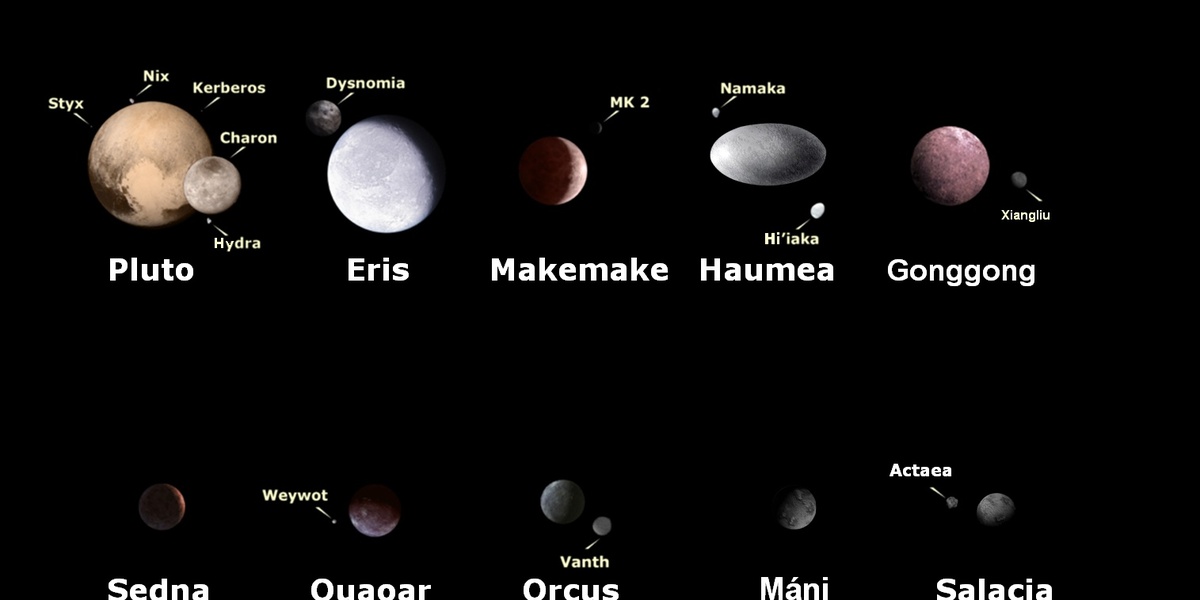
The outer reaches of our Solar System are scattered with small worlds that bridge the gap between asteroids and full-sized planets. Studying them gives a snapshot of how planets form and evolve, and it highlights the diversity of bodies orbiting the Sun.
There are 20 Dwarf Planets, ranging from 2002 AW197 to Varuna. For each entry you’ll find below the key facts arranged with the columns Status,Diameter (km),Avg distance (AU), so you can quickly compare classification, size, and orbital distance—you’ll find below.
What criteria are used to decide if an object is a dwarf planet?
An object is classed as a dwarf planet when it orbits the Sun, is not a satellite, has enough mass for its self-gravity to make it nearly round, but has not cleared its orbital neighborhood; size, observed shape, and orbital context are the main factors used by astronomers.
How can I use this list to compare physical size and orbital position?
Use the Diameter (km) column to rank objects by size and the Avg distance (AU) column to see where each sits relative to the Sun; pairing those with Status helps identify confirmed versus candidate objects and highlights trends across the population.
Dwarf Planets
| Name | Status | Diameter (km) | Avg distance (AU) |
|---|---|---|---|
| Ceres | IAU-recognized dwarf planet | 939.40 | 2.77 |
| Pluto | IAU-recognized dwarf planet | 2,376.60 | 39.48 |
| Haumea | IAU-recognized dwarf planet | 1,632.00 | 43.13 |
| Makemake | IAU-recognized dwarf planet | 1,430.00 | 45.79 |
| Eris | IAU-recognized dwarf planet | 2,326.00 | 67.78 |
| Gonggong (2007 OR10) | candidate | 1,230.00 | 67.34 |
| Quaoar | candidate | 1,110.00 | 43.69 |
| Sedna | candidate | 995.00 | 518.00 |
| Orcus | candidate | 917.00 | 39.16 |
| 2002 MS4 | candidate | 934.00 | 41.77 |
| Salacia | candidate | 854.00 | 42.19 |
| Varda | candidate | 740.00 | 45.70 |
| Varuna | candidate | 668.00 | 43.19 |
| Ixion | candidate | 617.00 | 39.57 |
| 2003 AZ84 | candidate | 727.00 | 39.40 |
| 2005 RN43 | candidate | 679.00 | 41.59 |
| 2002 AW197 | candidate | 768.00 | 47.17 |
| 2014 UZ224 (DeeDee) | candidate | 635.00 | 109.00 |
| 2004 GV9 | candidate | 680.00 | 42.02 |
| 2013 FY27 | candidate | 740.00 | 59.18 |
Images and Descriptions
Ceres
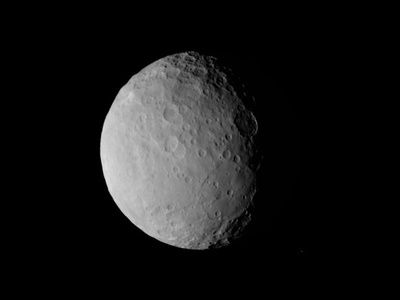
Discovered in 1801 by Giuseppe Piazzi, Ceres is the largest object in the asteroid belt. About 939 km across, Dawn spacecraft confirmed a differentiated interior and water-ice/possible cryovolcanism, making it scientifically unique among dwarf planets.
Pluto
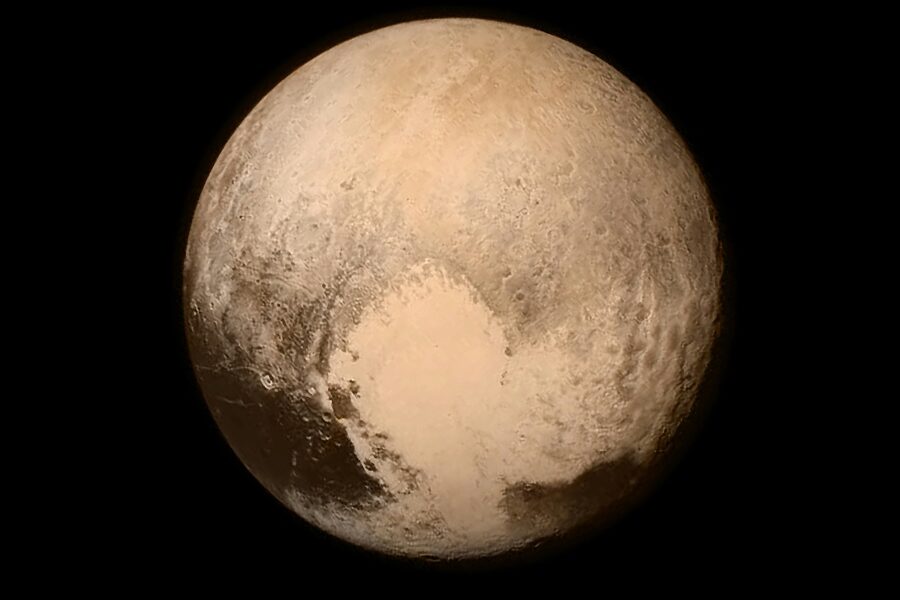
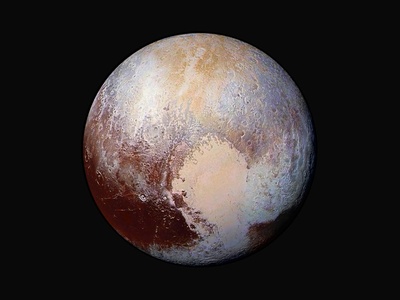
Discovered in 1930 by Clyde Tombaugh, Pluto (2,376.6 km) is a complex, icy world with mountains, plains, and an atmosphere. New Horizons revealed diverse geology and five known moons, keeping Pluto central to dwarf-planet studies.
Haumea
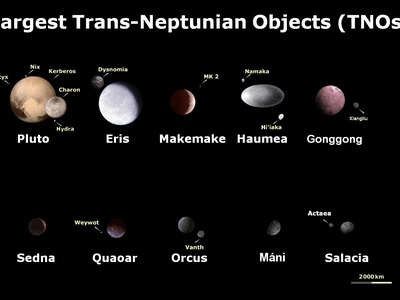
Discovered in 2003, Haumea is an elongated, fast-rotating Kuiper Belt object roughly 1,632 km in effective diameter. It has a collisional family and two moons; its odd shape and rapid spin make it notable and debated.
Makemake
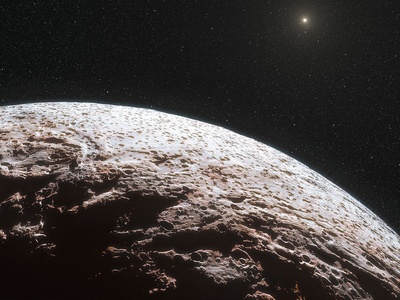
Found in 2005, Makemake (~1,430 km) is a bright, methane-rich Kuiper Belt object with no large atmosphere detected. Its reflective surface and seasonal volatiles earned it IAU dwarf-planet status and intense observational interest.
Eris
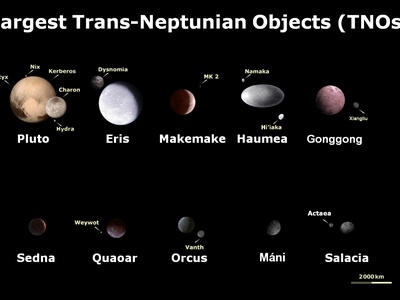
Discovered in 2005, Eris (≈2,326 km) is a massive scattered-disk object that rivaled Pluto in size, sparking the 2006 redefinition of “planet.” It has one known moon, Dysnomia, and a very reflective surface.
Gonggong (2007 OR10)
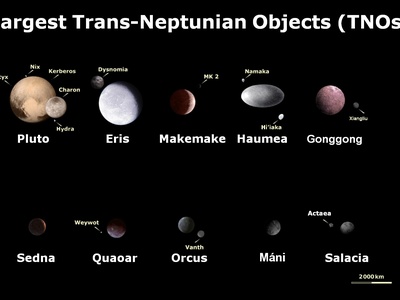
Discovered in 2007 (designated 2007 OR10), Gonggong is a red, likely ice-rich trans-Neptunian object about 1,230 km across. It has a small moon and is widely regarded as a probable dwarf-planet candidate.
Quaoar
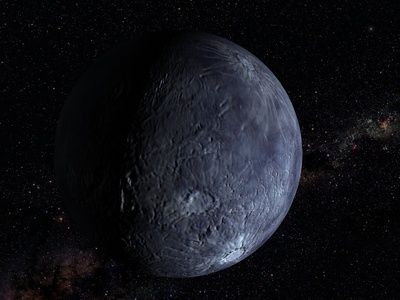
Found in 2002, Quaoar (~1,110 km) is a large classical Kuiper Belt object with a small moon (Weywot). Its size and relatively bright surface make it a leading dwarf-planet candidate studied for composition and history.
Sedna
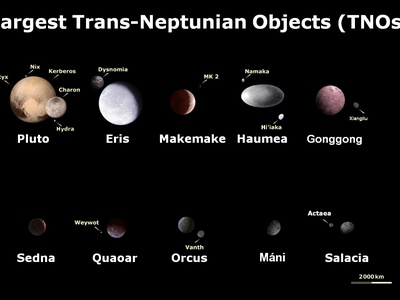
Discovered in 2003, Sedna (~995 km) orbits far beyond Neptune on a very elongated orbit (a≈518 AU). Its distant, slow path and likely pristine surface suggest a relic of the early Solar System and candidate dwarf status.
Orcus
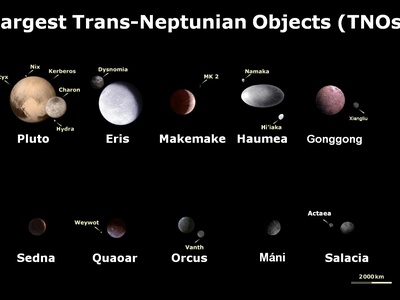
Discovered in 2004, Orcus (~917 km) is a plutino with a large moon, Vanth. Its size, relatively circular orbit, and spectral signs of ices make Orcus a commonly listed dwarf-planet candidate among outer Solar System objects.
2002 MS4
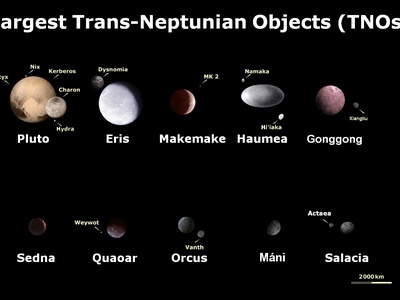
Discovered in 2002, 2002 MS4 (~934 km) is a sizeable Kuiper Belt object whose diameter and low albedo suggest a large, possibly relaxed body. Its status remains candidate pending better shape and mass constraints.
Salacia
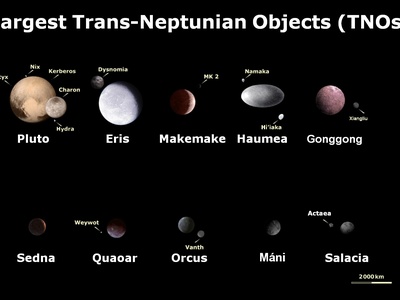
Discovered in 2004, Salacia (~854 km) lies in the classical Kuiper Belt and has a companion, Actaea. Observations suggest it may be near hydrostatic equilibrium, placing Salacia among widely noted dwarf-planet candidates.

Varda
Discovered in 2003, Varda (~740 km) is a binary Kuiper Belt object with the moon Ilmarë. Its relatively bright surface and companion allow mass estimates; many researchers list Varda as a plausible dwarf-planet candidate.
Varuna
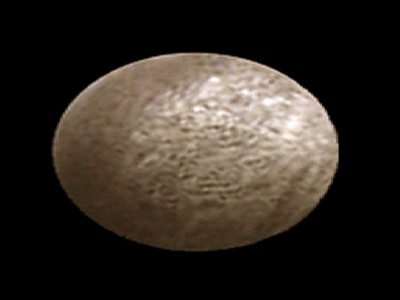
Found in 2000, Varuna (~668 km) is a fast-rotating classical Kuiper Belt object with an elongated shape. Its size, color, and rotation place it in discussions of possible dwarf status though its equilibrium shape is debated.
Ixion
Discovered in 2001, Ixion (~617 km) is a plutino with a moderately red surface and signs of water ice. Its size and orbit keep Ixion on many lists of probable dwarf-planet candidates pending clearer shape data.
2003 AZ84
Discovered in 2003, 2003 AZ84 (~727 km) is a resonant Kuiper Belt object with a moderately large size and possible companion signatures. Its physical properties make it a commonly cited dwarf-planet candidate.
2005 RN43
Found in 2005, 2005 RN43 (~679 km) is a classical Kuiper Belt object with a relatively bright surface. Its size and spectral features place it among widely acknowledged dwarf-planet candidates.
2002 AW197
Discovered in 2002, 2002 AW197 (~768 km) orbits in the classical belt and has a neutral-colored surface. Its diameter and mass estimates suggest it could be in hydrostatic equilibrium, making it a candidate dwarf planet.
2014 UZ224 (DeeDee)
Discovered in 2014 and nicknamed “DeeDee,” 2014 UZ224 (~635 km) orbits far from the Sun (a≈109 AU). Its remote, cold environment and measured size earn it attention as a distant dwarf-planet candidate.
2004 GV9
Discovered in 2004, 2004 GV9 (~680 km) is a classical Kuiper Belt object with a relatively bright surface and slow rotation. These properties keep it under consideration as a possible dwarf planet.
2013 FY27
Found in 2013, 2013 FY27 (~740 km) is a distant trans-Neptunian object with a moderately red surface and a suspected small satellite. Its size and characteristics place it among contemporary dwarf-planet candidates.