Ancient merchants on the banks of the Euphrates used the abacus as early as 2400 BCE to speed calculations for trade.
Tools turn abstract reasoning into concrete action: they save time, reduce error, and shape what problems we can tackle. From counting lanes in a marketplace to plotting orbits and modeling weather, instruments have guided commerce, navigation, and engineering for millennia. From the abacus to symbolic math software, a handful of key instruments have shaped how humans compute, measure, and visualize mathematical ideas.
Historical Calculation Tools
Early calculation devices extended what one person could compute by hand, accelerating trade, navigation, and engineering. Practical demands — merchants balancing accounts, sailors computing courses, builders estimating materials — drove inventions from Mesopotamia to Europe. These manual aids laid groundwork for 20th-century electronic calculators and, later, computers.
1. Abacus
The abacus is a bead-based computing frame for performing place-value arithmetic. Records and archaeological finds place abacus-like devices around 2400 BCE, and variants such as the Chinese suanpan and Japanese soroban remained central in East Asian bookkeeping for centuries. Users slide beads to represent units, tens and higher places; skilled practitioners mentally visualize moves and can perform multi-digit addition and subtraction very rapidly (speed competitors sometimes complete specific problems in under 2 seconds). Today the abacus survives in markets, classrooms, and in mental-abacus training that strengthens numerical intuition.
2. Napier’s Bones
John Napier introduced “Napier’s bones” around 1617 as a set of numbered rods that turn multiplication into repeated additions. Each rod encodes a multiplication table, and by arranging rods for one factor and reading diagonals you assemble partial products before summing them. For example, multiplying 23 × 47 is reduced to reading and adding the appropriate rod entries rather than multiplying each digit separately. Napier’s idea influenced logarithmic calculation and prefigured later mechanical aids used in 17th–18th-century Europe.
3. Slide Rule
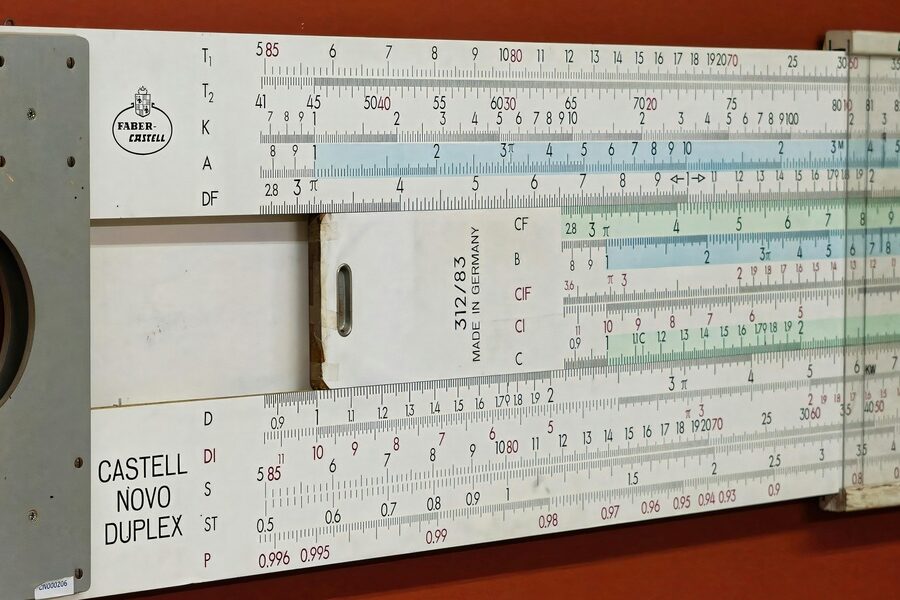
Built on Napier’s logarithms, the slide rule uses aligned logarithmic scales so multiplication and division become adding and subtracting distances on a ruler-like device. Originating in the 17th century, slide rules were standard engineering tools from the 1700s through the 1970s; their use plunged after affordable pocket electronic calculators arrived (sharp decline after about 1974). Engineers used slide rules to size components and even to design Apollo-era spacecraft, where quick, reliable estimates mattered during calculations on the workbench.
4. Mechanical Calculator (Pascaline and successors)
Blaise Pascal built the Pascaline in 1642, one of the first gear-driven adding machines. The device used geared wheels and dials to carry between columns, automating addition and subtraction. Mechanical calculators evolved into commercial machines in the 19th century (for example, the Arithmometer could handle several digits and was used in accounting offices). By the mid-20th century, electromechanical and then electronic calculators replaced these devices for speed and reliability.
Drawing and Measurement Instruments
Geometry instruments translate theoretical constructions into precise drawings. Used in architecture, surveying and education, these tools help measure lengths, angles, and areas so designs can be built and verified. They remain staples in classrooms and in analogue-to-digital workflows where a sketch must be measured or checked against plans.
5. Compass
A compass draws circles and transfers distances; it’s central to Euclidean constructions dating to classical Greece. With two pins—one fixed, one with a pencil—you can construct perpendicular bisectors, circumcircles, and exact arcs (Euclid’s constructions provide many classical examples). In drafting and early architectural work the compass translated geometric ideas into plans; in classrooms a common activity is constructing the perpendicular bisector of a segment to find a triangle’s circumcenter.
6. Straightedge and Ruler
The straightedge and ruler let you draw straight lines and measure lengths. The idealized straightedge has no markings and is a theoretical tool in straightedge-and-compass constructions; the ruler adds centimeter or inch markings (standard rulers often go to 30 cm, technical ones down to 1 mm). Surveyors and drafters use precision scales—architectural scales and engineering rulers—to lay out blueprints or transfer measurements onto plans.
7. Protractor
A protractor measures angles in degrees—common classroom protractors show 0–180°, while full-circle versions measure 0–360°. Use it to measure interior angles of polygons or to set a bearing in fieldwork. Carpenters, engineers and students rely on protractors to check sloping cuts, lay out truss angles, and verify geometric constructions precisely.
8. Planimeter
A planimeter measures the area of arbitrary planar regions by tracing their boundary. Invented and refined in the 19th century, mechanical planimeters became standard in surveying and cartography before digital mapping. The operator traces a map’s contour and the instrument integrates the path to give area (commonly reported in square meters or hectares); accuracies often reach a few tenths of a percent for well-drawn maps. Surveyors used planimeters to estimate farmland area from cadastral maps before GIS became widespread.
Digital and Software Tools

Electronic calculators replaced slide rules in the 1970s, and since the 1980s graphing calculators and computer algebra systems have broadened what individuals can compute and visualize. These tools handle large numerical problems, produce interactive plots, and perform symbolic manipulation that was once the domain of specialists.
9. Graphing Calculator
Graphing calculators are handheld devices that plot functions, solve numerically, and display data. Models from Texas Instruments became popular in schools during the 1980s and 1990s; for instance, the TI-83 debuted in 1996 and the TI-84 series followed, gaining deep classroom penetration. Students plot y = sin(x), explore parameter changes, and numerically find roots or intersections. Approved models appear on many standardized exams, and the visual feedback helps bridge algebraic manipulation and calculus concepts.
10. Mathematical Software and Computer Algebra Systems
Computer algebra systems (CAS) and numerical packages handle symbolic manipulation, large-scale linear algebra, and visualization. Mathematica first appeared in 1988; MATLAB became widespread in engineering from the 1980s onward; open-source ecosystems like Python with NumPy and SymPy surged in the 2010s. These tools can symbolically integrate complicated expressions, solve systems of 1,000 linear equations, and run reproducible simulations. They power work in weather modeling, machine learning, structural analysis, and cryptography research, letting teams tackle problems once impractical by hand.
Summary
- Tools translate abstract ideas into practical workflows; they’ve supported trade, navigation, and engineering across millennia.
- Some instruments have surprising longevity — the abacus dates to about 2400 BCE — while others, like the slide rule, dominated engineering until the 1970s and aided projects such as early spaceflight.
- Digital tools reshaped research: Mathematica (1988), MATLAB and Python toolchains handle problems far beyond manual reach.
- Try one small step: draw a Euclidean construction with compass and straightedge, plot y = sin(x) on a graphing calculator, or run a short CAS tutorial to experience how these instruments change mathematical work.