Hawaii’s islands hold a patchwork of microclimates — from dry leeward slopes to cloud-fed uplands — where long isolation let unique plants evolve. Those ecosystems are part of what makes local landscapes and traditions tied to specific species and places.
There are 12 Endemic Plants of Hawaii, ranging from Ahakea to ʻŌhiʻa lehua. For each species, you’ll find below the columns: Scientific name,Island(s),Conservation status so you can quickly see where each occurs and how threatened it is; use the list to guide further reading or field visits you’ll find below.
How threatened are these endemic plants and what does the conservation status mean?
Conservation status summarizes risks like habitat loss, invasive species, or disease — some of the 12 are stable in protected areas while others are federally listed or critically imperiled; the status column helps prioritize attention and shows where recovery efforts or habitat protection are most needed.
How can I observe Ahakea or ʻŌhiʻa lehua responsibly in the wild?
Look for them in designated reserves or parks and follow local guidelines: stay on trails, don’t collect plants, clean shoes and gear to avoid spreading pests or pathogens, and consult park resources or native plant groups for permitted viewing locations and seasonal notes.
Endemic Plants of Hawaii
| Common name | Scientific name | Island(s) | Conservation status |
|---|---|---|---|
| ʻŌhiʻa lehua | Metrosideros polymorpha | Hawaiʻi,Maui,Oʻahu,Kauaʻi,Molokaʻi,Lānaʻi,Niʻihau | IUCN Least Concern; threatened by Rapid ʻŌhiʻa Death |
| Koa | Acacia koa | Hawaiʻi,Maui,Oʻahu,Kauaʻi,Molokaʻi,Lānaʻi | IUCN Least Concern; locally depleted by historical logging |
| Silversword | Argyroxiphium sandwicense | Maui,Hawaiʻi | IUCN Endangered; USFWS Endangered |
| Hawaiian yellow hibiscus | Hibiscus brackenridgei | Big Island,Maui,Oʻahu,Kauaʻi (scattered) | IUCN Endangered; USFWS Endangered |
| Mamane | Sophora chrysophylla | Hawaiʻi,Maui,Molokaʻi (high elevations) | IUCN Vulnerable; threatened by habitat loss and browsing |
| Mamaki | Pipturus albidus | Hawaiʻi,Maui,Oʻahu,Kauaʻi,Molokaʻi,Lānaʻi | IUCN Least Concern; locally declining |
| ʻŌhelo | Vaccinium reticulatum | Hawaiʻi,Maui,Kauaʻi (alpine/subalpine) | IUCN Least Concern |
| Naio | Myoporum sandwicense | Hawaiʻi,Maui,Oʻahu,Kauaʻi,Molokaʻi,Lānaʻi,Niʻihau | IUCN Least Concern; locally reduced in places |
| ʻIeʻie | Freycinetia arborea | Hawaiʻi,Maui,Oʻahu,Kauaʻi,Molokaʻi,Lānaʻi | IUCN Least Concern |
| Kokia cookei | Kokia cookei | Molokaʻi | IUCN Critically Endangered; possibly extinct in wild |
| ʻIliahi (Hawaiian sandalwood) | Santalum freycinetianum | Kauaʻi,Oʻahu,Molokaʻi,Maui,Hawaiʻi (scattered) | IUCN Vulnerable; historically overexploited |
| Ahakea | Bobea sandwicensis | Oʻahu,Molokaʻi,Maui,Hawaiʻi | IUCN Vulnerable; habitat loss and browsing pressures |
Images and Descriptions
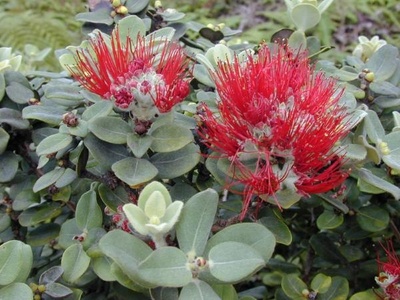
ʻŌhiʻa lehua
A variable native tree with bright red brushlike flowers that dominates forests from sea level to alpine. Found across all islands; culturally and ecologically vital, but many populations are suffering from an aggressive fungal disease called Rapid ʻŌhiʻa Death.
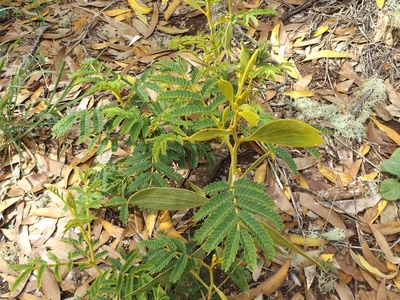
Koa
A large endemic tree prized for its curly-grained timber and canoe-making heritage. Grows in mid-elevation wet to mesic forests on most islands; ecologically important and the focus of many reforestation and restoration projects.
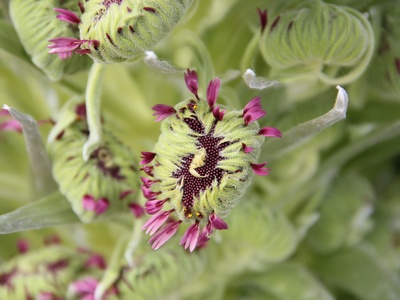
Silversword
A striking silvery rosette plant with a dramatic flowering stalk, confined to high-elevation volcanic slopes like Haleakalā and Mauna Kea. Slow-growing and specialized to alpine conditions, it is a rare, iconic species and major conservation focus.
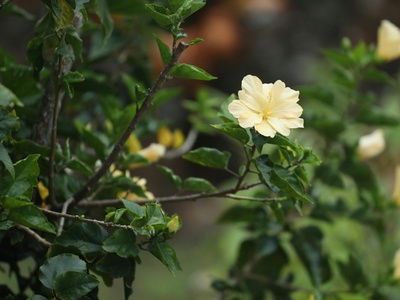
Hawaiian yellow hibiscus
The state flower: a bright yellow hibiscus shrub adapted to dry, sandy or rocky lowland habitats. Historically widespread but now rare and patchy; notable for its showy blooms and cultural importance.
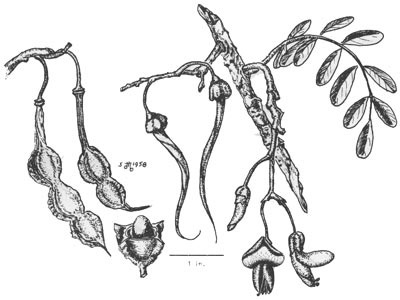
Mamane
A leguminous tree of subalpine and dry high-elevation slopes, important as the primary food plant for the palila bird. Recognizable by pinnate leaves and yellow pea-like flowers; often found on lava flows and open upland areas.

Mamaki
An understory shrub with soft, velvety leaves used traditionally to make herbal tea. Grows in mesic to wet forests across the islands; valued by native insects and people but sensitive to habitat change.
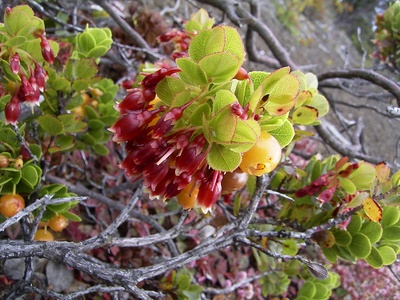
ʻŌhelo
A low shrub of alpine and subalpine zones that produces bright red to orange berries. Common on high-elevation lava and bogs; fruits are eaten by native birds and people and are a familiar sight above the treeline.
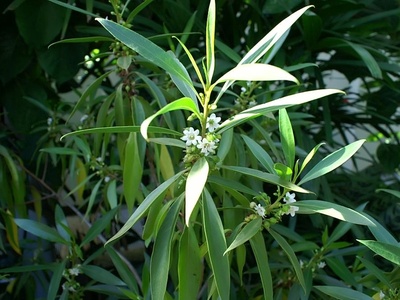
Naio
A small native tree with glossy leaves and fragrant white flowers, tolerant of dry coastal to mesic sites. Once widespread and used traditionally for tools and craft, it remains an important component of native lowland forests.
ʻIeʻie
A vine-like climbing plant with aerial roots and tight-bracted inflorescences found in wet forests and cliffs. Important culturally for thatching and cordage, it forms dense tangles in the understory and provides habitat structure for other species.
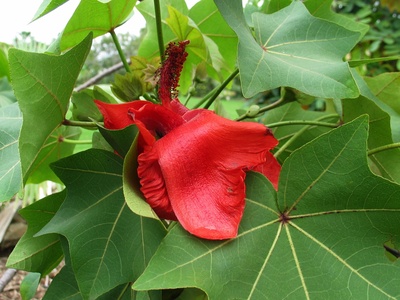
Kokia cookei
A tiny, tree-like relative of hibiscus once endemic to Molokaʻi, known for large pale flowers. Only a handful of individuals survive in cultivation; one of Hawaii’s rarest plants with concerted conservation and propagation efforts underway.
ʻIliahi (Hawaiian sandalwood)
A small, fragrant hardwood tree historically harvested for trade. Found in dry to mesic forests across several islands in remnant populations; valued for its aromatic heartwood and cultural uses, now reduced from historical levels.
Ahakea
A native tree of dry to mesic forests with smooth bark and pale urn-shaped flowers, traditionally used in canoe construction. Now patchy in distribution and threatened by land conversion and introduced grazers, making it a conservation priority.