In the nearby universe, elliptical galaxies often sit at the centers of groups and clusters, their smooth light profiles tracing long histories of mergers and star formation. Comparing examples across environments helps clarify how size, stellar content, and structure change with mass and neighborhood.
There are 20 Examples of Elliptical Galaxies, ranging from M105, NGC 5846 to illustrate the span of brightness and scale; each entry is organized by Catalog ID,Type,Distance (Mly) so you can quickly compare morphology and distance — you’ll find below.
How were these particular elliptical galaxies chosen for the list?
The selection focuses on well-documented, cataloged ellipticals with clear morphological classifications and reliable distance estimates; the aim is to sample a range of environments and luminosities so the list is useful for quick comparisons or starting points for deeper research.
How should I use the Catalog ID, Type, and Distance (Mly) columns when comparing entries?
Use the Catalog ID to locate original observations, the Type to see morphological subclass (e.g., E0–E7) which hints at shape and dynamics, and Distance (Mly) to scale sizes and estimate lookback time—together they let you compare physical properties and contextual environment efficiently.
Examples of Elliptical Galaxies
| Name | Catalog ID | Type | Distance (Mly) |
|---|---|---|---|
| M87 | Messier and NGC 4486 | E0 | 53.50 |
| M49 | Messier and NGC 4472 | E2 | 56 |
| M60 | Messier and NGC 4649 | E2 | 60 |
| M59 | Messier and NGC 4621 | E5 | 60 |
| M84 | Messier and NGC 4374 | E1 | 55 |
| M86 | Messier and NGC 4406 | E3 | 52 |
| M89 | Messier and NGC 4552 | E0 | 50 |
| M105 | Messier and NGC 3379 | E1 | 32 |
| M32 | Messier and NGC 221 | cE | 2.65 |
| NGC 205 (M110) | NGC and Messier 110 | dE5 | 2.02 |
| NGC 1399 | NGC 1399 | cD | 62 |
| NGC 1407 | NGC 1407 | E0 | 72 |
| NGC 4486B | NGC 4486B | cE | 53.50 |
| NGC 3377 | NGC 3377 | E5 | 32 |
| NGC 4365 | NGC 4365 | E3 | 60 |
| NGC 3923 | NGC 3923 | E4 | 98 |
| NGC 1600 | NGC 1600 | E3 | 210 |
| NGC 5846 | NGC 5846 | E0 | 90 |
| NGC 147 | NGC 147 | dE5 | 2.53 |
| NGC 185 | NGC 185 | dE3 | 2.02 |
Images and Descriptions

M87
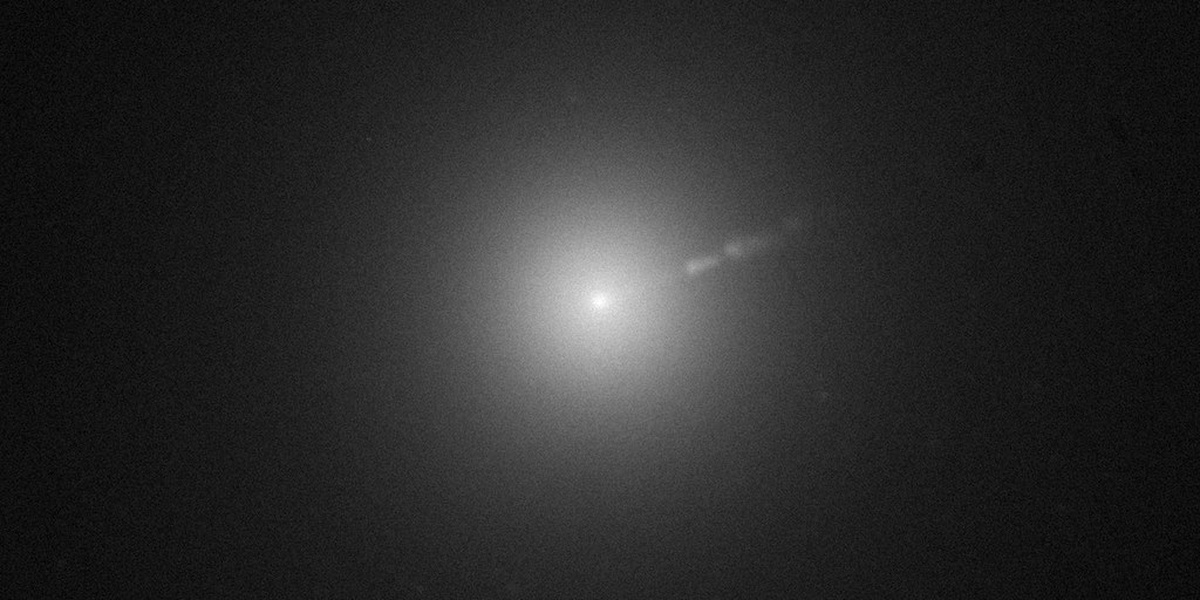
Giant elliptical in Virgo notable for its relativistic jet, massive central black hole imaged by the Event Horizon Telescope, and an enormous globular cluster system; an archetypal cD-like galaxy anchoring the Virgo Cluster’s core environment.
M49
Brightest Virgo Cluster elliptical located in Virgo, famous for a huge population of globular clusters and hot X-ray gas; a massive, metal-rich galaxy that helps astronomers study galaxy formation and cluster dynamics.
M60
Large elliptical near the Virgo center in Virgo constellation, notable for its supermassive black hole, rich globular cluster system and tidal interaction with nearby spiral NGC 4647; often studied for stellar populations and galactic dynamics.
M59
Elliptical galaxy in Virgo recognized for its flattened shape and old stellar population; relatively compact among giant ellipticals and useful for comparing structural properties across the Virgo members.
M84
Elliptical in Virgo with a low-luminosity active nucleus and radio jets, M84 helps astronomers study low-level AGN feedback in ellipticals and the connection between black hole activity and surrounding hot gas.
M86
A Virgo elliptical showing evidence of gas stripping as it moves through the cluster, M86 is notable for complex X-ray and optical features that reveal environmental effects on galaxy evolution.
M89
Round elliptical in Virgo with fine shell and dust features suggesting past minor mergers; M89’s symmetry and subtle disturbances make it a laboratory for studying elliptical assembly histories.
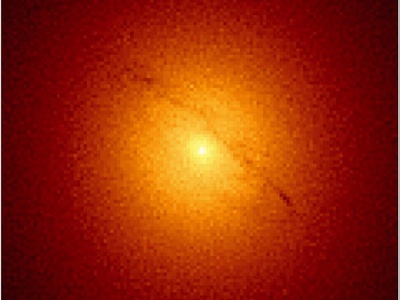
M105
Nearby Leo elliptical notable for a relaxed, old stellar population and a relatively low gas content; often used as a benchmark for the structure and stellar dynamics of normal ellipticals.
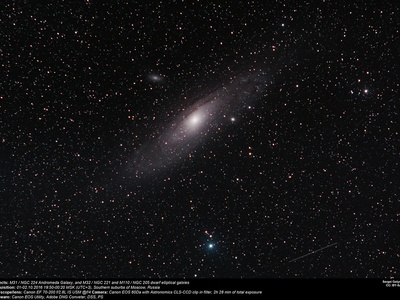
M32
Compact elliptical companion to Andromeda in Andromeda constellation, extremely dense and small for its luminosity; M32 is a textbook compact elliptical and a key object for studying tidal stripping and dense stellar systems.
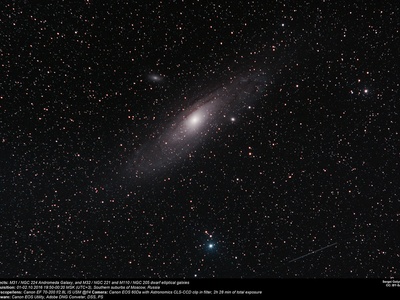
NGC 205 (M110)
Dwarf elliptical satellite of Andromeda showing pockets of younger stars and tidal disturbance; NGC 205 bridges dwarf ellipticals and spheroidals, illustrating environmental transformation of small galaxies.
NGC 1399
Central cD elliptical of the Fornax Cluster with an enormous globular cluster system and extended X-ray halo; NGC 1399 exemplifies cluster-center ellipticals and their role in cluster assembly and intracluster light production.
NGC 1407
Dominant elliptical in the Eridanus/Apollo group, notable for a rich globular cluster system and dense, old stellar population; often studied as an example of a group-central massive elliptical.
NGC 4486B
Compact elliptical satellite of M87 in Virgo, extremely dense and faint compared with giants; NGC 4486B is important for understanding compact elliptical formation and tidal interactions near massive hosts.
NGC 3377
Eccentric elliptical in Leo with a flattened shape and relatively low mass, used to probe how ellipticals vary in shape and kinematics across the luminosity function.
NGC 4365
Elliptical in Virgo known for a kinematically distinct core and complex globular cluster population; NGC 4365 provides insight into past merger events while retaining an overall elliptical classification.
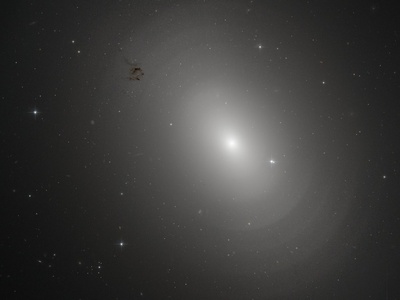
NGC 3923
Large shell-bearing elliptical in Hydra/Norma region famous for multiple concentric stellar shells that record past accretion events; an excellent example of how ellipticals can preserve merger debris over long timescales.
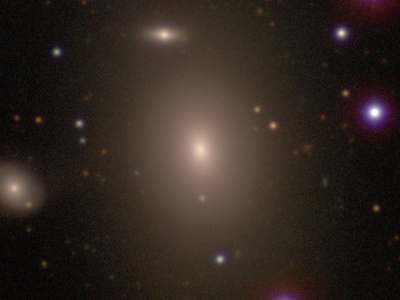
NGC 1600
Isolated massive elliptical notable for hosting an ultramassive black hole despite a relatively quiet environment; NGC 1600 challenges links between black hole mass and dense cluster environments.
NGC 5846
Central elliptical in a compact group with a prominent X-ray halo and numerous globular clusters; NGC 5846 serves as a nearby example of group-dominant ellipticals and hot gas interactions.
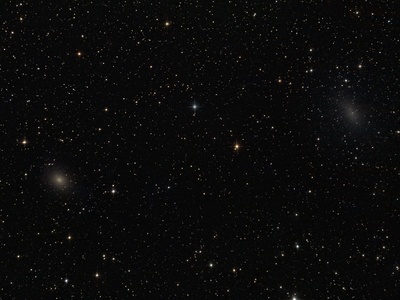
NGC 147
Dwarf elliptical companion to Andromeda in Cassiopeia/Andromeda region, low surface brightness with an old stellar population and subtle tidal signs; useful for studying the faint end of the elliptical family.
NGC 185
Dwarf elliptical companion to Andromeda with a mix of old stars and small young populations, plus dust lanes; NGC 185 illustrates how small ellipticals can retain residual star formation and complex histories.