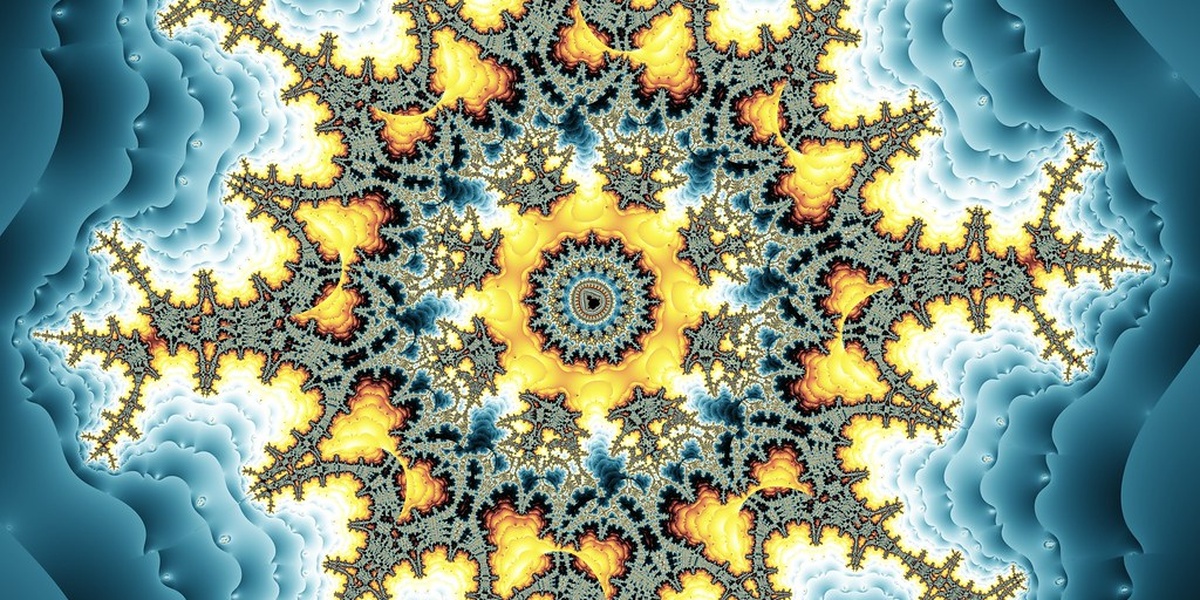
In 1975 Benoit Mandelbrot introduced the word “fractal” to describe shapes that look jagged and complex at every scale—an idea that changed how mathematicians and artists see patterns. That single term helped connect messy natural forms with clear mathematical rules, and it set the stage for his 1982 book, The Fractal Geometry of Nature. Fractals matter because they model how simple repeated rules produce the irregular shapes we see in coastlines, clouds, and trees, and because those same ideas power tools in graphics, antennas, and medical imaging. This piece collects 10 surprising, concrete facts about fractals that span the theory, examples in nature and art, and practical applications—so you can see how the same patterns reappear from broccoli florets to wireless antennas.
Mathematical Foundations
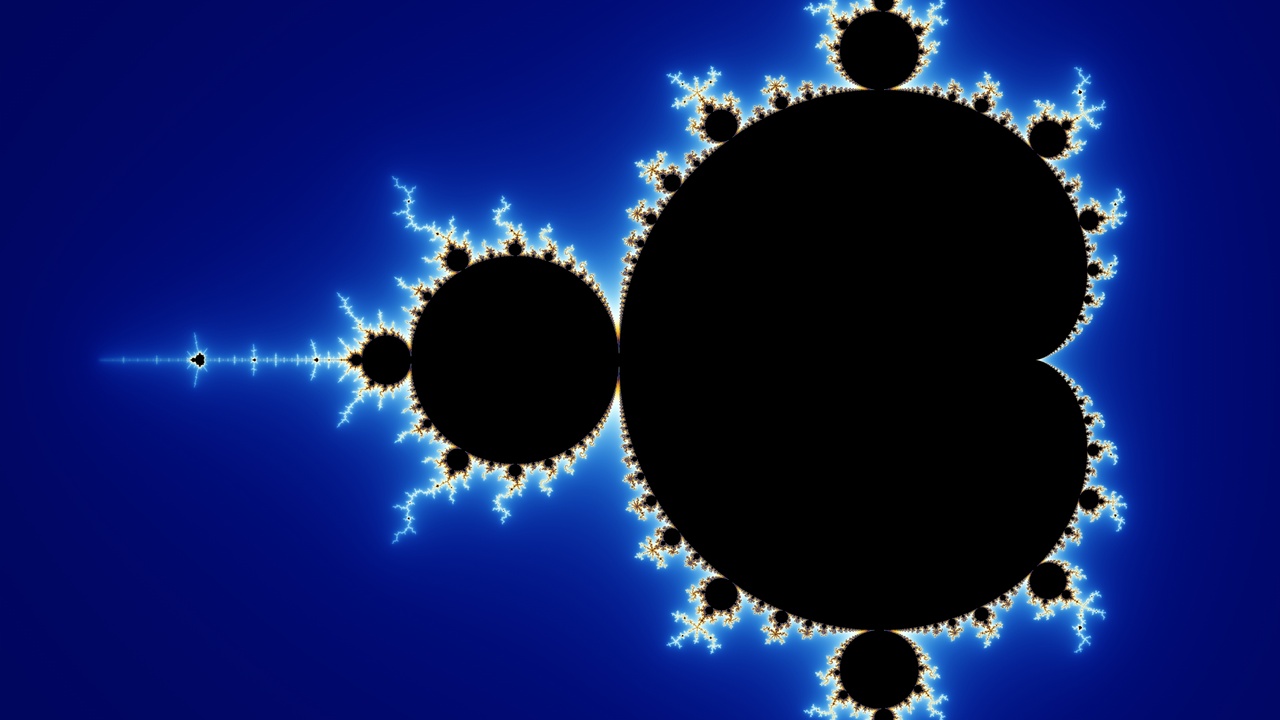
These points focus on the core math ideas behind fractals: self-similarity, fractional dimensions, and iteration. The examples below connect named objects—the Mandelbrot set, Sierpinski triangle, and Koch snowflake—with the historical work of Benoit Mandelbrot (coining “fractal” in 1975 and publishing The Fractal Geometry of Nature in 1982).
1. Self-similarity: Patterns repeat across scales
Many fractals are self-similar: a small piece of the shape resembles the whole. In plain terms, zoom in and you keep seeing the same motif at smaller sizes.
Classic mathematical examples include the Sierpinski triangle—made by repeatedly removing central triangles—and the Koch snowflake, which grows a jagged boundary by replacing line segments with a fixed motif. Nature offers obvious parallels: a fern leaf and Romanesco broccoli display repeated sub-units that echo the larger form.
Self-similarity matters because it models efficient packing and branching in biology and because it lets graphics and compression algorithms exploit repetition. Mandelbrot popularized this way of seeing patterns in 1975, and the idea underpins tools that use repeated rules to recreate complex-looking shapes with compact descriptions.
2. Fractional (non-integer) dimensions exist
Fractals can have non-integer dimensions, commonly measured by the Hausdorff dimension. This number quantifies how a set fills space between the familiar integer dimensions.
Concrete examples: the Koch snowflake has dimension about 1.2619, while the Sierpinski triangle’s dimension is about 1.585. By contrast, a straight line has dimension 1 and a filled plane has dimension 2.
That fractional idea explains real measurement puzzles: the apparent length of a coastline depends on the ruler you use—an observation Mandelbrot discussed in his 1967 work on natural fractal scaling—because more detailed measurements reveal more of the coastline’s jaggedness.
3. Simple iterative rules make complex boundaries
Iteration—repeating a simple rule—generates many fractal shapes. The classic formula for the Mandelbrot and Julia families is z_{n+1} = z_n^2 + c, which looks simple but yields incredibly intricate boundaries.
Tweaking the complex parameter c or the initial z produces wildly different images, and producing high-detail renderings typically requires on the order of 100–10,000 iterations per point to reveal fine structure.
Because the rule is elementary, anyone can generate fractals with modest code, spreadsheets, or free graphical tools—an accessible entry to how feedback and repetition produce complex geometry.
Fractals in Nature and Art
Fractal forms bridge science and aesthetics: living systems, landscapes, and some artworks show fractal-like structure. This section highlights biological examples and how artists and designers use fractal ideas.
4. Many natural forms approximate fractals
Trees, coastlines, clouds, and lungs exhibit fractal-like roughness or branching that increases functional surface area or transport efficiency. These patterns aren’t perfect mathematical fractals but follow similar scaling rules.
For example, the human lung contains roughly 300 million alveoli and provides a gas-exchange surface area on the order of 60–80 m², achieved through hierarchical branching that maximizes area in a small volume.
Those branching schemes help distribute fluids or gases efficiently, and they also explain why measuring geographic features like a coastline yields scale-dependent lengths, as Mandelbrot emphasized decades ago.
5. Fractals influence art, music, and design
Artists and musicians often employ fractal ideas, consciously or not. A well-known study by Richard Taylor (1999) analyzed Jackson Pollock’s drip paintings and identified fractal patterns in the splatter geometry.
On the botanical side, Romanesco broccoli provides an immediate, visible fractal-like spiral pattern students and designers use as an example. In digital art, programs such as Apophysis, Chaotica, and Photoshop’s fractal or noise filters let creators generate textures and generative visuals.
Fractal-based music and procedural visuals appear in installations and games where iterative or noise-based algorithms create evolving patterns, lending a natural, complex feel without hand-crafting every detail.
6. Fractals help model biological scaling and complexity
Fractal branching helps organisms scale while keeping transport efficient. Blood-vessel networks follow hierarchical branching to reach tissues with minimal energy loss.
Capillary networks number in the millions in a human body, providing a quantitative anchor for why fractal models suit vascular systems. Researchers also use fractal measures to quantify tissue complexity—for example, retinal-vessel fractal analysis appears in studies of vascular disease.
Such measures don’t replace standard diagnostics but complement them by providing a numeric descriptor of complexity that correlates with functional changes in some research contexts.
Technology, Data, and Applications
Fractal principles appear in engineering, computing, signal analysis, and medical imaging. The following points highlight practical uses from antenna design to network analysis.
7. Fractal antennas enable compact, multi-band designs
Antennas that use fractal shapes—such as the Sierpinski gasket antenna—can be compact while resonating at multiple frequency bands because their self-similar geometry supports similar current distributions at different scales.
Researchers and some commercial designs exploit these properties to shrink antenna size without sacrificing broadband capability, making them useful in small wireless modules and certain military communications equipment.
The technical reason is straightforward: each scale of the fractal geometry can support resonance at a different wavelength, so a single physical structure covers multiple bands.
8. Fractal algorithms power graphics and compression
In the 1980s Michael Barnsley and others developed fractal image-compression ideas that exploit self-similarity to encode images compactly. The core idea is to store rules that recreate repeated patterns instead of every pixel.
Fractal compression never became mainstream for photos due to computational costs and quality trade-offs, but fractal noise and related procedural techniques are widespread in game engines and visual effects for generating terrain, clouds, and textures.
Procedural terrain in many games uses layered noise functions—Perlin or fractal Brownian motion—to produce believable landscapes without storing vast heightmaps, saving memory and enabling dynamic worlds.
9. Fractal statistics reveal patterns in networks and markets
Complex systems often show fractal-like statistics: long-range dependence and scaling behavior across time or space. A landmark study by Leland et al. (1994) demonstrated self-similarity in Ethernet traffic, overturning simple Poisson models.
Benoit Mandelbrot also applied fractal ideas to finance, studying market volatility and heavy tails. Practitioners use the Hurst exponent to quantify persistence in time series: values above 0.5 indicate persistence or long-range dependence, while values near 0.5 suggest randomness.
These measures help analysts characterize network loads, market behavior, and other signals where scale-invariant structure matters for modeling and prediction.
10. Fractal analysis aids medical imaging and diagnostics
Researchers use fractal metrics to quantify complexity in medical images, offering additional descriptors beyond simple size or intensity measures. One applied example is retinal-vessel fractal dimension studied in diabetic retinopathy research.
Other studies examine tumor-border fractal measures to characterize irregularity that can correlate with malignancy in research settings. These approaches are research-backed tools that can enhance diagnostic insight but are not yet universal clinical standards.
Fractal measures complement conventional imaging by converting visual complexity into numbers that can be tracked and compared across patients or over time.
Summary
From simple iterative rules to natural branching and useful devices, fractal ideas tie together theory, observation, and engineering in surprising ways.
- Simple repetition creates complexity: a rule like zn+1=zn2+c can produce endlessly intricate boundaries.
- Fractals live between dimensions: objects like the Koch snowflake (≈1.2619) and Sierpinski triangle (≈1.585) show non-integer Hausdorff dimensions.
- Everyday examples abound—from Romanesco and lungs to Jackson Pollock’s paintings—and practical uses include antennas, graphics, and medical image analysis.
- Explore further by trying a fractal generator or examining patterns in leaves, coastlines, or clouds to see how simple rules produce complex results.
For a quick next step, run a free fractal app or online Mandelbrot viewer and zoom in: you’ll see the same surprising structure that inspired the first facts about fractals.