Everyday interactions — from a handshake to a car braking — hinge on what happens where surfaces meet. Whether you’re fixing a squeaky hinge, designing a seal, or modeling granular flow, the variety of forces that act at contact points determines motion, wear, and sticking.
There are 20 Contact Forces, ranging from Adhesive force to Viscous (Stokes) drag. For each entry I list Formula & units,Typical behavior,Examples / where found so you can quickly compare how they behave and where they appear in practice; you’ll find these details below.
How do contact forces differ from forces acting at a distance?
Contact forces arise from direct interactions between materials—pressure, friction, adhesion, and viscous resistance—whereas non-contact forces (gravity, electrostatic, magnetic) act across space without surface contact. In many problems you model contact forces from surface properties, normal loads, relative motion, or fluid viscosity rather than field equations.
What’s a simple way to estimate a contact force in the lab or field?
Pick the dominant mechanism: use F = μN for dry friction (measure normal load N and coefficient μ), use F = 6πμrv for low-Reynolds-number viscous drag (measure radius r, fluid viscosity μ, and speed v), or measure force directly with a load cell; compare with theoretical formulas listed below to check consistency.
Contact Forces
| Name | Formula & units | Typical behavior | Examples / where found |
|---|---|---|---|
| Normal force | N: N = mg cosθ (on flat surface) — units N | Acts perpendicular to contact surface; equals supporting load, often tens to thousands N for everyday objects; changes with angle and applied loads | Book on table, person standing on floor, block on incline |
| Static friction | F_s ≤ μ_sN — units N | Adjusts up to a maximum proportional to normal force; can be 0 up to μ_sN (prevents motion) | Pushing a heavy box that doesn’t move, shoes gripping pavement |
| Kinetic (sliding) friction | F_k = μ_kN — units N | Roughly constant during sliding and usually less than static friction; proportional to normal force | Sliding a crate, sled on snow, brake pads sliding on a rotor |
| Rolling resistance | F_rr ≈ C_rr N — units N | Much smaller than sliding friction; depends on deformation, speed, and material; typically fractions to tens of newtons for vehicles | Car tires on road, a rolling suitcase, ball bearings |
| Tension | T (along a rope or cable) — units N | Same magnitude throughout an ideal massless rope; limited by rope strength; can be from fractions to many thousands N in engineering | Hanging lamp cable, towing rope, suspension bridge cables |
| Compression | F_c (axial compressive force) — units N | Opposite of tension; magnitude depends on load and cross-section; common from small toys to structural kilonewtons | Columns supporting a roof, compressing a spring, packed soil |
| Spring (elastic) force | F = −kx — units N (k in N/m, x in m) | Proportional to displacement from equilibrium; can be small to large depending on stiffness (k) | Car suspension springs, mattress springs, lab spring-mass |
| Drag (form) — pressure-dominated | F_D = ½ρC_dA v^2 — units N | Grows with speed squared; small at walking speeds, very large at high speeds | Car at highway speeds, falling parachutist, airplane drag |
| Viscous (Stokes) drag | F = 6π η r v (for small spheres) — units N | Proportional to velocity at low Reynolds number; small particles experience viscous dominance | Dust in air, pollen settling, microfluidic flows |
| Lift (aerodynamic) | F_L = ½ρC_LA v^2 — units N | Depends on speed squared, surface shape, and angle of attack; can be comparable to weight at flight speeds | Airplane wings, sailboats, racing car wings |
| Buoyant force | F_b = ρ_f V_displaced g — units N | Equals weight of displaced fluid; can range from grams to many tons depending on displaced volume | Boat floating on water, helium balloon in air (pressure contact), submarine buoyancy control |
| Pressure force (surface) | F = pA (resultant from pressure distribution) — units N | Scales with pressure and area; can be small or large (e.g., 1 atm × 1 m^2 ≈ 101,325 N) | Hydrostatic forces on a dam, tire pressing road, hand on wall |
| Shear (surface) force | F_shear = τA (τ is shear stress) — units N | Proportional to area and shear stress; ranges depend on materials and loads | Cutting with a blade, sliding layers in a deforming block, adhesive joints |
| Impact (impulsive) force | Average F ≈ Δp/Δt — units N; impulse J = ∫F dt = Δp (N·s) | Very large for short durations; peaks can be kilo- to mega-newtons in collisions | Ball hitting bat, car crash, hammer striking nail |
| Adhesive force | F_ad (surface interactions; depends on contact area and surface energy) — units N | Can be tiny for macroscopic rough surfaces or substantial for sticky/tacky materials; scales with contact area and surface chemistry | Tape sticking to paper, gecko foot adhesion, glue bonds |
| Capillary force | F_cap ≈ 2πrγ cosθ — units N (γ = surface tension) | Significant at small scales (micro-newtons to millinewtons); scales with liquid surface tension and contact line length | Liquid bridge between wet glass plates, insect legs on water |
| Surface tension force | F = γL (γ is N/m, L length) — units N | Acts along a contact line; important at small scales where γL can support tiny weights | Floating needle on water, soap film pulling frame |
| Thrust (reaction from expelled fluid) | F = ṁ v_ex (mass flow rate × exhaust velocity) — units N | Can be small for model rockets to mega-newtons for rockets; scales with mass flow and speed | Rocket engines, jet engines, garden hose recoil |
| Rolling friction (hysteresis) | F_roll ≈ k_rr N (depends on deformation) — units N | Usually much smaller than sliding friction; depends on material damping and load | Bicycle tires, train wheels, rolling bearings |
| Compression contact (contact stress) | σ = F/A (compressive) — units N for force, Pa for stress; list force N | Force magnitude depends on load and area; structural members carry kilonewtons to meganewtons | Pillars in buildings, compressed soil under foundations |
Images and Descriptions

Normal force
Contact force perpendicular to a surface that prevents interpenetration; it balances components of applied loads (like weight) and adjusts magnitude depending on orientation and external forces.

Static friction
Friction between surfaces that prevents relative motion, matching applied tangential forces up to μ_sN; it depends on surface roughness and the normal load.
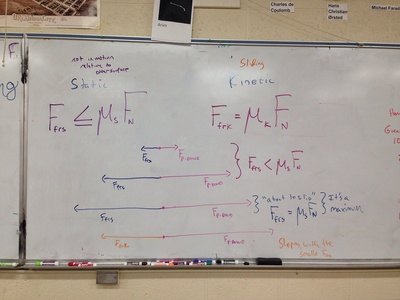
Kinetic (sliding) friction
Resistive force between surfaces in relative motion; converts mechanical energy to heat and typically equals μ_kN with μ_k from experiments.
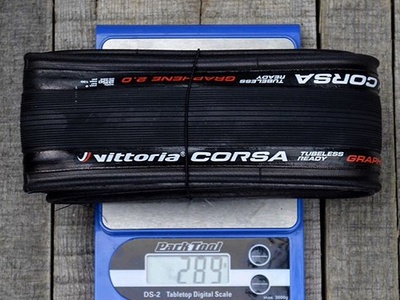
Rolling resistance
Resistive force opposing rolling motion, caused by hysteresis and deformation of contact patches; smaller than sliding friction but important for vehicles and wheels.
Tension
Force transmitted along a flexible connector (rope, cable, string) pulling on attached bodies; acts along the connector and resists extension.
Compression
Axial contact force that squeezes materials together; important in structures and can lead to buckling if large relative to geometry.
Spring (elastic) force
Restoring contact force in elastic elements following Hooke’s law; pulls or pushes to return an object toward equilibrium when stretched or compressed.
Drag (form) — pressure-dominated
Resistive force from pressure and flow separation in a fluid; depends on fluid density, object area, shape, and speed.
Viscous (Stokes) drag
Frictional force from fluid viscosity acting tangentially on objects; important for slow, small-scale motion where flow is laminar.
Lift (aerodynamic)
Upward contact force from pressure differences on surfaces moving through fluid; generated by flow pattern and surface shape and keeps aircraft aloft.
Buoyant force
Net upward force from fluid pressure acting on a submerged or partially submerged object; a contact force equal to the weight of displaced fluid (Archimedes’ principle).
Pressure force (surface)
Net contact force produced by fluid or gas pressure acting over an area; fundamental mechanism behind buoyancy and lift and important in engineering.
Shear (surface) force
Tangential contact force that causes layers to slide past each other; central to material failure, cutting, and frictional contacts.

Impact (impulsive) force
Large, short-duration contact forces during collisions; magnitude depends on change in momentum and contact time, often causing deformation or damage.
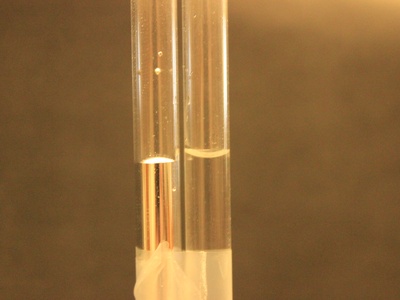
Adhesive force
Attractive contact force from molecular interactions or chemical bonds at touching surfaces; enables sticking, peeling resistance and plays role in soft-matter contacts.
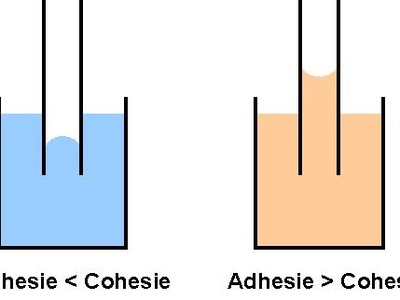
Capillary force
Force from surface tension where a liquid meets solids; draws objects together or supports small weights through meniscus and wetting behavior.

Surface tension force
Contact force from cohesive forces in a liquid surface that acts along an edge; creates contractile effects that minimize surface area.
Thrust (reaction from expelled fluid)
Contact force produced by momentum exchange when a fluid is expelled; reaction force on the vehicle is transmitted by pressure and shear on engine surfaces.
Rolling friction (hysteresis)
Resistive force from energy losses in the rolling contact patch due to material deformation and recovery; important for vehicle efficiency.
Compression contact (contact stress)
Axial contact force across an area that compresses material; used in structural contexts and characterized by resulting contact stress and possible buckling.