Whether you’re sketching cells in a lab, tending a backyard patch, or prepping notes for class, understanding plant tissues helps make sense of how plants grow and survive. A quick tour of tissue types clarifies roles from growth points to vascular transport.
There are 20 Examples of Plant Tissues, ranging from Apical meristem to Xylem. For each entry the data is organized as Scientific name,Type,Typical location so you can compare function, form, and where each tissue appears — you’ll find below.
How can I quickly distinguish major tissue types in a plant sample?
Look for structure and function: meristems have small, densely packed cells and indicate growth; epidermis is a single outer layer; parenchyma cells are thin-walled and common in storage; sclerenchyma and xylem show thick, lignified walls for support and transport. A simple stain and a low-power microscope make these differences clear.
Which tissues should I study first to understand water and nutrient movement?
Start with xylem and phloem: xylem transports water and minerals upward and has tracheids/vessels, while phloem moves sugars and uses sieve elements and companion cells. Understanding their arrangement in stems and roots explains most long-distance transport in plants.
Examples of Plant Tissues
| Name | Scientific name | Type | Typical location |
|---|---|---|---|
| Epidermis | Epidermis | Permanent; simple | Leaf, stem and root surface |
| Parenchyma | Parenchyma | Permanent; simple | Cortex, pith, leaf mesophyll and storage tissues |
| Palisade mesophyll | Palisade parenchyma (palisade mesophyll) | Permanent; simple | Upper leaf mesophyll |
| Spongy mesophyll | Spongy parenchyma (spongy mesophyll) | Permanent; simple | Lower leaf mesophyll |
| Collenchyma | Collenchyma | Permanent; simple | Stem cortex and leaf petioles, often under epidermis |
| Sclerenchyma | Sclerenchyma (fibers and sclereids) | Permanent; simple | Vascular bundles, seed coats and fruit shells |
| Xylem | Xylem | Permanent; complex | Vascular bundles in stems, roots and leaves |
| Phloem | Phloem | Permanent; complex | Vascular bundles in stems, roots and leaves |
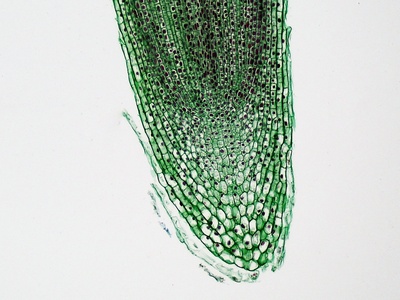
| Apical meristem | Apical meristem | Meristematic | Shoot and root tips |
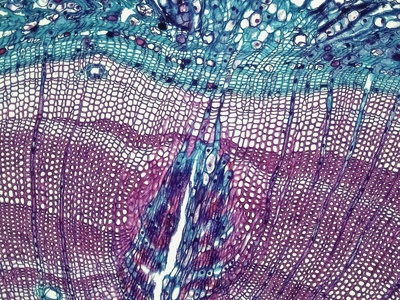
| Vascular cambium | Vascular cambium | Meristematic (lateral) | Between xylem and phloem in stems and roots |
| Cork cambium (phellogen) | Phellogen (cork cambium) | Meristematic (lateral) | Bark—outer stem and root layers |
| Intercalary meristem | Intercalary meristem | Meristematic | Base of leaves, internodes in grasses and some monocots |
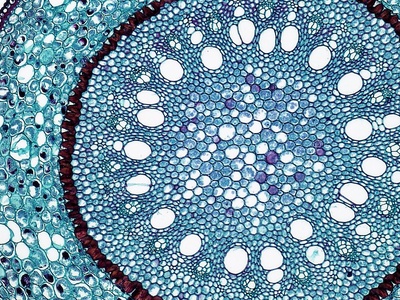
| Endodermis | Endodermis | Permanent; simple | Inner cylinder of roots surrounding vascular tissue |
| Pericycle | Pericycle | Permanent; simple | Just inside the endodermis of roots |
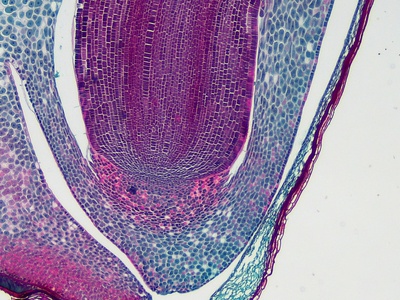
| Root cap | Root cap (columella and cap cells) | Permanent; simple | Tip of the root over the apical meristem |
| Laticifers | Laticifers | Permanent; secretory | Throughout certain stems, leaves, and bark (e.g., rubber trees) |
| Glandular trichomes | Glandular trichomes | Permanent; secretory | Leaf and stem surfaces |
| Resin ducts | Resin ducts (canals) | Resin ducts; Permanent; secretory | Bark, wood and needles of conifers |
| Nectary tissue | Nectaries | Permanent; secretory | Flowers (petals, sepals), extrafloral locations |
| Bundle sheath | Bundle sheath (vascular sheath) | Permanent; simple | Surrounding leaf vascular bundles and leaf veins |
Images and Descriptions
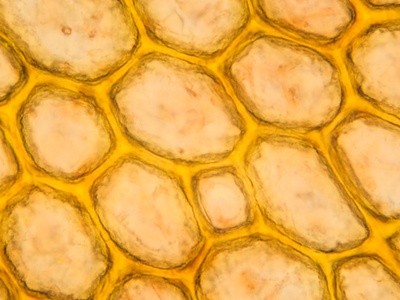
Epidermis
The epidermis is the outer protective tissue that controls water loss and gas exchange via stomata and a waxy cuticle. It hosts trichomes and guard cells and forms the first barrier against pathogens and mechanical damage.
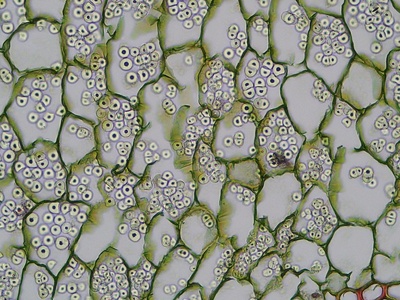
Parenchyma
Parenchyma is a versatile, living tissue of thin-walled cells for photosynthesis, storage and healing. Found throughout plants (pith, cortex, mesophyll), it stores starch or water and helps regenerate damaged tissues.
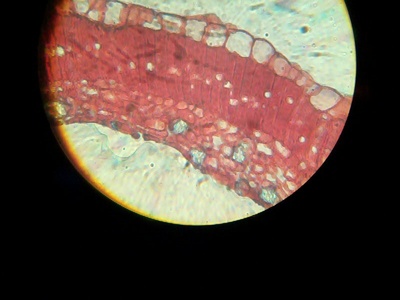
Palisade mesophyll
Palisade mesophyll is columnar parenchyma in the upper leaf layer packed with chloroplasts for efficient light capture and photosynthesis. It’s a textbook example of tissue specialization in leaves.
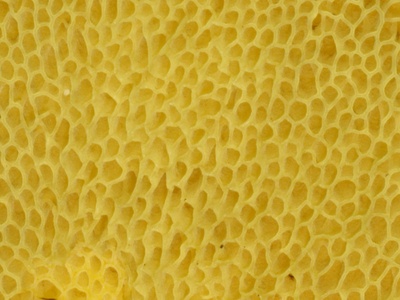
Spongy mesophyll
Spongy mesophyll is loosely arranged parenchyma with air spaces that facilitate gas diffusion and some photosynthesis. Its irregular cells and large intercellular spaces help CO2 reach palisade cells.
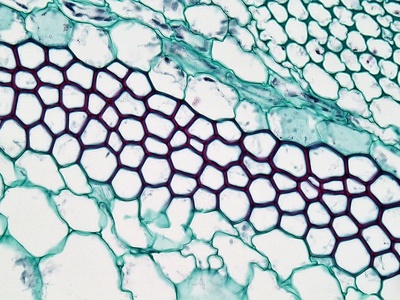
Collenchyma
Collenchyma provides flexible, living structural support in growing stems and leaves. Its unevenly thickened cell walls allow stems to bend without breaking, commonly seen as strings in celery.
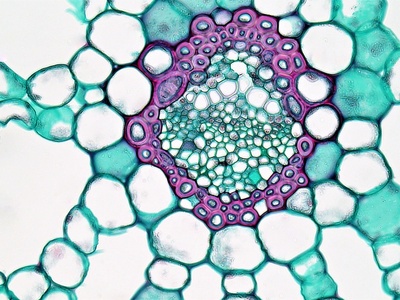
Sclerenchyma
Sclerenchyma is tough, dead-at-maturity tissue that strengthens plants with thick, lignified walls. It includes long fibers (support) and sclereids (gritty seed coats or pear texture) for protection and rigidity.
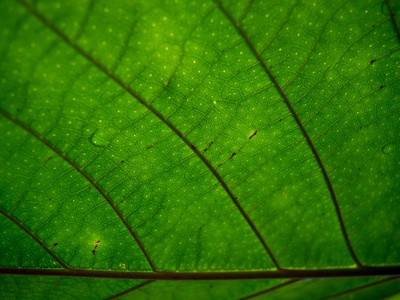
Xylem
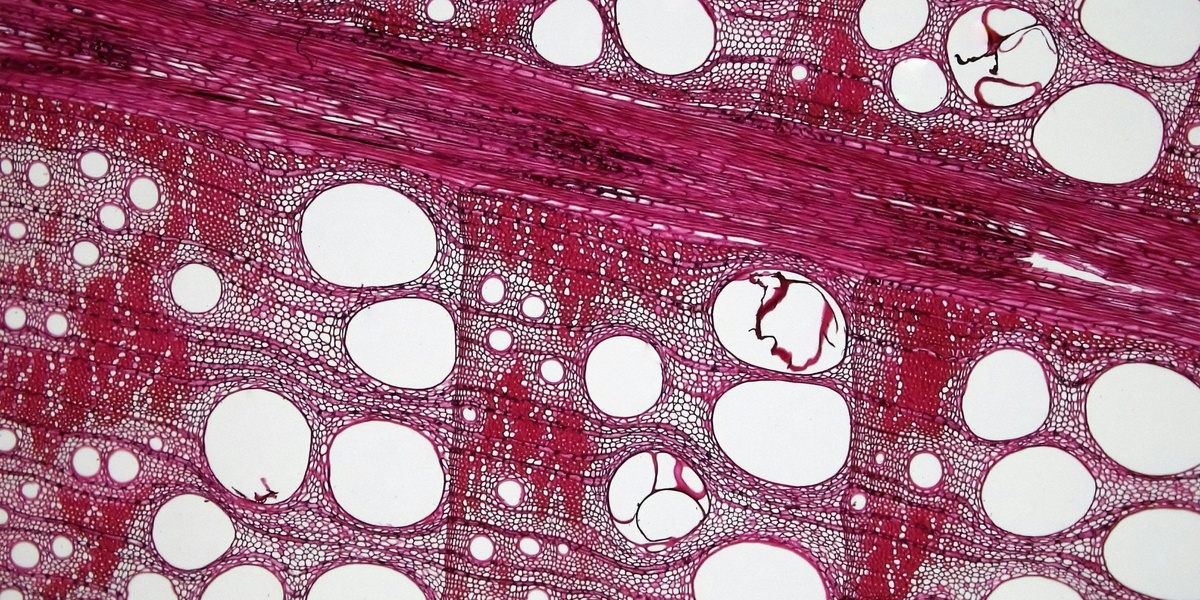
Xylem conducts water and dissolved minerals upward and provides mechanical strength. Complex tissue includes tracheids and vessel elements (water transport), xylem parenchyma and fibers; xylem vessels are key textbook examples.
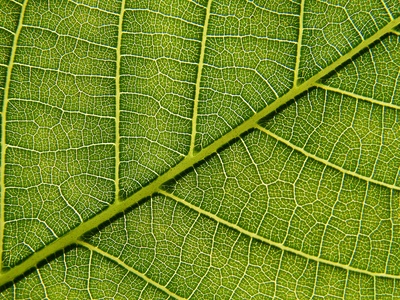
Phloem
Phloem transports sugars and signaling molecules from sources to sinks. It’s a complex tissue of sieve-tube elements, companion cells, phloem parenchyma and fibers; sieve tubes are notable for their pores and active transport roles.
Apical meristem
The apical meristem is a region of actively dividing cells at shoot and root tips, driving primary growth and forming new tissues. It produces leaves, stems and root tissues and maintains stem cell populations.
Vascular cambium
Vascular cambium is a lateral meristem that produces secondary xylem (wood) inward and secondary phloem outward, enabling radial growth and thickening in woody plants; essential for tree ring formation.

Cork cambium (phellogen)
Cork cambium generates protective outer tissues: cork (phellem) outward and sometimes phelloderm inward. It replaces epidermis in woody plants to form a tough, water-resistant bark layer.
Intercalary meristem
Intercalary meristems are zones of cell division at internodes or leaf bases that allow rapid regrowth and elongation, especially in grasses after grazing or mowing.
Endodermis
The endodermis is a root-specific layer with the Casparian strip that controls water and ion uptake into the vascular system. It acts as a selective barrier between soil and the plant’s conducting tissues.
Pericycle
The pericycle is a layer of cells that can initiate lateral roots and contributes to secondary growth. It retains some meristematic activity and is key for branch root formation and vascular connections.
Root cap
The root cap is a protective tissue covering the root tip, sensing gravity and secreting mucilage to ease soil penetration. It continuously sheds and replaces cells as the root grows.
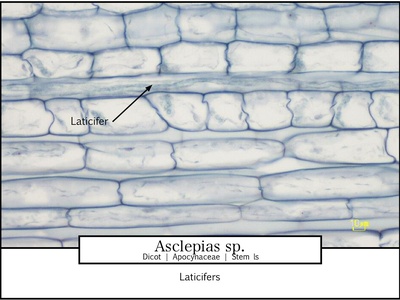
Laticifers
Laticifers are specialized secretory tubes or cells that produce latex or milky sap for defense and wound sealing. They occur individually or in networks and are prominent in poppies and rubber trees.
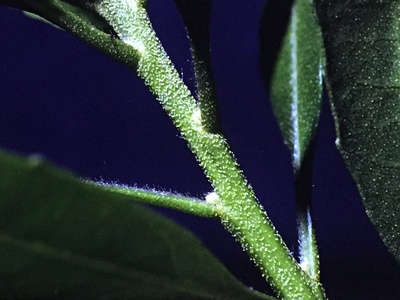
Glandular trichomes
Glandular trichomes are hairlike secretory structures on epidermis that produce scents, sticky resins or defensive compounds. They protect against herbivores, attract pollinators and are important in aromatic plants like mint.
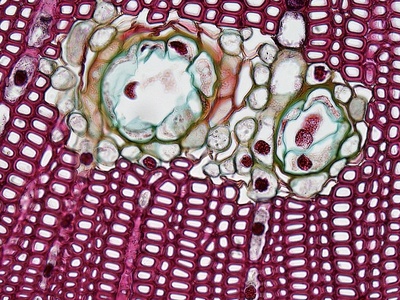
Resin ducts
Resin ducts are tubular secretory structures in many conifers that produce resin for defense against insects and pathogens. They form visible streaks in wood and can seal wounds rapidly.
Nectary tissue
Nectary tissue secretes nectar to attract pollinators and may occur in flowers or on other organs. It’s a specialized secretory tissue often richly vascularized and associated with nectary glands.
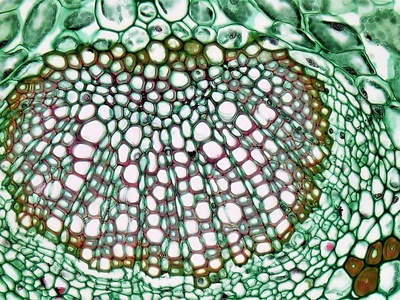
Bundle sheath
Bundle sheath cells form a protective and metabolic layer around leaf veins; in C4 plants they house the Calvin cycle. They help regulate metabolite exchange between mesophyll and vascular tissue.