In 1998, two independent teams measuring distant Type Ia supernovae found the universe’s expansion was speeding up — a discovery that implied most of the cosmos is dominated by invisible components.
Earlier work hinted at missing mass: Fritz Zwicky’s Coma cluster measurements in the 1930s and Vera Rubin’s galaxy rotation curves in the 1970s suggested unseen gravity, while the Bullet Cluster (2006) provided dramatic lensing evidence that mass and baryons can separate during collisions.
This article explains eight clear, scientifically grounded differences between dark matter and dark energy — from what they physically are and how we detect them to the roles they play in shaping structure and the open theoretical puzzles they leave. Understanding these contrasts matters because roughly 5% of the universe is ordinary matter, ≈27% behaves like unseen mass, and ≈68% drives accelerated expansion (numbers from combined Planck CMB, BAO, and supernova data). The distinctions affect galaxy formation, cosmic history, and fundamental physics.
First, let’s look at their physical nature.
Physical and Theoretical Properties

Physically, dark matter acts like extra mass that gravitates and clusters, while dark energy behaves like a nearly uniform energy density with negative pressure that accelerates the expansion. The cosmological inventory from Planck 2018 (combined with BAO and supernova data) gives ≈5% ordinary matter, ≈27% dark matter, and ≈68% dark energy. Theoretical approaches split neatly: dark matter is often modeled as new particles (WIMPs, axions, sterile neutrinos), whereas dark energy is commonly represented by a cosmological constant Λ or dynamical scalar fields such as quintessence (and more radical ideas involve modifying gravity). Both problems motivate different experiments and different theoretical work (Riess/Perlmutter 1998 and Planck 2018 are key touchstones).
1. Composition: particulate dark matter versus a pervasive energy component
Dark matter behaves like additional mass: it contributes to gravitational potential wells and therefore to orbital motions and lensing. That behavior motivates particle candidates—weakly interacting massive particles (WIMPs) motivated by extensions of the Standard Model, axions arising from solutions to the strong-CP problem, and lighter possibilities such as sterile neutrinos.
By contrast, dark energy is modeled as a uniform energy density with negative pressure. Einstein introduced the cosmological constant Λ; modern observations are broadly consistent with Λ (w≈−1). Theoretical attempts to identify Λ with vacuum energy run into an enormous discrepancy: naive quantum vacuum estimates overshoot the observed Λ by many orders of magnitude (often quoted as ∼10^60 to 10^120 depending on cutoffs and assumptions), creating the famous cosmological constant problem.
The experimental consequences differ. Dark matter drives particle searches in underground detectors (XENON1T, LUX), axion haloscope efforts (ADMX), and collider programs (LHC). Dark energy pushes cosmologists to make ever more precise distance and growth measurements and to rethink gravity and vacuum physics if Λ cannot be explained.
2. Distribution: clumpy halos versus near-uniform background
Observationally, dark matter clusters into halos around galaxies and along filaments of the cosmic web, while dark energy appears nearly homogeneous on large scales. Rotation curves directly reveal dark matter in individual galaxies; gravitational lensing maps and galaxy surveys trace halos and filaments across tens to hundreds of kiloparsecs and beyond.
The Bullet Cluster (2006, Clowe et al.) famously shows gravitational mass offset from the hot X-ray gas after a collision, supporting a collisionless, particulate form of dark matter. In contrast, dark energy exhibits smooth behavior on gigaparsec scales, influencing the overall expansion rather than clumping into halos. These distributional differences require different detection strategies: local searches and lensing for dark matter versus precision cosmological probes for dark energy.
Detection and Observational Evidence
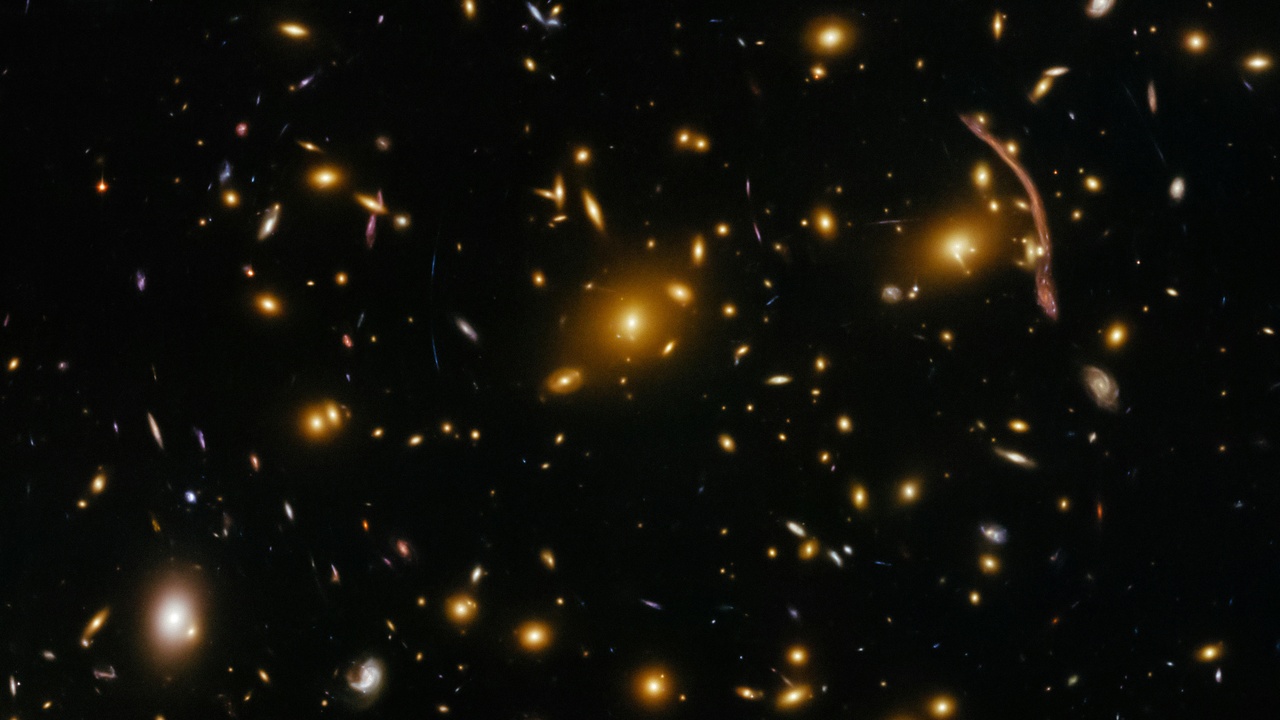
The evidence comes from independent threads. Zwicky’s 1930s Coma cluster observations started the missing-mass story, and Vera Rubin’s rotation-curve work in the 1970s strengthened it; by contrast, the 1998 Type Ia supernova studies (Riess and Perlmutter teams) revealed acceleration and led to a separate dark-energy line of evidence. Major missions and experiments—Planck, SDSS, DES, XENON1T, LUX, LHC—play complementary roles in building the case.
These are distinct signatures: dark matter reveals itself through gravity acting on matter and light, and through potential non-gravitational interactions in detectors; dark energy shows up in the expansion history and the growth rate of structure. Together they form a consistent cosmological picture, even though each raises unique puzzles.
3. How we detect dark matter: gravitational fingerprints and lab searches
Dark matter is most directly seen via gravity: flat galaxy rotation curves, strong and weak gravitational lensing, and signatures in the cosmic microwave background (CMB) anisotropies (Planck). Mass maps from Hubble and ground-based telescopes reveal halos around galaxies and clusters, while large surveys map the cosmic web where dark matter dominates the mass budget.
On the laboratory side, direct-detection experiments like XENON1T, LUX, and PandaX search for rare nuclear recoils from WIMPs and have set stringent upper limits on interaction cross-sections (XENON1T pushed many WIMP-nucleon cross-section limits down to ∼10^−47 cm^2 for certain mass ranges). Collider searches at the LHC probe complementary parameter space, and ADMX targets axions in the μeV mass range. Many searches have returned null results so far, but they constrain models and refine detector technology with spin-offs in cryogenics and low-background instrumentation.
4. How we infer dark energy: expansion history, supernovae, and large-scale surveys
Dark energy is inferred from the accelerated expansion first measured in 1998 by the Riess and Perlmutter teams (Nobel Prize 2011). Type Ia supernovae serve as standardized candles that trace the Hubble diagram; baryon acoustic oscillations (BAO) provide a standard ruler, and the CMB sets the early-universe baseline (Planck 2018).
Measurements constrain the equation-of-state parameter w to be close to −1 (current joint constraints, e.g., Planck+DES+supernovae, find w within a few percent of −1), consistent with Λ but leaving room for mild evolution. Ongoing and future surveys (DES, Euclid, Vera Rubin/LSST, Roman Space Telescope, DESI) aim for subpercent precision on expansion and growth, improving our ability to distinguish a true cosmological constant from dynamical alternatives.
Role in Structure and Cosmic Evolution

Dark matter and dark energy operate on different stages of cosmic history. After recombination at roughly 380,000 years, tiny density fluctuations seeded by inflation grew under dark matter’s gravity into stars, galaxies, and clusters over billions of years. Dark energy became dynamically important much later—roughly 5 billion years ago—driving the observed late-time acceleration and altering future evolution.
These distinct roles are apparent in simulations and observations: N-body and hydrodynamic runs reproduce halo formation and the cosmic web when dark matter is included, while surveys tracking expansion and growth probe dark energy’s influence on large scales and the universe’s eventual fate.
5. Influence on structure formation: scaffolding versus passive background
Dark matter provides the gravitational scaffolding that turns small overdensities into galaxies and clusters. N-body simulations such as the Millennium and Illustris projects show how collisionless dark matter forms halos and filamentary structure that baryons subsequently populate with stars and gas.
The timeline is concrete: recombination at ≈380,000 years; first stars and galaxies within a few hundred million years; hierarchical merging and growth over the next several billion years. Dark energy, by contrast, does not clump and therefore does not aid structure formation; when it dominates it suppresses further growth. Observables like cluster abundance and the growth-rate parameter fσ8 quantify these effects and serve as tests of ΛCDM versus alternatives.
6. Effect on the universe’s fate: gravity-bound versus runaway expansion
Dark matter’s gravity helps form and maintain bound systems—galaxies and clusters remain gravitationally bound despite cosmic expansion. Dark energy changes the global dynamics: a true cosmological constant (w=−1) produces exponential expansion and an event horizon, isolating bound structures over cosmic timescales.
Current measurements favor Λ and predict continued acceleration. With the universe’s age at about 13.8 billion years and acceleration becoming dominant roughly 5 billion years ago, the long-term picture is one of ever-growing cosmic horizons and increasingly isolated galaxy islands, unless dark energy evolves in unexpected ways.
Theoretical Status and Open Questions
Although both are central unsolved problems, their theoretical status differs. Dark matter fits naturally into particle-physics extensions of the Standard Model but remains undetected in the lab. Dark energy confronts us with the cosmological constant problem and forces tough questions about vacuum energy, fine-tuning, and the possible need to modify gravity. The coming decade of observations and experiments will be decisive for narrowing models and exposing new tensions between theory and data.
7. Theoretical frameworks: particle candidates versus vacuum energy and alternatives
Leading dark matter candidates include WIMPs (often in supersymmetric extensions), axions (motivated by the strong-CP problem), and sterile neutrinos. These ideas map onto concrete experimental strategies and parameter spaces. By contrast, dark energy options include a pure cosmological constant Λ, dynamical scalar fields (quintessence), and modified-gravity proposals (MOND-like theories or TeVeS).
The cosmological constant problem remains acute: theoretical vacuum-energy estimates and the observed Λ differ by many orders of magnitude (estimates vary by assumptions but commonly cite discrepancies up to ∼10^60–10^120). Modified-gravity alternatives struggle to reproduce cluster-scale observations and the CMB as cleanly as ΛCDM (for example, MOND has trouble with the Bullet Cluster and CMB acoustic peaks), which keeps Λ and dynamical dark energy as the leading explanations despite deep theoretical discomfort.
8. Practical implications and future searches: missions, instruments, and cross-disciplinary impacts
Resolving these differences drives major investments in telescopes, detectors, and computation. In the near term, the Vera Rubin Observatory (LSST) will begin survey operations and image billions of galaxies over a decade; Euclid (ESA) and the Roman Space Telescope (NASA) will map weak lensing and BAO with high precision; DESI will extend spectroscopic BAO measurements.
On the particle side, next-generation direct-detection experiments (XENONnT, LZ) and upgraded axion searches (ADMX) aim for order-of-magnitude sensitivity improvements. These projects will produce massive datasets that require advances in data science, low-background technology, cryogenics, and high-performance computing—benefits that spill over into industry and other fields. Watch the coming data releases; they will sharpen constraints and may finally reveal surprises.
Summary
Key takeaways that distill the eight differences:
- Composition: dark matter behaves like particulate extra mass (WIMPs, axions); dark energy acts like a uniform energy density (Λ or dynamical fields).
- Distribution: dark matter clusters into halos and filaments (kpc scales), while dark energy is nearly homogeneous on gigaparsec scales.
- Detection: dark matter is traced by gravitational effects and direct searches (XENON1T, LUX, LHC, ADMX); dark energy is inferred from expansion history via supernovae (1998), BAO, and the CMB (Planck 2018).
- Cosmic role and fate: dark matter seeds structure after recombination (~380,000 years); dark energy began dominating roughly 5 billion years ago and governs late-time acceleration and the universe’s eventual isolation of bound structures.
Follow upcoming missions and experiments—Vera Rubin/LSST, Euclid, Roman, DESI, XENONnT, LZ, ADMX—to see which hypotheses survive and how our picture of the cosmos sharpens.