Across the inner solar system and the main asteroid belt beyond Mars, millions of rocky bodies trace diverse paths and carry clues about early planet formation. Looking at a curated list makes it easier to compare orbit types and sizes without wading through raw catalogs.
There are 20 Examples of Asteroids, ranging from Apollo to Vesta; for each the information is organized as Designation,Orbit class,Diameter (km), and you’ll find below.
How were these particular asteroids selected?
The list focuses on representative objects across common orbit classes and size ranges so you can see contrasts — for example, near‑Earth Apollo types versus large main‑belt objects like Vesta. Selection aims to illustrate variety, not to be a complete catalog.
How reliable are the listed diameter values?
Diameter figures are usually best‑available estimates from telescopic observations, thermal models, or radar; they can have notable uncertainties depending on method and assumed albedo. Treat the numbers as useful approximations and check original sources for precision when needed.
Examples of Asteroids
| Name | Designation | Orbit class | Diameter (km) |
|---|---|---|---|
| Vesta | 4 Vesta | Main-belt | 525 |
| Pallas | 2 Pallas | Main-belt | 512 |
| Hygiea | 10 Hygiea | Main-belt | 434 |
| Juno | 3 Juno | Main-belt | 233 |
| Lutetia | 21 Lutetia | Main-belt | 101 |
| Mathilde | 253 Mathilde | Main-belt | 52.8 |
| Steins | 2867 Steins | Main-belt | 5.30 |
| Gaspra | 951 Gaspra | Main-belt | 18 |
| Ida | 243 Ida | Main-belt | 31.4 |
| Eros | 433 Eros | Near-Earth (Amor) | 16.8 |
| Itokawa | 25143 Itokawa | Near-Earth (Apollo) | 0.33 |
| Ryugu | 162173 Ryugu | Near-Earth (Apollo) | 0.87 |
| Bennu | 101955 Bennu | Near-Earth (Apollo) | 0.49 |
| Apophis | 99942 Apophis | Near-Earth (Aten) | 0.37 |
| Phaethon | 3200 Phaethon | Near-Earth (Apollo) | 5.10 |
| Toutatis | 4179 Toutatis | Near-Earth (Apollo) | 2.50 |
| Ganymed | 1036 Ganymed | Near-Earth (Amor) | 32.0 |
| Hektor | 624 Hektor | Jupiter Trojan | 225 |
| Patroclus | 617 Patroclus | Jupiter Trojan (binary) | 140 |
| Apollo | 1862 Apollo | Near-Earth (Apollo) | 1.50 |
Images and Descriptions

Vesta
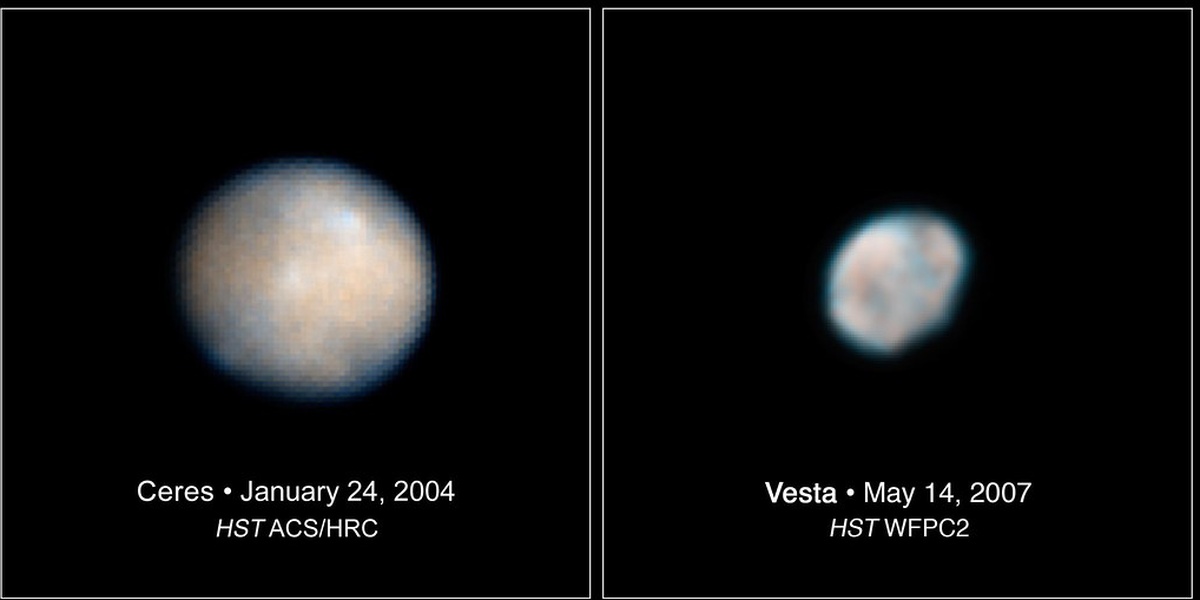
One of the largest main-belt asteroids, Vesta orbits between Mars and Jupiter and measures about 525 km across. Visited by NASA’s Dawn mission, it has a differentiated interior and a giant Rheasilvia basin. Named for the Roman goddess of the hearth.
Pallas
A very large main-belt asteroid roughly 512 km wide, Pallas has an inclined, eccentric orbit. Discovered in 1802, it is a primitive, rocky body important to studies of early solar system composition. Named for the Greek goddess Athena (Pallas).
Hygiea
Hygiea is a dark, carbon-rich main-belt asteroid about 434 km across. Its near-spherical shape and low brightness make it scientifically interesting; once considered a dwarf-planet candidate. Named after Hygieia, the Greek goddess of health and cleanliness.
Juno
Juno is a large, bright main-belt asteroid roughly 233 km across, discovered in the early 19th century. Noted historically for early telescopic study, it is stony and irregular. Named for the Roman goddess Juno, protector of women and marriage.
Lutetia
Lutetia is an unusually dense main-belt asteroid about 101 km across, flown by ESA’s Rosetta probe in 2010. Its surface shows complex cratering and mixed composition. Named after Lutetia, the ancient Roman name for Paris.
Mathilde
Mathilde is a dark, heavily cratered main-belt asteroid about 52.8 km wide, visited by NASA’s NEAR Shoemaker spacecraft. Its low density suggests a porous, rubble-pile structure. Named for the daughter of a German astronomer who discovered it.
Steins
Steins is a small, diamond-shaped main-belt asteroid about 5.30 km across, imaged up close by ESA’s Rosetta spacecraft in 2008. Its bright facets and craters revealed surprising surface features. Named after Czech painter and writer Karel Stein.
Gaspra
Gaspra is a ~18 km stony main-belt asteroid and the first asteroid imaged up close by a spacecraft (Galileo, 1991). Its resolved surface showed craters and ridges, changing how we view small bodies. Named after a Crimean spa town.
Ida
Ida is a ~31.4 km main-belt asteroid visited by Galileo in 1993; it famously has a tiny moon, Dactyl. Ida’s geology offered the first direct evidence of satellites around asteroids. Named for a nymph from Greek mythology associated with Crete.
Eros
Eros is a near-Earth asteroid about 16.8 km across that orbits between Earth and Mars. Visited and orbited by NASA’s NEAR Shoemaker, which landed on it in 2001, Eros provided detailed data on NEA geology. Named after the Greek god of love.
Itokawa
Itokawa is a small, 0.33 km rubble-pile near-Earth asteroid sampled by Japan’s Hayabusa mission and returned to Earth in 2010. Its bouldery, blocky surface revealed aggregate structure and formation history. Named for Japanese rocket pioneer Hideo Itokawa.
Ryugu
Ryugu is a carbon-rich near-Earth asteroid about 0.87 km across and the target of JAXA’s Hayabusa2 mission, which returned samples to Earth. Its spinning-top shape and dark surface offer clues to organic and water-bearing materials. Named for a Japanese sea-dragon palace.
Bennu
Bennu is a ~0.49 km carbonaceous near-Earth asteroid visited by NASA’s OSIRIS‑REx mission, which collected and returned samples. Its rubble-pile structure and potential to hold organic material make it scientifically valuable. Named after an Egyptian creation deity, Bennu.
Apophis
Apophis is a roughly 0.37 km near-Earth asteroid that drew attention for an early impact probability assessment; close approaches are now well characterized, including a notable 2029 flyby. Named after the Egyptian serpent deity Apep (Apophis).
Phaethon
Phaethon is a 5.10 km near-Earth asteroid with an unusually sun-skimming orbit that produces the Geminid meteor shower. It shows asteroid-like and comet-like activity during perihelion, making it a key object bridging both populations. Named after the mythic driver of the sun chariot.
Toutatis
Toutatis is an elongated, tumbling near-Earth asteroid about 2.50 km in effective diameter, extensively radar-imaged during close approaches. Its chaotic rotation and complex shape make it a fascinating dynamical case. Named for a Celtic god of protection.
Ganymed
Ganymed is the largest known near-Earth asteroid at about 32.0 km across, orbiting near Earth’s vicinity but not imminently hazardous. Its size and orbit make it important for understanding large NEA population statistics. Named after the mythic cupbearer to the gods.
Hektor
Hektor is a large, elongated Jupiter Trojan roughly 225 km across and possibly a contact binary. It has a small satellite and a very elongated shape, providing clues to Trojan formation. Named for Trojan leader Hektor from Greek mythology.
Patroclus
Patroclus is a binary Jupiter Trojan system with a combined effective diameter near 140 km; its two similar-sized components orbit one another. Targeted by NASA’s Lucy mission, it offers insight into early solar system bodies. Named for the Greek hero Patroclus.
Apollo
1862 Apollo is an Earth-crossing asteroid about 1.50 km across and the namesake of the Apollo class of near-Earth asteroids. Discovered in 1932, it helped define important orbital families that approach Earth’s orbit. Named after the Greek-Roman god Apollo.