Japan has long been a source of scientific innovation, from precision engineering to breakthroughs in physics and chemistry. Looking at the people behind those advances shows how local institutions, education and networks helped shape global research trends.
There are 12 Scientists born in Japan, ranging from Akira Suzuki to Yoichiro Nambu. For each entry you’ll find below Field,Born–Died (year),Birthplace so you can scan specialties, lifespans and origins at a glance.
How were these scientists chosen for the list?
The list highlights figures born in Japan who made notable, documentable contributions—Nobel recognition, seminal papers, or lasting techniques—aiming to represent different fields and eras rather than provide an exhaustive catalog.
Can I use this list for research or citation?
Yes, treat it as a concise reference point: use the names and basic data here to locate primary biographies, original papers, and authoritative databases for full citations and deeper research.
Scientists Born in Japan
| Name | Field | Born–Died (year) | Birthplace |
|---|---|---|---|
| Hideki Yukawa | theoretical physics | 1907–1981 | Tokyo, Tokyo |
| Shinichiro Tomonaga | theoretical physics | 1906–1979 | Tokyo, Tokyo |
| Yoichiro Nambu | theoretical physics | 1921–2015 | Tokyo, Tokyo |
| Leo Esaki | solid-state physics | born 1925 | Osaka, Osaka |
| Masatoshi Koshiba | astrophysics | 1926–2020 | Toyohashi, Aichi |
| Susumu Tonegawa | molecular biology | born 1939 | Nagoya, Aichi |
| Shinya Yamanaka | stem cell biology | born 1962 | Osaka, Osaka |
| Tasuku Honjo | immunology | born 1942 | Kyoto, Kyoto |
| Shuji Nakamura | materials science | born 1954 | Ikata, Ehime |
| Isamu Akasaki | applied physics | 1929–2021 | Chiran, Kagoshima |
| Akira Suzuki | chemistry | born 1930 | Mukawa, Hokkaido |
| Satoshi Omura | microbiology | born 1935 | Nirasaki, Yamanashi |
Images and Descriptions
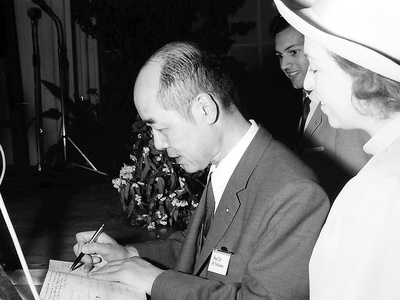
Hideki Yukawa
Predicted the meson and Yukawa potential explaining the nuclear force; Japan’s first Nobel laureate in physics (1949), he founded modern theoretical particle physics in Japan and influenced nuclear and particle theory worldwide.

Shinichiro Tomonaga
Developed renormalization methods for quantum electrodynamics and clarified interacting field theory; his work earned the 1965 Nobel Prize and provided rigorous formalism that guided postwar quantum field theory and Japanese physics research.
Yoichiro Nambu
Introduced spontaneous symmetry breaking into particle physics, a concept central to the Standard Model; his insights earned the 2008 Nobel Prize and bridged ideas between condensed matter and high-energy theory.
Leo Esaki
Pioneering semiconductor physicist who discovered electron tunneling in solids and invented the Esaki (tunnel) diode; his work on quantum transport earned the 1973 Nobel Prize and helped launch modern semiconductor electronics.
Masatoshi Koshiba
Built large underground neutrino detectors that observed astrophysical and solar neutrinos, resolving long-standing puzzles; he shared the 2002 Nobel Prize and founded experimental neutrino astronomy in Japan.
Susumu Tonegawa
Discovered the genetic mechanism producing antibody diversity (V(D)J recombination), transforming immunology and molecular genetics and earning the 1987 Nobel Prize for his work on adaptive immunity.
Shinya Yamanaka
Developed induced pluripotent stem cells (iPS cells) from adult tissues, allowing patient-specific pluripotent cells without embryos; his 2012 Nobel-winning work revolutionized regenerative medicine and biomedical research directions.
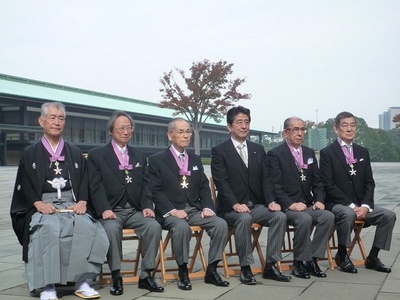
Tasuku Honjo
Discovered PD‑1, a key immune checkpoint receptor whose blockade became transformative cancer immunotherapy; his discovery earned the 2018 Nobel Prize and reshaped treatments for multiple cancers.
Shuji Nakamura
Invented efficient blue InGaN LEDs and technologies enabling white LED lighting, dramatically improving energy-efficient illumination and displays; his innovations were recognized with the 2014 Nobel Prize and widespread commercial impact.
Isamu Akasaki
Co-developed high-brightness blue LEDs and nitride semiconductor growth techniques crucial for white LEDs and energy-saving lighting; shared the 2014 Nobel Prize and advanced GaN materials science.
Akira Suzuki
Developed the Suzuki–Miyaura cross-coupling reaction for forming carbon–carbon bonds, a fundamental method in organic synthesis; his work reshaped pharmaceutical and materials chemistry and led to the 2010 Nobel Prize.
Satoshi Omura
Natural-products chemist who isolated avermectin from soil microbes, leading to ivermectin, a revolutionary antiparasitic drug; his discoveries earned the 2015 Nobel Prize and transformed control of river blindness and parasitic diseases.