Across projects and platforms—from quick scripts to systems programming—the way you organize sequential data shapes readability, performance, and maintenance. Small choices about containers and their behavior show up as big differences in latency, memory use, and developer ergonomics.
There are 24 Arrays, ranging from ArrayList,std::vector to other implementations; each entry is organized with Category,Memory/time (typical),Where used so you can compare trade-offs at a glance, and you’ll find below.
How do I choose between ArrayList and std::vector?
Pick based on language and guarantees: std::vector is the go-to in C++ for contiguous storage, predictable iteration speed, and low-overhead resizing; ArrayList is a common Java choice with similar semantics but different allocation and concurrency characteristics. Consider element type, required performance for random access vs. insertions, and whether you need language-specific features (like move semantics in C++).
What should I read first in the Category,Memory/time (typical),Where used table?
Start with Category to narrow purpose (dynamic array, ring buffer, sparse array), then check Memory/time (typical) for expected space and operation costs, and use Where used to match real-world patterns—this order helps you filter feasible options before benchmarking for your workload.
Arrays
| Name | Category | Memory/time (typical) | Where used |
|---|---|---|---|
| Static array | static | contiguous memory; O(1) indexed access; fixed size allocation | C, embedded systems, low-level code |
| Dynamic array | dynamic | contiguous; amortized O(1) append; O(1) random access; occasional O(n) resize | std::vector, ArrayList, Python list, many languages |
| C array | language-specific | contiguous memory; O(1) access; stack or static allocation common | C, microcontrollers, system libraries |
| std::array | language-specific | contiguous; O(1) access; fixed size at compile-time | C++ STL, templates, performance code |
| std::vector | language-specific | contiguous; O(1) random access; amortized O(1) append; occasional O(n) reallocation | C++ STL, game engines, system code |
| Java array | language-specific | contiguous for primitives; contiguous refs for objects; O(1) access; runtime bounds checks | Java JVM, Android apps, libraries |
| ArrayList | language-specific | contiguous; amortized O(1) append; O(1) access; occasional O(n) resize | Java standard library, Android code |
| Python list | language-specific | contiguous array of pointers; O(1) access; amortized O(1) append | Python core, scripts, many libraries |
| array.array | typed/GPU | contiguous typed memory; O(1) access; low memory per element | Python stdlib, binary I/O, small numeric tasks |
| NumPy ndarray | multidimensional | contiguous or strided; O(1) element access; vectorized operations for bulk work | NumPy, scientific computing, ML |
| NumPy memmap | memory-mapped | memory-mapped file-backed; page-faulted access; O(1) indexing per element | NumPy, large dataset processing, out-of-core tasks |
| Memory-mapped array | memory-mapped | file-backed memory mapping; OS paging; possibly non-contiguous view; O(1) element access | databases, file I/O, OS-level services |
| Jagged array | multidimensional | arrays of arrays; non-contiguous rows; O(1) row access; variable row lengths | C#, Java, languages with nested arrays |
| Row-major array | multidimensional | contiguous row-major layout; good row-wise locality; O(1) indexing | C, C++, NumPy (C-order), many libraries |
| Column-major array | multidimensional | contiguous column-major layout; good column-wise locality; O(1) indexing | Fortran, MATLAB, NumPy (Fortran-order), numerical libs |
| CSR | sparse | compact nonzero storage with row pointers; efficient row operations; O(nnz) storage | SciPy, Eigen, ML libs, sparse linear algebra |
| CSC | sparse | compact nonzero storage with column pointers; efficient column ops; O(nnz) storage | SciPy, sparse solvers, graph algorithms |
| COO | sparse | coordinate triples; simple insertion; less efficient arithmetic | SciPy, sparse conversions, incremental assembly |
| Bitset | bitset | packed bits in words; extremely compact; O(1) bit ops via masks | std::bitset, bitmap indexes, compression, bloom filters |
| Dynamic bitset | bitset | resizable packed bits; amortized O(1) resize; O(1) bit ops | boost::dynamic_bitset, Python bitarray, search indexes |
| Circular buffer | circular | fixed-size ring in contiguous buffer; O(1) enqueue/dequeue; constant-time head/tail ops | embedded systems, producers/consumers, audio I/O |
| CUDA device array | typed/GPU | contiguous device memory; high bandwidth; kernel access latency and host-device transfer cost | CUDA, cuBLAS, deep learning frameworks |
| TypedArray | typed/GPU | contiguous typed binary buffers; O(1) access; ArrayBuffer views | Web APIs, WebGL, Node.js, binary I/O |
| Structure of Arrays (SoA) | typed/GPU | separate contiguous arrays per field; improves SIMD/vectorization and cache | game engines, data-parallel code, GPU compute |
Images and Descriptions

Static array
Fixed-size contiguous block of elements allocated at compile- or runtime. Offers constant-time indexed access and minimal overhead but cannot grow. Common in low-level systems, embedded code, and performance-critical loops where predictable memory layout and cache behavior matter.
Dynamic array
Resizable contiguous array that grows by reallocating a larger buffer (usually geometric growth). Provides O(1) random access and amortized O(1) append, with occasional O(n) copies during resize. Ideal for generic collections needing fast indexing and dynamic size.
C array
C’s built-in fixed-size arrays are simple contiguous memory regions with direct pointer arithmetic and O(1) indexing. They can be allocated on stack or static data; lack bounds checking and automatic resizing, making safety and lifetime management the programmer’s responsibility.
std::array
std::array is a fixed-size wrapper around a C-style array providing STL container semantics. It stores elements contiguously with no heap allocation, guaranteeing O(1) indexing and better compile-time safety compared with raw arrays.
std::vector
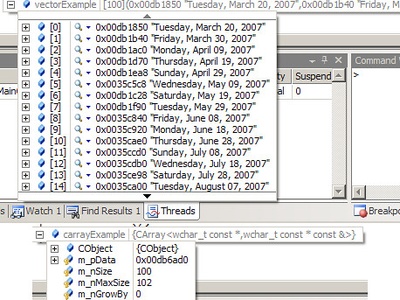
std::vector is the standard resizable contiguous sequence type in C++. It provides dynamic growth with amortized O(1) push back, constant-time indexing, and strong cache locality. Offers iterator semantics, exception safety options, and manual capacity control via reserve.
Java array
Java arrays are fixed-size and store either primitives contiguously or references contiguously with separate heap objects. They offer O(1) indexing, runtime bounds checks, and predictable memory layout for primitives, commonly used for performance-sensitive loops and native interop.
ArrayList
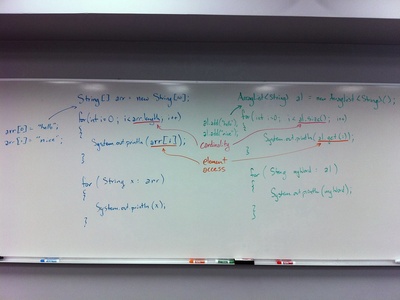
ArrayList is Java’s resizable array-backed list. It encapsulates a contiguous Object[] buffer that grows by reallocation, delivering O(1) indexing and amortized O(1) appends, with overhead from boxing primitives and concurrent modifications requiring external synchronization.
Python list
Python list is a dynamic array of pointers to PyObject. It provides O(1) indexing and amortized O(1) append, with growth strategies tuned for typical workloads. Because elements are references, memory overhead and indirection impacts performance compared with typed arrays.
array.array
array.array is a compact typed array of C-style numeric values in Python. It stores values contiguously with minimal overhead, enabling efficient binary I/O and lower memory footprint than lists while retaining Python-level APIs for small numeric sequences.
NumPy ndarray
NumPy’s ndarray is a typed, N-dimensional array supporting contiguous or strided memory layouts and vectorized operations. It offers efficient bulk computations, slicing views without copies, and explicit memory order control (row- or column-major) for scientific and machine-learning workloads.
NumPy memmap
NumPy memmap maps large array data to disk files allowing array access without loading entire dataset into RAM. Access pages in-demand, enabling processing of datasets larger than memory with near-memory-speed access patterns subject to OS paging behavior.
Memory-mapped array
Memory-mapped arrays map file regions into virtual memory, giving programs direct byte-wise access as if in-RAM. They reduce copy overhead and simplify I/O, but performance depends on OS page faults and alignment; useful for large datasets, IPC, and persistence.
Jagged array
Jagged arrays are arrays whose elements are arrays, allowing rows of varying lengths and independent memory allocation. They save space for irregular data, enable per-row operations, and differ from rectangular multidimensional arrays in memory layout and cache behavior.
Row-major array
Row-major arrays store multi-dimensional data with rows contiguous in memory, optimizing row-wise iteration and locality. Common in C and C-order libraries; choice of layout affects cache performance and interop with libraries expecting different memory orders.
Column-major array
Column-major layout stores columns contiguously, improving column-wise access patterns and matrix operations optimized for that order. Used in Fortran, MATLAB, and some numerical libraries. Aligning algorithm access patterns with layout improves cache efficiency and BLAS interoperability.

CSR
CSR stores nonzero values and column indices with row pointers, ideal for sparse matrices with efficient row access and matrix-vector products. It dramatically reduces memory for sparse data but has overhead for insertions and irregular pattern updates.

CSC
CSC is like CSR but organizes data by columns with column pointers and row indices. It excels at column-oriented operations and solving linear systems, while insertions and random updates remain expensive compared with dense arrays.
COO
COO format stores explicit (row, column, value) tuples for each nonzero entry, making construction and incremental assembly simple. It is conversion-friendly and flexible but less efficient for arithmetic or repeated access than CSR/CSC.
Bitset
Fixed-size bitsets pack boolean flags as bits in contiguous words, offering very low memory per element and fast bitwise bulk operations. Good for flags, bitmap indices, and set operations; lack dynamic resizing but have excellent cache and vectorized instruction opportunities.
Dynamic bitset
Dynamic bitsets provide resizable packed-bit arrays, combining compact memory with operations like rank/select and bitwise arithmetic. They support dynamic growth and efficient bulk operations, useful in indexing, compression, and algorithms needing compact boolean vectors.
Circular buffer
A fixed-size circular buffer reuses a contiguous buffer for FIFO queues with head and tail indices. It provides constant-time enqueue and dequeue without allocations, ideal for streaming, real-time audio, and inter-thread communication with minimal overhead.
CUDA device array
CUDA device arrays reside in GPU memory and are optimized for parallel kernel access and high-bandwidth transfers. They are contiguous, typed buffers used by GPU kernels and libraries for linear algebra and deep learning; host-device transfers and alignment affect performance.
TypedArray
TypedArray family provides contiguous binary buffers (ArrayBuffer views) with specific element types like Uint8Array or Float32Array. They enable efficient binary data handling, WebGL buffers, and low-level I/O in JavaScript with predictable memory layout and no per-element objects.
Structure of Arrays (SoA)
SoA arranges each field of a structure into its own contiguous array, improving SIMD and cache-friendly vectorized processing compared with Array-of-Structures. It boosts throughput for data-parallel workloads and can simplify GPU/massively-parallel memory access patterns.