In labs, field sites and quality-control benches, electrochemical methods are the go-to tools for measuring trace metals, monitoring corrosion, testing batteries and sensing biomolecules. A quick, targeted technique can turn hours of sample prep into a clear signal and actionable result.
There are 30 Types of Electrochemical Analysis, ranging from Adsorptive stripping voltammetry (AdSV) to Voltammetry; for each method you’ll find below concise entries organized by Principle, Typical analytes/applications, and Typical sensitivity (LOD, M) so you can compare capabilities at a glance — you’ll find below the full list and details.
How do I pick the best technique for my analyte and required sensitivity?
Choose based on the target species, concentration range and sample matrix: stripping methods (like AdSV) suit trace metals, voltammetric and amperometric approaches work for redox-active organics, and impedance or capacitive methods are better for interface or sensor studies; consult the Typical sensitivity column below to match method to detection limits.
Are these methods broadly applicable across environmental, clinical and industrial samples?
Yes—many techniques translate across fields, but matrix effects and preparation differ; use the Principle and Typical analytes/applications columns below to see which methods are routinely used for environmental monitoring, clinical assays or process control and whether additional cleanup or calibration is needed.
Types of Electrochemical Analysis
| Technique | Principle | Typical analytes/applications | Typical sensitivity (LOD, M) |
|---|---|---|---|
| Potentiometry | Measure potential at zero current to determine ion activity | pH and general ion analysis, environmental and clinical | 10^-6–10^-2 M |
| Ion-selective electrode (ISE) potentiometry | Selective membrane potential measurement for specific ions | Na+, K+, Ca2+, nitrate in water, clinical samples | 10^-6–10^-1 M |
| Potentiometric titration | Track potential change to locate titration endpoints | Acid–base, redox, complexometric titrations in labs | 10^-6–10^-3 M |
| Conductometry | Measure solution electrical conductance to infer ionic content | Ionic strength, water quality, titrations, reaction monitoring | 10^-5–10^-1 M |
| Conductometric titration | Monitor conductivity changes during titration for endpoints | Precipitation and acid–base titrations, water analysis | 10^-4–10^-2 M |
| Voltammetry | Apply varying potential and measure current response | Redox-active organics, metals, electrochemical fingerprinting | 10^-6–10^-9 M |
| Cyclic voltammetry (CV) | Sweep potential cyclically and record current to probe redox | Mechanistic studies, sensor development, electrode characterization | 10^-6–10^-3 M |
| Linear sweep voltammetry (LSV) | Single linear potential sweep while measuring current | Quantitative redox detection, calibration and screening | 10^-6–10^-4 M |
| Differential pulse voltammetry (DPV) | Superimpose voltage pulses on a sweep to reduce background | Trace organics and metal ions in environmental and clinical samples | 10^-9–10^-6 M |
| Square wave voltammetry (SWV) | Apply square-wave potential modulation for differential current | Fast trace screening of organics and ions, sensor work | 10^-9–10^-7 M |
| Anodic stripping voltammetry (ASV) | Preconcentrate by electrodeposition then strip anodically, measure peaks | Trace heavy metals like Pb, Hg, Cd in water and food | 10^-10–10^-8 M |
| Adsorptive stripping voltammetry (AdSV) | Preconcentrate analyte by adsorption before voltammetric stripping | Organic molecules and metal complexes in environmental samples | 10^-10–10^-8 M |
| Polarography | Voltammetry with a dropping mercury electrode to record currents | Trace metals, mechanistic redox studies in research | 10^-6–10^-9 M |
| Amperometry | Measure current at fixed potential to quantify electroactive species | Oxygen, glucose, H2O2, organic analytes in biosensors | 10^-6–10^-9 M |
| Flow-injection amperometric detection (FIA-EC) | Flow-injection sample handling with amperometric detection | High-throughput drug, pesticide, water and clinical assays | 10^-6–10^-9 M |
| Chronoamperometry | Apply potential step(s) and record current vs time | Diffusion studies, concentration measurements, sensor response | 10^-6–10^-9 M |
| Chronopotentiometry | Apply constant current and record potential vs time | Titration endpoints, electrode process monitoring | 10^-6–10^-4 M |
| Coulometry | Measure total charge passed during complete electrolysis for quantitation | Assay standards, trace quantification, stoichiometric determinations | 10^-6–10^-9 M |
| Coulometric titration | Generate or consume titrant by electrolysis and measure charge | Redox titrations in pharmaceutical and reference labs | 10^-6–10^-8 M |
| Electrochemical impedance spectroscopy (EIS) | Apply AC perturbation and measure frequency-dependent impedance | Biosensing, corrosion, sensor characterization, binding studies | 10^-12–10^-6 M |
| Capacitance sensing | Monitor double-layer or interfacial capacitance changes | Label-free biosensors, adsorption, film formation monitoring | 10^-12–10^-6 M |
| Scanning electrochemical microscopy (SECM) | Scan a microelectrode probe near surface to map local currents | Corrosion mapping, biological samples, catalyst activity mapping | 10^-6–10^-9 M |
| Scanning electrochemical cell microscopy (SECCM) | Droplet-based scanning probe for localized electrochemistry | Microscale mapping on catalysts, batteries, material heterogeneity | 10^-6–10^-9 M |
| Rotating disk electrode voltammetry (RDE) | Rotate disk electrode to control mass transport during sweep | Kinetic studies, catalyst evaluation, reaction rate determination | 10^-6–10^-4 M |
| Rotating ring-disk electrode voltammetry (RRDE) | Disk with concentric ring captures intermediates from disk | Detect reaction intermediates, oxygen reduction studies, catalysis | 10^-6–10^-4 M |
| Ultramicroelectrode voltammetry (UME) | Use very small electrodes to enhance mass transport and reduce IR drop | Microscale sensors, single-cell studies, in vivo probes | 10^-7–10^-9 M |
| Stripping chronopotentiometry | Preconcentrate analyte then strip at constant current measuring potential-time | Trace metal analysis in environmental and food testing | 10^-9–10^-6 M |
| Electrochemical quartz crystal microbalance (EQCM) | Simultaneous electrochemical current and crystal frequency shift measurement | Mass changes during redox, film growth, corrosion studies | 10^-6–10^-9 M |
| Ion-sensitive field-effect transistor (ISFET) potentiometry | Field-effect device transducing ion activity into voltage | pH and ion monitoring, point-of-care and wearable sensors | 10^-6–10^-2 M |
| Single-particle collision electrochemistry | Detect current transients when single particles collide with electrode | Nanoparticle sizing, catalysis at single-entity level, ultra-trace detection | 10^-12–10^-9 M |
Images and Descriptions

Potentiometry
Measures electrical potential between electrodes at zero current to determine ion activity; common for pH and ion analysis; fast, simple and widely used in environmental and clinical chemistry; calibration and reference electrode stability are important practical considerations.
Ion-selective electrode (ISE) potentiometry
Uses membrane-selective electrodes to measure specific ion activity; popular for Na+, K+, Ca2+ and nitrate; inexpensive and portable for point-of-care, water and soil testing; selectivity, interference and detection limits depend on membrane chemistry.
Potentiometric titration
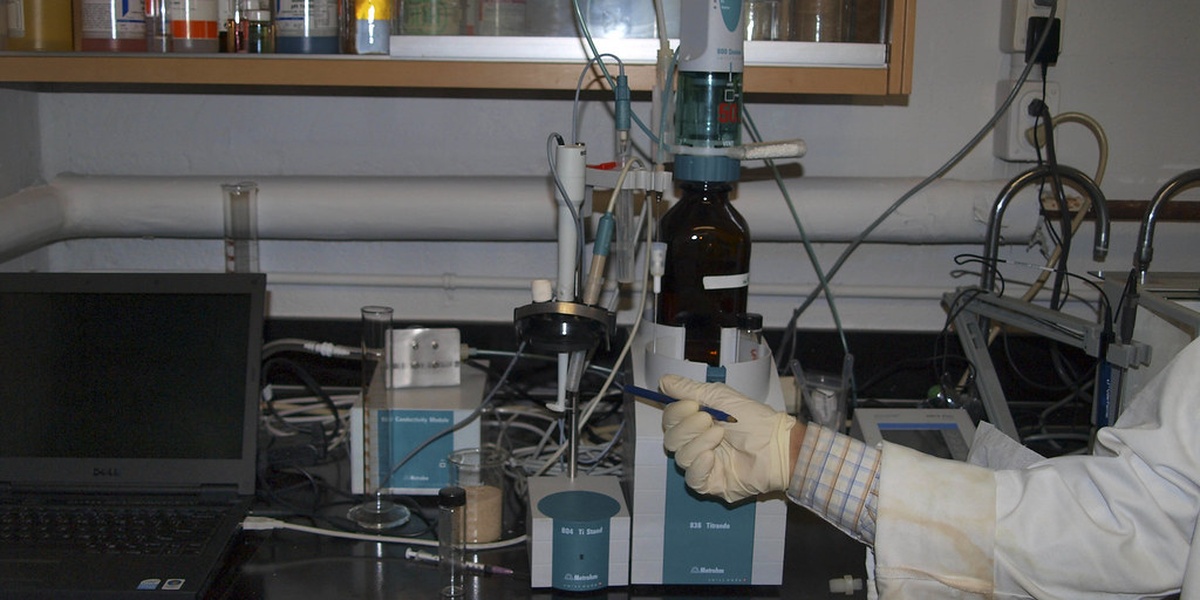
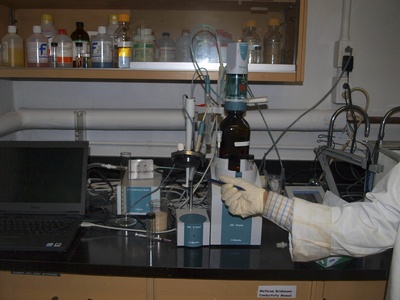
Monitors potential change during titration to find endpoints without indicators; useful for acid–base, redox and complexometric titrations; offers automatable, precise endpoint detection for colored or turbid samples where optical titration fails.
Conductometry
Measures solution conductivity to infer ionic strength or concentration; used in water quality, titrations and reaction monitoring; simple electrodes, tolerant of colored samples, but less selective—often paired with titration or separation for specificity.
Conductometric titration
Tracks conductivity changes during titration to detect endpoints; especially useful for precipitation or acid–base titrations with conductivity shifts; straightforward and automatable but affected by temperature and background ions and ionic strength.
Voltammetry
Applies a varying potential and measures resulting current to identify redox behaviors and concentrations; versatile across research, environmental monitoring and sensors; choice of waveform and electrode largely determines sensitivity and selectivity.
Cyclic voltammetry (CV)
Sweeps potential cyclically while recording current to probe redox processes, reaction mechanisms and kinetics; widely used in research and sensor development; provides qualitative fingerprints rather than ultra-trace quantification but can guide analytical method choices.
Linear sweep voltammetry (LSV)
Applies a single linear potential sweep and measures current to detect redox-active species; simpler than CV for quantitative analysis, often used for calibration, kinetics and preliminary screening in labs and field setups.
Differential pulse voltammetry (DPV)
Superimposes voltage pulses on a linear sweep to reduce background current and enhance peak resolution; widely used for trace analysis of organic molecules and metal ions with low nanomolar detection limits.
Square wave voltammetry (SWV)
Applies square-wave potential modulation for fast, sensitive current measurements; excellent for trace detection, deconvoluting overlapping signals and rapid screening in environmental and biochemical samples. It combines speed with good sensitivity and is popular for portable sensors.
Anodic stripping voltammetry (ASV)
Preconcentrates metal ions by electroplating, then strips them anodically while measuring current peaks; extremely sensitive for trace metals like lead, mercury and cadmium, often reaching pico- to nanomolar levels and widely used in environmental monitoring and food safety.
Adsorptive stripping voltammetry (AdSV)
Uses adsorption of analyte onto the electrode surface for preconcentration before voltammetric stripping; useful for organic compounds and metal complexes with very low detection limits and minimal sample preparation in routine and field analyses.
Polarography
Classic voltammetric method using a dropping mercury electrode to record current–potential curves; historically important for trace metal analysis and mechanistic studies, though mercury use has declined due to toxicity concerns.
Amperometry
Measures steady-state or transient current at a fixed potential to quantify electroactive species; widely used in flow cells, biosensors and environmental monitors for oxygen, glucose and small organics and gases.
Flow-injection amperometric detection (FIA-EC)
Combines flow-injection sample handling with amperometric detection for rapid, high-throughput measurements; common in clinical and environmental labs for drugs, pesticides and routine water analyses. It provides reproducible peaks and is easy to automate for many routine assays.
Chronoamperometry
Applies potential steps and records current versus time to study diffusion and reaction kinetics; useful for concentration measurements, electrode processes, and transient analytical assays, often used in sensor calibration and mechanistic electrochemistry.
Chronopotentiometry
Applies constant current and measures potential change over time to quantify analytes or monitor electrode reactions; helpful for titrations and controlled electrolysis endpoint detection. It gives charge-based information that complements other electrochemical methods.
Coulometry
Quantifies analyte by measuring total charge passed during complete electrolysis; extremely accurate for stoichiometric determinations and low-volume samples when full conversion is achieved. Used for assay standards, trace quantification and coulometric titrations in quality control labs.
Coulometric titration
End-point detection through coulometric generation or consumption of titrant with charge measurement; highly precise for redox-active species and small samples without need for standard solutions. Popular in pharmaceutical and reference labs.
Electrochemical impedance spectroscopy (EIS)
Applies small AC perturbations and measures frequency-dependent impedance to probe interfaces and binding events; powerful for biosensing, corrosion studies and sensor characterization with high sensitivity to surface changes and label-free detection.
Capacitance sensing
Monitors double-layer or interfacial capacitance changes to detect adsorption or binding events; useful for label-free biosensors and monitoring thin-film formation, often complementary to impedance techniques with fast response times suitable for real-time monitoring.
Scanning electrochemical microscopy (SECM)
Uses a microelectrode probe scanned near a surface to map local electrochemical activity and concentration gradients; valuable for studying corrosion, biological samples and localized reactivity with spatial resolution in both research and sensor development.
Scanning electrochemical cell microscopy (SECCM)
A droplet-based scanning probe that delivers localized electrochemical measurements at high spatial resolution; ideal for mapping electrochemical heterogeneity on catalysts, batteries and materials at microscale and used increasingly in materials analysis.
Rotating disk electrode voltammetry (RDE)
Controls mass transport by rotating a disk electrode while sweeping potential, enabling kinetic studies and analytic current measurements; common for catalytic activity evaluation and reaction rate determination in fuel-cell and electrocatalysis research.
Rotating ring-disk electrode voltammetry (RRDE)
Combines rotating disk with an annular ring to detect reaction intermediates produced at the disk; useful for mechanistic studies of oxygen reduction and multi-step electrochemical reactions and catalyst screening in labs.
Ultramicroelectrode voltammetry (UME)
Uses very small electrodes to minimize ohmic drop and improve mass-transport, enabling fast, high-sensitivity measurements in tiny volumes and resistive media for trace analysis. Popular for in vivo probes, microscale sensors and electrochemical studies of single cells.
Stripping chronopotentiometry
Combines preconcentration with constant-current stripping while monitoring potential-time transients; effective for trace metal analysis with good selectivity and useful when stripping currents or peaks are complex in environmental and food testing.
Electrochemical quartz crystal microbalance (EQCM)
Simultaneously measures electrochemical current and frequency shifts of a quartz crystal to monitor mass changes during redox, adsorption or film growth; helpful in battery, corrosion and surface chemistry studies and sensor development.
Ion-sensitive field-effect transistor (ISFET) potentiometry
Solid-state potentiometric sensors using field-effect devices to transduce ion activity into voltage; fast, miniaturizable, used for pH, ion monitoring and point-of-care sensors with CMOS integration and wearable applications in environmental and clinical monitoring.
Single-particle collision electrochemistry
Detects individual nanoparticles or vesicles via current steps when they collide with an electrode; enables single-entity analysis for nanoparticle sizing, catalysis studies and ultra-low concentration detection, promising for advanced environmental and materials analysis.