Niobium quietly shapes many modern materials — from ceramics and capacitors to catalysts and research reagents — thanks to its variable chemistry and useful electronic properties. Whether you’re exploring inorganic catalogs or planning a materials project, a compact, well-organized list makes it easier to spot relevant compounds.
There are 25 Niobium Compounds, ranging from Ammonium niobium oxalate to Sodium niobate, and they are organized by Formula,Category,Oxidation state — you’ll find below.
What are the typical uses for these niobium compounds?
Niobium compounds appear in a few practical areas: oxides and mixed oxides are common in capacitors and ceramics, certain complexes are studied as catalysts or precursors for thin films, and specific salts are useful in laboratory syntheses; knowing the category and oxidation state helps identify likely applications quickly.
How should I interpret the Formula,Category,Oxidation state columns when scanning the list?
Read the Formula as the chemical composition, Category as the compound type (oxide, halide, complex, etc.), and Oxidation state as the niobium formal charge; together they let you assess stability, reactivity, and likely uses without diving into full datasheets.
Niobium Compounds
| Name | Formula | Category | Oxidation state |
|---|---|---|---|
| Niobium pentoxide | Nb2O5 | oxide | +5 |
| Niobium(II) oxide | NbO | oxide | +2 |
| Niobium dioxide | NbO2 | oxide | +4 |
| Niobic acid | HNbO3 | oxide | +5 |
| Lithium niobate | LiNbO3 | oxide | +5 |
| Sodium niobate | NaNbO3 | oxide | +5 |
| Potassium niobate | KNbO3 | oxide | +5 |
| Barium niobate | BaNb2O6 | oxide | +5 |
| Niobium pentachloride | NbCl5 | halide | +5 |
| Niobium pentafluoride | NbF5 | halide | +5 |
| Niobium pentabromide | NbBr5 | halide | +5 |
| Niobium pentaiodide | NbI5 | halide | +5 |
| Niobium oxychloride | NbOCl3 | halide | +5 |
| Niobium oxyfluoride | NbOF3 | halide | +5 |
| Niobium ethoxide | Nb(OEt)5 | organometallic | +5 |
| Niobium nitride | NbN | nitride | +3 |
| Niobium carbide | NbC | carbide | +4 |
| Niobium disulfide | NbS2 | chalcogenide | +4 |
| Niobium diselenide | NbSe2 | chalcogenide | +4 |
| Niobium ditelluride | NbTe2 | chalcogenide | +4 |
| Niobium(V) sulfide | Nb2S5 | chalcogenide | +5 |
| Potassium hexaniobate (layered) | K4Nb6O17 | complex salt | +5 |
| Ammonium niobium oxalate | (NH4)NbO(C2O4)2·xH2O | complex salt | +5 |
| Niobium tetrachloride | NbCl4 | halide | +4 |
| Niobocene dichloride | (C5H5)2NbCl2 | organometallic | +4 |
Images and Descriptions

Niobium pentoxide
A white, high‑melting oxide and the primary commercial source of niobium; used for ceramics, optical coatings, and as a precursor to catalysts and capacitors. Insoluble and chemically robust; dust can irritate skin and lungs and it is a strong Lewis acid when activated.
Niobium(II) oxide
A metallic, black suboxide with a rock‑salt structure; studied for its electrical and magnetic behavior and nonstoichiometry. Forms under strongly reducing conditions and oxidizes in air; fine powders are pyrophoric and can be irritating if inhaled.
Niobium dioxide
A dark, conductive oxide studied for metal–insulator transitions and electrochemical devices. Less common than Nb2O5 and stable under reducing atmospheres; dusts are respirable and it reacts slowly with oxidizers at high temperatures.
Niobic acid
Hydrated niobium(V) oxide often written as niobic acid, used as a precursor for catalysts and sol–gel films. Gel‑like and acidic, it converts to Nb2O5 on heating; handle as an irritant and avoid inhalation of powders.
Lithium niobate
A ferroelectric, piezoelectric crystal widely used in optics, modulators, and surface acoustic wave devices. Grown as single crystals for photonics; chemically stable but dust is irritating and some processing involves hazardous solvents.
Sodium niobate
A perovskite oxide with temperature‑dependent ferroelectric and antiferroelectric phases; studied for capacitors and sensors. Prepared by solid‑state routes; typical ceramic handling precautions apply for fine powders.
Potassium niobate
A ferroelectric oxide used in nonlinear optics and electro‑optic devices. Often synthesized as single crystals or ceramics; stable but powders can be dust hazards and high‑temperature processing requires care.
Barium niobate
A niobate perovskite used in nonlinear optics and photonics research; notable for good dielectric properties. Ceramic synthesis involves high temperatures; treat powders as irritants and avoid generating dust.
Niobium pentachloride
A white to yellow moisture‑sensitive solid and powerful Lewis acid used to make organoniobium reagents and catalysts. Hydrolyzes violently with water to HCl and oxides; corrosive and fuming in moist air.
Niobium pentafluoride
A hygroscopic, colorless solid that forms fluoroanions; used in fluoride chemistry and as a Lewis acid in synthesis. Highly corrosive, reacts with water to release HF; strong handling precautions and fluoride safety required.
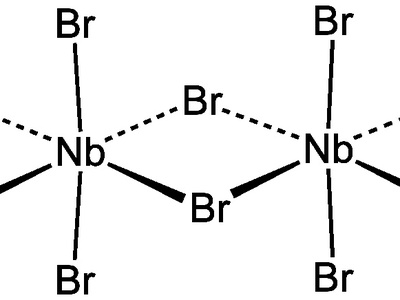
Niobium pentabromide
A dark red‑brown, moisture‑sensitive solid used in halide chemistry and as a precursor to bromoniobium complexes. Hydrolyzes on exposure to air; corrosive and an irritant, requiring dry‑box techniques for manipulation.
Niobium pentaiodide
A less common, dark volatile halide used in specialized syntheses; sensitive to air and moisture and decomposes on contact with water. Useful in research chemistry but must be handled under inert atmosphere.
Niobium oxychloride
An orange oxychloride formed by partial hydrolysis of NbCl5 and used as a precursor to oxides and catalysts. Reacts with water to give Nb oxides and HCl; corrosive and irritant like other oxyhalides.
Niobium oxyfluoride
An oxyfluoride exhibiting mixed oxide/fluoride character, used in fluoride chemistry and as a precursor to mixed‑anion materials. Hygroscopic and corrosive; releases HF on hydrolysis and requires fluoride‑safe handling.
Niobium ethoxide
A volatile niobium alkoxide used as a chemical‑vapor‑deposition precursor and sol–gel source for Nb2O5 films. Moisture‑sensitive and flammable; hydrolyzes readily to oxides and must be handled under inert conditions.
Niobium nitride
A hard, refractory ceramic and superconductor in thin‑film form, used for superconducting devices, coatings, and Josephson junctions. Chemically robust but machining powders requires dust controls; synthesis often involves high temperatures or reactive sputtering.
Niobium carbide
A very hard, wear‑resistant refractory carbide used in cutting tools and cermets; exhibits metallic conductivity and high melting point. Powders are hazardous if inhaled; high‑temperature processing needed for dense parts.
Niobium disulfide
A layered transition‑metal dichalcogenide with interesting electronic properties and catalytic potential. Produced by solid‑state reactions or vapor transport; layers can be exfoliated but fine powders and vapors need fume control.
Niobium diselenide
A layered material known for superconductivity and charge‑density‑wave behavior; used in low‑temperature physics and 2D materials research. Synthesized as crystals; caution with powdered or vapor phases and low‑temperature handling requirements.
Niobium ditelluride
A layered transition‑metal telluride studied for electronic and catalytic properties. Less common than sulfides/selenides; brittle crystals and powders require standard inorganic powder safety precautions.
Niobium(V) sulfide
A niobium(V) sulfide used as a precursor in chalcogen chemistry and materials synthesis. Prepared from elements or salts at high temperature; sensitive to strong oxidizers and conventional powder handling safety is advised.
Potassium hexaniobate (layered)
A layered potassium niobate oxide used as a photocatalyst and in ion‑exchange studies; notable for 2D‑like sheets and intercalation chemistry. Stable ceramic but fine powders are respiratory irritants.
Ammonium niobium oxalate
A water‑soluble niobium(V) coordination complex used as a precursor for sol–gel and oxide materials. Forms crystalline hydrates; handle with standard lab PPE and avoid ingesting or inhaling powders.
Niobium tetrachloride
A paramagnetic dark solid used in study of low‑valent niobium chemistry and prepared by comproportionation of NbCl5 and NbCl3. Moisture‑sensitive and corrosive; manipulate under inert atmosphere to prevent hydrolysis.
Niobocene dichloride
A sandwich‑complex organoniobium compound of historical interest in organometallic chemistry; synthesized for reactivity studies and ligand substitution. Air‑ and moisture‑sensitive; handle under inert conditions with organic solvent precautions.