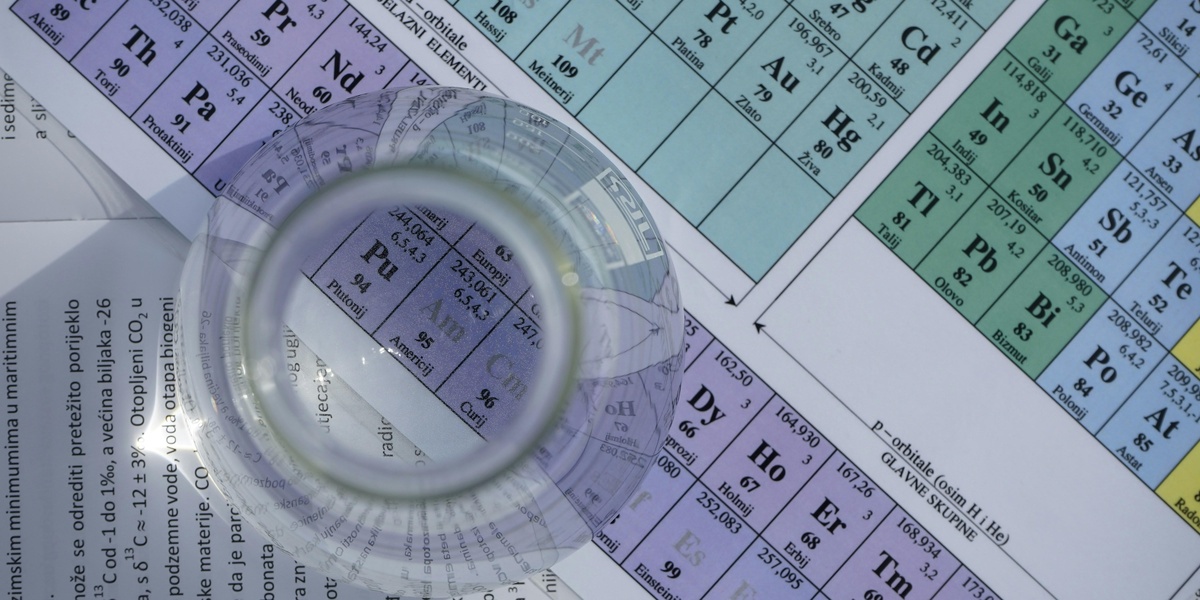
In 2003, a joint team at the Joint Institute for Nuclear Research (JINR, Dubna) and U.S. collaborators first synthesized element 115 by fusing americium-243 with calcium-48, adding a superheavy entry to the periodic table and setting off decades of theoretical chemistry.
Moscovium (atomic number 115) is compelling precisely because its observed isotopes live for only fractions of a second to, at best, milliseconds or seconds, so chemists rely on calculations and clever single-atom techniques to probe its behavior. Those short lifetimes make bench chemistry impossible, but they also create a clear testbed for relativistic effects on electron shells and for checking how periodic trends hold up at extreme nuclear charge.
This article lists eight elements moscovium reacts with, drawing on analogies to lighter group‑15 members (like bismuth), computational predictions, and the experimental contexts—gas‑phase thermochromatography, adsorption on gold, cryogenic matrix trapping—that would reveal fleeting Mc compounds. The discussion is grouped into three categories: simple binary compounds (oxides, hydrides, sulfides), halogens and other electronegative partners, and organometallic/metal interactions.
Predicted Simple Binary Compounds
Many first‑pass predictions for moscovium chemistry are simple binary species: oxides, hydrides, and sulfides. That expectation follows periodic trends for group‑15 elements (think Bi and Sb), yet relativistic stabilization and contraction of valence orbitals can shift preferred oxidation states compared with lighter homologs.
Because moscovium is made atom‑by‑atom (243Am + 48Ca fusion), experimental tests must capture single atoms in transit and identify daughter nuclides by alpha‑decay chains. Most concrete proposals are computational, and observations would typically come from rapid gas‑phase chemistry or chromatography within milliseconds to seconds after production.
1. Oxygen — formation of moscovium oxides
Oxygen is a top candidate for forming simple moscovium oxides. Group‑15 elements commonly form stable oxides (Bi2O3 is a useful analogue), and calculations extend those tendencies to McOx species with varying stoichiometries.
Relativistic effects may favor lower or atypical oxidation states compared with bismuth, so detecting an oxide would directly reveal Mc’s preferred valence. Practically, gas‑phase thermochromatography or rapid chromatography following recoil separation would be the way to spot Mc–O signatures and validate theoretical models.
2. Hydrogen — possible hydride behavior
Hydrogen can form hydrides with many heavy p‑block elements, and moscovium might form species such as McH or polyhydrides like McH3 according to some models. Hydride formation points toward lower formal oxidation states, potentially influenced by relativistic stabilization of the 7p and 7s orbitals.
Hydrides are valuable because they can trap and transport single atoms in carrier gases and cryogenic matrices. Experimentalists would likely attempt cryogenic matrix isolation or fast gas‑phase reactions to stabilize and identify Mc–H vibrational signatures against a short decay clock.
3. Sulfur — sulfides and chalcogenide predictions
Sulfur is another plausible partner: computational work that predicts oxides often extends to sulfides and mixed chalcogenides. Chalcogen trends for group‑15 suggest Mc–S bonding could range from largely covalent to somewhat ionic, depending on oxidation state and orbital mixing.
Gas‑phase or surface‑based thermal desorption experiments could test Mc–S bond strengths, with Bi2S3 and Sb sulfides serving as chemical reference points. Observing sulfide behavior would help map out covalency for superheavy element bonds.
Halogens and Electronegative Partners
Halides are commonly targeted when studying new elements because halogens often form volatile compounds that are experimentally tractable. Fluorine in particular stabilizes high oxidation states in heavy elements, while chlorine frequently provides a more practical route for chemical separation and detection.
Predicted McF and McCl species could be generated in fast fluorination or chlorination setups, and volatility or adsorption behavior measured by gas‑phase thermochromatography. Success detecting halides for elements such as nihonium and flerovium shows this approach works for single‑atom chemistry.
4. Fluorine — stabilization of high oxidation states
Fluorine is a prime candidate to form moscovium fluorides that may stabilize higher oxidation states. Highly electronegative fluorine can draw out electron density and has helped reveal halide chemistry for other superheavy elements in past JINR and GSI studies.
Computational predictions often show strong Mc–F binding and volatile McFx species; measuring their adsorption behavior in a temperature gradient would indicate Mc’s effective oxidation number and the influence of relativistic orbital shifts.
5. Chlorine — accessible and informative halide chemistry
Chlorine is less aggressive than fluorine but easier to handle experimentally, making McCl species attractive targets. Chlorides are useful in radiochemical separations and ion‑exchange protocols that work on the millisecond timescale.
Computations support Mc–Cl bonding, and rapid aqueous or gas‑phase separation methods could reveal whether moscovium behaves more like bismuth (less volatile) or shows unexpectedly volatile halide behavior; ion‑exchange and quick chromatographic traps are standard approaches.
Organometallic and Metal Interactions
Organometallic complexes and interactions with metal surfaces are powerful probes of bonding character, especially when only single atoms are accessible. Mc–C bonds would test covalent participation of valence orbitals, while adsorption on metal surfaces—gold in particular—lets teams capture single atoms and measure adsorption energies.
Surface deposition, microcalorimetry, and alpha‑decay tagging are practical techniques for observing such fleeting complexes. Computational studies guide ligand choices and surface models so experiments know what signatures to seek in the few seconds available after production.
6. Carbon — organometallic bonding and Mc–C predictions
Carbon-centered organometallics are central to predictions for moscovium because Mc–C bonds would reveal the degree of covalency in element 115 compounds. Theoretical work suggests stable Mc–C interactions are possible in small, transient complexes.
If organometallic species form, trapping them in a matrix or on a cold surface could allow spectroscopic or decay‑chain identification. Analogies with bismuth organometallic chemistry and recent predictions for nihonium–carbon bonds inform ligand design and trapping strategies.
7. Gold (and other metal surfaces) — adsorption and capture
Gold surfaces are a common choice for capturing single superheavy atoms during chemistry experiments. Atoms recoil onto a gold substrate, and their adsorption strength versus temperature reveals volatility and the nature of surface bonding.
Alpha‑decay tagging of atoms on gold, combined with thermochromatography, has characterized behavior for flerovium and others; the same techniques could distinguish whether Mc behaves like a volatile halide or a less volatile pnictogen on metal surfaces.
8. Nitrogen — nitrides and coordination chemistry
Nitrogen can coordinate to group‑15 elements to form nitrides or ligated complexes, and Mc–N interactions are plausible according to comparative modeling. Nitrides would help define bond geometries and the balance between ionic and covalent character.
Matrix isolation or rapid gas‑phase reactions with nitrogen ligands could trap Mc–N species long enough for identification; bismuth–nitrogen chemistry again provides a reference framework for interpreting any observed coordination patterns.
Summary
Across oxides, halides, organometallics and surface interactions, theory and single‑atom techniques point to eight plausible partners for moscovium spanning oxygen, hydrogen, sulfur, fluorine, chlorine, carbon, gold (as a surface material), and nitrogen.
Most of the chemistry described remains predictive because moscovium isotopes are produced one atom at a time via 243Am + 48Ca fusion and decay in milliseconds to seconds. Experimental paths forward include gas‑phase thermochromatography, adsorption studies on gold, cryogenic matrix trapping, ion‑exchange separations, and alpha‑decay tagging linked to rapid chromatography.
These directions should help experimentalists and theorists sharpen hypotheses about element 115 compounds and narrow what to look for when new production runs or improved detectors become available.
- Eight plausible partners were evaluated: O, H, S, F, Cl, C, Au (surface), and N, informed by Bi/Sb analogues and relativistic predictions.
- Most proposed species are computational; observed isotopes typically last only milliseconds to seconds, so single‑atom techniques are essential.
- Gas‑phase thermochromatography and gold‑surface adsorption (with alpha‑decay tagging) are the most practical experimental paths to confirmation.
- Continued high‑precision computations and improved single‑atom experiments will be key to turning predictions about elements moscovium reacts with into measured chemistry.