Gamma rays are the highest-energy photons and they appear across the universe and in our atmosphere — from radioactive isotopes in space to brief flashes above thunderstorms. Knowing the different kinds of gamma-ray sources helps scientists trace nuclear processes, high-energy particles, and transient events.
There are 20 Examples of Gamma Rays, ranging from 26Al to Terrestrial Gamma-ray Flash (TGF). For each entry you’ll find below the three columns used to organize the data: Type,Energy range (keV/MeV/GeV),Example origin or isotope/event — this shows both typical energies and where the emission comes from, and you’ll find below detailed entries arranged that way.
How do the different gamma-ray examples relate to energy and origin?
Gamma-ray examples span many orders of magnitude: radioactive decay lines (like 26Al) appear at specific keV–MeV energies tied to nuclear transitions, while cosmic sources (pulsars, blazars) can emit into the GeV–TeV range from particle acceleration; transient events like TGFs are short, intense bursts linked to lightning and atmospheric processes.
Can any of these gamma-ray types affect people or electronics on Earth?
Most gamma rays from cosmic sources are absorbed by the atmosphere and pose no direct risk at ground level, but terrestrial sources like TGFs and local radioactive contamination can produce detectable radiation; monitoring and shielding mitigate risks for sensitive electronics and human exposure.
Examples of Gamma Rays
| Name | Type | Energy range (keV/MeV/GeV) | Example origin or isotope/event |
|---|---|---|---|
| GRB | astrophysical | 100 keV–100 GeV | core-collapse or compact-merger relativistic jets |
| Blazar | astrophysical | 100 MeV–10 TeV | relativistic jet from supermassive black hole (e.g., 3C 279) |
| Crab Pulsar | astrophysical | 100 keV–100 GeV | rotating neutron star magnetospheric emission |
| Crab Nebula | astrophysical | 100 keV–10 TeV | pulsar wind shock and inverse Compton scattering |
| Supernova remnant | astrophysical | 100 keV–10 TeV | shock-accelerated particles and pion decay (e.g., RX J1713) |
| Solar flare | astrophysical | 100 keV–100 MeV | magnetic reconnection, nuclear de-excitation, pion decay |
| Terrestrial Gamma-ray Flash (TGF) | terrestrial | 100 keV–100 MeV | thunderstorm electric fields and runaway electrons |
| Positron annihilation (Galactic 511 keV) | astrophysical | 511 keV | positron-electron annihilation in Galactic center region |
| 26Al | astrophysical | 1.81 MeV | radioactive decay from massive-star nucleosynthesis |
| 60Fe | astrophysical | 1.17 MeV–1.33 MeV | radioactive decay from supernova nucleosynthesis |
| 44Ti | astrophysical | 1.16 MeV | decay in young supernova ejecta (e.g., Cas A) |
| Diffuse extragalactic gamma-ray background | astrophysical | 100 MeV–100 GeV | unresolved AGN, star-forming galaxies, other sources |
| Atmospheric gamma rays | terrestrial | 100 keV–100 GeV | cosmic-ray interactions with Earth’s atmosphere |
| Co-60 | anthropogenic | 1.17 MeV–1.33 MeV | beta decay of cobalt-60 isotope |
| Cs-137 | anthropogenic | 662 keV | decay of Ba-137m following Cs-137 beta decay |
| Tc-99m | medical | 140 keV | isomeric transition used in diagnostic imaging |
| I-131 | medical | 364 keV | beta decay with gamma emission used in thyroid therapy |
| K-40 | natural | 1.46 MeV | natural radioactive potassium in Earth and bodies |
| Ir-192 | industrial | 300 keV–600 keV | decay of iridium-192 used in radiography |
| Nuclear reactor gamma emissions | anthropogenic | 100 keV–10 MeV | fission fragments and neutron capture gamma rays |
Images and Descriptions
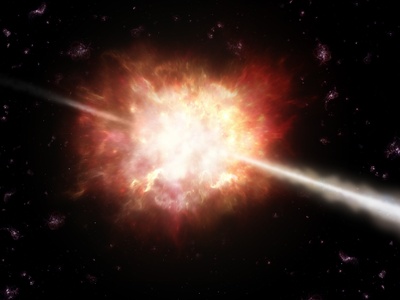
GRB
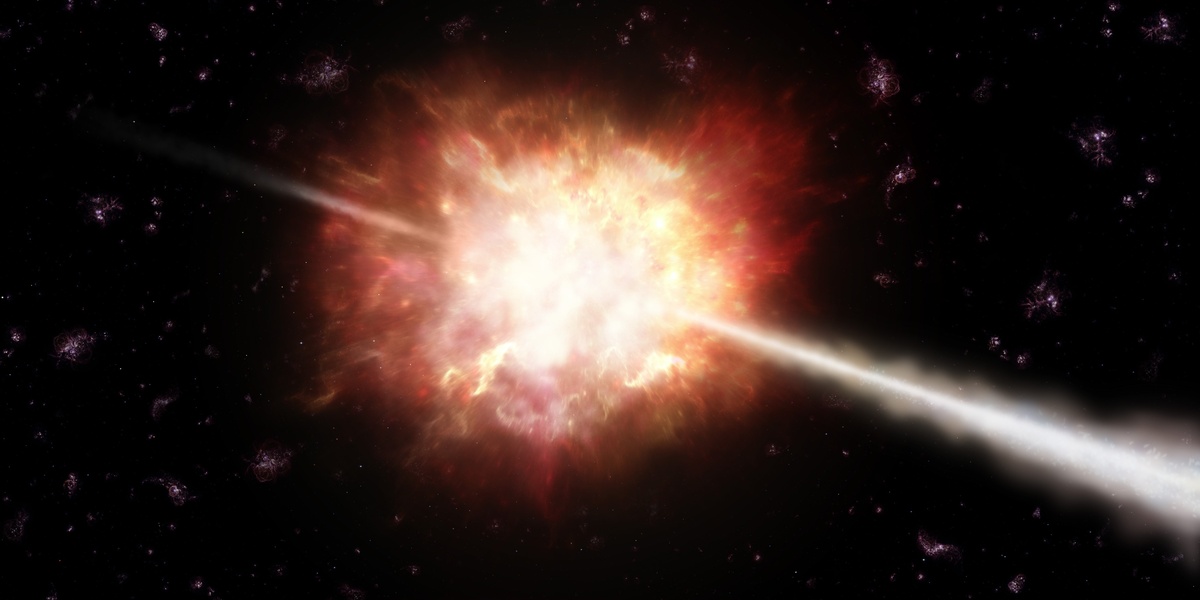
Brief, intense bursts from collapsing stars or neutron-star mergers producing MeV–GeV photons; seen across the universe by space telescopes, notable for extreme brightness and probing extreme physics and cosmology.
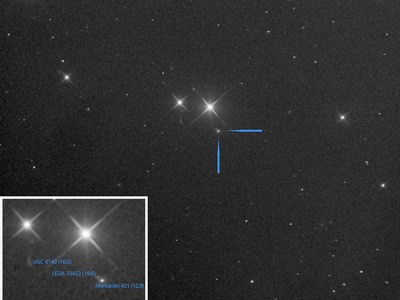
Blazar
Active galactic nuclei with jets pointed at Earth, emitting variable gamma rays up to TeV energies; monitored by Fermi and Cherenkov telescopes, important for jet physics and particle acceleration.
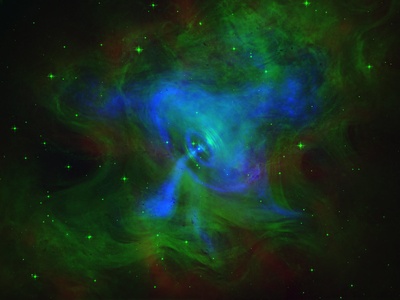
Crab Pulsar
Young pulsar in the Crab Nebula producing pulsed gamma rays via accelerated particles in its magnetosphere; a calibration and study target for high-energy observatories.
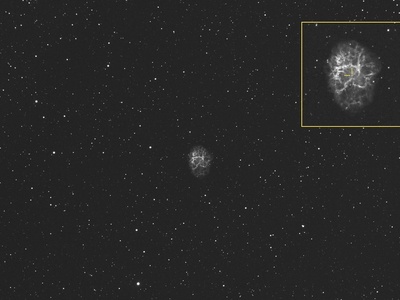
Crab Nebula
A pulsar wind nebula shining from X-rays to TeV gamma rays, detected as a steady high-energy source; crucial for studying cosmic accelerators and particle transport.
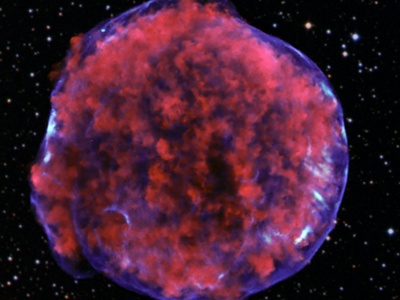
Supernova remnant
Expanding remnants accelerate cosmic rays that produce gamma rays through inverse Compton and pion-decay, observed by space and ground telescopes, revealing sites of Galactic particle acceleration.
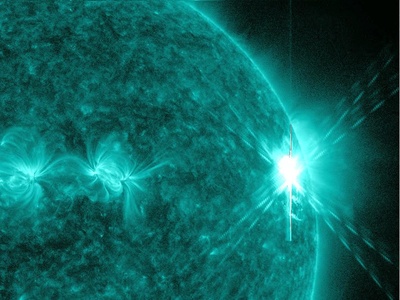
Solar flare
Flares on the Sun accelerate electrons and ions, producing nuclear gamma lines and continuum; observed by satellites, important for solar physics and space weather.

Terrestrial Gamma-ray Flash (TGF)
Millisecond bursts from thunderstorms observed by satellites and ground detectors; illustrate powerful atmospheric particle acceleration and link weather to high-energy physics.
Positron annihilation (Galactic 511 keV)
A sharp 511 keV emission line seen from the Milky Way center, arising when positrons annihilate with electrons; informs on positron sources and interstellar medium conditions.
26Al
Galactic 1.81 MeV line traces ongoing nucleosynthesis from massive stars and supernovae; observed in gamma-ray maps, it reveals recent star formation and ejecta transport.
60Fe
Long-lived isotope producing MeV gamma lines detected in the Galaxy; provides direct evidence of past nearby supernovae and nucleosynthesis history.
44Ti
Gamma lines from 44Ti probe very young supernova remnants, revealing inner explosion asymmetries and nucleosynthesis within decades to centuries after explosion.
Diffuse extragalactic gamma-ray background
Isotropic high-energy glow measured by satellites, composed of many unresolved sources and processes; important for cosmic-ray and galaxy evolution studies.
Atmospheric gamma rays
Secondary gamma rays produced when cosmic rays hit air molecules, detected by ground and balloon experiments; contribute to background radiation and atmospheric physics.
Co-60
Common industrial and medical gamma source emitting two strong MeV lines used for sterilization and radiotherapy; easy to detect and important in radiation safety and calibration.
Cs-137
Widely used and encountered gamma source with a 662 keV line; used in industrial gauges and environmental monitoring, notable for persistence after nuclear incidents.
Tc-99m
The most common nuclear medicine tracer emitting 140 keV gamma photons for diagnostic scans; produced in generators, prized for ideal imaging energy and short half-life.
I-131
Used in diagnostics and therapy for thyroid disease, emitting 364 keV gamma photons; important clinically and for monitoring environmental contamination after releases.
K-40
Naturally occurring isotope producing 1.46 MeV gamma rays, contributing to background radiation in soils, rocks, and biological tissue; used in geophysics and radiometric dating contexts.
Ir-192
Radioisotope source for industrial radiography and brachytherapy with multiple gamma lines in the several-hundred keV range; commonly encountered in industry and regulated for safety.
Nuclear reactor gamma emissions
Complex gamma spectrum from reactors due to fission products and activation; monitored for reactor operation, safety, and environmental release assessments.