From soil and ocean sediments to the surfaces of our skin and gut, bacterial reproduction shapes ecosystems, fermentation processes and infectious outbreaks. Knowing the main modes helps you predict growth, survival under stress and how populations change over time.
There are 7 Types of Bacterial Reproduction, ranging from Aerial sporulation (exospores/arthrospores) to Viviparity (internal offspring). For each type I summarize its Mechanism (≤15 words),Generation time (min),Example species (≤15 words) so you can compare processes and timelines—you’ll find below.
How quickly do different reproduction types produce new cells?
Generation times vary widely: simple binary fission can be as fast as ~20 minutes under optimal conditions, while spore formation and recovery from dormancy take hours to days; budding and viviparity generally show intermediate to slow rates. Use reported generation times as rough guides—environment and nutrient availability often change them by orders of magnitude.
Which reproduction types are most relevant to health or industry?
Binary fission dominates clinically and industrially (rapid growth of E. coli, Lactobacillus), while sporulation matters for persistence and sterilization (Bacillus, Clostridium). Less common modes like budding or viviparity matter in specific niches or bioprocesses; knowing the mode guides control strategies and process design.
Types of Bacterial Reproduction
| Name | Mechanism (≤15 words) | Generation time (min) | Example species (≤15 words) |
|---|---|---|---|
| Binary fission | Cell grows, DNA replicates, septum forms, cell divides evenly | 20 | Escherichia coli, Bacillus subtilis |
| Budding | New cell forms as a bud from the parent cell | 120 | Caulobacter crescentus, Hyphomicrobium |
| Polar differentiation | Polar differentiation yields distinct daughter cell types (e.g., swarmer and stalked) | 120 | Caulobacter crescentus |
| Fragmentation (hormogonia) | Filament breaks into motile or juvenile fragments that grow independently | 1,440 | Anabaena, Oscillatoria |
| Baeocyte formation (multiple fission) | Parent cell divides internally into many small daughter cells (baeocytes) | 480 | Pleurocapsa, Chroococcidiopsis |
| Aerial sporulation (exospores/arthrospores) | Aerial hyphae form chains of spores that disperse and found colonies | 720 | Streptomyces coelicolor, Actinomyces spp. |
| Viviparity (internal offspring) | Parent forms internal daughter cells that mature and are released | 1,440 | Epulopiscium fishelsoni |
Images and Descriptions
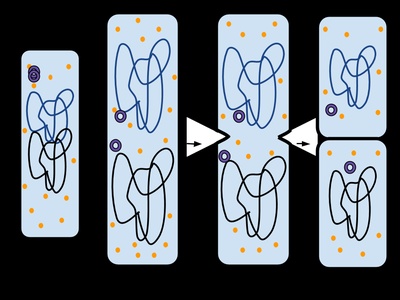
Binary fission
The standard method where one bacterium splits into two genetically identical daughter cells. It’s fast and common in labs and nature; rates depend on species and conditions, making binary fission central to population growth, ecology, and infection spread.

Budding
Budding produces a smaller daughter that pinches off from a parent, often at a pole or stalk. Seen in aquatic and soil bacteria, it creates asymmetric life cycles and specialized cell types important for surface colonization and niche specialization.
Polar differentiation
Some bacteria divide asymmetrically to produce different cell types—a motile swarmer and a sessile stalked cell. This specialization helps disperse to new sites and establish colonies, and is a model for studying cell-cycle control and developmental regulation.
Fragmentation (hormogonia)
Filamentous bacteria form long chains that can fragment into hormogonia or juvenile pieces which move and develop into new filaments. Common in cyanobacteria and soil microbes, fragmentation aids dispersal, recolonization, and rapid recovery after damage.
Baeocyte formation (multiple fission)
Certain cyanobacteria reproduce by multiple fission, producing numerous tiny daughter cells (baeocytes) inside a parent cell that are released when mature. This yields many offspring at once and suits intermittent growth under variable or stressful conditions.
Aerial sporulation (exospores/arthrospores)
Actinobacteria produce aerial hyphae bearing chains of reproductive spores that disperse and establish new colonies. Unlike bacterial endospores (survival structures), these exospores are propagules for reproduction and are important for soil dispersal and lifecycle completion.
Viviparity (internal offspring)
Rare giant bacteria in surgeonfish guts reproduce by generating internal offspring that grow inside the parent and are released when mature. This viviparous strategy replaces binary fission in this niche and highlights unexpected diversity in bacterial reproductive modes.