White dwarfs are the dense, cooling cores left behind when stars like the Sun exhaust their fuel. Seen across the night sky, they vary in brightness and behavior, making them useful markers for studying stellar evolution and the local galactic neighborhood.
There are 6 Examples of White Dwarfs, ranging from 40 Eridani B to WD 1145+017. This list highlights a small but representative sample and presents each entry with Constellation,Distance (pc),Apparent magnitude (V) so you can compare location, distance, and brightness — you’ll find below.
How are distances and apparent magnitudes for these white dwarfs determined?
Distances are usually measured by parallax (direct geometric shifts) or inferred from spectral characteristics and models; apparent magnitude (V) comes from calibrated photometry in the visible band. Combining spectra and photometry also reveals temperature and composition, which helps place each object on a cooling track.
What makes WD 1145+017 different from 40 Eridani B in this list?
40 Eridani B is a nearby, well-studied white dwarf notable for its brightness and accessibility, while WD 1145+017 is famous for signs of disintegrating planetary debris and atmospheric pollution; together they show the range from typical nearby remnants to systems with active circumstellar material.
Examples of White Dwarfs
| Name | Constellation | Distance (pc) | Apparent magnitude (V) |
|---|---|---|---|
| Sirius B | CMa | 2.6 | 8.44 |
| Procyon B | CMi | 3.5 | 10.83 |
| 40 Eridani B | Eri | 5.0 | 9.52 |
| Van Maanen 2 | Psc | 4.3 | 12.37 |
| Stein 2051 B | Cyg | 5.5 | 12.60 |
| WD 1145+017 | Vir | 174.0 | 17.00 |
Images and Descriptions

Sirius B
The nearest and best-known white dwarf, orbiting bright Sirius A. Its high mass and compact size provided early tests of the white-dwarf mass–radius relation and general relativity; easy to point out as a textbook example of a companion white dwarf.
Procyon B
A faint companion to Procyon A, Procyon B is a nearby white dwarf whose orbit allows precise mass measurement. It’s important for understanding binary evolution and cooling ages in one of the closest stellar systems to the Sun.
40 Eridani B
Part of a famous triple system, 40 Eridani B is an easily observed nearby white dwarf. Historically important for testing white-dwarf theory, it’s a textbook example of a low-mass, visible white dwarf in a multiple-star system.
Van Maanen 2
One of the nearest solitary white dwarfs and the first high-proper-motion white dwarf discovered. Its atmosphere shows heavy-element “pollution,” evidence of past rocky bodies and ongoing accretion from planetary debris, intriguing for exoplanetary archaeology.
Stein 2051 B
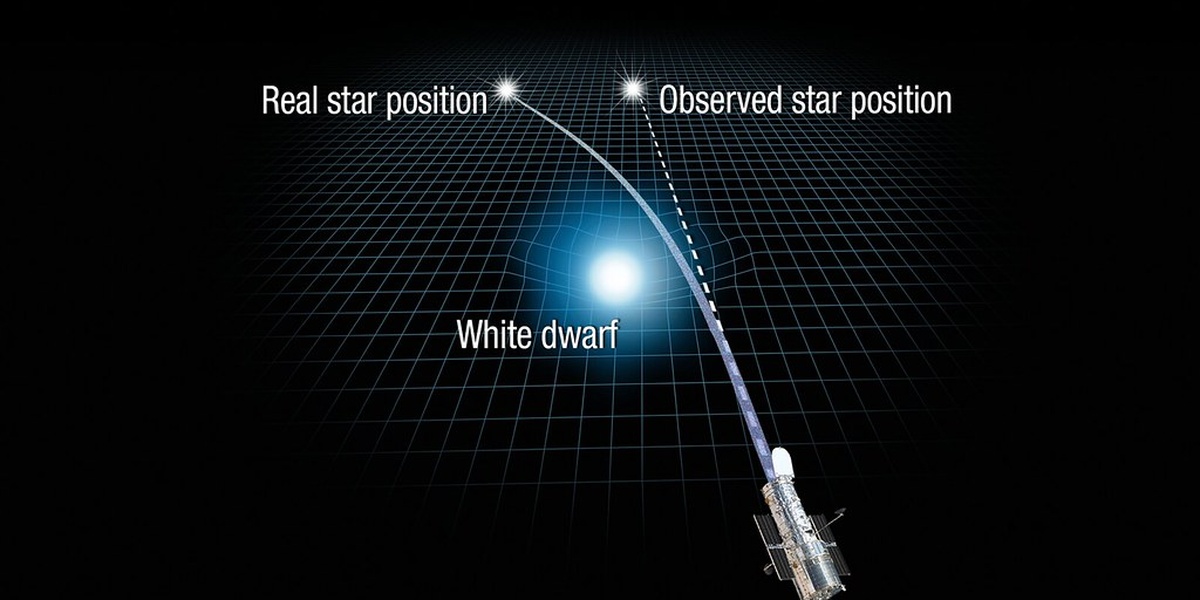
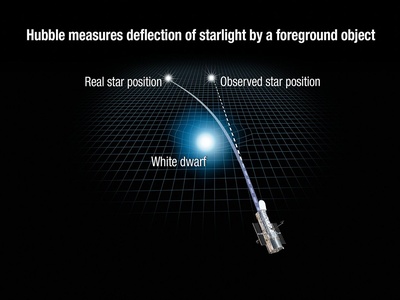
A nearby white dwarf notable for a landmark Hubble Space Telescope measurement: its mass was determined by measuring gravitational deflection of a background star. That astrometric lensing gave a precise mass test of white-dwarf theory and general relativity.
WD 1145+017
A white dwarf famous for transiting, disintegrating planetesimals producing periodic dips and dusty debris. It’s a vivid, real-time example of how white dwarfs can accrete and reveal the fate of planetary systems after their star’s death.