Look up on a clear night and you might pick out stars that far outshine and outsizes our Sun — these supergiants mark late stages of stellar life and help map nearby star-forming regions and stellar evolution. Observing them gives a practical sense of how mass, temperature and life cycle connect in astronomy.
There are 15 Examples of Supergiant Stars, ranging from Alnilam to Zeta Puppis to show the spread in temperature and size. Data for each is organized by Spectral type (color), Distance (ly), Radius (R☉); you’ll find below.
How do astronomers determine the distance and radius of these stars?
Distance comes from parallax for nearby cases and from spectroscopic methods or Gaia data for farther stars; angular diameter measured by interferometry or inferred from eclipsing binaries combined with distance gives radius estimates, so multiple techniques are cross-checked for reliability.
What causes the different colors and spectral types among supergiants?
Color reflects surface temperature and spectral type—blue for hottest, red for coolest—while winds, circumstellar dust and interstellar reddening can shift observed color; spectroscopy separates temperature effects from dust and composition.
Examples of Supergiant Stars
| Name | Spectral type (color) | Distance (ly) | Radius (R☉) |
|---|---|---|---|
| Betelgeuse | M2 Iab, red | 642 ly | 764 R☉ |
| Antares | M1.5 Iab, red | 550 ly | 680 R☉ |
| Rigel | B8 Ia, blue-white | 860 ly | 78 R☉ |
| Deneb | A2 Ia, white-blue | 2,615 ly | 203 R☉ |
| Mu Cephei | M2 Ia, red | 2,400 ly | 1,420 R☉ |
| Zeta Puppis | O4 I(n)fp, blue | 1,090 ly | 14 R☉ |
| Alnilam | B0 Ia, blue | 1,340 ly | 25 R☉ |
| Alnitak | O9.5 Iab, blue | 811 ly | 20 R☉ |
| Saiph | B0.5 Ia, blue | 650 ly | 22 R☉ |
| Delta Cephei | F5 Iab, yellow-white | 887 ly | 44 R☉ |
| RS Puppis | F8 Iab, yellow | 6,500 ly | 200 R☉ |
| P Cygni | B1 Ia, blue | 5,500 ly | 76 R☉ |
| VV Cephei A | M2 Iab, red | 5,000 ly | 1,500 R☉ |
| V382 Carinae | F8 Ia, yellow-white | 4,400 ly | 200 R☉ |
| Pistol Star | O3 I, blue | 25,000 ly | 420 R☉ |
Images and Descriptions
Betelgeuse
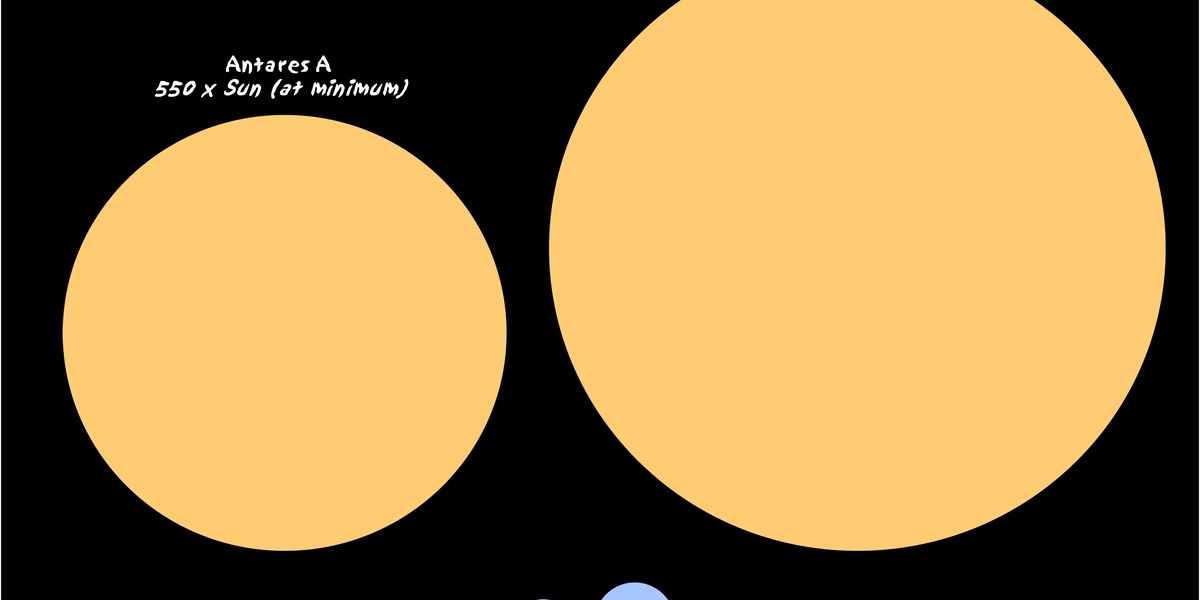
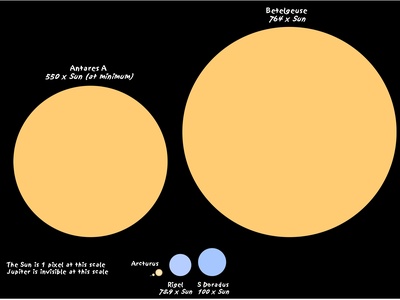
Famous red supergiant in Orion’s shoulder, visibly variable and bright; roughly 642 ly away with a radius of about 764 Suns. Catalogued as Alpha Orionis (HR 2061), noted for its 2019–2020 dimming and large-scale convective activity.

Antares
Bright red supergiant marking Scorpius’s heart, about 550 ly away with radius near 680 Suns. Alpha Scorpii is a semi-regular variable often paired visually with a hot companion; well-known for its deep red color and strong stellar winds.
Rigel
Blue-white supergiant at Orion’s foot, roughly 860 ly away, radius about 78 Suns. Beta Orionis (Rigel) is extremely luminous, powers nearby reflection nebulae, and serves as a textbook example of a massive star that will end as a core-collapse supernova.
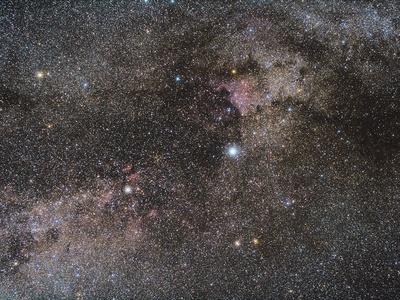
Deneb
Deneb is a luminous A-type supergiant in Cygnus about 2,615 ly distant with radius near 203 Suns. Alpha Cygni is one of the most intrinsically bright visible stars and a prototype of small-amplitude α Cyg variables used for distance and evolution studies.
Mu Cephei
Herschel’s Garnet Star in Cepheus is a red supergiant about 2,400 ly away and roughly 1,420 Suns across. Its deep red hue and strong variability make it a classic example of an evolved massive star with an extended atmosphere and mass loss.
Zeta Puppis
Zeta Puppis (Naos) is an O4 blue supergiant around 1,090 ly away with radius ~14 Suns. Extremely hot and luminous, it shows very strong, fast stellar winds, rapid rotation and bright UV/X-ray emission, making it vital for massive-star wind studies.
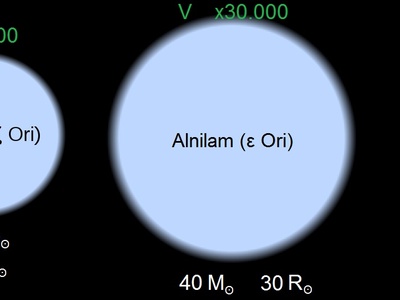
Alnilam
Epsilon Orionis (Alnilam) is a B0 Ia blue supergiant in Orion’s Belt, about 1,340 ly distant with radius near 25 Suns. Very luminous and mildly variable, it is frequently used as a landmark in studies of massive-star structure and Orion’s young population.
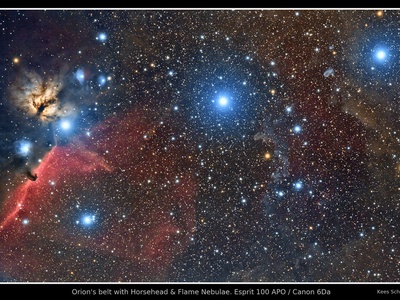
Alnitak
Zeta Orionis (Alnitak) is an O9.5 Iab blue supergiant at Orion’s eastern belt, roughly 811 ly away and about 20 Suns in radius. Part of a multiple system, it excites nearby nebulosity and exemplifies hot, luminous supergiants in star-forming regions.
Saiph
Kappa Orionis (Saiph) is a B0.5 Ia blue supergiant in Orion’s knee, about 650 ly away with radius ≈22 Suns. Cooler and less luminous than Rigel, Saiph helps illustrate the diversity of blue supergiants visible in the winter sky.
Delta Cephei
Prototype Cepheid variable Delta Cephei is an F5 Iab yellow-white supergiant roughly 887 ly away with radius near 44 Suns. Its regular pulsations defined the period–luminosity relation critical for measuring distances across the galaxy and beyond.
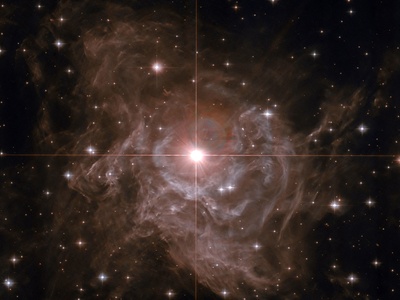
RS Puppis
RS Puppis is a long-period Cepheid (F8 Iab) around 6,500 ly away with radius ≈200 Suns. One of the most luminous Cepheids, it is embedded in a reflection nebula that enabled geometric distance measurements and helped calibrate the cosmic distance ladder.
P Cygni
P Cygni is a B1 Ia blue supergiant about 5,500 ly distant with radius ~76 Suns; its spectrum gives the eponymous “P Cygni profile” showing outflowing gas. It’s an eruptive luminous star with historical outbursts and expanding circumstellar shells.
VV Cephei A
VV Cephei A is a red supergiant in an eclipsing binary about 5,000 ly away, with radius roughly 1,500 Suns. Its dramatic eclipses by a hot companion make it a rare laboratory for direct measurements of massive star sizes and mass transfer effects.
V382 Carinae
V382 Carinae (HR 3872) is an F8 Ia yellow-white supergiant in Carina, about 4,400 ly distant with radius near 200 Suns. A luminous, low-amplitude variable, it is often cited in studies of post-main-sequence evolution in intermediate-to-high-mass stars.
Pistol Star
One of the most luminous stars known, the Pistol Star is an O-type (class I) blue supergiant near the Galactic Center roughly 25,000 ly away with an estimated radius of a few hundred Suns. Noted for extreme luminosity and heavy mass loss in a dense environment.