Waves shape everything from a shoreline swell to the flicker of X-rays passing through tissue; they carry energy and information across very different scales and settings. Noticing where a wave occurs and what it moves through is often the quickest way to understand its behavior.
There are 20 Examples of Waves, ranging from Atmospheric gravity wave to X-ray. That span highlights how wavelength and medium change with type, and the table below makes comparisons simple: entries are organized with Category,Typical wavelength (m),Medium/location so you can scan scale, source, and environment you’ll find below.
How do I tell which wave type applies to a real-world situation?
Look at the source (mechanical disturbance, electromagnetic emission, or fluid instability), the medium (air, water, vacuum, solid), and the scale—wavelength or frequency. The Category and Typical wavelength (m) columns give quick clues: long wavelengths imply large-scale phenomena (e.g., atmospheric waves), while very short ones point to high-energy electromagnetic waves like X-rays.
Can I rely on the listed wavelengths for calculations or are they just estimates?
Typical wavelength entries are approximate and meant for comparison; many waves span ranges rather than single values. Use them for order-of-magnitude estimates, then consult specialized references or measurements for precise calculations (and remember to convert units if your equations use different units).
Examples of Waves
| Name | Category | Typical wavelength (m) | Medium/location |
|---|---|---|---|
| Sound | Mechanical | 0.02-20 | Air |
| Water surface gravity wave | Geophysical | 0.1-100 | Ocean surface |
| Capillary wave | Geophysical | 0.001-0.02 | Water surface |
| Tsunami | Geophysical | 10,000-200,000 | Open ocean |
| Seismic P-wave | Geophysical | 10-5,000 | Earth interior (solids and liquids) |
| Seismic S-wave | Geophysical | 10-5,000 | Earth interior (solids only) |
| Rayleigh wave | Geophysical | 10-1,000 | Earth surface |
| Love wave | Geophysical | 10-1,000 | Earth surface |
| Ocean internal wave | Geophysical | 10-10,000 | Internal ocean layers |
| Atmospheric gravity wave | Geophysical | 100-100,000 | Atmosphere |
| Phonon (lattice vibration) | Mechanical | 1e-10-1e-6 | Solids (crystal lattices) |
| Radio wave | Electromagnetic | 1-1,000 | Vacuum/air |
| Microwave | Electromagnetic | 0.001-1 | Vacuum/air |
| Infrared | Electromagnetic | 7e-7-1e-3 | Vacuum/air |
| Visible light | Electromagnetic | 4e-7-7e-7 | Vacuum/air |
| Ultraviolet | Electromagnetic | 1e-8-4e-7 | Vacuum/air |
| X-ray | Electromagnetic | 1e-11-1e-8 | Vacuum/air |
| Gamma ray | Electromagnetic | 1e-14-1e-11 | Vacuum/space |
| Electron matter wave | Matter | 1e-12-1e-9 | Vacuum/beamlines/solids |
| Gravitational wave | Gravitational | 1,000-1,000,000,000 | Spacetime/vacuum |
Images and Descriptions

Sound
Pressure waves in air or other media produced by vibrating objects; audible sound carries energy and information at roughly 340 m/s in air. Typical frequencies give wavelengths from centimeters to tens of meters; notable for reflection, diffraction and interference.

Water surface gravity wave
Waves on the interface between water and air driven by gravity and wind; they range from small ripples to large breakers. They transport energy across the ocean surface, refract near shore, and show interference and dispersion depending on depth.

Capillary wave
Tiny surface ripples where surface tension dominates over gravity; common when wind first disturbs water and in rain impacts. Wavelengths are millimeters to a few centimeters, these waves disperse quickly and show characteristic wavelength-dependent speeds and interference patterns.
Tsunami
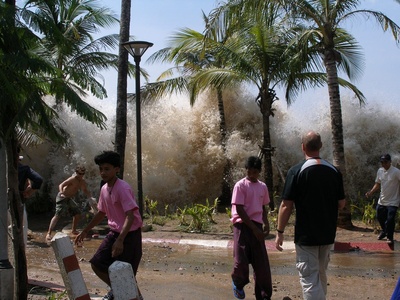
Long-wavelength ocean waves triggered by seabed displacement from earthquakes or landslides; wavelengths can be tens to hundreds of kilometers and they cross oceans at high speeds. They carry huge energy and amplify dramatically near coasts, causing destructive inundation.
Seismic P-wave
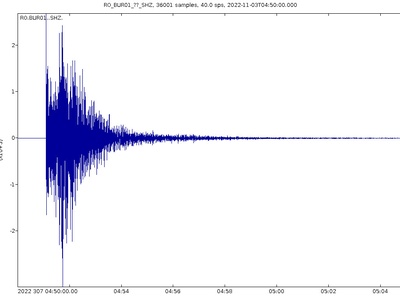
Compressional body waves that travel through Earth’s interior and fluids; they move fastest among seismic waves, typically kilometers per second. P-waves compress and rarefy material, arriving first at seismometers and helping locate earthquake sources and internal structure.
Seismic S-wave
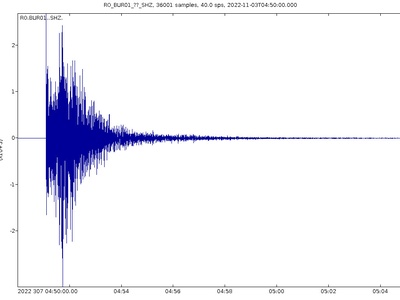
Shear body waves that move material perpendicular to their direction of travel; slower than P-waves and unable to pass through liquids. S-waves cause much of earthquake shaking, reveal Earth’s solid structure, and show polarization and reflection at interfaces.

Rayleigh wave
Surface seismic waves that roll along Earth’s surface producing both vertical and horizontal particle motion; they are slower than body waves but often have large amplitudes near an earthquake. Rayleigh waves decay with depth and are especially destructive in shallow soils.

Love wave
Horizontally polarized surface shear waves that move the ground side-to-side without vertical motion; Love waves can produce strong lateral shaking and are often prominent at particular distances from quakes. They are dispersive and sensitive to Earth’s layered structure.
Ocean internal wave
Waves propagating along density interfaces inside the ocean rather than the surface; internal waves commonly have wavelengths from tens of meters to kilometers and can move large water masses. They influence nutrient mixing, submarine operations, and create surface signatures visible from space.
Atmospheric gravity wave
Atmospheric waves where buoyancy restores vertical displacements, often generated by mountains or storms; wavelengths range from hundreds of meters to hundreds of kilometers. They transport momentum and energy, shape cloud patterns, and can propagate into the stratosphere and mesosphere affecting circulation.
Phonon (lattice vibration)
Collective quantized vibrations of atoms in a solid that carry heat and sound at microscopic scales; phonons behave like waves and particles, with wavelengths from atomic spacing to microns. Notable for determining thermal conductivity and dispersion in crystals.

Radio wave
Low-frequency electromagnetic waves used for radio broadcasting, communication and radar; wavelengths span meters to kilometers. They propagate through air and space, diffract around obstacles and follow the ionosphere or antenna patterns, making them essential for long-range wireless links.

Microwave
Shorter radio-frequency electromagnetic waves used in radar, satellite links and microwave ovens; wavelengths span millimeters to tens of centimeters. They interact strongly with dielectric materials, can heat polar molecules, penetrate atmosphere with modest loss, and are guided by waveguides or antennas.

Infrared
Electromagnetic waves just longer than visible light, emitted strongly by warm objects and used for thermal imaging and remote sensing; wavelengths range from roughly 700 nanometers to 1 millimeter. Infrared carries heat signatures and is selectively absorbed by atmospheric gases.
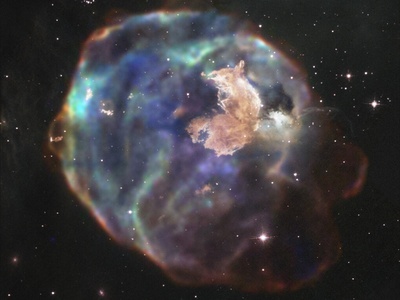
Visible light
Part of the electromagnetic spectrum detected by the human eye, with wavelengths roughly 400–700 nanometers. Visible light enables color vision, photography and optics; it refracts, reflects, diffracts and interferes, producing images, color effects, and familiar optical phenomena.
Ultraviolet
Higher-energy electromagnetic radiation just beyond violet visible light, with wavelengths around 10–400 nanometers. Ultraviolet induces chemical changes, can damage biological tissue (sunburn), sterilize surfaces, and is variably absorbed by atmospheric ozone across UVA, UVB and UVC bands.
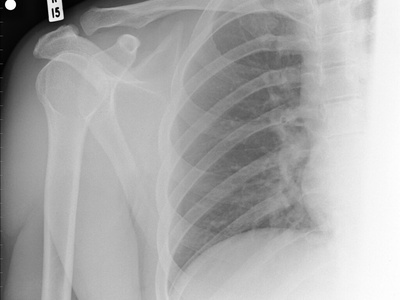
X-ray
High-energy electromagnetic radiation with wavelengths from about 0.01 to 10 nanometers, used in medical imaging and crystallography. X-rays penetrate many materials, can ionize atoms, and are notable for producing diffraction patterns that reveal molecular and crystal structures.
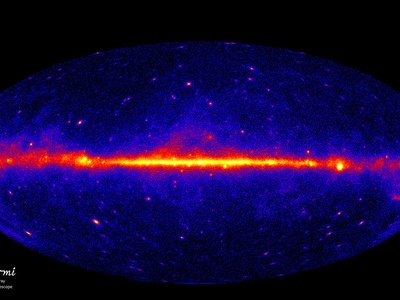
Gamma ray
Very short-wavelength, extremely high-energy electromagnetic radiation emitted by nuclear decays and cosmic explosions; wavelengths are much shorter than X-rays. Gamma rays penetrate deeply, ionize matter strongly, and are used in astronomy and cancer therapy while signalling extreme energetic processes.
Electron matter wave
Quantum waves associated with electrons where wavelength depends on momentum (de Broglie wavelength); typical values range from picometers for fast electrons to nanometers in low-energy beams. Electron waves diffract and interfere, enabling electron microscopy and demonstrating wave–particle duality.
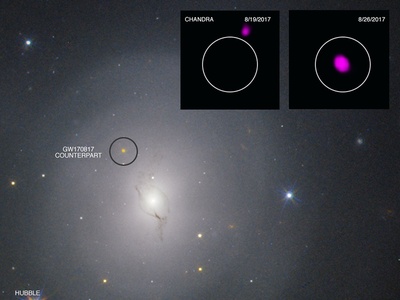
Gravitational wave
Ripples in spacetime produced by accelerating massive objects such as merging black holes or neutron stars; they propagate at the speed of light and cause tiny stretching and squeezing of distances. Gravitational waves carry direct information about extreme astrophysical events and are measured by laser interferometers.